The Ulutas Medical Journal · ISSN 2149-0430 (print), 2149-388X (online) · https://www.ulutasmedicaljournal.com/?mno=91802
Original Article · Open access
Influence of Workplace, Location and Experience on Preoperative Routine Viral Screening Tests: A Post-Hoc Observation from an Online Survey
- Faculty Room A001. Block A, AIIMS Raipur Hospital Complex. Tatibandh
- Anaesthesiology Department. Block A, AIIMS Raipur Hospital Complex. Tatibandh
Abstract
- Introduction
- Possible occupational exposure to Human Immunodeficiency type 1 and 2 (HIV-1/2), hepatitis B virus (HBV), and hepatitis C virus (HCV) poses a great apprehension among the perioperative health care providers. Routine screening of these disease statuses is frequent, but it is unknown whether there is an influence of workplace, location, and experience on such routine screening.
- Materials and Methods
- The present analysis is a post-hoc analysis of a previously conducted online survey from February 2018 to April 2018. One-hundred-ninety responses (86.3% Anesthesiologists, rest surgeons) were analyzed; 88.9% were practicing preoperative viral testing routinely. The influence of workplace, location, and experience on such routine screening was analyzed using Fisher's exact test; two-tailed p<0.05 was considered as significant.
- Results
- Anaesthesiologists working in the autonomous institutes with teaching background were doing less routine practices, yet there were no significant differences among the anesthesiologists and surgeons and no influence of workplace and experience noted.
- Conclusion
- This mini-survey indicates that routine preoperative viral screening is very frequent and practiced equally by anesthesiologists and surgeons working across different health care setups and having different experiences.
Keywords
Full text
Introduction
Infections like Human Immunodeficiency type 1 and 2 (HIV-1/2), Hepatitis B virus (HBV), and hepatitis C virus (HCV) pose risks to other patients and health care providers during perioperative care. These infections can be and are exposed to the risk of potential infection. Although it is known that precautions prevent exposure, the care of such patients has remained an extra concern to date. Over the last two decades, both the National Institute for transmitted through body fluids and Health and Clinical Excellence (NICE) and the anesthesiologists, surgeons and other health care providers involved in perioperative care frequently comes in contact with such fluids, American Society of Anesthesiologists (ASA) has come out with evidence-based guidelines for the preoperative laboratory tests have been formulated (1, 2). The NICE guideline had also been updated recently in 2016. However, there is no recommendation on mandatory screening or routine testing for viral serology in patients who undergo various surgeries or procedures. The Centre for Disease Control and Prevention (United States), recommend every case to be considered as a potential positive case (3). In India, this issue is neither covered categorically by any administrative/public health guideline, nor by health insurance policies. These facts lead to a dilemma in the context of preoperative routine viral screening, and routine preoperative viral screening/testing is very much prevalent in practice (4). The present analysis was conducted to evaluate the relationship between workplace and experience of anesthesiologists and surgeons and ordering routine preoperative viral serological testing.
Materials and Methods
Study Design & Ethical Statement
The present analysis was conducted from the databank of a previously conducted online survey. Approval from the affiliated institute with an exemption for consent was taken for the survey. The present study does not need an Ethical Approvement due to be a survey analysis.The original survey was conducted online from February 2018 to April 2018, was created and conducted using free online survey software and questionnaire tool service from GoogleForms (https://docs.google.com/forms). An email with a link to the online survey was sent to the anesthesiologist, surgeons, and public health professionals, including a few public health administrators affiliated with the different public health organizations across the country (India). The emails were collected from the different institutional websites and societies available in the public domain. Reminder emails were also sent to potential respondents if no reply was received after two weeks of the original email request. Responses were collected anonymously via the survey. For this analysis, we included only the responses of the anesthesiologists and surgeons as they are the concerned health care providers usually responsible for ordering the preoperative tests. Data concerning the practitioner’s hospital, including hospital type, location of the hospital, and experience of the practitioner and their practice of routine serology screening were collected. In the original survey, the responses were directly downloaded from the Google form as an Excel file, and the same excel master chart after deleting the responses of public health professionals/administrators was used. The data were then categorized into different groups based on workplace (i.e. autonomous institute, medical college, private teaching hospital, private non-teaching hospital, and public sector non-teaching hospital), location (i.e. Metro city, Tier-II city, district headquarter and semi-urban) and experience (i.e. more than 10 years, 5 to 10 years and less than five years).
Statistical Analysis
The response of participants in context to routine testing was noted and presented as an absolute number and percentage scale. For analyzing the influence, the comparison was made taking autonomous institute, Metro city, and experience more than ten years as the reference. Fisher’s exact test and INSTAT software (GraphPad Prism Software Inc., La Jolla, CA, USA) was used for the purpose. A p less than or equal to 0.05 was significant.
Results
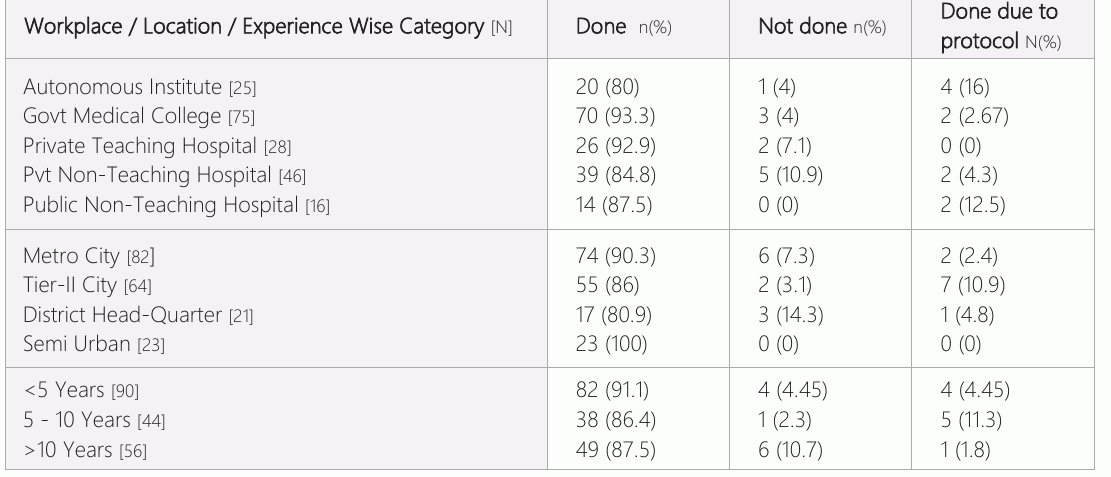
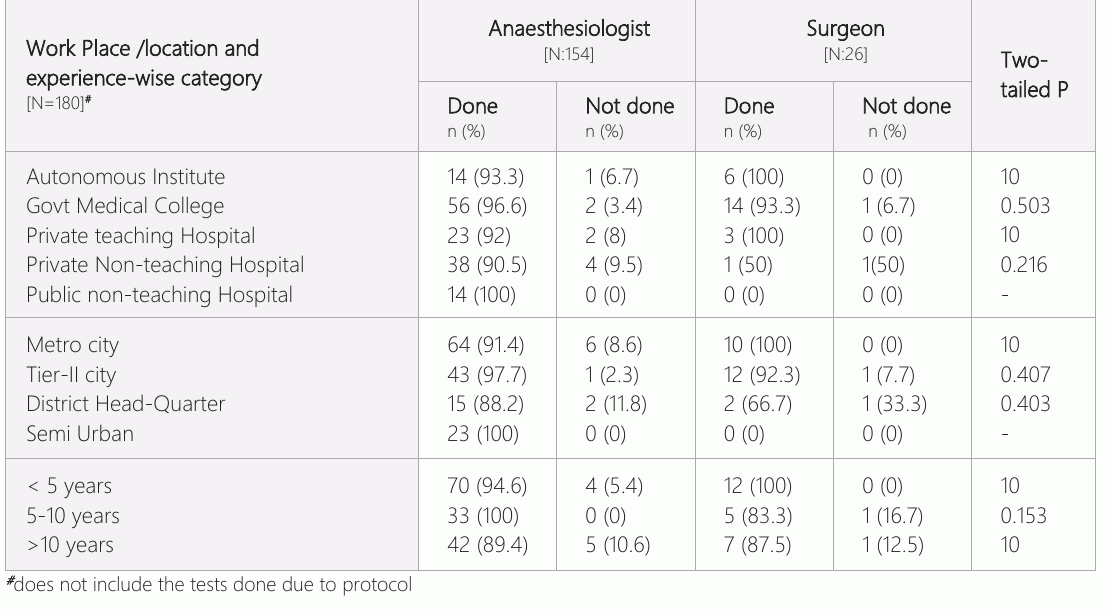
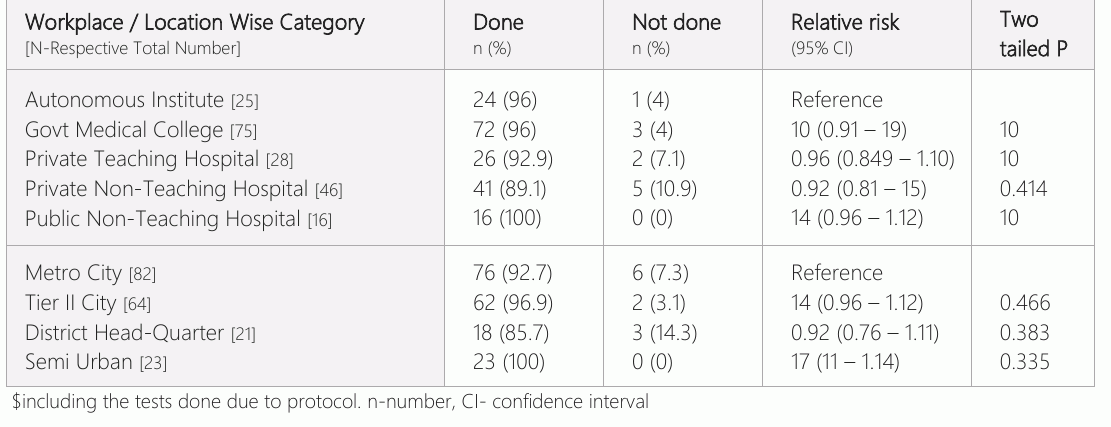
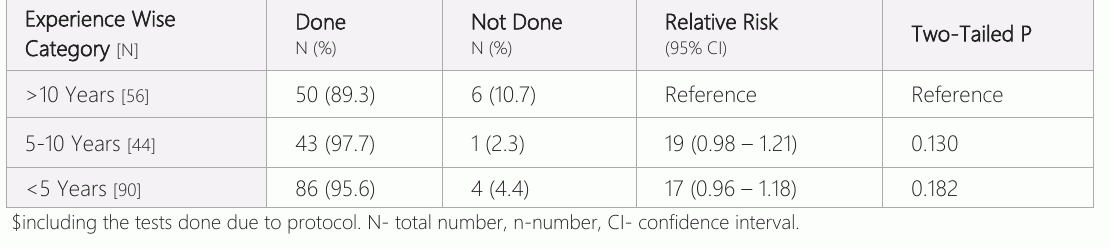
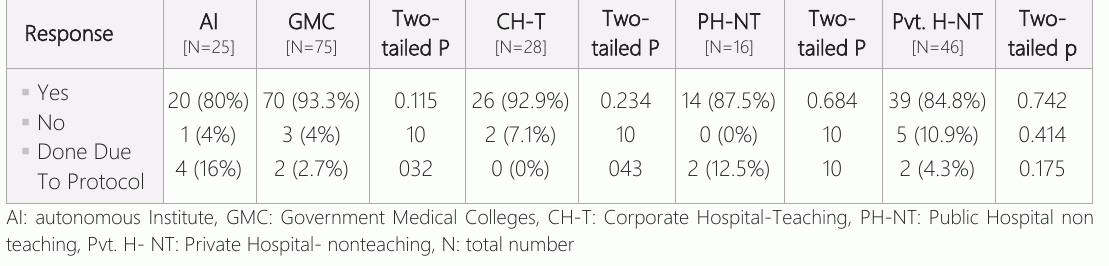
A total of 190 (164 from Anesthesiologists and 26 from the surgeon) responses were eligible for the analysis.One-hundred sixty-nine (88.9%) of the responders were practicing preoperative viral testing routinely; 5.3% did not want to do but had to do due to institutional protocol, and only 5.8% were not doing the tests. While 10 (6.1%) out of 164 anesthesiologists agreed that they do not want the tests to be done but we're doing the tests as per institute protocol; none of the 26 surgeons expressed so (P 0.362, odds ratio 3.6 with 95% confidence 0.20 – 63.37). Among the anesthesiologists who did not want but were doing due to protocol; 40% were from autonomous institutes, and 60% were from teaching backgrounds (from teaching hospitals, colleges, and institutes). Overall, the difference between the surgeon and anesthesiologists in the practice pattern was also not significant, P 0.661. Even the autonomous institutes had a practice of doing the tests in 80% of the time when tests done due to institute protocol were deducted. The test rate was highest in the low experience group (91.1% in the <5 years). The practice pattern of the workplace, location, and experience-wise groups are presented in table 1. Workplace, location, and experience-wise, the practice pattern of anesthesiologists and surgeons were also similar (table 2). The analysis of the total tests done (including the tests done due to protocol) and not done concerning workplace and location, taking autonomous institute and metro city as reference respectively; no statistical difference was noted (table 3). Similar results were also noted in context to experience; total tests done/not done were indifferent in the lower experienced group as compared to the experience of more than10 years (table 4). However, tests done due to protocol (otherwise was not in favor of doing the tests) were significantly lower in government medical colleges (p=0.03) and corporate teaching hospitals (p=0.04) as compared to autonomous institutes (Table 4).
Discussion
The present analysis showed that the practices of ordering preoperative viral screening tests are very much prevalent in all types of hospitals and across all participants with all levels of experience. Nearly 90% of the participants of any category were practicing it, and this rate is higher than a study conducted by Weber et al (5). They analyzed data of 15,482 adult patients and found that the screening rate was 65%. However, the study also found that the incidence of newly detected infections was low and concluded with a strong argument in favor of omitting routine preoperative screening (5). The argument in favor of doing such tests is also prevalent despite the lower prevalence of infection. A study reporting hepatitis C sero prevalence as 2.11%(95%CI;1.1-5.21) argued that by offering routine screening to patients, surgeons have an opportunity to maintain intraoperativesafety(6). However, the argument cannot be accepted as a ground for universal screening as the CDC clearly states that every patient should be taken as a potential positive case and due precautions to be taken (3). The statement of the American College of Surgeons regarding the surgeon and hepatitis and HIV type 1 and 2 also emphasizes on the highest standard of infection control and advises to use the effective sterile barriers, universal precautions, or all bloodborne pathogens (7, 8). Thir statement also emphasizes on immunization against HBV for the surgeon for the prevention of infection from patient to surgeons.
Criticisms of the universal screening are not only limited to the cost and universal precaution, but also due to the window period negativity fact (9). Advise to screen for hepatitis and HIV has been given based on the resources available from universal screening in high-resource setups to no screening in poor resource setups. The present study analyses the variation of screening or preoperative viral testing in context to the workplace, location, and experience. Usually, the autonomous institutes and big hospitals of metro cities are high resource setups while the semi-urban place hospitals are resource-poor setups. However, the present study findings suggest that there was no difference in the practice of preoperative viral testing in context to the workplace and location. The present study also found that the experience of the health care provider also did not affect the practice of preoperative viral screening. The striking finding was that nearly 90% of the practitioners were advising the tests.
Among Hepatitis B, Hepatitis C, and HIV-1/2, Hepatitis C bears extra importance as it has the highest incidence of transmission after body-fluid contact. The WHO recommended that HCV serology testing be offered to individuals who are part of a population with high HCV prevalence or who have a history of HCV risk exposure/behavior (10).
Resource consideration is also emphasized by the WHO. The 2014 Guidelines Development Group agreed that the infrastructure for both screening and treatment is necessary for screening to have an impact on key outcomes. Therefore, only screening is not the answer, especially in a country whose per capita health expenditure is minimal.
The present survey is very much limited with a lower number of responses and a national level survey will be required with a larger sample size for a more comprehensible view, especially for the influence of the workplace.
Conclusion
To conclude, this mini-survey indicates that routine preoperative viral screening is frequent and practiced equally by anesthesiologists and surgeons working across different health care setups and having different experiences.
Declarations
- Author contributions (CRediT)
- All authors contributed equally to all 14 CRediT roles (Conceptualization, Data curation, Formal analysis, Funding acquisition, Investigation, Methodology, Project administration, Resources, Software, Supervision, Validation, Visualization, Writing – original draft, Writing – review & editing).
- Funding
-
Funding information was not reported in the published version of this article.
- Conflicts of interest
- The authors declare no competing interests.
- Ethics approval
- The present study does not need an Ethical Approvement due to be a survey analysis.The original survey was conducted online from February 2018 to April 2018, was created and conducted using free online survey software and questionnaire tool service from Google Forms (https://docs.google.com/forms).
- Data availability
- A data availability statement was not reported in the published version of this article.
References (10)
6 of 10 references are linked to their DOI.
- National Guideline Centre (UK). Preoperative Tests (Update): Routine Preoperative Tests for Elective Surgery. NICE Guideline, No. 45. London: National Institute for Health and Care Excellence; 2016 Apr. [cited 2019 Feb 21] Available from: https://www.ncbi.nlm.nih.gov/pubmedhealth/PMH0086571 DOI Crossref PubMed Google Scholar
- Committee on Standards and Practice Parameters, Apfelbaum JL, Connis RT, Nickinovich DG: American Society of Anesthesiologists Task Force on Preanesthesia Evaluation. Pasternak LR, Arens JF, et al. Practice advisory for preanesthesia evaluation: An updated report by the American Society of Anesthesiologists task force on preanesthesia evaluation. Anesthesiology 2012;116:522–38. DOI Crossref PubMed Google Scholar
- Centers for Disease Control and Prevention (CDC). Recommendations for prevention of HIV transmission in health-care settings. MMWR Suppl. 1987 Aug 21;36(2):1-18 DOI Crossref PubMed Google Scholar
- Mistry T, Karim HM. An online survey on practice and opinion on preoperative viral serology testing among Anaesthesio logists, Surgeons and Public Health professionals. Acta Medica Int. 2020. doi: 10.4103/ami.ami_38_19 DOI Crossref PubMed Google Scholar
- Weber P, Eberle J, Bogner JR, Schrimpf F, Jansson V, Huber-Wagner S. Is there a benefit to a routine preoperative screening of infectivity for HIV, hepatitis B and C virus before elective orthopaedic operations? Infection 2013;41:479-83 DOI Crossref PubMed Google Scholar
- DelSole EM, Mercuri JJ, Stachel A, Phillips MS, Zuckerman JD. Risk of hepatitis C virus exposure in orthopedic surgery: is universal screening needed? Am J Orthop (Belle Mead NJ). 2014;43(6):117-23 PubMed Google Scholar
- American College of Surgeons. Statement on the Surgeon and Hepatitis. American College of Surgeons; 2004 Apr 1. Available: www.facs.org/about-acs/statements/22-hepatitis PubMed Google Scholar
- American College of Surgeons. Statement on the Surgeon and Hepatitis. American College of Surgeons; 2004 May 1. Available: www.facs.org/about-acs/statements/13-hiv-infection PubMed Google Scholar
- Ahmed R, Bhattacharya S. Universal screening versus universal precautions in the context of preoperative screening for HIV, HBV, HCV in India. Indian J Med Microbiol. 2013;31: 219-25 DOI Crossref PubMed Google Scholar
- Guidelines for the screening care and treatment of persons with chronic hepatitis C infection. Updated version, April 2016. Geneva: World Health Organization; 2017. Available from: http://apps.who.int/medicinedocs/documents/s22483en/s224 83en.pdf PubMed Google Scholar
Respond to this article
Comments on a published article are welcome as a Letter to the Editor.
Get an e-mail when new articles in your fields are published
Questions to the authors
Questions are moderated: an editor approves each question, the authors answer, and an editor approves the answer before both appear here.
No answered questions yet.
Ask the authors a question
Discussion
Comments are moderated: they appear after the writer confirms the e-mail address and an editor approves them. Each comment carries a conflict-of-interest statement.
No comments yet.
Write a comment
Read the full text
Open the PDF here
Loading the PDF…
If the PDF does not show here, use the download button above.
How to cite this article
Karim HMR, Mistry T. Influence of Workplace, Location and Experience on Preoperative Routine Viral Screening Tests: A Post-Hoc Observation from an Online Survey. Ulutas Med J. 2020;6(2):74-79. doi:10.5455/umj.20200311082916
Karim, H. M. R., & Mistry, T. (2020). Influence of Workplace, Location and Experience on Preoperative Routine Viral Screening Tests: A Post-Hoc Observation from an Online Survey. The Ulutas Medical Journal, 6(2), 74–79. https://doi.org/10.5455/umj.20200311082916
Karim, H.M.R. and Mistry, T. (2020) 'Influence of Workplace, Location and Experience on Preoperative Routine Viral Screening Tests: A Post-Hoc Observation from an Online Survey', The Ulutas Medical Journal, 6(2), pp. 74–79. doi: 10.5455/umj.20200311082916.