The Ulutas Medical Journal · ISSN 2149-0430 (print), 2149-388X (online) · https://www.ulutasmedicaljournal.com/?mno=138500
Original Article · Open access
The Effect of Midazolam and Magnesium Sulfate on Preoperative Anxiety in Patients Undergoing Rhinoplasty Operation
- Department of Anesthesiology and Reanimation, Faculty of Medicine, Van Yuzuncu Yil University, Van, 65080, Turkey ROR
- Department of Anesthesiology and Reanimation, Van Training and Research Hospital, Van, 65080, Turkey ROR
- Department of Plastic and Reconstructive Surgery, Faculty of Medicine, Van Yuzuncu Yil University, Van, 65080, Turkey ROR
Abstract
- Introduction
- Preoperative anxiety is a common psychological condition caused by many factors and can affect anesthesia results, postoperative analgesia, and surgery. This study investigated the effects of midazolam and midazolam combined with magnesium sulfate on preoperative anxiety.
- Materials and Methods
- Sixty patients in the ASA I-II group, aged between 18-60 years, undergoing rhinoplasty operations were included in the study. Patients included in the study were randomly divided into two groups using the sealed envelope method. The first group (Group M; n:30) received 0.02-0.04 mg/kg midazolam in 100 ml isotonic, and the second group (Group MM; n:30) received 2g magnesium sulfate+0.02-0.04 mg/kg midazolam in 100 ml isotonic administered intravenously 15 minutes before surgery. In addition, state-trait anxiety inventory (STAI-TX) was evaluated preoperatively at 0. minutes and postoperative at 0., 3., 6. hours and the visual analog scale (VAS) was evaluated at 0., 3., and 6. hours postoperatively.
- Results
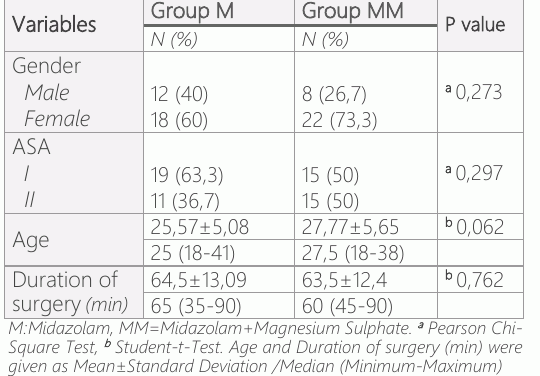
- 66.7% were female (n:40), 56.7% were ASA-I (n:34), the mean age was 26.17±5.57(18-41) years, and the mean surgery time was 64±12.64 (35-90) minutes. There was no statistically significant difference between the groups regarding age, gender, ASA, and surgical duration of the cases. In addition, heart rate, systolic arterial pressure, diastolic arterial pressure, mean arterial pressure, and VAS decreased compared to preoperative values, while TOF and STAI-TX values increased in both the M and the MM groups.
- Conclusion
- Midazolam and midazolam-magnesium sulfate can be safe and effective for preoperative anxiety.
Keywords
Full text
Introduction
A person’s reaction to any unknown situation is called anxiety and is defined as restlessness and anxiety (1). Anxiety occurs predominantly during the perioperative period and is the worst aspect of the perioperative process (1–3). On the other hand, preoperative anxiety is an unpleasant tension that may develop secondary to a patient’s anxiety about hospitalization, anesthesia, or surgery or not knowing what will happen after surgery and pain (4, 5). Although preoperative anxiety is quite common, its prevalence varies between 11-80%, depending on the differences in assessment methods in clinical studies (2, 6, 7). A recent study reported that approximately 7% to 8% of the patients did not experience preoperative anxiety, and the most severe anxiety was experienced in the preoperative waiting room (6). Some studies showed risk factors for preoperative anxiety are female gender, negative perception of the future, history of cancer and smoking, previous psychiatric disorder, a high-level education, and moderate to severe depressive symptoms (>12 years) (4).
Effective communication strategies, cognitive-behavioral therapy, perioperative education, music therapy, massage therapy, psychological preparation, and various pharmacological agents are used in the perioperative period to reduce anxiety among surgery (1, 8–12). Antidepressants, monoamine oxidase inhibitor or anxiolytic sedative are pharmacological treatments often used to reduce anxiety. Midazolam is a benzodiazepine widely used in hospitals to treat preoperative anxiety and sedate patients in various diagnostic/therapeutic procedures and intensive care units. The duration of action of midazolam, which starts to act intravenously in 2 minutes, is 45-60 minutes in oral intake. It can be administered intramuscularly about half an hour before surgery in adults and orally in the pediatric population (13).
Magnesium (Mg) is the fourth most abundant cation in the body, involved in hundreds of enzymatic reactions, including nucleic acid synthesis and energy metabolism. It is used alone or in combination with other drugs to strengthen the effects. This strengthens the drugs, reducing their requirements and minimizing their side effects (14). In addition, studies have demonstrated the antinociceptive effect of Mg (15, 16). Due to these properties, it has recently been used in anesthesia to prevent the hemodynamic response to intubation, provide analgesia in the perioperative period, and reduce the analgesic drug dose (17).
State-trait anxiety inventory assessment (STAI- TX) is widely used to measure psychological anxiety in various experimental studies. It has been reported that this evaluation can yield positive results even in clinical situations where it is necessary to reduce the patient burden, such as minimizing the duration of anesthesia by reducing preoperative anxiety(18). Therefore, it is considered to reflect patients’ anxiety levels before surgery accurately.
This study aimed to investigate the effects of midazolam administration and midazolam + Mg sulfate administration on preoperative and postoperative anxiety in patients undergoing rhinoplasty operation, using STAI-TX and visual analog scale (VAS).
Materials and Methods
Ethical Statement
A randomized, controlled, double-blind clinical study was carried out between August 2020 and January 2021 at Van Yüzüncü Yıl University Faculty of Medicine. Prior to the study, approval (Decision #08, Date: July 16, 2020) was obtained from the Clinical Research Ethics Committee of Van Yüzüncü Yıl University Faculty of Medicine. In addition, all patients participating in the study signed an informed consent form.
Study Design
Sixty patients in the ASA I-II group, aged between 18-60, who underwent rhinoplasty operations were included in the study. The exclusion criteria in the study were as follows: patients younger than 18 years old, over 60 years old, patients other than ASA I-II, patients with severe heart, lung, liver disease and kidney failure, patients with bleeding diathesis, fever, active infection, obese patients with BMI>30, patients with intraoperative blood loss of more than 1000 ml, allergic to drugs to be used, hypothermia and acid-base disorders, and electrolyte disorders such as hypokalemia and hypocalcemia. Sixty patients were randomly divided into two groups using the sealed envelope method. The first group (Group M; n:30) received 0.02-0.04 mg/kg midazolam in 100 ccs of saline, and the second group (Group MM; n:30) received 2g Mg sulfate + 0.02-0.04 mg/kg midazolam in 100ccs saline administered intravenously (iv) 15 minutes before surgery. In addition, patients’ demographic data (age, ASA score, and duration of surgery) were recorded. STAI-TX was evaluated preoperatively at 0. minutes and postoperative at 0., 3., 6. hours, and visual analog scale (VAS) evaluation was performed at 0., 3., 6. hours postoperatively. After patients’ standard monitoring on the operating table, vascular access was provided with 2 18-gauge cannulas. With adequate preoxygenation, induction was achieved with 2mg/kg propofol, 2µg/kg fentanyl, and 0.6mg /kg rocuronium. For anesthesia maintenance, 40% O2, 60% medical air, and 1 minimal alveolar concentration (MAC) value desflurane were used as the inhaled anesthetic agent. Hypoxia, hypercapnia, hypocapnia, hypertension, and hypotension were avoided during general anesthesia. If the mean arterial pressure (MAP) was 20% over the initial value for one minute, the superficial anesthesia findings, such as tears and sweating, were evaluated and treated with fentanyl 1 µg/kg iv when necessary. In the persistence of hypertension, 50-100 µg iv of nitroglycerin was administered. Hypotension was a MAP 20% lower than the initial value for one minute or longer. In hypotension, the intravenous fluids’ administration rate was increased, and if hypotension persisted, it was treated with 5 mg iv ephedrine. A heart rate (HR) below 45 beats/min was considered bradycardia, and over 100 beats/min as tachycardia. In bradycardia, 0.5 mg iv atropine was used, whereas 5-10 mg iv esmolol was administered in tachycardia. In addition, 0.1 mg/kg rocuronium was administered in case of requirement for additional muscle relaxants. At the end of the operation, extubation was performed after standard decurarization with atropine and neostigmine when appropriate conditions were provided. For postoperative analgesia, 1 mg/kg tramadol + 10 mg/kg para cetamol iv were administered as a standard procedure. Operation time, HR, MAP, Systolic arterial pressure (SAP), diastolic arterial pressure (DAP), peripheral oxygen saturation (SpO2) and neuromuscular monitoring (Train of four [TOF]) data were recorded.
Statistical Reviews
The NCSS (Number Cruncher Statistical System) 2007 (Kaysville, Utah, USA) was used for statistical analysis. Descriptive statistical methods (mean, standard deviation, median, frequency, percentage, minimum, maximum) were used. The conformity of the quantitative data to normal distribution was tested with the Shapiro-Wilk test and graphical analysis. Independent t-test was used to compare normally-distributed quantitative variables between two groups, and the Mann-Whitney U test was used to compare two groups of non-normally distributed quantitative variables. Repeated analysis of variance measurements was used for intra-group comparisons of normally distributed quantitative variables, and Bonferroni-corrected binary evaluations for pairwise comparisons. The Friedman Test was used for intragroup comparisons of quantitative variables with anormal distribution, and the Bonferroni-corrected Wilcoxon signed ranks test was used to evaluate pairwise comparisons. Pearson chi-square compared qualitative data. Significance was accepted as p<0.05.
Results
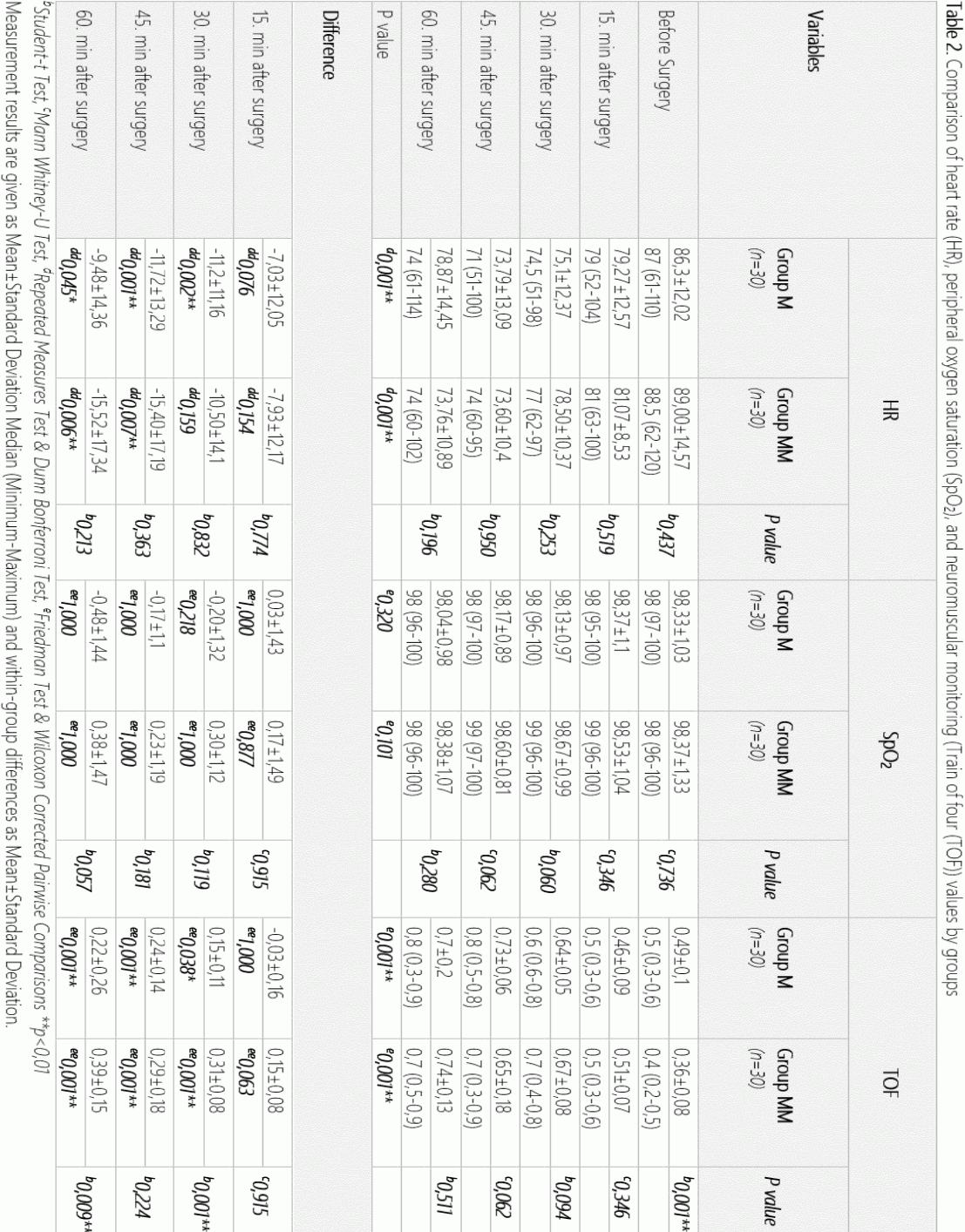
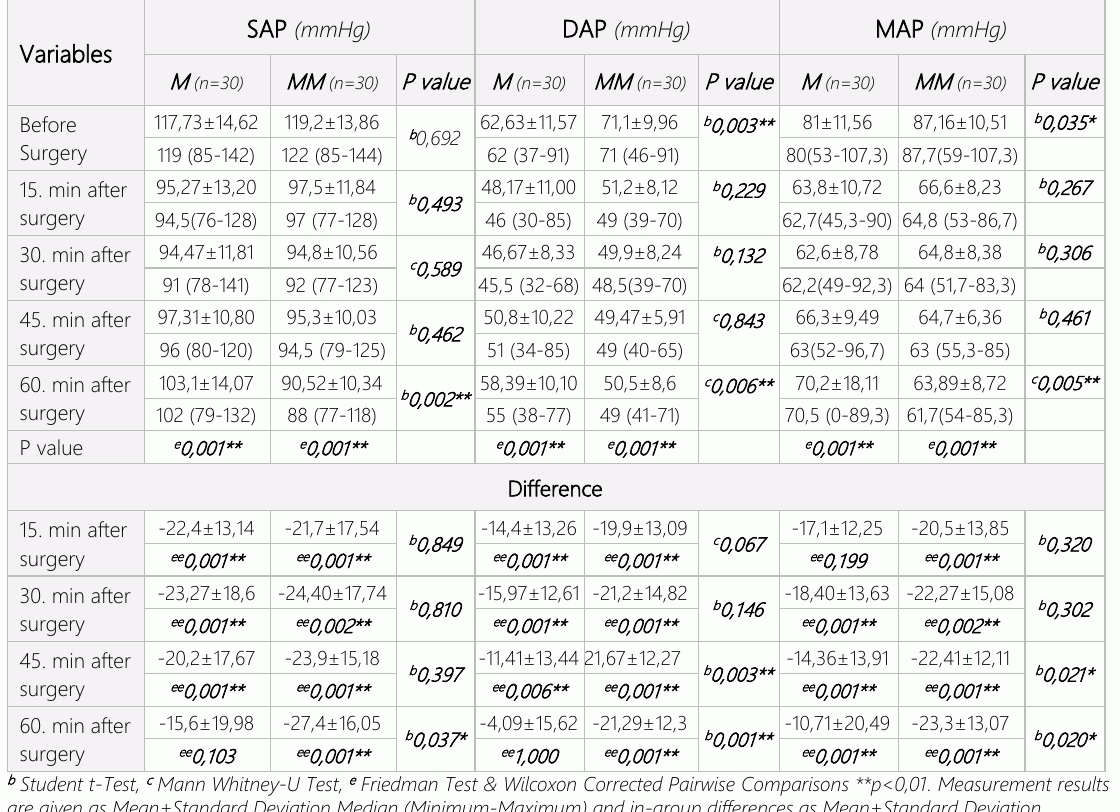
Of the participants, 66.7% were female (n:40), 56.7% were ASA I (n:34), the mean age was 26.17±5.57 (18-41) years, and the mean surgery time was 64.00±12.64 (35-90) minutes (Table 1). There was no statistically significant difference between the groups regarding age, gender, ASA, and surgery time (p>0.05). HR, SpO2, and TOF values are shown in Table 2. While there was no difference between the HR and SpO2 values, TOF values were significantly lower in the preoperative MM than in the M group. However, when the groups were evaluated within themselves, HR measured after the surgery decreased compared to preoperative values (p<0.001), TOF increased (p<0.001), and there was no change in SpO2(p>0.05) (Table 2). The participants’ SAP, DAP, and MAP values are given in Table 3. The postoperative 60. minute SAP values of the participants in the MM group were lower than those in the M group. In addition, it was observed that the preoperative DAP and MAP values of participants in the MM group were higher than the M group, and the values measured at the postoperative 60th minute were significantly lower. When the groups were evaluated within themselves, the postoperative values decreased compared to the preoperative values (p<0.001).
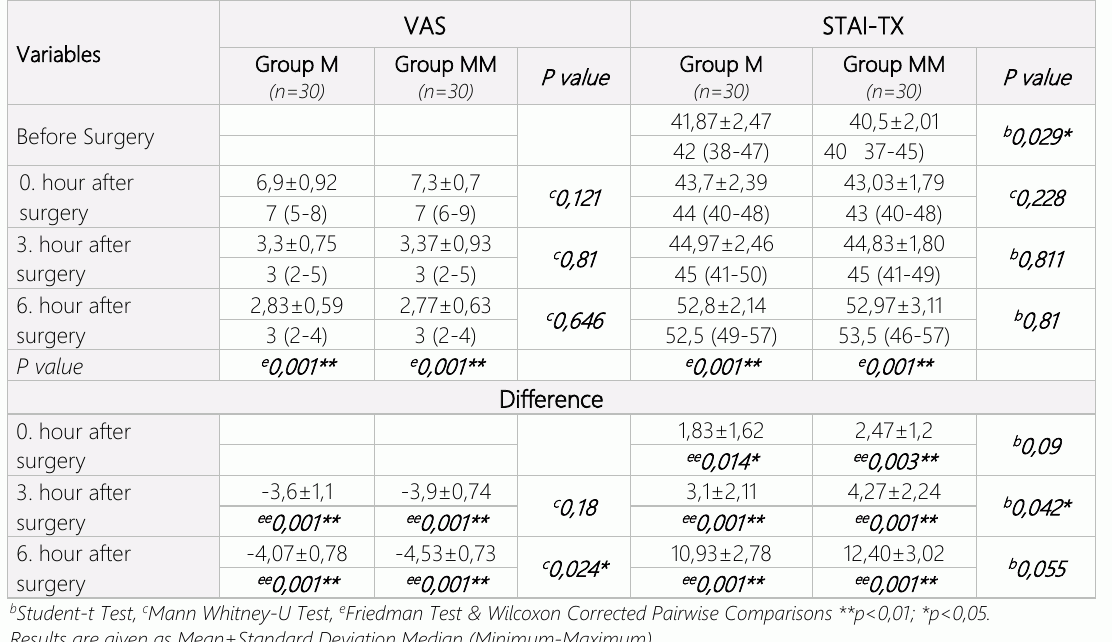
The VAS and STAI-TX results of the participants are given in Table 4. It was observed that the postoperative VAS values in both groups were significantly lower than the preoperative values (p<0.001), and the decrease in the VAS values of group MM was higher than that of group M, especially at the postoperative 6th hour (p= 0.024). Both groups’ postoperative STAI-TX values were higher than preoperative values (p<0.001). In addition, the preoperative STAI-TX measurements of the M group were higher than the MM (p<0.05). When the increase in STAI-TX values was examined, the increase in the MM group was higher at the postoperative 3rd hour than in the M group (p=0.42).
Discussion
Preoperative anxiety, one of the patients’ main problems, can increase the intraoperative risk and worsen the postoperative prognosis. Therefore, in this study, we investigated the effects of midazolam and midazolam + Mg sulfate on the preoperative and postoperative anxiety undergoing rhinoplasty. Administering midazolam and midazolam+ Mg sulfate caused a decrease in VAS and increased STAI-TX.
Patient's preoperative anxiety also affects their pain, analgesic needs, length of stay in the hospital, perioperative care and treatment, postoperative anxiety, and patient satisfaction (4, 19–21). Perioperative anxiety can increase the distress experienced by the patient, making it difficult to manage and control postoperative pain (4). Furthermore, patient’s preoperative and postoperative anxiety and psychological distress may increase intraoperative analgesic requirements. In addition, patient-controlled analgesia may lead to more frequent analgesic demand (22). As a result, it has been reported that patients with high preoperative anxiety or high distress may have higher postoperative complication rates and impaired or delayed wound healing (23). Therefore, treating anxiety in the perioperative period can improve the patient’s perioperative experience and the adverse effects that may arise from anxiety. Psychological therapy and pharmacological/non-pharmacological agents for therapeutic purposes have been investigated to reduce the perioperative anxiety of patients undergoing surgical operations. Preoperative anxiety, fear, and an unpleasant feeling associated with illness activate the sympathetic nervous system, increasing catecholamine release, glucocorticoid levels, HR, and blood pressure. At the same time, it may cause postoperative complications by affecting immune responses (24). For this reason, anxiety rating scales and patients’ parameters, such as HR and MAP, are evaluated regarding anxiety in studies.
Preoperative anxiety is associated with a lower quality of life and cognitive performance, greater need for information, poorer memory and attention, extended hospital stays, depressive symptoms, and increased physical disability (25). In a study investigating the effects of clonidine and gabapentin on preoperative anxiety in cardiac surgery patients, it was determined that both drugs caused a decrease in anxiety levels, but the clonidine group gave better results (26). In a study of children aged 4-12 years undergoing ophthalmologic surgery under general anesthesia, oral clonidine, dexmedetomidine, and midazolam exhibited effective sedation, anxiolysis, and acceptable separation from parents. Children given midazolam were calmer and less anxious 15, 30, 45, and 60 min after premedication compared to those given clonidine and dexmedetomidine (27). In addition, it has been documented that midazolam increases patient comfort during transesophageal echocardiography, reduces stress, causes amnesia, and makes the patient more adaptable (28). Habib et al. (29) determined that intravenous midazolam administration in patients undergoing cataract surgery did not differ between those who received it and those who did not. It has been suggested that this result is probably due to the low dose in elderly patients who need to be alert. Pekcan et al. (30) found that diazepam and midazolam reduced anxiety levels before anesthesia compared to a placebo.
Gupta et al. (31) reported that a higher dose of midazolam (0.06 mg/kg) produced better-quality anxiolysis and sedation with lower intraoperative recall rates without significantly affecting heart rate, respiratory rate, and SAP compared to a lower dose (0.02 mg/kg). However, they observed that a higher dose of midazolam caused a significant decrease in DAP and oxygen saturation in room air. This study determined that HR, SAP, DAP, MAP, and VAS decreased compared to preoperative values, while TOF and STAI-TX increased after 0.02-0.04mg/kg midazolam administration. Our study’s results are similar to those of previous studies with midazolam.
Mg is helpful in treating painful conditions when used alone or as an adjuvant to potentiate the effects of drugs. Mg may also reduce the consumption of analgesics in the intraoperative and postoperative periods. Tramer et al. (32) found a significant decrease in the postoperative morphine requirements of patients who were administered Mg. In another similar study, Özkan et al. (33) observed that preoperative single-dose Mg administration reduced postoperative morphine consumption. Altun et al. (14) reported that administration of Mg with midazolam moderately reduced overall midazolam consumption without serious side effects. It has been reported that due to the decrease in midazolam consumption, the time to start spontaneous ventilation with the endotracheal tube and the extubation time is shortened. In the same study, the authors suggested that adding Mg as an adjuvant reduces the sedation requirement and provides better sedation during mechanical ventilation. Based on this information, this study observed a decrease in HR, SAP, DAP, MAP, and VAS values and an increase in TOF and STAI-TX values in the MM group, administered 2g Mg sulfate together with midazolam. In the MM group, the increase in TOF at 30. and 60. minutes after surgery, the decrease in SAP, DAP, and MAP at 45. and 60. minutes after the operation and the decrease in the VAS values at the postoperative 6th hour were statistically significantly different compared to the M. The more significant decrease in blood pressure at postoperative 45. and 60. minutes due to Mg administration is due to the more significant hypotensive effect of Mg administration with midazolam. Although there were differences in the HR, VAS, and STAI-TX compared to the preoperative period, the surgical time, HR, VAS, and STAI-TX in the M were similar to the results of the patients who received only midazolam. The strength of our study is that it is the first study to investigate the effect of Mg sulfate application combined with midazolam on preoperative anxiety. The weaknesses of our study are that it is a single-center study, and the blood level of Mg cannot be measured. Therefore, our results should be supported by multicenter studies with larger sample size and diversity.
Conclusion
In conclusion, as previous studies have shown, midazolam and Mg sulfate, combined with midazolam, can be used as safe and effective treatments for preoperative anxiety. However, more studies are needed to measure the Mg blood level to find the appropriate Mg dose.
Declarations
- Author contributions (CRediT)
- All authors contributed equally to all 14 CRediT roles (Conceptualization, Data curation, Formal analysis, Funding acquisition, Investigation, Methodology, Project administration, Resources, Software, Supervision, Validation, Visualization, Writing – original draft, Writing – review & editing).
- Funding
-
Funding information was not reported in the published version of this article.
- Conflicts of interest
- The authors declare no conflict of interest.
- Ethics approval
- Prior to the study, approval (Decision #08, Date: July 16, 2020) was obtained from the Clinical Research Ethics Committee of Van Yüzüncü Yıl University Faculty of Medicine. In addition, all patients participating in the study signed an informed consent form.
- Data availability
- A data availability statement was not reported in the published version of this article.
References (33)
29 of 33 references are linked to their DOI.
- Jellish WS, O'Rourke M. Anxiolytic use in the postoperative care unit. Anesthesiol Clin. 2012;30(3):467-80 DOI Crossref PubMed Google Scholar
- Johnston M. Anxiety in surgical patients. Psychol Med. 1980;10(1):145-52 DOI Crossref PubMed Google Scholar
- Walker EMK, Bell M, Cook TM, Grocott MPW, Moonesinghe SR, Central S- O, et al. Patient reported outcome of adult perioperative anaesthesia in the United Kingdom: a cross-sectional observational study. Br J Anaesth. 2016;117(6):758-66 DOI Crossref PubMed Google Scholar
- Caumo W, Schmidt AP, Schneider CN, Bergmann J, Iwamoto CW, Adamatti LC, et al. Risk factors for postoperative anxiety in adults. Anaesthesia. 2001;56(8):720-8 DOI Crossref PubMed Google Scholar
- Ramsay MA. A survey of pre-operative fear. Anaesthesia. 1972;27(4):396-402 DOI Crossref PubMed Google Scholar
- Aust H, Eberhart L, Sturm T, Schuster M, Nestoriuc Y, Brehm F, et al. A cross-sectional study on preoperative anxiety in adults. J Psychosom Res. 2018;111:133-9 DOI Crossref PubMed Google Scholar
- Wallace G, Mindlin LJ. A controlled double-blind comparison of intramuscular lorazepam and hydroxyzine as surgical premedicants. Anesth Analg. 1984;63(6):571-6 DOI Crossref PubMed Google Scholar
- Bailey L. Strategies for decreasing patient anxiety in the perioperative setting. AORN J. 2010;92(4):445-57 DOI Crossref PubMed Google Scholar
- Bradt J, Dileo C, Shim M. Music interventions for preoperative anxiety. Cochrane Database Syst Rev. 2013(6):CD006908 DOI Crossref PubMed Google Scholar
- Dao TK, Youssef NA, Armsworth M, et al. Randomized controlled trial of brief cognitive behavioral intervention for depression and anxiety symptoms preoperatively in patients undergoing coronary artery bypass graft surgery. J Thorac Cardiovasc Surg. 2011; 142(3):e109-15 DOI Crossref PubMed Google Scholar
- Kesanen J, Leino-Kilpi H, Lund T, Montin L, Puukka P, Valkeapaa K. Increased preoperative knowledge reduces surgery- related anxiety: a randomised clinical trial in 100 spinal stenosis patients. Eur Spine J. 2017;26(10):2520-8 DOI Crossref PubMed Google Scholar
- Powell PA, Azlan HA, Simpson J, Overton PG. The effect of disgust-related side- effects on symptoms of depression and anxiety in people treated for cancer: a moderated mediation model. J Behav Med. 2016;39(4):560-73 DOI Crossref PubMed Google Scholar
- Zanella S, Buccelletti F, Vassiliadis A, De Bortoli R, Visentini S, Pedrotti G. Preoperative anxiety management: acupuncture vs. pharmacological treatment - A prospective study. Eur Rev Med Pharmacol Sci. 2022;26(3):900-5 PubMed Google Scholar
- Altun D, Eren G, Cetingok H, Hergunsel GO, Cukurova Z. Can we use magnesium for sedation in the intensive care unit for critically ill patients: Is it as effective as other sedatives? Agri. 2019;31(2):86-92 DOI Crossref PubMed Google Scholar
- Kara H, Sahin N, Ulusan V, Aydogdu T. Magnesium infusion reduces perioperative pain. Eur J Anaesthesiol 2002;19(1):52-6 DOI Crossref PubMed Google Scholar
- Unlugenc H, Ozalevli M, Guler T, Isik G. Postoperative pain management with intravenous patient-controlled morphine: comparison of the effect of adding magnesium or ketamine. Eur J Anaesthesiol. 2003;20(5):416-21 DOI Crossref PubMed Google Scholar
- Levaux C, Bonhomme V, Dewandre PY, Brichant JF, Hans P. Effect of intra-operative magnesium sulphate on pain relief and patient comfort after major lumbar orthopaedic surgery. Anaesthesia. 2003;58(2):131-5 DOI Crossref PubMed Google Scholar
- Rossi V, Pourtois G. Transient state-dependent fluctuations in anxiety measured using STAI, POMS, PANAS or VAS: a comparative review. Anxiety Stress Coping.2012;25(6):603-45 DOI Crossref PubMed Google Scholar
- Bayrak A, Sagiroglu G, Copuroglu E. Effects of Preoperative Anxiety on Intraoperative Hemodynamics and Postoperative Pain. J Coll Physicians Surg Pak. 2019;29(9):868-73 DOI Crossref PubMed Google Scholar
- Doleman B, Leonardi-Bee J, Heinink TP, Bhattacharjee D, Lund JN, Williams JP. Pre-emptive and preventive opioids for postoperative pain in adults undergoing all types of surgery. Cochrane Database Syst Rev. 2018;12(12):CD012624 DOI Crossref PubMed Google Scholar
- Kain ZN, Sevarino F, Alexander GM, Pincus S, Mayes LC. Preoperative anxiety and postoperative pain in women undergoing hysterectomy. A repeated-measures design. J Psychosom Res. 2000;49(6):417-22 DOI Crossref PubMed Google Scholar
- Ip HY, Abrishami A, Peng PW, Wong J, Chung F. Predictors of postoperative pain and analgesic consumption: qualitative systematic review. Anesthesiology. 2009;111(3):657-77 DOI Crossref PubMed Google Scholar
- Britteon P, Cullum N, Sutton M. Association between psychological health and wound complications after surgery. Br J Surg. 2017;104(6):769-76 DOI Crossref PubMed Google Scholar
- Kalkman JC, Visser K, Moen J, Bonsel JG, Grobbee ED, Moons MKG. Preoperative prediction of severe postoperative pain. Pain. 2003;105(3):415-23 DOI Crossref PubMed Google Scholar
- Oteri V, Martinelli A, Crivellaro E, Gigli F. The impact of preoperative anxiety on patients undergoing brain surgery: a systematic review. Neurosurg Rev. 2021;44(6):3047-57 DOI Crossref PubMed Google Scholar
- Mudgalkar N, Kandi V, Baviskar A, Kasturi RR, Bandurapalli B. Preoperative anxiety among cardiac surgery patients and its impact on major adverse cardiac events and mortality: A parallel- group study. Ann Card Anaesth. 2022; 25(3):293-6 50 77 Midazolam and Magnesium Sulfate on Anxiety Demirkıran et al. DOI Crossref PubMed Google Scholar
- Kumari S, Agrawal N, Usha G, Talwar V, Gupta P. Comparison of Oral Clonidine, Oral Dexmedetomidine, and Oral Midazolam for Premedication in Patients Undergoing Elective Surgery. Anesth Essays Res. 2017;11(1): 185-91 DOI Crossref PubMed Google Scholar
- Aeschbacher BC, Portner M, Fluri M, Meier B, Luscher TF. Midazolam premedication improves tolerance of trancesophageal echocardiography. Am J Cardiol. 1998;81(8): 1022-6 PubMed Google Scholar
- Habib NE, Mandour NM, Balmer HG. Effect of midazolam on anxiety level and pain perception in cataract surgery with topical anesthesia. J Cataract Refract Surg. 2004;30(2):437-43 DOI Crossref PubMed Google Scholar
- Pekcan M, Celebioglu B, Demir B, Saricaoglu F, Hascelik G, Yukselen MA, et al. The effect of premedication on preoperative anxiety. Middle East J Anaesthesiol. 2005;18(2): 421-33 PubMed Google Scholar
- Gupta R, Santha N, Upadya M, Manissery JJ. Effect of Different Dosages of Intravenous Midazolam Premedication on Patients Undergoing Head and Neck Surgeries- A Double Blinded Randomized Controlled Study. J Clin Diagn Res. 2017;11(8):UC01-UC4 DOI Crossref PubMed Google Scholar
- Tramer MR, Schneider J, Marti RA, Rifat K. Role of magnesium sulfate in postoperative analgesia. Anesthesiology. 1996; 84(2):340-7 DOI Crossref PubMed Google Scholar
- Özkan T, Talu G, Şentürk E, Güneş D, Ertürk E, Şentürk M, et al. The effect of preoperative single dose magnesium sulphate on the postoperative morphine consumption: a preliminary study. Agri. 2001;13(2):59-63 PubMed Google Scholar
Read the full text
Open the PDF here
Loading the PDF…
If the PDF does not show here, use the download button above.
How to cite this article
Demirkiran H, Yetkin H, Kacar C, Demir CY, Tekeli AE. The Effect of Midazolam and Magnesium Sulfate on Preoperative Anxiety in Patients Undergoing Rhinoplasty Operation. Ulutas Med J. 2023;9(1):42-50. doi:10.5455/umj.20230111112358
Demirkiran, H., Yetkin, H., Kacar, C., Demir, C. Y., & Tekeli, A. E. (2023). The Effect of Midazolam and Magnesium Sulfate on Preoperative Anxiety in Patients Undergoing Rhinoplasty Operation. The Ulutas Medical Journal, 9(1), 42–50. https://doi.org/10.5455/umj.20230111112358
Demirkiran, H. et al. (2023) 'The Effect of Midazolam and Magnesium Sulfate on Preoperative Anxiety in Patients Undergoing Rhinoplasty Operation', The Ulutas Medical Journal, 9(1), pp. 42–50. doi: 10.5455/umj.20230111112358.