The Ulutas Medical Journal · ISSN 2149-0430 (print), 2149-388X (online) · https://www.ulutasmedicaljournal.com/?mno=334258
Original Article · Open access
Comparison of Anxiety and Depression Symptoms Between Residents of Anesthesiology and Family Medicine
Also available in: العربية · Türkçe · 中文
- Department of Anesthesiology and Reanimation, Faculty of Medicine, Van Yüzüncü Yıl University, Van, Türkiye ROR
- Department of Psychiatry, Keçiören Training and Research Hospital, Ankara, Türkiye ROR
- Department of Family Medicine, Aydın Adnan Menderes University, Aydın, Türkiye ROR
Abstract
- Background
- Residency training can be psychologically demanding, but the workload and day-to-day pressures vary across specialties. We compared symptoms of anxiety and depression in anesthesiology and family medicine.
- Materials and Methods
- In this single-center cross-sectional study, 20 anesthesiology residents and 20 family medicine residents completed a sociodemographic questionnaire and the Hospital Anxiety and Depression Scale (HADS). HADS anxiety and depression subscale scores were compared using the Mann–Whitney U test. Scores of ≥10 on HADS-A and ≥7 on HADS-D were considered positive screening results. Holm correction was applied to the exploratory item-level analyses.
- Results
- Anesthesiology residents reported more shifts per month [median 7.0 (interquartile range IQR 6.0–9.0) vs. 4.0 (0.8–5.0); p=0.000028] and had spent more time working in the intensive care unit [13.0 (7.0–18.0) vs. 0.0 (0.0–0.0) months; p=0.000005]. The groups did not differ significantly in HADS-A [9.0 (7.5–11.3) vs. 7.5 (4.8–10.5); p=0.237] or HADS-D [8.5 (4.0–10.5) vs. 4.5 (2.0–8.5); p=0.061] scores. Positive anxiety screens occurred in 40% and 30% of participants, respectively (p=0.741), and positive depression screens in 60% and 35% (p=0.205). No item-level difference remained significant after Holm correction.
- Conclusion
- Despite a heavier shift and intensive care workload among anesthesiology residents, this small study found no statistically significant difference between the specialties in HADS-A or HADS-D scores. Larger multicenter studies are needed to clarify whether meaningful differences exist.
Keywords
Full text
Introduction
Residency is a formative stage of a physician's career, but it is also a period of considerable psychological strain. Heavy workloads, growing clinical responsibility and disrupted sleep often occur at the same time. A systematic review estimated the prevalence of depression or depressive symptoms among resident physicians at 28.8%, although estimates varied substantially according to the instrument and cutoff used (1). Long working hours, limited control over schedules, and professional responsibilities are frequently reported sources of stress (2). In addition to these psychological demands, organizational factors such as workload and working conditions have been associated with anxiety and other adverse mental health outcomes among physicians and postgraduate medical trainees (3).
These pressures vary across specialties. Large studies have found specialty-related variation in burnout and career choice regret (4), while surveys of anesthesiology trainees documented substantial levels of burnout, distress, and depression (5). Family medicine residents work in a different environment, where continuity of care and sustained patient interaction may shape their stress experience (6). Recent studies from Türkiye have also reported substantial levels of anxiety and other psychological symptoms among resident physicians (7, 8). Few studies directly compared anesthesiology and family medicine residents within the same institution. Therefore, the present study aimed to compare anxiety and depression symptoms, assessed using the Hospital Anxiety and Depression Scale (HADS), together with selected sociodemographic and professional characteristics, between residents in these two specialties.
Materials and methods
Subjects
This single-center cross-sectional study was conducted at the University Faculty of Medicine from 15 October to 15 December 2019. At the time of the study, the institution had 22 anesthesiology and reanimation residents and 44 family medicine residents. Residents were eligible if they were actively working, had completed at least 6 months of training, and agreed to participate. Residents from each specialty completed the questionnaire, with participation rates of 90.9% for anesthesiology and 45.5% for family medicine. We aimed to invite the entire eligible population; therefore, we did not perform a separate sample size calculation. The University Non-Interventional Clinical Research Ethics Committee approved the study on 27 September 2019 (decision no. 2019/14-06). The study followed the Declaration of Helsinki, and all participants provided written informed consent.
Methods
We collected all data using an online questionnaire created in SurveyMonkey. The link was distributed by e-mail and WhatsApp, and participants completed the questionnaire once. The first section covered age, sex, marital status, holiday work, monthly shift count, duration of residency, and time spent working in the intensive care unit.
The second section contained the 14-item HADS, developed by Zigmond and Snaith (9) and validated in Turkish by Aydemir et al. (10). The anxiety and depression subscales each comprise seven items scored from 0 to 3, giving a possible score of 0–21 for each subscale. The continuous HADS-A and HADS-D scores were the co-primary outcomes. Based on the Turkish validation study, scores of ≥10 on HADS-A and ≥7 on HADS-D were classified as positive screening results. These cutoffs identify participants at increased risk of symptoms but do not establish a psychiatric diagnosis. Item-level comparisons were exploratory. We analyzed the total HADS score as a secondary exploratory outcome and did not consider it a primary endpoint.
Statistical Analysis
We performed statistical analyses using Python 3.12.13, NumPy 2.3.5, and SciPy 1.17. Continuous variables were presented as median and interquartile range, and categorical variables as count and percentage. Continuous variables between the two independent groups were compared using the two-tailed Mann–Whitney U test. The Pearson chi-square test was used for categorical variables when expected cell counts were adequate. We compared HADS-A and HADS-D screening positivity using Fisher’s exact test. Holm correction was applied to the 14 exploratory item-level comparisons. For the primary HADS-A and HADS-D comparisons, we also quantified effect sizes using Cliff’s delta (δ), with the 95% confidence intervals estimated by nonparametric bootstrap resampling. We considered P<0.05 statistically significant.
Results
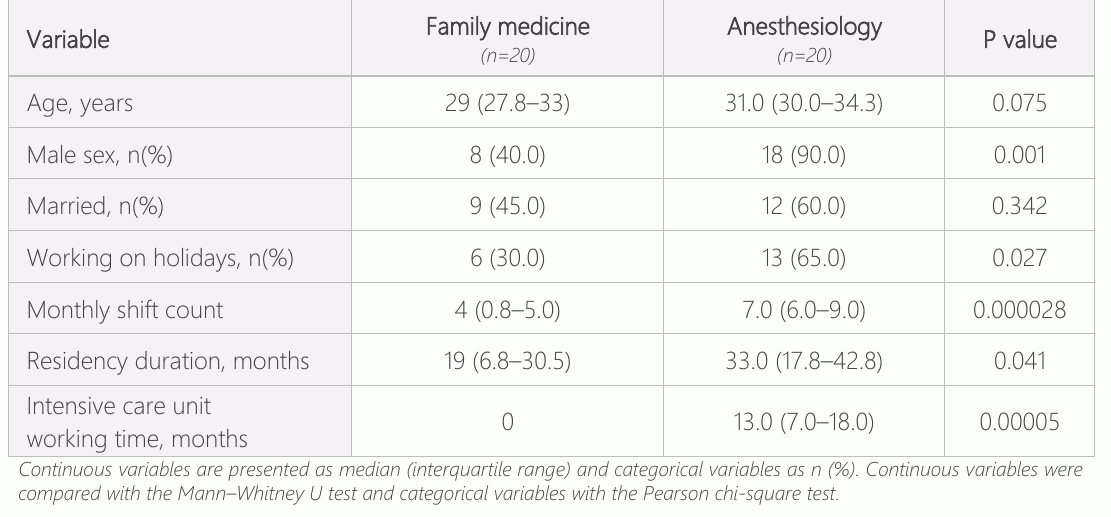
Of the 66 residents in the study population, 40 met the eligibility criteria and completed the questionnaire, including 20 from each specialty. Age and marital status were similar between the groups. The anesthesiology group included a higher proportion of men (90.0% vs. 40.0%; p=0.001) and more often reported working on holidays (65.0% vs. 30.0%; p=0.027). These residents had also been in training longer [33.0 (17.8–42.8) vs. 19.0 (6.8–30.5) months; p=0.041], worked more shifts per month [7.0 (6.0–9.0) vs. 4.0 (0.8–5.0); p=0.000028], and had spent more time working in the intensive care unit [13 (7–18) vs. 0 months; p=0.000005].
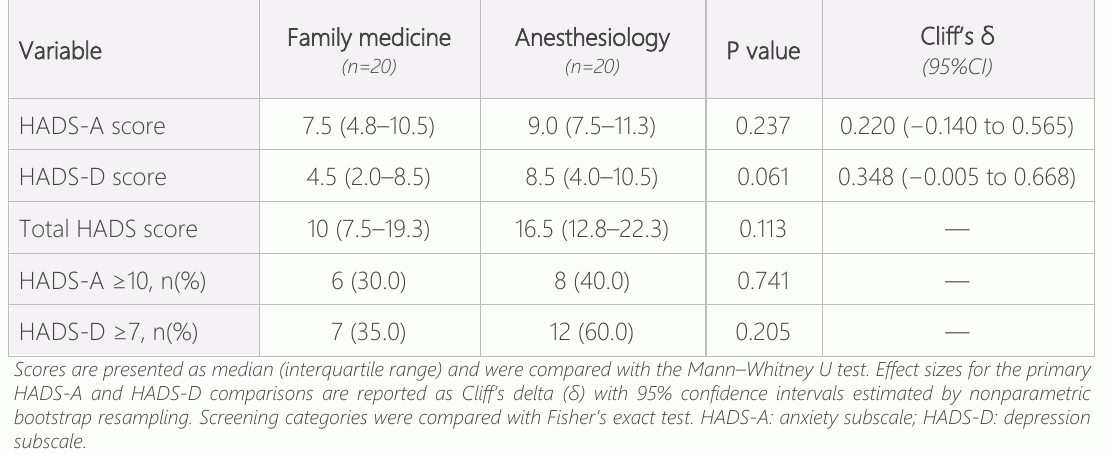
The HADS-A score was 9.0 (7.5–11.3) in the anesthesiology group and 7.5 (4.8–10.5) in the family medicine group(p=0.237; Cliff’s δ=0.220, 95%CI −0.140 to 0.565). HADS-D scores were 8.5 (4.0–10.5) and 4.5 (2.0–8.5), respectively (p=0.061; Cliff’s δ=0.348, 95%CI −0.005 to 0.668). Total HADS scores did not differ significantly between groups [16.5 (12.8–22.3) vs. 10.0 (7.5–19.3); p=0.113]. Anxiety screening positivity was 8/20 (40.0%) in anesthesiology group and 6/20 (30.0%) in the family medicine group (p=0.741). Depression screening positivity was 12/20 (60%) and 7/20 (35%), respectively (p=0.205). Two HADS items had unadjusted p values below 0.05. Neither remained significant after Holm correction; the smallest adjusted P valuewas 0.251. Supplementary Table-1 presents detailed item-level analyses of the HADS anxiety and depression items.
Discussion
The clearest difference between the groups was workload: anesthesiology residents had more shifts and substantially greater exposure to intensive care. We found no difference in HADS-A or HADS-D, or in the proportions screening positive for anxiety or depression. These findings should not be interpreted as evidence that the specialties carry the same psychological risk. Rather, the sample was not large enough to demonstrate a difference. The anesthesiology group nevertheless had higher median HADS scores, particularly on the depression subscale. This pattern may be clinically relevant, but the small sample leaves considerable uncertainty around the observed difference. Previous surveys of anesthesiology residents have likewise identified depression and distress as important concerns and have linked better psychological well-being with institutional support, work–life balance, and social support (5). Findings from larger resident cohorts also suggest that psychological outcomes vary by specialty and are unlikely to reflect workload alone (4). Recent evidence likewise indicates that workload and working conditions are associated with anxiety, depression, and burnout among physicians and postgraduate medical trainees (3). These findings support the view that multiple interacting factors, not workload alone, shape the psychological impact of residency.
Family medicine residents face different demands, including continuity of care and patient communication. In one study, their anxiety levels were not higher than those of reference populations, and the authors suggested that support within the training program may have been protective (6). A study conducted across residency programs 18 months into the COVID-19 pandemic also reported burnout, depression, anxiety, and stress among residents (11). More recent studies from Türkiye have similarly demonstrated a substantial burden of anxiety and other psychological symptoms among resident physicians (7, 8). Evaluations of resident mental health should therefore consider each specialty's broader working environment, not simply the number of shifts.
Several limitations should be considered. The cross-sectional, single-center design precludes causal conclusions, and the small sample limits precision. Because no a priori power analysis was performed, the study may have been underpowered to detect differences between groups. The lower participation rate among family medicine residents also raises the possibility of selection bias. Sex distribution differed markedly by specialty, but the sample was too small to adjust for this potential confounder in a multivariable model. In addition, HADS is a self-report screening instrument rather than a diagnostic interview (12). The item-level analyses were exploratory, and none remained significant after correction for multiple testing. Another limitation is that the data were collected in 2019, and residents’ working conditions, including work schedules, post-pandemic working practices, and educational environments, may have changed over time; therefore, caution is warranted when generalizing these findings directly to current residents. Finally, the questionnaire did not directly assess suicidal ideation or suicide risk, and the findings should not be interpreted in those terms.
Anesthesiology residents reported more shifts and greater intensive care exposure than family medicine residents. However, this small cross-sectional study did not show a difference in HADS anxiety or depression scores, or in the proportions screening positive. Larger multi-center studies with more balanced participation and adjustment for demographic and professional factors are needed.
Declarations
- Author contributions (CRediT)
- All authors contributed equally to all 14 CRediT roles (Conceptualization, Data curation, Formal analysis, Funding acquisition, Investigation, Methodology, Project administration, Resources, Software, Supervision, Validation, Visualization, Writing – original draft, Writing – review & editing).
- Funding
-
Funding information was not reported in the published version of this article.
- Conflicts of interest
- A conflict of interest statement was not reported in the published version of this article.
- Ethics approval
- The University Non- Interventional Clinical Research Ethics Committee approved the study on 27 September 2019 (decision no. 2019/14-06).
- Data availability
- A data availability statement was not reported in the published version of this article.
References (12)
11 of 12 references are linked to their DOI.
- Mata DA, Ramos MA, Bansal N, Khan R, Guille C, Di Angelantonio E, et al. Prevalence of depression and depressive symptoms among resident physicians: a systematic review and meta-analysis. JAMA. 2015;314(22):2373-2383. DOI Crossref PubMed Google Scholar
- Levey RE. Sources of stress for residents and recommend - dations for programs to assist them. Acad Med. 2001;76(2):142-150. DOI Crossref PubMed Google Scholar
- Obeng Nkrumah S, Adu MK, Agyapong B, da Luz Dias R, Agyapong VIO. Prevalence and correlates of depression, anxiety, and burnout among physicians and postgraduate medical trainees: a scoping review of recent literature. Front Public Health 2025;13:1537108. DOI Crossref PubMed Google Scholar
- Dyrbye LN, Burke SE, Hardeman RR, Herrin J, Wittlin NM, Yeazel M, et al. Association of clinical specialty with symptoms of burnout and career choice regret among US resident physicians. JAMA. 2018;320(11):1114-1130. DOI Crossref PubMed Google Scholar
- Sun H, Warner DO, Macario A, Zhou Y, Culley DJ, Keegan MT. Repeated cross-sectional surveys of burnout, distress, and depression among anesthesiology residents and first-year graduates. Anesthesiology. 2019;131(3):668-677. DOI Crossref PubMed Google Scholar
- Michels PJ, Probst JC, Godenick MT, Palesch Y. Anxiety and anger among family practice residents: a South Carolina family practice research consortium study. Acad Med. 2003;78(1):69-79. DOI Crossref PubMed Google Scholar
- Demir M, Muştucu A, Güllülü RA, Akkaya C. Mental Health Status of Medical Residents: A Cross-Sectional Study of Depression and Anxiety in a University Hospital. Uludağ Tıp Derg. 2026 Sep 1;52. DOI Crossref PubMed Google Scholar
- Emiral E, Ors B, Cantürk N. Assessing depression, anxiety, stress, and occupational decision regret levels among resident physicians working at Ankara University Faculty of Medicine Hospital. Turk J Med Sci. 2024;54(5):970-978. DOI Crossref PubMed Google Scholar
- Zigmond AS, Snaith RP. The Hospital Anxiety and Depression Scale. Acta Psychiatr Scand. 1983;67(6):361-370. DOI Crossref PubMed Google Scholar
- Aydemir Ö, Güvenir T, Küey L, Kültür S. Hastane Anksiyete ve Depresyon Ölçeği Türkçe formunun geçerlilik ve güvenilirlik çalışması. Türk Psikiyatri Derg. 1997;8(4):280-287. PubMed Google Scholar
- Ofei-Dodoo S, Irwin G, Wright B, Krohn K, Williams K, Dooley P, et al. Burnout, depression, anxiety, and stress among resident physicians 18 months into the COVID-19 pandemic: a cross-sectional study. Kans J Med. 2022;15(3):403-411. DOI Crossref PubMed Google Scholar
- Fomenko A, Dümmler D, Aktürk Z, Eck S, Teusen C, Karapetyan S, et al. Hospital Anxiety and Depression Scale Anxiety subscale (HADS-A) for detecting anxiety disorders in adults. Cochrane Database Syst Rev 2025;7(7):CD015456. DOI Crossref PubMed Google Scholar
Respond to this article
Comments on a published article are welcome as a Letter to the Editor.
Get an e-mail when new articles in your fields are published
Questions to the authors
Questions are moderated: an editor approves each question, the authors answer, and an editor approves the answer before both appear here.
No answered questions yet.
Ask the authors a question
Discussion
Comments are moderated: they appear after the writer confirms the e-mail address and an editor approves them. Each comment carries a conflict-of-interest statement.
No comments yet.
Write a comment
Tell me when this article is cited
Leave your e-mail address and confirm it. These notices are not being sent yet; your confirmed address is kept for them and used for nothing else.
Read the full text
Open the PDF here
Loading the PDF…
If the PDF does not show here, use the download button above.
How to cite this article
Demirkiran H, Analan ME, Layik ME. Comparison of Anxiety and Depression Symptoms Between Residents of Anesthesiology and Family Medicine. Ulutas Med J. 2026;12(3):49-53. doi:10.5455/umj.20260911124919
Demirkiran, H., Analan, M. E., & Layik, M. E. (2026). Comparison of Anxiety and Depression Symptoms Between Residents of Anesthesiology and Family Medicine. The Ulutas Medical Journal, 12(3), 49–53. https://doi.org/10.5455/umj.20260911124919
Demirkiran, H., Analan, M.E. and Layik, M.E. (2026) 'Comparison of Anxiety and Depression Symptoms Between Residents of Anesthesiology and Family Medicine', The Ulutas Medical Journal, 12(3), pp. 49–53. doi: 10.5455/umj.20260911124919.
@article{umj334258,
  title = {Comparison of Anxiety and Depression Symptoms Between Residents of Anesthesiology and Family Medicine},
  author = {Demirkiran, Hilmi and Analan, Mehmet Enver and Layik, Mehmet Emin},
  journal = {The Ulutas Medical Journal},
  year = {2026},
  volume = {12},
  number = {3},
  pages = {49--53},
  doi = {10.5455/umj.20260911124919},
  url = {https://www.ulutasmedicaljournal.com/?mno=334258},
  issn = {2149-388X}
}