The Ulutas Medical Journal · ISSN 2149-0430 (print), 2149-388X (online) · https://www.ulutasmedicaljournal.com/?mno=127864
Original Article · Open access
Survey Analysis of Anxiety in Gynecological Cancer Patients in the SARS‑CoV‑2 Pandemic
- Department of Gynecologic Oncology, Ankara City Hospital, University of Health Sciences, Ankara, Turkey ROR
- Department of Perinatology, Etlik Zübeyde Hanım Woman's Health Care Training and Research Hospital, Ankara, Turkey ROR
- Department of Psychiatry, Ankara Oncology Education and Research Hospital, Ankara, Turkey ROR
- Department of Gynecologic Oncology, Ankara Oncology Education and Research Hospital, Ankara, Turkey ROR
Abstract
- Introduction
- The study aimed to evaluate the relationship between anxiety and SARS-CoV-2-related anxiety in obstetrics and gynecology patients who received systemic anticancer therapy and did not receive any treatment through questionnaires measuring stress.
- Materials and Methods
- This non-invasive observational survey was conducted between February 2017 and June 2021. Demographic and clinical data such as age, gender, type of cancer, and type of treatment were collected from the patient's medical histories. Patients were asked to participate in the STAI-1, 2, Covid-19 Stress (C19S), and Distress Thermometer (DT) questionnaires to measure their fear/anxieties about the SARS-CoV-2 coronavirus. Chemotherapy (CT) and Radiotherapy (RT) were recorded and analyzed for each patient.
- Results
- Cancer significantly affected STAI-1, STAI-2 C19S, and DT scores. Patients with cancer had 1.39-fold higher (95%CI: 1.32-1.47) STAI-1 scores than those without cancer (p<0.001). Similarly, patients with cancer had 1.37 times (95%CI: 1.3-1.45) higher STAI-2 scores than patients without cancer (p<0.001). In the analysis for C19S score, cancer had 1.41 times (95%CI: 1.32-1.52) higher C19S than patients without cancer (p<0.001). For DT scores, this ratio was 1.65 times (95%CI: 1.5-1.8) (p<0.001). University education, chronic illness, psychological drugs, and age did not affect STAI-1, STAI-2, C19S, and DT (p>0.05).
- Conclusion
- Cancer patients have been subject to a strong challenge in treating mental health symptoms during the pandemic. According to our study, cancer patients were affected by this condition for anxiety, so clinicians should remain vigilant for mood complications.
Keywords
Full text
Introduction
The coronavirus disease caused by the SARS- CoV-2 Virus, announced in early 2020, killed 600,000 people in one year (1). The coronavirus not only resulted in a high mortality disease, but it caused social functioning changed and view of health in all areas of life entirely (2, 3). As the process progresses, the increasing morbidity and mortality of Covid-19, which is associated with many diseases, has led to changes in the understanding of medicine (4, 5). Some Covid- 19 preventive practices were implemented by the scientific committee established in our country (6, 7). Some of these included: the constant wearing of masks, social distancing restrictions, no crowded meetings, limiting the number of stores, and temporary closure of restaurants (8, 9). In hospitals, regulations such as visitor restriction, reduction in elective surgery,removal of systemic treatment, change of chemotherapy regimens, extension of intervals between cycle and implementation Üof teleconsultations were introduced (10). Although these measures proved very beneficial and reduced the number of infected individuals, with Covid-19 mortality, many patients with cancer had to change places where they received systemic treatment, resulting in varying proportions of anxiety (11). According to recent studies, the pandemic has been shown to cause various mental changes such as intense posttraumatic stress, depression, insomnia, fear, and anxiety that reduce patients' quality of life and adversely affect compliance with medical treatment (12). Especially the patients in the obstetrics clinics, which consisted of female patients, were significantly affected by the process (13). Cancer patients followed up in this patient group were also affected by the devastating effect of the Covid-19 process (14).
The study evaluates the relationship between anxiety and SARS-CoV-2-related anxiety in obstetrics & gynecology patients who received systemic anticancer therapy and did not receive any treatment through questionnaires measuring stress through different methods.
Materials and Methods
Ethical Statement
This non-invasive observational survey study was conducted between February 2017 and June 2021. The study was approved by the local ethics committee (date: 27/01/2021 - ID: 2021-01/908). This study was carried out in accordance with the Declaration of Helsinki.
Study Design
All patients have signed a written consent for treatment and data analysis. The treatment has not been changed by the design of this study. Eligible patients at the obstetrics clinic were selected from adults 18 years of age and older with histopathologic confirmation of malignant neoplasm who received systemic oncological therapy and at least one treatment cycle during the study. Patients who could not complete the questionnaires on their own and those with an unclear diagnosis of psychiatric disorders were excluded from the study. Demographic and clinical data such as age, gender, type of cancer, and type of treatment were collected from the patients' medical histories. Patients were asked to participate in the STAI-1, 2, C19S, and DT questionnaires to measure their fear/anxieties about the SARS-CoV-2 corona virus. Chemotherapy (CT) and Radiotherapy (RT) were recorded and analyzed for each.
C19S scale
In the questionnaire study of Covid-19 Stress (C19S), we used the scale designed by Ahorsu et al. (15) as “FCS” and the Turkish version of the scale adapted by Bakioğlu et al. (16). In this form, where high scores from the scale mean that there is a high level of fear of Covid-19, the system was as follows: There are seven statements related to fear of Covid-19, and the scoring range is between 7 and 35.
STAI scale
We assessed fear or anxiety with the STAI score developed by Spielberger and adapted to the Turkish population (17). STAI is a self-test application with two primary subscales (STAI-1 and STAI-2) that evaluates trait anxiety levels and consists of 20 items. Scores from each scale increase with the severity of anxiety symptoms.
Distress Thermometer
The Distress Thermometer (DT) is a single-item, 11-point visual analogue scale, with respondents indicating how distressed they have felt over the past week (18). The scale is the most frequently used mood scale in cancer and palliative settings, and the most frequently used reference measure in cancer populations.
Statistical Analysis
This power analysis calculation required a total sample size of at least 255. The sample size was estimated based on a hypothetical prevalence of fear with 80% power of the test with a 5% margin of error to be tolerated at a 95% confidence. Statistical analysis was performed using the Statistical Package for Social Sciences ver.22. Demographic and clinical data were analyzed using descriptive. The relationship between demographic/clinical characteristics and distress was investigated with correlations, independent t-tests, and analysis of variance.
Results
Demographic data
A total of 302 patients participated in the present study. The mean age of the patients was 49.15±12 years, and the age range was between 19-83. Cancer was diagnosed in 179 (59.3%) patients, while 123 (40.7%) did not have any cancer. The 179 cancer patients were listed as follows according to the affected regions: 36 (20.1%) endometrium, 85 (47.5%) breast, 33 (18.4%) ovary, 23 (12.8%) cervix, and 2 (1.2%) uterus. Sixty-four (21.2%) of the patients had a diagnosis of Covid-19. Twenty (6.6) patients died from Covid-19. Twenty-one (7%) of the patients were receiving psychiatric medication.
Relationship of Scores to Cancer Patients
Cancer significantly affected STAI-1, STAI-2 C19S, and DT scores. Patients with cancer had 1.39-fold higher (95%CI:1.32-1.47) STAI-1 scores than those without cancer (p<0.001). Similarly, patients with cancer had 1.37 times (95%CI: 1.3- 1.45) higher STAI-2 scores than patients without cancer (p<0.001). In the analysis for C19S score, cancer had 1.41 times (95%CI: 1.32-1.52) higher C19S than patients without cancer (p<0.001). For DT scores, this ratio was 1.65 times (95%CI: 1.5-1.8) (p<0.001). University education, chronic illness, psychological drugs, and age did not affect STAI-1, STAI-2, C19S, and DT (p>0.05).
Relationship of Scores to Cancer Treatments
The STAI-1 scores of the patients who received CT were 1.16 times [95% CI: 1.03-1.32] than the STAI-1 scores of the patients who had cancer but did not receive additional tx(p<0.001). STAI- 1 scores of the patients who received RT were 1.13 times the STAI-1 scores of the patients who had cancer but did not receive additional tx [95 %CI: 1.01-1.27] is higher (p<0.001). The STAI-1 scores of patients who received CT+RT were 1.18 times [95% CI: 1.05-1.33] more elevated than the STAI-1 scores of patients who had cancer and did not receive additional tx (p<0.001). The STAI-2 scores of patients with cancer who received CT+RT treatment were 1.14 times [95% CI: 1.02-1.28] higher than patients with cancer who did not receive treatment (p<0.001). RT (p=0.06) and CT (p=0.09) had no effects on STAI-2 scores.
The C19S of cancer patients who received CT, RT, and CT+RT were higher than those who did not receive treatments (p<0.001). The C19S of the patients who received KT were 1.22 times [95% CI: 1.05-1.41] than the C19S of the patients who had cancer but did not receive additional tx (p<0.001). 1.29 times [95%CI: 1.13-1.48], and C19S of patients who received LT+RT were 1.26 times [95% CI: 1.10-1.45] higher than the C19S of patients who had cancer but did not receive additional tx (p<0.001).
Only RT(p=0.001) and CT+RT(p<0.001) among additional tx types for cancer patients had significant effects on DT scores. The DT scores for those who received CT, RT, and CT+RT were higher than those who had cancer and did not receive these treatments. The DT scores who received RT were 1.33 times (95%CI: 1.13-1.58) than the DT scores who had cancer but did not receive additional tx (p<0.001), and the DT scores of the patients who received CT+RT were 1.38 times the DT scores of the patients who had cancer but did not receive additional tx (95%CI: 1.16-1.64) is higher (p<0.001).
The scores of patients with and without cancer
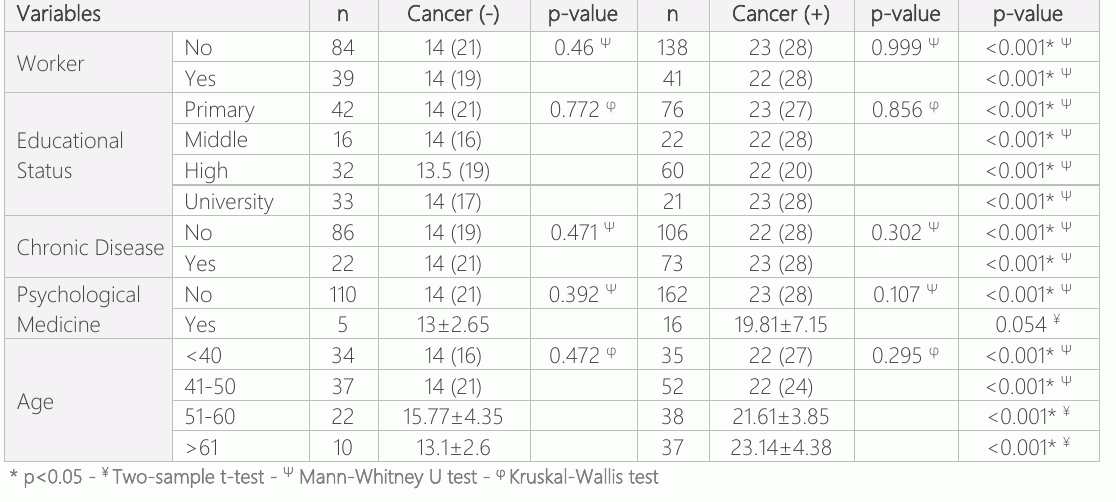
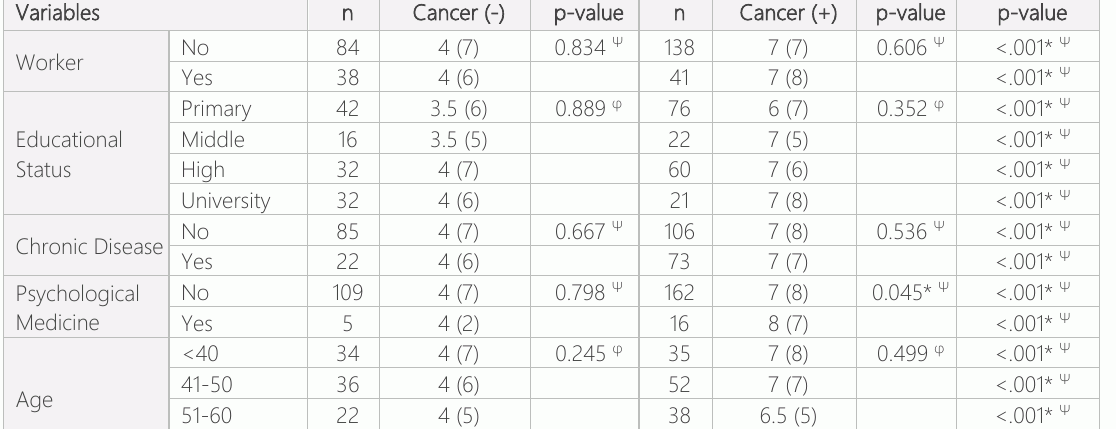
For the C19S and DT score, in the analysis made on patients with and without cancer; there was no difference in terms of working and unemployed, chronic disease and non-user, psychological drug user and non-use, age groups, and educational status (p>0.05). As explained in Table 1, the comparative analysis found significance in the many parameters. A significant difference was found between the DT scores of patients using and not using psychological drugs (p=0.045). The DT score of those who used psychological drugs with
Score comparison for patients with cancer
cancer was higher than the DT score of those who did not have cancer (Table-2). There was no difference between the patient groups with breast, cervix, endometrial and ovarian cancer in terms of STAI-1 (p=0.815), STAI-2 (p=0.462), C19S (p=0.265) and DT (p=0.718) scores. In terms of STAI-1 (p=0.03) and STAI-2 score (p=0.021), a difference was found between the patient groups whose time value was 2021, 2020, 2019, 2018, and before 2017—the STAI-1 who were between 2021 and 2017 and before differed from each other (p=0.021). Again, the STAI-1 score of 2020 patients and the score of 2017 and earlier were different from each other (p=0.003). The STAI-2 scores of 2021 patients and the scores of 2017 and before differed from each other (p=0.012). The 2020 STAI-2 score and the score of the patients in and before 2017 differed from each other (p=0.002). The groups that differed in the C19S and DT scores were: patients with 2021 and 2017 and earlier, and patients with 2020 and before 2017, the C19S score (p<0.001).
Discussion
The questionnaire we describe here, in a cohort of participants with healthy and with cancer who received anticancer treatment for different cancer types in gynecology clinics, examined the course of anxiety and fear symptoms and quality of life compared to the treatments they received during the SARS-CoV-2 pandemic. Consistent with our hypothesis, we found evidence of a clinically significant increase in mental health symptoms and a clinically significant increase in anxiety values in the cancer and healthy patient groups. Therefore, cancer patients were affected in terms of mental health and anxiety values during the pandemic.
According to the results of some individual studies, a high prevalence of depressive symptoms,anxiety and stress were encountered during the pandemic (19). However, meta-analyses analysis of Ayubi et al. and Yu et al. showed lower anxiety in patients who encountered with Covid-19 (20, 21). The meta-analysis of Robinson et al. found an increase in mental health symptoms shortly after the pandemic, which then decreased (22). According to Pinkman et al., the impact of events related to COVID-19 on mental health may need time (23). Our study progressed with 3 questionnaires and, in agreement with the majority of the literature, anxiety increased in all who had Covid-19. During the pandemic process, both gender and age factors affected the health-related behaviors and preferences of individuals. In the study of Yildirim et al. (24), and Moccia et el. (25) reported higher depression and anxiety levels in female patients. Of course, the population of this study was predominantly female, and the difference may be related to the fact that women are disadvantaged in terms of social freedom or carry a heavy burden in terms of domestic responsibilities. In the study conducted in numerical equality, Özdin et al. found the anxiety about the pandemic to be higher in women (26). Furthermore, elderly patients preferred to postpone their appointments for a while and stay at home. Zhao et al. showed that anxiety and mental disorders are more intense in areas where quarantine practices are in place (27). 302 patients participated in our survey, with a wide range of ages. 21.2% of the patients had a diagnosis of Covid-19, while 6.6% died from Covid-19. Twenty-one of the patients were receiving psychiatric medication. Merz et al. stated that sociodemographic characteristics of cancer patients, such as education and age, affect their anxiety levels more than disease-related characteristics, and stated that low education level is associated with high anxiety levels of cancer patients during the pandemic (28). But, according to our results, education, chronic illness, psychological drugs, and age did not affect anxiety scores.
The study of Hacimusalar et al. have shown that not only female gender but also carrying a chronic disease are risk factors for anxiety during the pandemic(29). Treatment processes, which are especially important for cancer patients, are negatively affected by their effects on anxiety (30, 31). Although uncertainties, such as the variable restrictions imposed by COVID- 19, cause anxiety and fear for cancer patients, studies on its psychological effects for these patients are limited. Baffert et al. investigated COVID-related anxiety in cancer patients and found a reduction in anxiety levels after quarantine (32). A study by Sigorski et al., in his study of 306 patients with breast cancer, reported that being under 65, female, and having breast cancer was associated with the highest levels of anxiety. It also reported that cancer-related anxiety was higher than COVID-related anxiety (33). In our study, cancer was diagnosed in 59.3% according to the affected regions: 20.1% endometrium, 47.5% breast, 18.4% ovary, 12.8% cervix, and 1.2% uterus. Cancer significantly affected STAI-1, STAI-2 C19S, and DT. Patients with cancer had 1.39-fold higher STAI-1 scores than those without cancer. Similarly, patients with cancer had 1.37 times higher STAI-2 than patients without cancer. In the analysis for C19S score, cancer had 1.41 times higher C19S than patients without cancer. For DT scores, this ratio was 1.65 times.
The STAI-1 scores of the patients who received CT were 1.16 times than the STAI-1 scores of the patients who had cancer but did not receive additional tx. STAI-1 scores of the patients who received RT were 1.13 times the STAI-1 scores of the patients who had cancer but did not receive additional tx is higher (p<0.001). The STAI-1 scores of patients who received CT+RT were 1.18 times more elevated than the STAI-1 scores of patients who had cancer and did not receive additional tx. The STAI-2 scores of patients with cancer who received CT+RT treatment were 1.14 times higher than patients with cancer who did not receive treatment. RT and CT had no effects on STAI-2 scores. The C19S of cancer patients who received CT, RT, and CT+RT were higher than those who did not receive treatments. The C19S of the patients who received CT were 1.22 times than the C19S of the patients who had cancer but did not receive additional tx. C19S of patients who received LT+RT were 1.26 times higher than the C19S of patients who had cancer but did not receive additional tx.
The strongest aspect of this study is that it is a unique and the detailed survey to analyze the Covid-19 impact with anxiety change. It had several limitations, especially due to the fact that it was research conducted during the pandemic. The most important limitation was that the study was conducted in only one hospital and did not include a control. It did not allow us to investigate changes in the pre-pandemic period, as it did not include baseline data before COVID-19. Although we added the groups that did not have covid-19, some patients had the disease without being diagnosed with covid-19 and we could not certain that issue. Second, the hospital where the study was conducted may differ from COVID-19 death rates around the world. Finally, we conducted the surveys in predetermined time periods and decisions can be affected by situational factors.
Conclusion
Cancer patients have been subject to a strong challenge in the care of mental health symptoms during the pandemic. According to our study, cancer patients were affected by this condition for anxiety, and therefore clinicians should remain vigilant for mood complications.
Declarations
- Author contributions (CRediT)
- All authors contributed equally to all 14 CRediT roles (Conceptualization, Data curation, Formal analysis, Funding acquisition, Investigation, Methodology, Project administration, Resources, Software, Supervision, Validation, Visualization, Writing – original draft, Writing – review & editing).
- Funding
-
Funding information was not reported in the published version of this article.
- Conflicts of interest
- Conflict of I nterest The author declares no conflict of interest.
- Ethics approval
- The study was approved by the local ethics committee (date: 27/01/2021 - ID: 2021-01/908). This study was carried out in accordance with the Declaration of Helsinki. Study Design All patients have signed a written consent for treatment and data analysis.
- Data availability
- A data availability statement was not reported in the published version of this article.
References (33)
31 of 33 references are linked to their DOI.
- Ghaznavi H, Shirvaliloo M, Sargazi S, Mohammad ghasemipour Z, Shams Z, Hesari Z, et al. SARS-CoV-2 and influenza viruses: Strategies to cope with coinfection and bioinformatics perspective. Cell Biol Int. 2022;46(7):1009-20 DOI Crossref PubMed Google Scholar
- Kucukyildiz K, Yilmaz-Oral D, Turkcan D, Oztekin CV, Gur S. Impact of COVID-19 on male urogenital health: Success of vaccines. Drug Discov Today. 2022;27(10):103327 DOI Crossref PubMed Google Scholar
- Rizvi AA, Kathuria A, Al Mahmeed W, Al-Rasadi K, Al- Alawi K, Banach M, et al. Post-COVID syndrome, inflammation, and diabetes. J Diabetes Complications. 2022;36(11):108336 DOI Crossref PubMed Google Scholar
- Sirin S, Nigdelioglu Dolanbay S, Aslim B. The relationship of early- and late-onset Alzheimer's disease genes with COVID-19. J Neural Transm (Vienna). 2022;129(7):847-59 133 77 Anxiety in Cancer During the SARS‑CoV‑2 Zehra Ozturk Basarir et al. DOI Crossref PubMed Google Scholar
- van Mulukom V, Pummerer LJ, Alper S, Bai H, Čavojová V, Farias J, et al. Antecedents and consequences of COVID-19 conspiracy beliefs: A systematic review. Soc Sci Med. 2022;301:114912 DOI Crossref PubMed Google Scholar
- Laçinel Gürlevik S, Günbey C, Ozsurekci Y, Oygar PD, Kesici S, Gocmen R, et al. Neurologic manifestations in children with COVID-19 from a tertiary center in Turkey and literature review. Eur J Paediatr Neurol. 2022;37:139-54 DOI Crossref PubMed Google Scholar
- Rahman MM, Marzo RR, Chowdhury S, Qalati SA, Hasan MN, Paul GK, et al. Knowledge, Attitude and Practices Toward Coronavirus Disease (COVID- 19) in Southeast and South Asia: A Mixed Study Design Approach. Front Public Health. 2022;10:875727 DOI Crossref PubMed Google Scholar
- Bargon CA, Batenburg MCT, van Stam LE, Mink van der Molen DR, van Dam IE, van der Leij F, et al. Impact of the COVID-19 Pandemic on Patient-Reported Outcomes of Breast Cancer Patients and Survivors. JNCI Cancer Spectr. 2021;5(1):104 DOI Crossref PubMed Google Scholar
- Grajek M, Krupa -Kotara K, Rozmiarek M, Sobczyk K, Działach E, Górski M, et al. The Level of COVID-19 Anxiety among Oncology Patients in Poland. Int J Environ Res Public Health. 2022;19(18):54 -59 DOI Crossref PubMed Google Scholar
- Yasin AI, Topcu A, Shbair AT, Isleyen ZS, Ozturk A, Besiroglu M, et al. Anxiety levels of breast cancer patients in Turkey during the COVID-19 pandemic. Future Oncol. 2021;17(25):3373-81 DOI Crossref PubMed Google Scholar
- Yildirim OA, Poyraz K, Erdur E. Depression and anxiety in cancer patients before and during the SARS-CoV-2 pandemic: association with treatment delays. Qual Life Res. 2021;30(7):1903-12 DOI Crossref PubMed Google Scholar
- De Jaeghere EA, Kanervo H, Colman R, Schrauwen W, West P, Vandemaele N, et al. Mental Health and Quality of Life among Patients with Cancer during the SARS-CoV-2 Pandemic: Results from the Longitudinal ONCOVID Survey Study. Cancers (Basel). 2022;14(4):89-110 DOI Crossref PubMed Google Scholar
- Manchanda R, Oxley S, Ghaem-Maghami S, Sundar S. COVID-19 and the impact on gynecologic cancer care. Int J Gynaecol Obstet. 2021;155 Suppl 1(Suppl 1):94-101 DOI Crossref PubMed Google Scholar
- Derksen JWG, May AM, van de Poll-Franse LV, de Rooij BH, Hafkenscheid DA, Verkooijen HM, et al. Colorectal Cancer Care and Patients' Perceptions Before and During COVID-19: Implications for Subsequent SARS-CoV-2 Infection Waves. JNCI Cancer Spectr. 2021;5(4):047 DOI Crossref PubMed Google Scholar
- Ahorsu DK, Lin CY, Imani V, Saffari M, Griffiths MD, Pakpour AH. The Fear of COVID-19 Scale: Development and Initial Validation. International journal of mental health and addiction. 2022;20(3):1537-45 PubMed Google Scholar
- Bakioğlu F, Korkmaz O, Ercan H. Fear of COVID-19 and Positivity: Mediating Role of Intolerance of Uncertainty, Depression, Anxiety, and Stress. International journal of mental health and addiction. 2021;19(6):2369-82 DOI Crossref PubMed Google Scholar
- Spielberger C, Gorsuch R, Lushene R, Vagg P, Jacobs GJPAS. Manual for the State-Trait Anxiety Inventory; Palo Alto, CA, Ed. 1983 PubMed Google Scholar
- Kozlov E, Eghan C, Moran S, Herr K, Reid MC. Palliative Care Providers' Practices Surrounding Psychological Distress Screening and Treatment: A National Survey. Am J Hosp Palliat Care. 2018;35(7):938-44 DOI Crossref PubMed Google Scholar
- Momenimovahed Z, Salehiniya H, Hadavandsiri F, Allahqoli L, Günther V, Alkatout I. Psychological Distress Among Cancer Patients During COVID-19 Pandemic in the World: A Systematic Review. Front Psychol. 2021;12:682154 DOI Crossref PubMed Google Scholar
- Ayubi E, Bashirian S, Khazaei S. Depression and Anxiety Among Patients with Cancer During COVID-19 Pandemic: A Systematic Review and Meta-analysis. J Gastrointest Cancer. 2021;52(2):499-507 DOI Crossref PubMed Google Scholar
- Yu H, Zhou Z, Mo Q, Zhou X, Liu Y, Feng S. Prevalence of Anxiety and Depression Among Cancer Patients During the COVID-19 Pandemic: a Systematic Review and Meta-analysis. Research Square Platform LLC; 2020 DOI Crossref PubMed Google Scholar
- Robinson E, Sutin AR, Daly M, Jones A. A systematic review and meta-analysis of longitudinal cohort studies comparing mental health before versus during the COVID-19 pandemic in 2020. J Affect Disord. 2022;296:567-76 DOI Crossref PubMed Google Scholar
- Pinkham AE, Ackerman RA, Depp CA, Harvey PD, Moore RC. A Longitudinal Investigation of the Effects of the COVID-19 Pandemic on the Mental Health of Individuals with Pre-existing Severe Mental Illnesses. Psychiatry Res. 2020;294:113493 DOI Crossref PubMed Google Scholar
- Yildirim OA, Poyraz K, Erdur E. Depression and anxiety in cancer patients before and during the SARS-CoV-2 pandemic: association with treatment delays. Quality of life research: an international journal of quality of life aspects of treatment, care and rehabilitation. 2021;30(7):1903-12 DOI Crossref PubMed Google Scholar
- Moccia L, Janiri D, Pepe M, Dattoli L, Molinaro M, De Martin V, et al. Affective temperament, attachment style, and the psychological impact of the COVID-19 outbreak: an early report on the Italian general population. Brain Behav Immun. 2020;87:75-9 DOI Crossref PubMed Google Scholar
- Özdin S, Bayrak Özdin Ş. Levels and predictors of anxiety, depression and health anxiety during COVID-19 pandemic in Turkish society: The importance of gender. Int J Soc Psychiatry. 2020;66(5):504-11 DOI Crossref PubMed Google Scholar
- Zhao H, He X, Fan G, Li L, Huang Q, Qiu Q, et al. COVID-19 infection outbreak increases anxiety level of general public in China: involved mechanisms and influencing factors. J Affect Disord. 2020;276:446-52 DOI Crossref PubMed Google Scholar
- Merz V, Ferro A, Piras EM, Zanutto A, Caffo O, Messina C. Electronic Medical Record-Assisted Telephone Follow-Up of Breast Cancer Survivors During the COVID-19 Pandemic: A Single Institution Experience. JCO Oncol Pract. 2021;17(1):44- DOI Crossref PubMed Google Scholar
- Hacimusalar Y, Kahve AC, Yasar AB, Aydin MS. Anxiety and hopelessness levels in COVID-19 pandemic: A comparative study of healthcare professionals and other community sample in Turkey. J Psychiatr Res. 2020;129:181-8 DOI Crossref PubMed Google Scholar
- Greer JA, Pirl WF, Park ER, Lynch TJ, Temel JS. Behavioral and psychological predictors of chemotherapy adherence in patients with advanced non-small cell lung cancer. J Psychosom Res. 2008;65(6):549-52 134 77 Anxiety in Cancer During the SARS‑CoV‑2 Zehra Ozturk Basarir et al. DOI Crossref PubMed Google Scholar
- Karacin C, Bilgetekin I, F BB, Oksuzoglu OB. How does COVID-19 fear and anxiety affect chemotherapy adherence in patients with cancer. Future Oncol. 2020;16(29):2283-93 DOI Crossref PubMed Google Scholar
- Baffert KA, Darbas T, Lebrun-Ly V, Pestre-Munier J, Peyramaure C, Descours C, et al. Quality of Life of Patients With Cancer During the COVID-19 Pandemic. In Vivo. 2021;35 (1):663-70 DOI Crossref PubMed Google Scholar
- Sigorski D, Sobczuk P, Osmola M, Kuć K, Walerzak A, Wilk M, et al. Impact of COVID-19 on anxiety levels among patients with cancer actively treated with systemic therapy. ESMO Open. 2020;5(5):e000970 DOI Crossref PubMed Google Scholar
Read the full text
Open the PDF here
Loading the PDF…
If the PDF does not show here, use the download button above.
How to cite this article
Basarir ZO, Arslanca SB, Hamurcu HD, Atalay F. Survey Analysis of Anxiety in Gynecological Cancer Patients in the SARS‑CoV‑2 Pandemic. Ulutas Med J. 2022;8(4):127-134. doi:10.5455/umj.20221106083739
Basarir, Z. O., Arslanca, S. B., Hamurcu, H. D., & Atalay, F. (2022). Survey Analysis of Anxiety in Gynecological Cancer Patients in the SARS‑CoV‑2 Pandemic. The Ulutas Medical Journal, 8(4), 127–134. https://doi.org/10.5455/umj.20221106083739
Basarir, Z.O. et al. (2022) 'Survey Analysis of Anxiety in Gynecological Cancer Patients in the SARS‑CoV‑2 Pandemic', The Ulutas Medical Journal, 8(4), pp. 127–134. doi: 10.5455/umj.20221106083739.