The Ulutas Medical Journal · ISSN 2149-0430 (print), 2149-388X (online) · https://www.ulutasmedicaljournal.com/?mno=239004
Original Research · Open access
Prevelans of Upper Extremity Musculoskeletal Complaints and Its Relationship with Risk Factors for Bank Employees Working with Computer
Also available in: العربية · Türkçe · 中文
- Adnan Menderes University, Faculty of Nursing, Public Health Nursing Department, Aydin, Turkiye ROR
- Professor, Ege University, Medical School, Public Health Department ROR
Abstract
- Aim
- To determine the frequency and risk factors of upper extremity musculoskeletal complaints (UE-WMSCs) of the bank employees working with computer.
- Method
- This cross-sectional observational study was conducted among 221 bank employees between July and September 2013 in Aydın, Turkey. For data collection socio-demographic characteristics and working environment form, evaluation of upper extremity musculoskeletal symptoms with visual analogue scale (VAS) form, MSC (Musculoskeletal complaints) preventive behaviors and Karasek job strain scale was used.
- Results
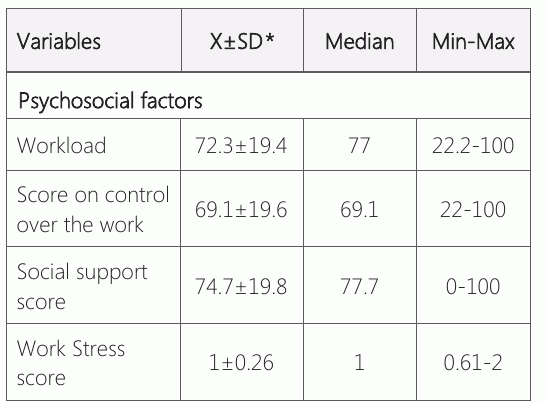
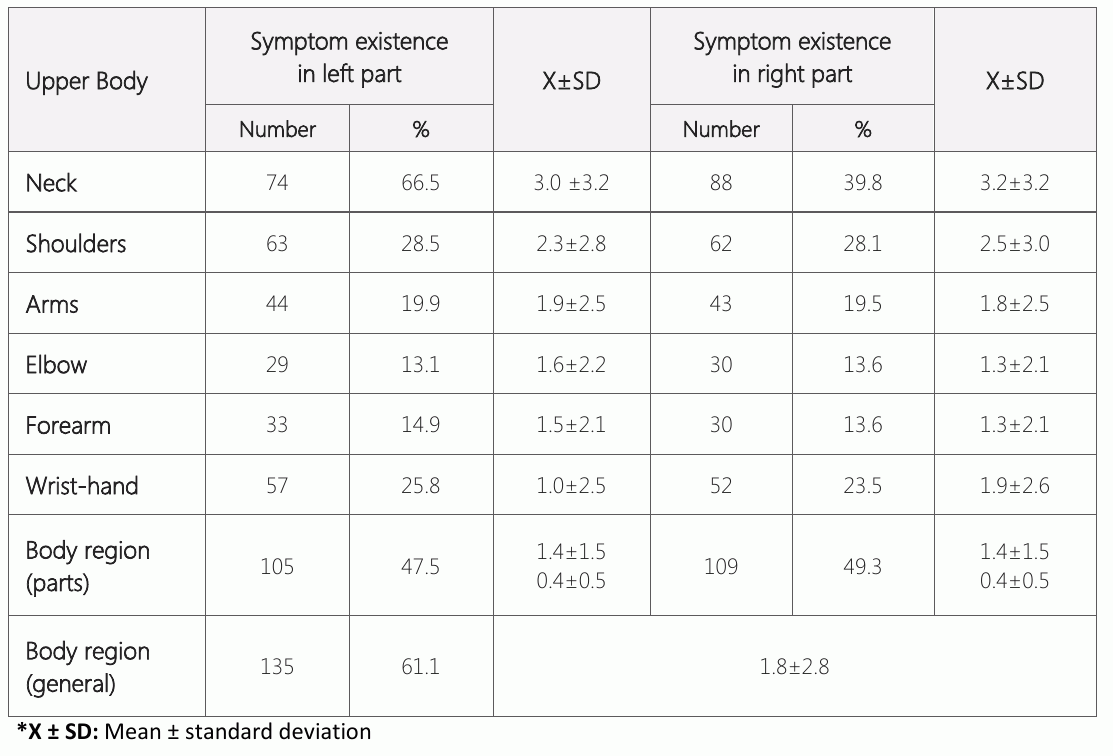
- The rate of existence of a symptom anywhere in upper body area is 61.1%, and the average VAS pain intensity is 1.8±2.8. The most common complaint is reported in the left neck (66.5%) and left shoulder (28.5%) areas. The least existence of symptoms is found out in left elbow region (13.1%). Average scale points for psycho-social elements of workload, control over the work and social support are determined as 72.3±19.4, 69.1±19.6 and 74.7±19.8 respectively. The average score for work stress is determined to be 1.0±0.26 (0.61-2.0). There has been found out a close relationship between the risk for musculoskeletal complaints on one hand and age, the number of children, working time and work control on the other hand.
- Conclusion
- Neck and shoulders are most affected areas in the bodies of bank employees working with a computer. It is found out that socio-demographic characteristics, working conditions, and work control are closely connected with UE-WMSC.
Keywords
Full text
Introduction
It is reported that work-related musculo skeletal complaints (WMSCs) make up 42-58% of all occupational diseases (1). More than 25% of working population in Europe have musculoskeletal symptoms (2). It is also repor-ted that WMCs constitute 40% of the injuries for which work compensation paid in USA (3). The studies show that age and gender as socio-demographic factors and as vocational factors, repetitive movements, static physical posture, daily time spent using computer, heavy workload and poor working conditions are risk factors for WMCs (1, 4, 5).Employees in the banking sectors are subject to long hours of static work, bad posture and activities of repetitive computer use. Therefore, the duties of bank employees make them prone to WMSCs (6, 7). Working in the same posture for long periods of time, repetitive movements and agronomical inadequacies in work environments bring about several health problems, in particular,musculoskeletal complaints. These health problems result in serious loss of time, economic value and workforce, and increase the importance of the subject. The purpose of this study is to determine upper extremity musculoskeletal complaints of bank employees working with computer and to evaluate its relationship with psychosocial factors in the work environment and other risk factors.
Methodology
Study design
This cross-sectional and observational study was carried out in the Center of Aydın Province between July and September 2013. Study workgroup covers bank employees working with thecomputer (WWCs) in Aydın Provincial Center, who agreed to attend the study.
Setting and sample
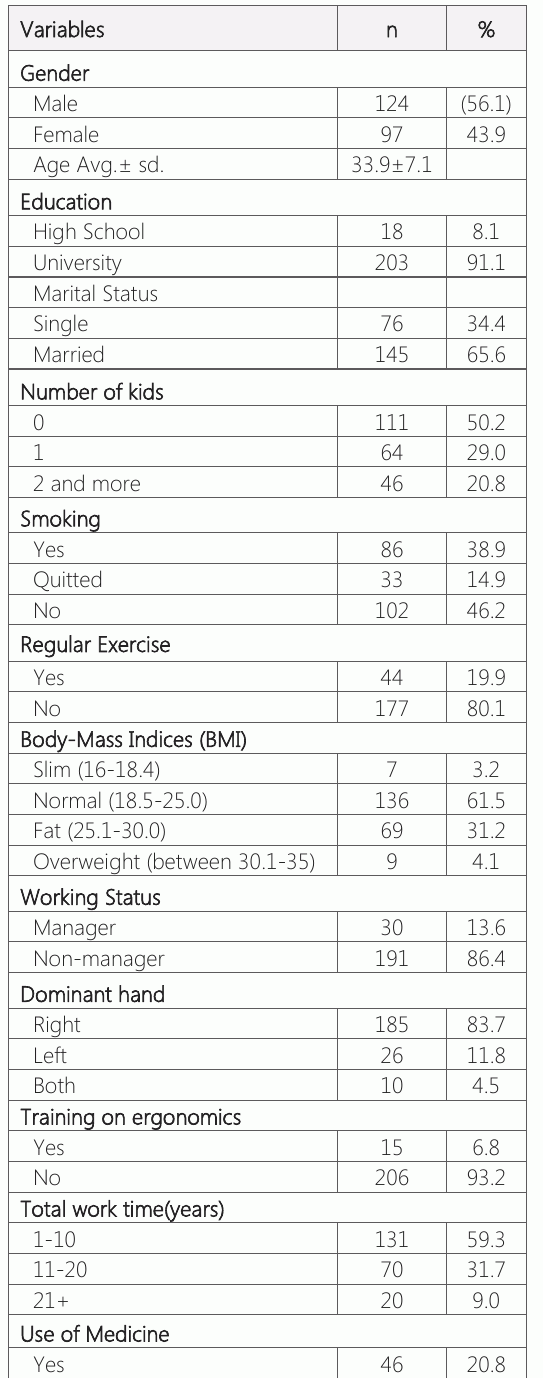
The bank employees who use acomputer at least 10 hours in a week are included in the group while pregnant women and those who had motor vehicle accidents during last one year were excluded. 221 WWCs attended the study.56.1% of the participants in the study are male, the average age is 33.9±7.1 and %91.1 of the participants areuniversity graduates.
Measurement/Instruments
In this study “Visual Analogue Scale” (VAS) is used to find out upper body MS complaints. It measures the intensity of pain of the symptom (complaint, pain, numbness, tingling, weakness, incompetence, etc.). This scale, whose validity and reliability is already tested(8), is 10 cm long and graded over a vertical or horizontal line (0=no pain and 10=most severe pain). The person attending the study is asked to mark the point over this line, which corresponds to the level of his/her pain. The distance between the point which is marked and the lowest point of this line (0=no pain) is measured in cm, and the numerical value represents the intensity of pain of the patient’s pain (9). The existence of the symptom is accepted in cases where the patient declares the intensity of pain of his/her pain over 5.
Psycho-social elements are measured by using Karasek’s workload-control-social support model. For this purpose, a psycho-social information form is used (10). Psycho-social factors information form is composed of 17 questions with an answer format of four-point Likert scale. The validity of the scale is tested by Demiral et al (11, 12). According to this model,the interaction between psychosocial work-load and work control determines work stress level. Workload describes the demand for necessary power and the density of the work which also covers speed of work. Work control shows the employee’s skill level, the possibilities of using this skill and involvement in the decision-making procedures in the execution of the work. Comparing the workload with work control results in the calculation of a value called “work tension” or “work stress.” For workload, control and social support subsections of the scale, Cronbach’s alpha coefficients vary between 0.51-0.72.Total score for work control is calculated by adding up scores obtained for use of skills and decision freedom. High scores mean high workload, work control, and high social support. Work tension is valued as the ratio of workload over work control.Socio-demographic attributes of the participants, working conditions and their activities/behaviors aimed at preventing upper body musculoskeletal complaints are also evaluated through a questionnaire.
Data Collection/ Procedure
Data were collected using face to face and anonymous questionnaire. Written approvals are obtained from participants and from The Turkish Ministry of Health, Public Hospitals Institution, Tepecik Education and Research Hospital’s Ethics Committee which is numbered 51/11.
Statistical analysis
Data is analyzed with SPSS v15. Numbers and percentages of the participants are calculated according to socio-demographic variables.Chi-square test, studentst-test, and logistics regression are used in the analysis; averages are given together with standard deviations. For statistical significance, it is assumed that p<0.05.
Results
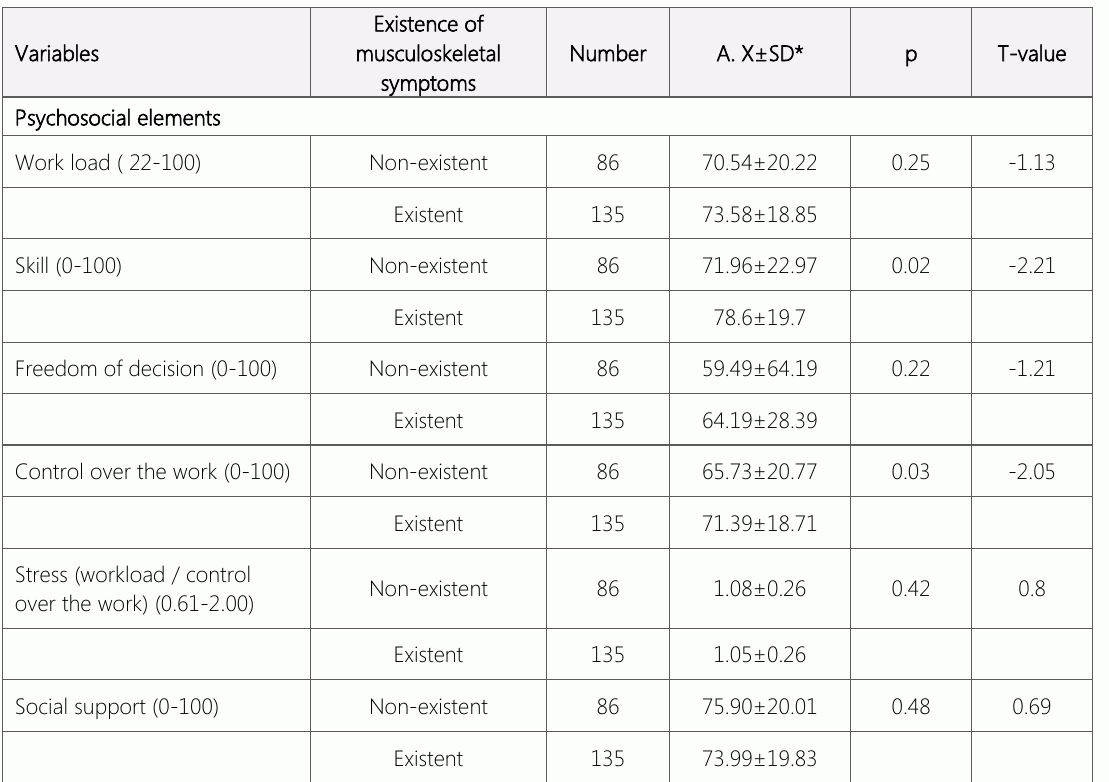
Distribution of bank employees, who participated in the study, in terms ofcertain sociodemographical attributes is given in Table-1. It is reported that 56.1% of bank employees are male,65.6% married,81.1% university graduate and 50.2% of the participants do not have children. Bank employees report that 38.9% of them smoke while 19.9% do physical exercise. According to evaluation of body mass index, 61.5% of participants are of medium weight. 93.2% of the participants have not had any training related to office ergonomics.The existence of a symptom in any part of the participating bank employees is 61.1%, and the average for the body is 1.8±2.8; the highest existence is in the left neck region with 66.5% and in the left shoulder region with 28.5%. The lowest existence of symptom is in left elbow region with 13.1%. The general rate of symptom existence is 47.5% for the left side of body and 49.3% for right part of body (Table-2). Four different types of scores are obtained for psychosocial elements: work-load, control over the work score, social support score and work stress score (Table-3).
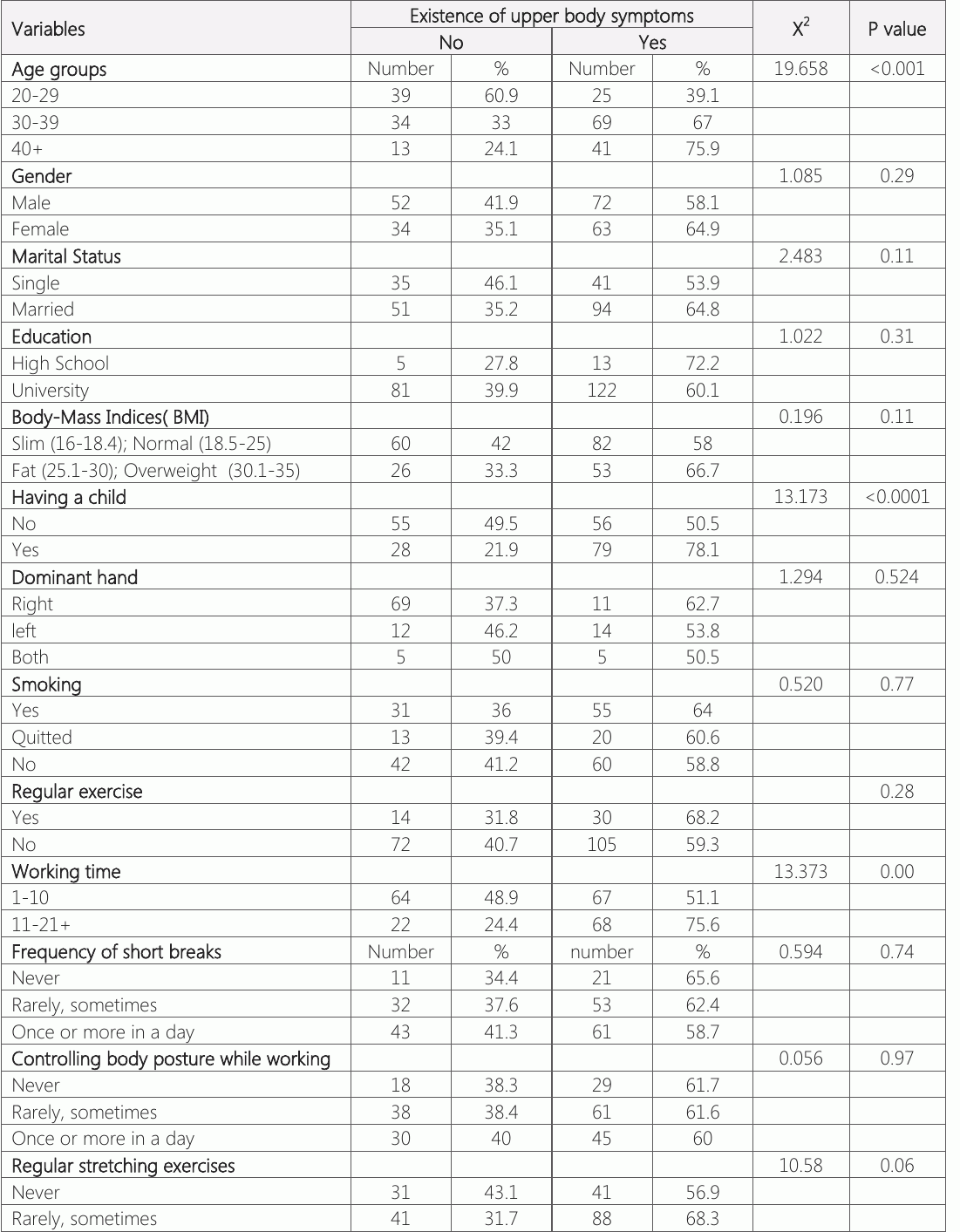
When MSC preventive behaviors are evaluated, the average score for doing exercise is found as 2.3±1.52.3 while these numbers are 3.1±1.7and2.6±1.5 for the frequency of giving short breaks and for paying attention to posture. Distribution of the symptoms according to certain attributes of the participants are shown in table-4.
The existence of the symptoms is observed to be more in women, older people, married people, people with kids and people working longer hours. When the existence of upper body musculoskeletal symptoms and psycho-social elements are considered together, there exists a meaningful relationship between skill scores and scores for control over the work (Table-5).
Discussion
Prevalence of upper body musculoskeletal symptoms for bank employees working with computer and risk factors affecting this situation are determined. In this study, therate of symptom existence in any part of theupper body is found to be 61.1%. This result is in line with previous research by which the prevalence is reported between 27% and 63% (13). In a study carried by Abledu et al., the density of upper body area symptoms within last 12 months is found to be 83.5% (14, 15), while Bhanderi reported frequency as 72.2% (6, 14). As a result of a study over the density of upper body region symptoms within last 12 months, it is observed that neck and shoulder symptoms are more prevalent. It is understood that symptom prevalence is higher in the left region of the body than in the right region and that the lowest prevalence is observed in the left elbow region. UE-WMSC prevalence in elbow region is found to be lower than what is repor-ted in previous studies, between 6.0%- 30% (16). This situation could be explained by the joint structure of elbows, by use of handarm support and by the fact that degenerative diseases are less observed in this region.In a cross-sectional study carried out in Kuwait to determine existence of UE-WMSC for bank employees, prevalence of MSC is found to be 80% while the most affected parts of the body are neck (53.5%), waists (51,1%), shoulders (49.2%) and back (38.4%) (17). In Balcı’s dis- sertation study covering the bank employees in Gaziantep Province, the prevalence of musculoskeletal complaints is determined as 58.5%, while the most common complaints are reported as waist pains (29.0%), back pain (28,8%) and neck pain (27.9%)(18). Jensen et al. showed that the most common symptoms for women working in call centers are observed in neck (53%), which is followed by shoulders (42%) and hand-wrist area (30%) (19). In his study Wood reports that participants had musculoskeletal complaints at least once in a year; 56% of the participants experienced musculoskeletal disorders within last week, and 20% of the participants experienced musculoskeletal disorders that had hindered working (20). Çalık et al. found out that white-collar workers have most common musculoskeletal complaints in theback of the body (69.9%), in the waist (68%), neck (67.1%) and 50.6% in right shoulder (21).In a study carried out by Klussmann et al., it is shown that the symptoms of last one year are reported in theneck (55%), shoulders (38%), hand-wrist (21%) and elbow and forearm (15%) (22). In this study, it is found out that individual factors such as age, thenumber of children, working time and scores of psychosocial factors such as skill and control over the work are related with UE- WMSC. Viikari et al. determined that the risk of WMSC in the neck and upper extremity increases with advancing age (23).
In some studies, it is reported that complaints in arms, wrist and hand increase after theage of 40 (24, 25). Torqvist et al. reported that neck and shoulder symptoms slightly increase between ages of 40 and 48 while after the age of 50, an increase in shoulder symptoms are observed (26). Holmström et al. studied the relationship between age and musculoskeletal complaints and observed that they increase with advancing age (27).
Mostly in literature it is reported that MSC is more common for women than men (7, 21, 25, 28–30). The possibility of development of a musculoskeletal problem is higher for women working in thebank compared to men. Being a woman is reported as a risk factor for the progress of MSC (31). However, no statistical significance is determined (p>0.05). In some studies, it is reported that women had more symptoms given their domestic workload and child care (30, 31).
In this study, no significant statistical relationship is found out between working with the computer (WWC) and musculoskeletal complaints (p<0.11). In a similar way, in some studies carried out, no relationship is observed between WWC and UE-WMSC (33, 34). Viester et al. in a study carried out in Holland, found out the relationship between musculoskeletal complaints and body-mass index (35). In this study, no relationship was found between UE-WMSC and smoking, regular sports and stretching exercises. However, physical activity has many positive effects such as protection of muscular force, protection of body shape and posture, reducing fatigue, protection against muscle contraction, maintenance of bone mineral density, body protection against injuries and accidents, etc.(36). In this study, a relationship was observed between working time and existence of musculoskeletal symptoms. In a similar study, (statistical) significance was observed between working time and UE-WMSC (22, 37). In many studies, smoking is evaluated as an individual risk factor affecting the development of musculoskeletal diseases. However, no relationship has been reported in this study. No relationship has been established between musculoskeletal symptom development and the frequency of having short breaks and controlling body posture.
In previous epidemiologic studies, it was reported that short resting breaks have positive effects (7, 37, 38). Use of screen is diminished together with short breaks, muscle load due to poor ergonomic conditions is decreased. Short breaks provide muscular relief and recovery (4, 39,45). In this study, statistical significance is determined between UE-WMSC and control over the work. Especially imbalance between the workload and control for the employees results in work stress. Bot et al. found out that sickness absenteeism increases for employees with high workload and low work control (40). In previous studies, psychosocial factors are evaluated as determinant factors for WMSC (22,39,4142,43,44).
Conclusion
It is found out that frequency of neck and shoulder musculoskeletal symptoms are most commonly observed in bank employees working with acomputer. The presence of upper body musculoskeletal symptoms are observed more with advancing age, for women, married, people with children, people with more working hours. It is also understood that skill and control over the work are among the workplace psychosocial elements that constitute risk factors for upper body musculoskeletal symptoms. It is necessary that preventive programs for musculoskeletal symptoms of bank employees should concentrate primarily on neck and shoulder disorders. It is also important to get rid of psychosocial factors that are negatively affecting the health of bank employees.
Declarations
- Author contributions (CRediT)
- All authors contributed equally to all 14 CRediT roles (Conceptualization, Data curation, Formal analysis, Funding acquisition, Investigation, Methodology, Project administration, Resources, Software, Supervision, Validation, Visualization, Writing – original draft, Writing – review & editing).
- Funding
-
Funding information was not reported in the published version of this article.
- Conflicts of interest
- A conflict of interest statement was not reported in the published version of this article.
- Ethics approval
- Ethics approval details were not reported in the published version of this article.
- Data availability
- A data availability statement was not reported in the published version of this article.
References (42)
28 of 42 references are linked to their DOI.
- Griffiths KL, Mackey MG, Adamson BJ. Behavioral and psychophysiological responses to job demands and association with musculoskeletal symptoms in computer work. J Occup Rehabil 2011;21(4):482-92. DOI Crossref PubMed Google Scholar
- Smith S, Salaway G, Caruso BJ. The ECAR study of under graduate students and information technology: Research study:EDUCAUSE center for applied research 2009. https:/ /net.educause.edu/ir/library/pdf/ers0906/rs/ERS0906w.pdf PubMed Google Scholar
- National Research Council, The National Academy of Sciences. Musculo skeletal disorders and the workplace: low back and upper extremity musculoskeletal disorders. Washington (DC): National Academy Press. 2001. PubMed Google Scholar
- Andersen JH, Fallentin N, Thomsen JF, Mikkelsen SH. Risk factors for neck and upper extremity disorders among computers users and the effect of interventions: an overview of systematicreviews. PLoSOne 2011;12; 6(5). DOI Crossref PubMed Google Scholar
- Ranasinghe P, Perera YS, Lamabadusuriya DA, Kulatunga S, Jayawardana N, Rajapakse S, et al. Work related complaints of neck, shoulder and arm among computer office workers: A cross- sectional evaluation of prevalence and risk factors in a developingcountry. EnvironHealth 2011; 10 (1),1. DOI Crossref PubMed Google Scholar
- Abledu J and Abledu K. Multiple Logistic Regression Analysis of Predictors of Musculoskeletal Disorders and Disability among Bank Workers in Kumasi, Ghana. J Ergonomics 2012;2:111-5. PubMed Google Scholar
- Wu S, He L, Li J, Wang J, Wang S. Visual Display Terminal Use Increases the Prevalence and Risk of Work-related Musculoskeletal Disorders among Chinese Office Workers: A Cross- sectional Study. J Occup Health 2012;54:34-43. DOI Crossref PubMed Google Scholar
- Podniece Z. Work-related musculoskeletal disorders: prevention report European Agency for Safety and Health at Work. 2008. Luxembourg, Belgium. PubMed Google Scholar
- Cho C, Hwang Y, Cherng R. Musculoskeletal Symptoms and Associated Risk Factors Among Office Workers With High Workload Computer Use. J Manipulative Physiol Ther. 2012;35(7):534-540. DOI Crossref PubMed Google Scholar
- Price DD, McGrath PA, Rafii A, Buckingham B. The validation of visualanaloguescales as ratio scale measures for chronic and experimental pain. Pain; 1983; 17:45-56. DOI Crossref PubMed Google Scholar
- Punnett L, Wegman DH. Work-related musculoskeletal disorders: the epidemiologic evidence and the debate. J Electromyogr Kinesiol 2004;14:13–23. DOI Crossref PubMed Google Scholar
- Demiral Y, Ünal B, Kılıç B, ve ark. İş Stresi Ölçeğinin İzmir Konak Belediyesi’nde Çalışan Erkek İşçilerde Geçerlilik ve Güvenirliliğinin İncelenmesi. Toplum Hekimliği Bülteni, Ocak-Nisan 2007;26(1): 11-18. PubMed Google Scholar
- Baldwin ML, Butler RJ. Upper extremity disorders in the workplace: costs and outcomes beyond the first return to work. J Occup Rehabil 2006; 16:303-323. DOI Crossref PubMed Google Scholar
- Bhanderi D, Choudhary SK, Parmar L and Doshi V. A study of occurrence of musculoskeletal discomfort in computer operators. Indian J Community Med 2008; 33(1): 65–66. DOI Crossref PubMed Google Scholar
- Naidoo RN, Haq SA.Occupational use syndromes. Best Pract Res Clin Rheumatol 2008;22(4):667-691. DOI Crossref PubMed Google Scholar
- Fourth European Working Conditions Survey, 2007. http:// www.eurofound.europa.eu/pubdocs/2006/98/en/2/ef0698 en. pdf PubMed Google Scholar
- Akrouf QA, Crawford JO, Al-Shatti AS, Kamel MI. Musculo skeletal disorders among bank officeworkers in Kuwait. East Mediterr Health J.2010;16(1). DOI Crossref PubMed Google Scholar
- Balcı Ö. Gaziantep İl Merkezindeki Bankaların Büro ergo-nomisine uygunluk durumları ve banka çalışanlarının bazı sağlık yakınmaları.Gaziantep Üniversitesi, Tıp Fakültesi, Halk Sağlığı Anabilim Dalı, doktora tezi. 2007. Risk Factors for Bank Employees using Computer Safiye Ozvurmaz, et al. PubMed Google Scholar
- Jensen C et al. Musculoskeletal symptoms and duration of computer and mouse use. Int J Ind Ergon,2002,30(4-5):265-75. DOI Crossref PubMed Google Scholar
- Woods V. Musculoskeletal disorders and visual strain in intensive data processing workers. Occup Med 2005; 55 (2):21–7. DOI Crossref PubMed Google Scholar
- Çalık BB, Orçin TA, Başkan E, Gökçe B. Bilgisayar Kullanan Masa Başı Çalışanlarında Kas İskelet Sistemi Rahatsızlıkları, İşin Engellenmesi ve Risk Faktörlerinin İncelenmesi Marmara Üniversitesi Sağlık Bilimleri Enstitüsü Dergisi: 2013;3(4):208-214. PubMed Google Scholar
- Klussmann A, Gebhardt H, Liebers F, Rieger MA. Musculoskeletal symptoms of the upper extremities and the neck: a cross sectional study on prevalence and symptom predicting factors at visual display terminal (VDT) workstations. BMC Musculoskelet Disord 2008;9:96. DOI Crossref PubMed Google Scholar
- Viikari JE, Martinikainen R, Lukkonen R, Mutanen P, Takala EP, Riihimäki H. Longitudinalstudy on work related and individual risk factors affecting radiating neck pain. Occup Environ Med 2001; 58: 345-352. PubMed Google Scholar
- Gerr F, Marcus M, Ensor C, Kleinbaum D, Cohen S, Edwards A, Gentry E, Ortiz DJ, Monteilh C. A.Prospective study of computer users: I. Study design and incidence of musculoskeletal symptoms and disorders. Am J Ind Med 2002; 41: 221-235. DOI Crossref PubMed Google Scholar
- Wahlström J, Svensson J, Hagberg M, Johnson PW. Differences between work methods and gender in computer mouse use. Scand J Work Environ Health 2000; 26(5):390-7. DOI Crossref PubMed Google Scholar
- Tornqvist EW, Hagberg M, Hagman M, Risberg EH, Toomingas A. Theinfluence of working conditions and individual factors on the incidence of neck and upper limb symptoms among Professional computer users. Int Arch Occup Environ Health 2009; 82(6):689-702. PubMed Google Scholar
- Holmström E, Engholm G. Musculoskeletaldisorders in relation to age and occupation in Swedish construction workers. Am J Ind Med 2003;44(4):377-384. DOI Crossref PubMed Google Scholar
- Guo HR, Chang YC, Yeh WY, Chen CW, Guo YL. Prevalence of Musculoskeletal Disorder among Workers in Taiwan: A Nationwide Study. J Occup Health 2004; 246: 26-36. DOI Crossref PubMed Google Scholar
- Janwantanakul P, Pensri P, Jiamjarasrangsri V, Sinsongsook T. Prevalence of self-reported musculoskeletal symptoms among office workers. Occup Med 2008; 58: 436-438. DOI Crossref PubMed Google Scholar
- Krantz B K(ed). The Swedish Work Environment Authority. Musculoskeletal ergonomics statistics. The Swedish Work Environment Authority. 2006; p.6-11. PubMed Google Scholar
- Boogar RI,Mirkouhi G M. Psychosocial and Occupational Risk Factors of Musculoskeletal Pains Among Computer Users: Retrospective Cross-Sectional Study in Iran. IJOH 2013; 5(2):46-52. PubMed Google Scholar
- Krantz G, Berntsson L, Lundberg U. Total workload, work stress and perceived. Eur J Public Health 2005;15(2): 209-214. PubMed Google Scholar
- Loghmani A, Golshiri P, Zamani A, Kheirmand M, Jafari N. Musculoskeletal symptoms and job satisfaction among Office-workers: A Cross- sectionalstudyfrom Iran. Acta Med Acad. 2013;42(1):46-54. DOI Crossref PubMed Google Scholar
- Roquelaure Y, Ha C, Rouillon C, Fouquet N, Leclerc A, Descatha A et.al. Risk Factors for Upper-Extremity Musculo skeletal Disorders in the Working Population. Arthritis Rheum. 2009 Oct 15;61(10):1425-34. DOI Crossref PubMed Google Scholar
- Viester L, Verhagen EA, OudeHengel KM, Koppes LL, van der Beek AJ, Bongers PM.The relation between body mass index and musculoskeletal symptoms in the working population. BMC Musculoskelet Disord 2013;14:238 DOI Crossref PubMed Google Scholar
- Bozhüyük A, Özcan S, Kurdak H, Akpınar E, Saatçı E, Bozdemir N.Sağlıklı Yaşam Biçimi ve Aile Hekimliği. TJFMPC 2012;6(1). PubMed Google Scholar
- Akrouf QA, Crawford JO, Al-Shatti AS, Kamel MI. Musculo skeletal disorders among bank officeworkers in Kuwait. Eastern Mediterranean Health Journal, EMHJ. 2010;16 (1):94-100. DOI Crossref PubMed Google Scholar
- Cagnie B, Danneels L, Van Tiggelen D, De Loose V, Cambier D. Individual and work related risk factors for neck pain among Office workers: a cross sectional study. Eur Spine J. 2007 May;16(5):679-86. DOI Crossref PubMed Google Scholar
- Mclean L, Tingley M, Scott RN, Rickards J.Computer terminal work and the benefit of microbreaks. Appl Ergon 2001;32(3):225-237. DOI Crossref PubMed Google Scholar
- Bot SD, Terwee, CB, van der Windt, DA et al. Work-related physical and psychosocial risk factors for sick leave in patients with neck or upper extremity complaints. Int Arch Occup Environ Health 2007;80(8):733-741. DOI Crossref PubMed Google Scholar
- Ariens GA, van Mechelen W, Bongers PM, Bouter LM, van der Wal G. Psychosocial risk factors for neck pain. Am J Ind Med 2001;39: 180-193. DOI Crossref PubMed Google Scholar
- Devereux JJ, Vlachonikolis IG, Buckle PW. Epidemiological study to investigate potential interaction between physical and psychosocial factors at work that may increase the risk of symptoms of musculoskeletal disorders of the neck and upperlimb. Occup Environ Med 2002;59:269-277. DOI Crossref PubMed Google Scholar
Respond to this article
Comments on a published article are welcome as a Letter to the Editor.
Get an e-mail when new articles in your fields are published
Questions to the authors
Questions are moderated: an editor approves each question, the authors answer, and an editor approves the answer before both appear here.
No answered questions yet.
Ask the authors a question
Discussion
Comments are moderated: they appear after the writer confirms the e-mail address and an editor approves them. Each comment carries a conflict-of-interest statement.
No comments yet.
Write a comment
Tell me when this article is cited
Leave your e-mail address and confirm it. These notices are not being sent yet; your confirmed address is kept for them and used for nothing else.
Read the full text
Open the PDF here
Loading the PDF…
If the PDF does not show here, use the download button above.
How to cite this article
ozvurmaz S, Mandiracioglu A. Prevelans of Upper Extremity Musculoskeletal Complaints and Its Relationship with Risk Factors for Bank Employees Working with Computer. Ulutas Med J. 2017;3(2):39-47. doi:10.5455/umj.20160922084115
ozvurmaz, S., & Mandiracioglu, A. (2017). Prevelans of Upper Extremity Musculoskeletal Complaints and Its Relationship with Risk Factors for Bank Employees Working with Computer. The Ulutas Medical Journal, 3(2), 39–47. https://doi.org/10.5455/umj.20160922084115
ozvurmaz, S. and Mandiracioglu, A. (2017) 'Prevelans of Upper Extremity Musculoskeletal Complaints and Its Relationship with Risk Factors for Bank Employees Working with Computer', The Ulutas Medical Journal, 3(2), pp. 39–47. doi: 10.5455/umj.20160922084115.
@article{umj239004,
  title = {Prevelans of Upper Extremity Musculoskeletal Complaints and Its Relationship with Risk Factors for Bank Employees Working with Computer},
  author = {ozvurmaz, Safiye and Mandiracioglu, Aliye},
  journal = {The Ulutas Medical Journal},
  year = {2017},
  volume = {3},
  number = {2},
  pages = {39--47},
  doi = {10.5455/umj.20160922084115},
  url = {https://www.ulutasmedicaljournal.com/?mno=239004},
  issn = {2149-388X}
}