The Ulutas Medical Journal · ISSN 2149-0430 (print), 2149-388X (online) · https://www.ulutasmedicaljournal.com/?mno=268786
Original Research · Open access
Meta-analysis for Searching Efficacy of Tinidazole and Metronidazole
Also available in: العربية · Türkçe · 中文
- Assoc Prof of Pathology Consultant Microbiologist Al Nafees Med College Isra University Islamabad Campus Pakistan. Assoc Prof of Pathology Consultant Haematologist Al Nafees Med College Isra University Islamabad Campus Pakistan. Assist Prof of Operative Dentistry Rawal Dental College Rawal Institutue of Health Sciences, Islamabad Pakistan. Senior Registrar Rawal Dental College Rawal Institute of Health Sciences Islamabad, Pakistan. Prof of Pathology Head of Pathology Department Consultant Histopathologist Al Nafees Med College Isra University Islamabad Campus Pakistan ROR
- Pathology Consultant Haematologist Al Nafees Med College Isra University, Islamabad Campus, Pakistan ROR
- Operative Dentistry Rawal Dental College Rawal Institutue of Health Sciences, Islamabad, Pakistan
- Rawal Dental College Rawal Institute of Health Sciences, Islamabad, Pakistan ROR
- Pathology Consultant Histopathologist Al Nafees Med College Isra University, Islamabad Campus, Pakistan ROR
Abstract
The 5-nitroimidazole antimicrobial agents are considered as the treatment of choice for managing the amebic, protozoal and anerobic infections since 1969. With the advancement in medical field certain preference of drugs in this group were given. Tinidazole is now considered as a better one as compared to metronidazole because of specific pharmacokinetic & pharmacodynamics properties. Therefore the current study was hypothesized that tinidazole is a better option for managing anaerobic, amebic and protozoal infection as compared to metronidazole.
Keywords
Full text
Introduction
Tinidazole and metronidazole drugs are the 5-nitroimidazole antimicrobial agents. Initially in 1969, it was considered to be of successful use only for unicellular parasites. Tinidazole is structural similarity to metronidazole. These drugs are the approved ones by US Food and Drug Administration and are in common use for more than 2 decades. Both harbor good efficacy against protozoal and anaerobic infection (1, 2). Drugs are available in oral,vaginal, topical,intravenouspreparation(5). A comparative pharmacokinetic studies for Tinidazole upon comparison with metronidazole revealed that tinidazole has higher Cmax and longer half life in serum concentra-tions (3, 4). The half life of tinidazole is 14–14.7 h. The half life of metronidazole is 7.9-8.8 h (14). Both of these drugs achieve can good tissue levels i.e 70 to 100%. The high steady serum concentration was observed statistically for oral tinidazole as compared to oral metronidazole (4).
Therefore the current study was hypothesized that tinidazole is a better option for managing anaerobic, amebic andprotozoal infection as compared to metronidazole.
Methodology
The hypothesis of study is that tinidazole is more efficacious to manage anaerobic, amebic and protozoal infection as compared to metronidazole.
Search method adopted for methodology
Total 32 studies in 04 decades were included in the study i.e 1978 – 2017by simple random sampling technique. All the authentic sources were considered to maintain the quality criteria. The National and Internationally published data was gathered by using electronic measures and via certain search engines i.e pubmed researches, medscape, Pak medinet. com, google search, Euraopean, Canadian, Australlian, Centre for Disease Control (CDC), World Health Organization (WHO) published guidelines.
Inclusion criteria: The published authentic guidelines, original and review articles were included in the study. Exclusion criteria: Case reports, letter to editor, editorials and short communications were excluded.
The Quality criteria for the included data ensured by using the indexed, recognized and authentic medical websites. Data was analyzed bySPSSv19. For statistical justification, frequencies were calculated in terms of percentages.
Results
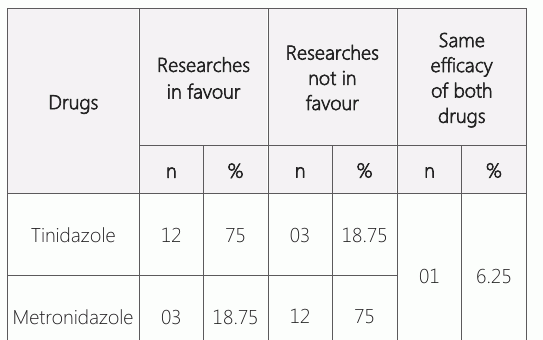
Total 32 studies were included in the study. Out of which based upon the inclusion and exclusion criteria,16 studies were selected by simple random sampling techniqueThe results of current study showed that out of 75% (n=12) out of total 16 studies are in favour of preferring tinidazole.
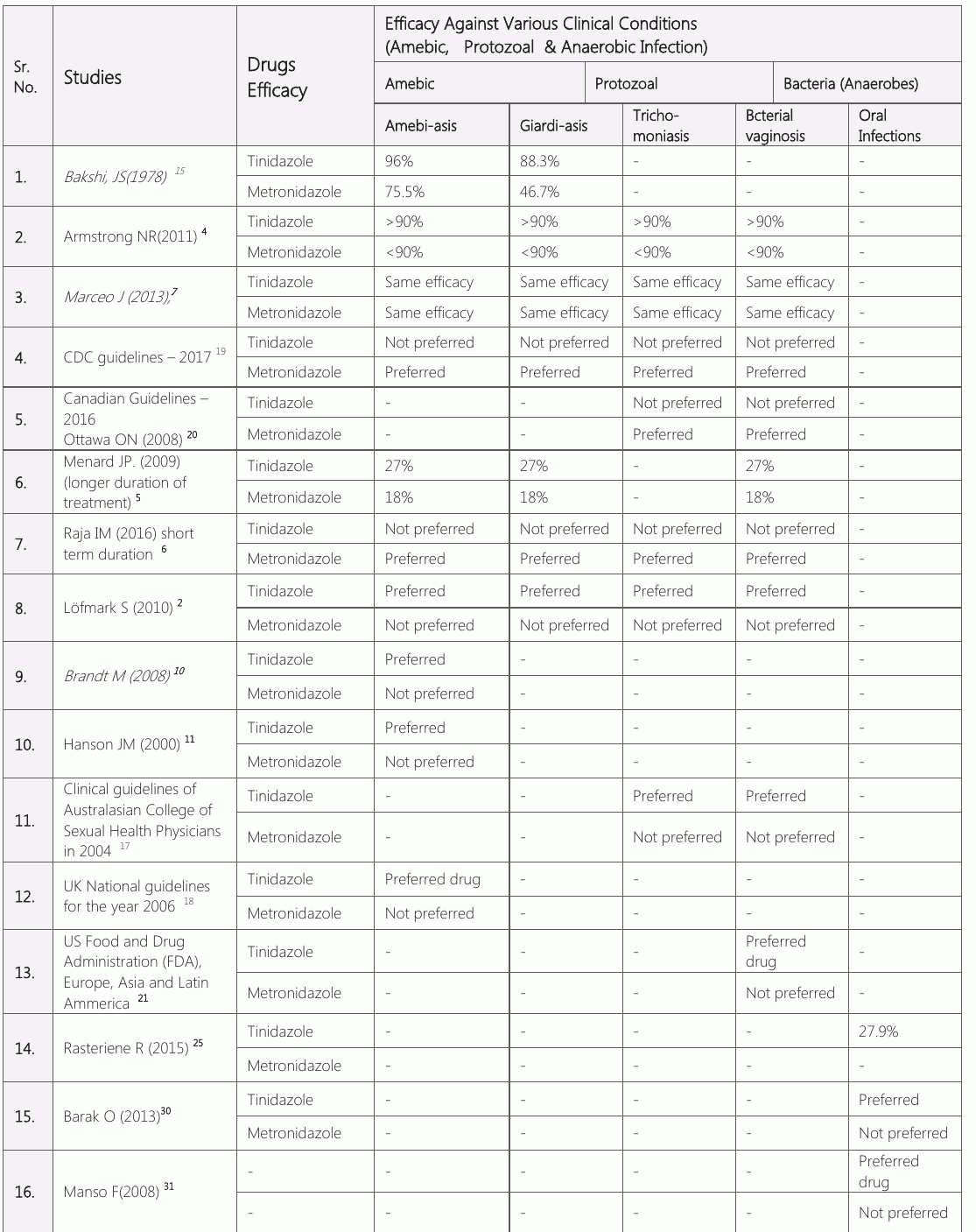
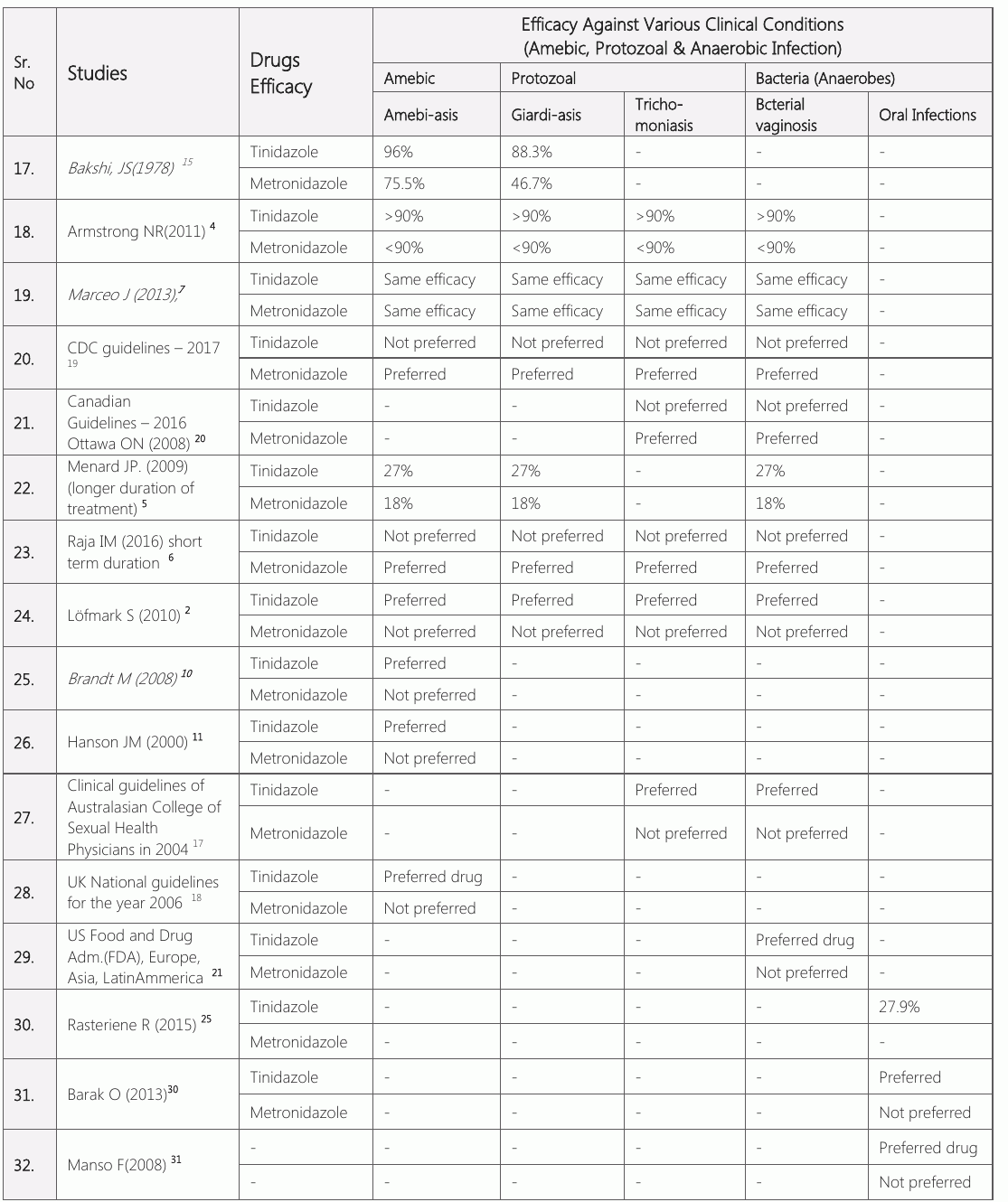
The frequency preference of metronidazole is 18.75% (n=03). Only one study (6.25%) showed the efficacy of both drugs is same. Both these findings are shown in tables I & II. Regarding the statistics of Amebiasis, 05 number (n) of studies are in favour of preferring tinidazole by showing successful outcomes. While 02 (n) studies were against preferring tinidazole over metronidazole. Only one (n=01) study showed same efficacy of both drugs. This is shown in table-I.
Regarding the Giardiasis and Trichomoniasis, 05 number (n) of studies are in favour of preferring tinidazole by showing successful outcomes. While 03 (n) studies were against preferring tinidazole over metronidazole. Only one (n=01) study showed same efficacy of both drugs. This is shown in table-I.
Regarding the bacterial infections i.e anaerobes, 08 number (n) of studies are in favour of preferring tinidazole by showing successful outcomes. While 03 (n) studies were against preferring tinidazole over metronidazole. Only one (n=01) study showed same efficacy of both drugs. This is shown in table I.
The overall distribution for frequencies in terms of percentages is tabulated in table-II.
Discussion
The results of current study shows that tinidazole is a better drug for managing amebic, protozoal and anaerobic infections. This findings are supported by many published studies by justifying the preference for using tinidazole. Menard JP (2009); showed that the treatment failure rate was less for tinidazole i.e 27% when compared to metronidazole i.e 18% for longer duration of treatment (5). Raja IM (2016); also described that the relapse rate of infections for short term duration has no significant difference (6). Marceo J (2013); concluded that the efficacy for the treatment of tinidazole and metronidazole are similar for treating bacterial vaginosis. Tinidazole was considered ineffective for the treatment of plasmodium infection (3, 7).
The commonly encountered adverse reactions for both the drugs are same i.e yeast infections, nausea, vomiting, and bad or metallic taste in mouth (8). Oduyebo OO (2009); detected that the candidiasis is not a side effect of topical metronidazole (9). Brandt M (2008); described that the side effects of metronidazole are severe and commonly seen even on single oral or topical administration of metronidazole (10). Thus, upon comparison with tinidazole, longer duration of treatment with metronidazole is difficult because of early occurrence of side effects. The resultant outcome is the incomplete treatment and higher relapse rates with metronidazole therapy. (11)No renal or haematological side effect was reported from either of these drugs (15).
Therefore because of less side effects and cost effective as well, tinidazole should be preferred on metronidazole (5). Sanz et al (1985); concluded that a single 2gm dose of tinidazole was more effective i.e in 92% cases as compared to single 2 mg dose of metronidazole (12). Buranawarodmkul etal (1990); and Thulkar J (2012); supplemented the findings of Sanz et al (13, 14).
Cure rates of tinidazole is >90% for the treatment of giardiasis, amebiasis, trichomoniasis, bacterial vaginosis and amebic liver abscess (1, 3). The study findings by Bakshi, JS (1978); showed that the dose of tinidazole and metronidazole for the management of amebic liver abscess is same i.e 2 gm once daily dose used for 2 days. Upon comparison of both groups the cure rate for patients using tinidazole was 96% while for metronidazole it was 75.5%. For giardiasis the calculated dose of 50mg/kg body weight was used for two groups each i.e treated by tinidazole and metronidazole respectively. The results revealed 88.3 % cure rate for tinidazole. While it was 46.7% for the group managed by metronidazole (15).
Bacterial vaginosis is a very commonly encountered lower reproductive tract infection in females. The responsible microbes are mostly anaerobes like Mobillincus species, Prevotella species, Mycoplasma hominis and Gardnerella vaginalis. While trichomoniasis is a protozoal casue of vaginosis. It is caused by Trichomonas vaginalis i.e flagellated protozoa (16). The reported Clinical Guidelines of Australasian College of Sexual Health Physicians in 2004, tinidazole was considered as a drug of choice for managing bacterial vaginosis by 2gm single dose (17). The published UK National guidelines for the year 2006 recommended tinidazole a first line management option for bacterial vagionsis in a single 2gm dose (18). Many studies conducted in the years 2006 & 2008 didn’t preferred tinidazole to manage bacterial vaginosis (19, 20). In the year 2011, US Food and Drug Administration (FDA), Europe, Asia and Latin Ammerica also approved Tinidazole as the drug of choice for treating bacterial vaginosis because of its good efficacy and the significant results of Livengood etal (2007) study (8, 21).
In 2016, tinidazole was considered as a better management option for Helicobacter pylori gastric infection as part of its triple therapy management (22). The cure rate of patients having trichomoniasis, giardiasis and amebiasis is significantly more than the ones treated with metronidazole (23).
A reported data for the year 2016 revealed that because of good penetration in blood brain barrier, efficacy of metronidazole to treat central nervous system, bone and teeth infections is more as compared to tinidazole (24). The common anerobes involved in oral infections include Prevotella intermedia/nigrescens, Streptococcus constellatus, and Agg-regatibacter actinomycetemcomitans (25). Odeh NSR (2010) and Patait M (2015) narrated that the commonly prescribing antibiotics for dental procedures include metronidazole,macrolides, betalactams, tetracyclines and clindamycin (26–29). The study report by Rasteriene R (2015) showed 27.9% susceptinility to metronidazole (30). Rams TE (2014) showed that metronidazole is resistant to all these anaerobes (25). Barak O (2013) supplemented that the efficacy of metronidazole is less for anaerobes (31). Manso F(2008) concluded by his study that tinidazole because of having good bactericidal activityharbours excellent susceptibility against anaerobes. He justified that because of its pharmacokinetic andpharmacodynamic properties it results in successful outcome for managing anaerobic odontogenic infections (32).
Conclusion
Tinidazole because of specific pharmacokinetic and pharmacodynamics properties, is a better option to manage amebic, protozoal and anaerobic infections.
Recommendation
Tinidazole should be amongst the first line drugs to manage amebic, protozoal and anaerobic infections
Declarations
- Author contributions (CRediT)
- All authors contributed equally to all 14 CRediT roles (Conceptualization, Data curation, Formal analysis, Funding acquisition, Investigation, Methodology, Project administration, Resources, Software, Supervision, Validation, Visualization, Writing – original draft, Writing – review & editing).
- Funding
-
Funding information was not reported in the published version of this article.
- Conflicts of interest
- A conflict of interest statement was not reported in the published version of this article.
- Ethics approval
- Ethics approval details were not reported in the published version of this article.
- Data availability
- A data availability statement was not reported in the published version of this article.
References (34)
16 of 34 references are linked to their DOI.
- Sim Fung HB, Doan TL, Malar J. Tinidazole: a nitroimida zole antiprotozoal agent.Clin Ther. 2005;27(12):1859-84. DOI Crossref PubMed Google Scholar
- Löfmark S, Edlund C, Nord CE. Metronidazole is still the drug of choice for treatment of anaerobic infections. Clin Infect Dis. 2010;50(1):16– 23. DOI Crossref PubMed Google Scholar
- Armstrong NR, Wilson JD. Tinidazole in the treatment of bacterial vaginosis. Int J Womens Health. 2010;1(1):59– 65. DOI Crossref PubMed Google Scholar
- Armstrong NR,Wilson JD. Tinidazole in the treatment of bacterial vaginosis. Int J Womens Health. 2011; 3(2): 295– 305. PubMed Google Scholar
- Menard JP. Antibacterial treatment of bacterial vaginosis: current and emerging therapies. Int J Womens Health. 2009; 1(1): 59–65. PubMed Google Scholar
- Raja IM, Basavareddy A, Mukherjee D, Meher BR. Rando - mized, double-blind, comparative study of oral metroni-dazole and tinidazole in treatment of bacterial vaginosis. Indian J Pharmacol 2016;48 (6):654-8. PubMed Google Scholar
- Macareo L, Lwin KM, Cheah PY, Yuentrakul P, Miller RS, Nosten F etal. Triangular test design to evaluate tinidazole in the prevention of Plasmodium vivax relapse. Malar J. 2013; 12(4): 173. DOI Crossref PubMed Google Scholar
- Livengood CH, Ferris DG, Wiesenfeld HC. Effectiveness of two tinidazole regimens in treatment of bacterial vagino-sis: a randomized controlled trial. Obstet Gynecol. 2007; 110 (3):302– 309. DOI Crossref PubMed Google Scholar
- Oduyebo OO, Anorlu RI, Ogunsola FT. The effects of antimicrobial therapy on bacterial vaginosis in nonpreg-nant women. Cochrane Database Syst Rev. 2009;3(4): 55-60. DOI Crossref PubMed Google Scholar
- Brandt M, Abels C, May T, Lohmann K, Winkler SI, Hoyme UB etal. Intravaginally applied metronidazole is as effective as orally applied in the treatment of bacterial vaginosis, Efficacy of Tinidazole and Metronidazole Humaira Zafar, et al. but exhibits significantly less side effects. Eur J Obstet Gynecol Reprod Biol. 2008;141(5):158–162. DOI Crossref PubMed Google Scholar
- Hanson JM, Gregor MJA, Hillier SL. Metronidazole for bacterial vaginosis. A comparison of vaginal gel vs oral therapy. J Reprod Med. 2000;45(2):889– 896. DOI Crossref PubMed Google Scholar
- Buranawarodomkul P, Chandeying V, Sutthijumroon S. Seven day metronidazole versus single dose tinidazole as therapy for nonspecific vaginitis. J Med Assoc Thai. 1990;73(1):283– 7. PubMed Google Scholar
- Sanz SF, Hernanz A, Sancher E. Comparative trial of metronidazole versus tinidazole in the treatment of non specific vaginitis. Rev Esp Obst y Gin. 1985;44(1):717– 20. DOI Crossref PubMed Google Scholar
- Thulkar J, Kriplani A, Agarwal N. A comparative study of oral single dose of metronidazole, tinidazole, secnidazole and ornidazole in bacterial vaginosis. Indian J Pharmacol 2012;44(2):243-5 DOI Crossref PubMed Google Scholar
- Bakshi JS, Ghiara, JM, Nanivadekar AS. How Does Tinidazole Compare with Metronidazole? Drugs.1978; 15(1): 33–42 DOI Crossref PubMed Google Scholar
- Bhalla P, Chawla R, Garg S, Singh MM, Raina U, Bhalla R, et al. Prevalence of bacterial vaginosis among women in Delhi. Indian J Med Res. 2007;125(2):167– 72. PubMed Google Scholar
- Australasian College of Sexual Health Physicians: Clinical Guidelines for the management of sexually transmissible infections among priority populations 2004. Website: http://www.wsahs.nsw.gov.au/services/sexualhealth/docu ments/STI_Management_Priority_Populations_000.pdf. Retrieved on 23 rd March 2017. PubMed Google Scholar
- United Kingdom National Guideline for the management of bacterial vaginosis 2006. Website: http://www.bashh.org /documents/62/62.pdf. Retrieved on 24 th March 2017 PubMed Google Scholar
- CDC Sexually transmitted diseases treatment guidelines MMWR 2006 RR- 11. DOI Crossref PubMed Google Scholar
- Website:[ http://www.cdc.gov/std/treatment/2006/vaginal-discharge.htm#vagdis2.] Retrieved on 24 th March 2017 PubMed Google Scholar
- Ottawa ON: Public Health Agency of Canada; Canadian Guidelines on Sexually Transmitted Infections. [Revised January 2008] PubMed Google Scholar
- Website:[http://www.phac-aspc.gc.ca/std -mts/sti_2006/pdf /408_Vaginal_Discharge.pdf]. Retrieved on24 th March 2017 PubMed Google Scholar
- Food and Drug Administration. Website:http://accessdata. fda.gov/drugsatfda_docs/label/2007/021618s003lbl.pdf. Retrieved on 24 th March 2017. DOI Crossref PubMed Google Scholar
- Tinidazole tablets for infection. Website: http:patient.info/ medicine/tinidazole-tablets-for-infection-fasigyn–patient-UK] Retrieved on 24 th March 2017 PubMed Google Scholar
- Tinidazole.Website https://medlineplus.gov/druginfomeds /a604036.html. Retrieved on 24 th March 2017 PubMed Google Scholar
- Metronidazole. Website: www.petmd.com/pet -medication /metronidazole. Retrieved on 24 th March 2017 PubMed Google Scholar
- Manso F, Gamboa MS, Giménez M, Bascones A, Lus GML, Aguilar L.Why not revisiting tinidazole as potential treatment of odontogenic infections? Rev Esp Quimioter. 2008;21(3):198-202. PubMed Google Scholar
- Odeh NSR. Abdalla O, Hammad A, Khaleed Khraisat S, etal. Antibiotic prescribing practices by dentists: a review. Clin Risk Manag. 2010; 6(2): 301–306. PubMed Google Scholar
- Patait M, Urvashi N, Rajderkar M, Kedar S, Shah K, Patait R. Antibiotic prescription: An oral physician's point of view. J Pharm Bioallied Sci. 2015;7(2):116-20. DOI Crossref PubMed Google Scholar
- Egea SJJ, Gould K, Şen BH, Jonasson P, Cotti E, Mazzoni A, etal. Antibiotics in Endodontics: a review. Int Endod J. 2016 PubMed Google Scholar
- Falkenstein S, Stein JM, Henne K, Conrads G.Trends in antibiotic use and microbial diagnostics in periodontal treatment: comparing surveys of German dentists in a ten-year period. Clin Oral Investig. 2016;20(8):2203-2210. DOI Crossref PubMed Google Scholar
- Rasteriene R. A 10yera retrospective analysis. Surg Infect. 2015; 16(3): 305-312. PubMed Google Scholar
- Barak O, Dashper SG, Catmull DV, Adams GG, Sela MN, Machtei EE, etal. Antibiot ic susceptibility of Aggregati bacter actinomycetemcomitans JP2 in a biofilm. J Oral Microbiol. 2013; 8(1):5-32 PubMed Google Scholar
- Rams TE, Degener JE, Winkelhoff VAJ. Antibiotic resistance in human chronic periodontitis microbiota. J Periodontol.2014;85(1):160-9. DOI Crossref PubMed Google Scholar
Respond to this article
Comments on a published article are welcome as a Letter to the Editor.
Get an e-mail when new articles in your fields are published
Questions to the authors
Questions are moderated: an editor approves each question, the authors answer, and an editor approves the answer before both appear here.
No answered questions yet.
Ask the authors a question
Discussion
Comments are moderated: they appear after the writer confirms the e-mail address and an editor approves them. Each comment carries a conflict-of-interest statement.
No comments yet.
Write a comment
Tell me when this article is cited
Leave your e-mail address and confirm it. These notices are not being sent yet; your confirmed address is kept for them and used for nothing else.
Read the full text
Open the PDF here
Loading the PDF…
If the PDF does not show here, use the download button above.
How to cite this article
Zafar H, Bukhari KT, Noor N, Humayoun S, Lakhnana NK. Meta-analysis for Searching Efficacy of Tinidazole and Metronidazole. Ulutas Med J. 2017;3(2):32-38. doi:10.5455/umj.20170607081427
Zafar, H., Bukhari, K. T., Noor, N., Humayoun, S., & Lakhnana, N. K. (2017). Meta-analysis for Searching Efficacy of Tinidazole and Metronidazole. The Ulutas Medical Journal, 3(2), 32–38. https://doi.org/10.5455/umj.20170607081427
Zafar, H. et al. (2017) 'Meta-analysis for Searching Efficacy of Tinidazole and Metronidazole', The Ulutas Medical Journal, 3(2), pp. 32–38. doi: 10.5455/umj.20170607081427.
@article{umj268786,
  title = {Meta-analysis for Searching Efficacy of Tinidazole and Metronidazole},
  author = {Zafar, Humaira and Bukhari, Kiran Tauseef and Noor, Nouman and Humayoun, Sadaf and Lakhnana, Noor Khan},
  journal = {The Ulutas Medical Journal},
  year = {2017},
  volume = {3},
  number = {2},
  pages = {32--38},
  doi = {10.5455/umj.20170607081427},
  url = {https://www.ulutasmedicaljournal.com/?mno=268786},
  issn = {2149-388X}
}