The Ulutas Medical Journal · ISSN 2149-0430 (print), 2149-388X (online) · https://www.ulutasmedicaljournal.com/?mno=27789
Original Article · Open access
Effects of Preoperative Laboratory Findings to the Risk of Re-exploration after Coronary Artery Bypass Graft Surgery
- Department of Anesthesiology and Reanimation, Sanko University School of Medicine, Gaziantep, Turkey ROR
- Feragat, Uygur, Department of Cardiovascular Surgery, Sanko University School of Medicine, Gaziantep, Turkey ROR
Abstract
- Background
- Coronary artery bypass grafting (CABG) operation is a surgical procedure commonly used in the treatment of patients with ischemic heart disease. In some cases, there is a need for re-exploration after CABG. This is a retrospective study conducted to determine the characteristics and risk factors of patients who underwent re-exploration because of bleeding after CABG operations in our center. Materials and Method: In the present study, patients who underwent coronary artery bypass grafting (CABG) operation with open heart surgery and required re-exploration in Sanko University, Medicine Faculty Hospital Cardiovascular Surgery Clinic between December 2016 and May 2018 were evaluated retrospectively. The demographic data, laboratory findings, lengths of stay in the ICU, and total lengths of stay in the hospital of all patients were recorded. The patients were divided into two groups as patients who underwent and those who did not undergo re-exploration.
- Results
- A total of 200 patients, 131 (65.5%) males and 69 (34.5%) females, were included in this study. Of the patients, 13 (6.5%) had undergone the re-exploration operation because of bleeding after CABG. There was no statistically significant difference between the two groups in terms of age, gender, length of stay in the ICU and the total length of stay in the hospital. It was seen that 2 (15.4%) of the patients who underwent re-exploration were female and 11 (84.6%) were male. There was no significant difference between the patients in terms of preoperative period INR, APTT, BUN, creatinine, glucose, cholesterol levels, CBCT results and complete blood counts (p>0.05).
- Conclusion
- It was determined that the clinical features and laboratory parameters of patients who underwent CABG operation were inadequate for being used to predict the re-exploration to be implemented because of bleeding in these patients. It is thought that prospective studies with more detailed data and larger patient participation are needed for this subject.
Keywords
Full text
Introduction
Coronary artery bypass grafting (CABG) operation is a surgical procedure commonly used in the treatment of patients with ischemic heart disease (1). The frequency of coronary artery disease has been increasing recently, and this increases the rates of open heart surgery. In some cases, patients can be reoperated within the first 24 hours after surgery due to bleeding, hypotension, and arrhythmia (revision /re-exploration surgery) (2). This may be due to operational reasons, as well as defects in blood values before the operation.
Despite the recent advances in perioperative care in the last decade, the re-exploration continues to be a frequent complication with increased mortality and morbidity after surgical methods, extracorporeal circulatory systems, and blood conservation strategies and cardiac surgery. In studies conducted before 1990, the rate of re-exploration increased to 14%, while this rate has been reported as 3% in recent studies (3). Re-exploration is needed because; of bleeding in 2-6% of the patients who underwent CABG. However, sternotomy due to bleeding, after CABG is a vital source of morbidity in many cardiac units. The re-exploration-induced operations have been described in many studies as an independent risk factor for early postoperative morbidity and mortality. In studies conducted in recent years, it is associated with an increase in in-hospital mortality rate between 2 and 4.7 times in patients requiring re-exploration (2, 4, 5).
Factors, including postoperative bleeding, hemodynamic status of a patient, echocardio graphic findings, and the experience of the responsible surgeon, affect the re-exploration decision (6, 7). Based on this, a retrospective study conducted to determine characteristics and risk factors of patients who underwent re-exploration because of bleeding after CABG operations in our center.
Materials and Methods
Patient Selection
In the present study, patients who underwent coronary artery bypass grafting (CABG) operation with open heart surgery and required re-exploration in Sanko University, Medicine Faculty Hospital Cardiovascular Surgery Clinic between December 2016 and May 2018 were evaluated retrospectively. The demographic data, laboratory findings, lengths of stay in the ICU, and total lengths of stay in the hospital of all patients were recorded. The patients were divided into two groups as patients who underwent and those who did not undergo re-exploration.
Inclusion and exclusion criteria Patients with coronary artery disease between the ages of 18 and 85, for whom the CABG decisions were made and who underwent CABG only under elective conditions, were included. Patients who were combined with cardiac valve repair/ replacement, ventricular aneurysm resectionor other surgical procedure, as well as patients who were operated under emergency conditions, who used pre-operative thrombolytic and anti-coagulant drugs and had a history of previous cardiac surgery, were not included in the study.
Anesthesia practice All patients were premedicated with 0.05 mg/kg midazolam (Demizolam® 5mg/5 ml, Dem Ilac, Istanbul, Turkey) intravenously. The patients were monitored by 5-lead electro cardiography (EKG) and pulse oximetry. A radial artery catheter was inserted for invasive arterial pressure monitoring. Following monitorization, the anesthesia induction was performed intravenously using propofol 200mg, 0.1 mg/kg midazolam, rocuronium (Esmeron, Organon, USA) 0.5 mg/kg and 5 mcg/kg fentanyl (Fentanyl® 0.05 mg/ml, 10 ml, Johnson & Johnson, Istanbul, Turkey) with sevoflurane, fentanyl, midazolam and rocuronium for maintenance at 20 min intervals. Following the patients were intubated with endotracheal intubation tubes suitable for their weights, 8F central venous catheters were placed in their internal jugular veins. The ventilation was provided with the oxygen-air mixture in pressure mode, with peak airway pressure not exceeding 30 cmH2O and in a way to create 8- 10 ml/kg tidal volume.
Heparinization and extracorporeal circulation Antiplatelet medications were discontinued 7 days before the operation and anticoagulant medications were discontinued at least 3 days before the operation in patients who underwent elective CABG. All patients included in the study were operated with median sternotomy by the same surgeon team. Right after the sternotomy and the opening of the pericardium, 300 U/kg heparin iv. was administered before the CABG procedure and the activated coagulation time (ACT) was set as 480 sec and above. Heparin was neutralized with protamine after CABG.
In our clinic, the same perfusion protocol is applied to all adult patients who underwent open heart surgery. Same surgical method was applied for all patients.
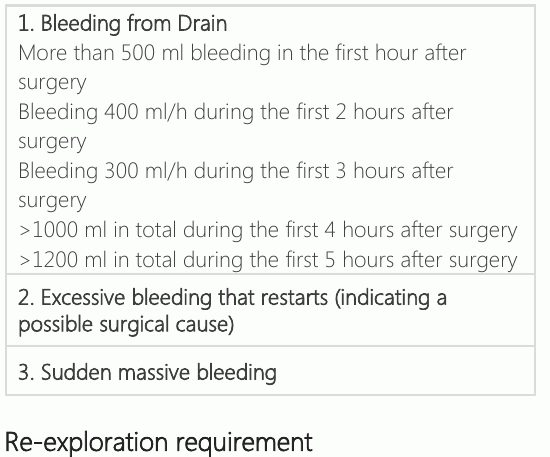
In the postoperative period, the amounts of bleeding of the patients taken to the ICU were calculated as from the time when they were taken to the ICU. In our clinic, the clinical approach based on the re-exploration criteria of Barratt Boyes is used for the re-exploration decision (Table-1).
Statistical analysis The SPSS v25 (IBM Corporation, Armonk, New York, United States) was used to analyze the variables. The conformity of the data to normal distribution was assessed by the Shapiro-Wilk test and variance homogeneity by the Levene test. The Independent-SamplesT-test was used with the Bootstrap results, while the Mann- Whitney U test was used with the Monte Carlo simulation method in the comparison of two independent groups according to quantitative data. The Fisher Exact test was used with the Exact results in the comparison of the groups according to the categorical variables. The quantitative variables were shown as mean±SD (Standard Deviation) and median (Maximum/Minimum), while the categorical variables were shown as n (%) in the tables. The variables were analyzed at 95% confidence level, and the p-value was accepted as significant when it was lower than 0.05.
Results
In the study, the demographic characteristics of the patients were evaluated. The study includes a total of 200 patients, 131 (65.5%) males, and 69 (34.5%) females. Thirteen (6.5%) patients had undergone the re-exploration operation because of bleeding after CABG. The mean age of the patients undergoing re-exploration after CABG was 60.92±8.63 (43/73) years, while the mean age of patients for whom the re-exploration was not required was 61.63±9.18 (32/85) years. There was no statistically significant difference between the two groups in terms of age, gender, length of stay in the ICU, and the total length of stay in the hospital (Table-2).
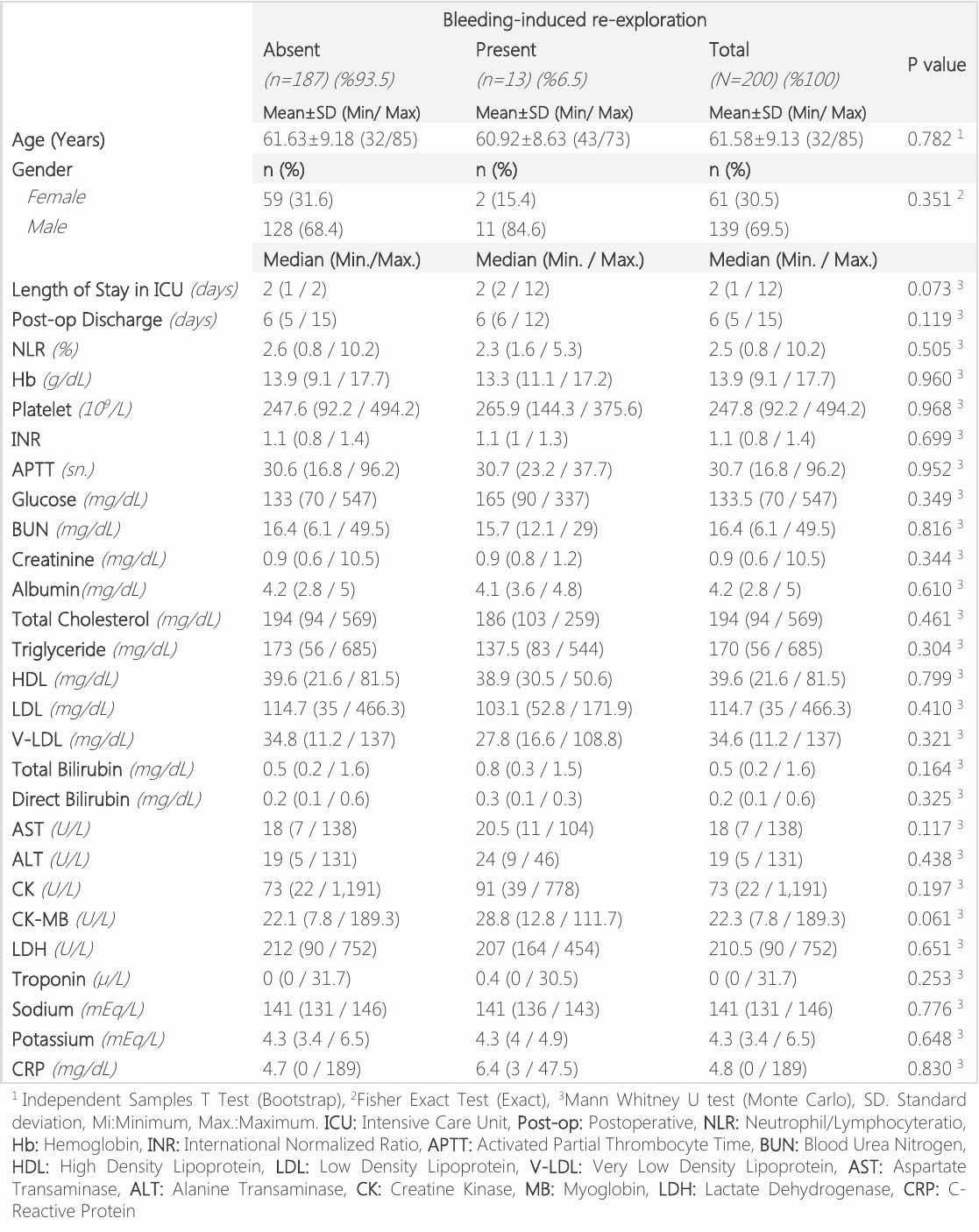
It was seen that two (15.4%) of the patients who underwent re-exploration were female, and 11 (84.6%) were male. All re-exploration operations performed was due to bleeding. The re-exploration process was implemented twice in one patient, and one patient who underwent revision surgery died. There was no significant difference between the patients in terms of preoperative period INR, APTT, BUN, creatinine, glucose, cholesterol levels, CBCT results, and blood count (Table-2).
Discussion
Postoperative bleeding increases the need for re-exploration and significantly affects the length of hospital stay and the frequency of morbidity and mortality. Patients requiring resternotomy are at high risk because of surgical interventions for complications such as transfusion reactions, viral infections, suppression of the immune system, and hemostasis. The re-exploration rate decreased to 2-6% with advances in perioperative care, surgical methods, extracorporeal circulation support,and blood transfusion strategies(9–11). Bleeding-induced re-exploration has been the subject of a large number of studies in cardiac surgery literature. Bleeding-induced re-exploration is associated with an increased incidence of atrial fibrillation, serum creatinine levels, length of ICU stay, and frequency of wound infections in the area of sternotomy (12–14). To predict the increase in the risk of re-exploration due to bleeding in patients to undergo CABG operation is essential for surgeons in the preoperative period. In the present study, it was found that the current parameters were not sufficient to predict the need for re-exploration. Post-CABG bleeding is most commonly associated with anastomoses, cannulation sites (surgical bleeding) or coagulo pathy (non-surgical bleeding). Biancari et al. (3) emphasize that a surgeon’s experience and approach may affect postoperative bleeding as well and therefore,arigorous surgical technique may reduce the need for re-exploration during graft separation and anastomosis.
Perioperative bleeding is associated with surgical damage in blood vessels and disorders in hemostatic mechanisms. Most hemostatic defects are associated with prolonged exposure of blood cells to CPD.CPB has been shown to cause a decrease in coagulation factor levels, stimulate fibrinolysis, and cause thrombo cytopenia and platelet dysfunction. The effects of heparin and protamine in the circulation should also be taken into account.
In a study by Karthik et al. (15) conducted on patients who underwent CABG, the rate of re-exploration was reported as 3.1%. In this study, it was emphasized that the variables such as advanced age, low BMI, emergency surgery, and more than two graft usage increased the re-exploration rates. Kristensen et al. (2) found that low BMI, high EuroSCORE value, preoperative renal failure level, diabetes mellitus and long duration of CPB were associated with increased re-exploration rates. In the study by Choong et al. (16), the advanced age, low BMI, preoperative use of clopidogrel or aspirin, type of surgery, and a longer duration of CPB have been shown to be independent risk factors for bleeding-induced re-exploration.
In some studies, the bleeding-induced re-exploration was found to be an independent risk factor for sternal wound infection (17, 18). In an extensive study by Kubota et al.(5) in 2013, it was reported that bleeding-induced re-exploration led to an increase in the incidence of a deep sternal wound infection, which significantly increases mortality. In the studies by Karthik (15) and Choong (16), the early re-exploration decision was found to be associated with better clinical outcomes.
Ruel et al. (12) showed that early bleeding-induced re-exploration in patients with no significant clinical findings after CABG had no significant effect on survival. However, Choong et al. (16) showed that a delay in re-exploration led to a more extended ICU stay, more need for intra-aortic balloon pump (IABP) support, and this was associated with increased mortality. In the present study, the frequency of re-exploration due to bleeding after CABG (6.5%) was higher than ones reported by recent studies. The most important reason for this is thought to be the aggressive re-exploration approach in our clinic.
In the present study, only one of the patients undergoing re-exploration died due to graft dysfunction and heart failure on the 5thday of hospitalization. Therefore, it is thought that the approach applied in our clinic does not increase the adverse outcomes. However, the patients undergoing re-exploration should be evaluated with data that are more detailed.
In this study, there are general limitations of retrospective observational studies, including the difficulties in identifying the variables affecting re-exploration and the risk of inevitable bias in patient selection.
There were difficulties in the determination of risk factors due to the findings related to CABG operation (graft count, graft type, operation time, and duration of CPB), bleeding amount, and blood transfusion needs. There are difficulties in the determination of the risk factors because the findings of the patients related to the CABG operation (like the number of grafts, type of graft, duration of surgery, duration of CPB), amount of bleeding and blood transfusion needs cannot be obtained retrospectively.
Conclusion
In conclusion, in the retrospective study conducted in our clinic, it was determined that the frequency of bleeding-induced re-exploration after CABG operation was still significantly high (6.5%). It was determined that the clinical features and laboratory parameters of patients who underwent CABG operation were inadequate for being used to predict the re-exploration to be implemented because of bleeding in these patients. It is thought that prospective studies with more detailed data and larger patient participation are needed for this subject.
Declarations
- Author contributions (CRediT)
- All authors contributed equally to all 14 CRediT roles (Conceptualization, Data curation, Formal analysis, Funding acquisition, Investigation, Methodology, Project administration, Resources, Software, Supervision, Validation, Visualization, Writing – original draft, Writing – review & editing).
- Funding
-
Funding information was not reported in the published version of this article.
- Conflicts of interest
- None of the authors has a conflict of interest with the present article.
- Ethics approval
- Ethics approval details were not reported in the published version of this article.
- Data availability
- A data availability statement was not reported in the published version of this article.
References (18)
16 of 18 references are linked to their DOI.
- Reece TB, Cleveland JCJ. Noteworthy Literature in Cardiac Surgery in 2015. Semin Cardiothorac Vasc Anesth. 2016 Mar;20(1):34– 9 DOI Crossref PubMed Google Scholar
- Kristensen KL, Rauer LJ, Mortensen PE, Kjeldsen BJ. Reoperation for bleeding in cardiac surgery. Interact Cardiovasc Thorac Surg. 2012 Jun;14(6):709–13 DOI Crossref PubMed Google Scholar
- Biancari F, Mikkola R, Heikkinen J, Lahtinen J, Kettunen U, Juvonen T. Individual surgeon’s impact on the risk of re-exploration for excessive bleeding after coronary artery bypass surgery. J Cardiothorac Vasc Anesth. 2012 Aug;26(4):550–6 DOI Crossref PubMed Google Scholar
- Mehaffey JH, Hawkins RB, Byler M, Charles EJ, Fonner C, Kron I, et al. Cost of individual complications following coronary artery bypass grafting. J Thorac Cardiovasc Surg. 2017 DOI Crossref PubMed Google Scholar
- Kubota H, Miyata H, Motomura N, Ono M, Takamoto S, Harii K, et al. Deep sternal wound infection after cardiac surgery. J Cardiothorac Surg. 2013 May;8:132 DOI Crossref PubMed Google Scholar
- Ruel M, Chan V, Boodhwani M, Mcdonald B, Ni X, Gill G, et al. How detrimental is reexploration for bleeding after cardiac surgery ? J Thorac Cardiovasc Surg [Internet]. 2015;154(3): 927–35 PubMed Google Scholar
- Frojd V, Jeppsson A. Reexploration for Bleeding and Its Association With Mortality After Cardiac Surgery. Ann Thorac Surg. 2016 Jul;102(1):109– 17 DOI Crossref PubMed Google Scholar
- Canádyová J. Re-exploration for bleeding or tamponade after cardiac operation. 2012;14(March):704– 7 DOI Crossref PubMed Google Scholar
- Dacey LJ, Munoz JJ, Baribeau YR, Johnson ER, Lahey SJ, Leavitt BJ, et al. Reexploration for hemorrhage following coronary artery bypass grafting: incidence and risk factors. Northern New England Cardiovascular Disease Study Group. Arch Surg. 1998 Apr;133(4):442 –7 DOI Crossref PubMed Google Scholar
- Unsworth-White MJ, Herriot A, Valencia O, Poloniecki J, Smith EE, Murday AJ, et al. Resternotomy for bleeding after cardiac operation: a marker for increased morbidity and mortality. Ann Thorac Surg. 1995 Mar;59(3):664–7 PubMed Google Scholar
- Sellman M, Intonti MA, Ivert T. Reoperations for bleeding after coronary artery bypass procedures during 25 years. Eur J Cardiothorac Surg. 1997 Mar;11(3):521– 7 DOI Crossref PubMed Google Scholar
- Ruel M, Chan V, Boodhwani M, McDonald B, Ni X, Gill G, et al. How detrimental is reexploration for bleeding after cardiac surgery? J Thorac Cardiovasc Surg. 2017 Sep;154(3):927– 35 DOI Crossref PubMed Google Scholar
- Ranucci M, Bozzetti G, Ditta A, Cotza M, Carboni G, Ballotta A. Surgical Reexploration After Cardiac Operations: Why a Worse Outcome? Ann Thorac Surg. 2008;86(5):1557–62 DOI Crossref PubMed Google Scholar
- Ismail MF, El- Mahrouk AF, Hamouda TH, Radwan H, Haneef A, Jamjoom AA. Factors influencing postoperative atrial fibrillation in patients undergoing on-pump coronary artery bypass grafting, single center experience. J Cardiothorac Surg. 2017;12(1):40 DOI Crossref PubMed Google Scholar
- Karthik S, Grayson AD, McCarron EE, Pullan DM, Desmond MJ. Reexploration for bleeding after coronary artery bypass surgery: risk factors, outcomes, and the effect of time delay. Ann Thorac Surg. 2004 Aug;78(2):527– 34 DOI Crossref PubMed Google Scholar
- Choong CK, Gerrard C, Goldsmith KA, Dunningham H, Vuylsteke A. Delayed re-exploration for bleeding after coronary artery bypass surgery results in adverse outcomes. Eur J Cardiothorac Surg. 2007 May;31(5):834–8 DOI Crossref PubMed Google Scholar
- Moulton MJ, Creswell LL, Mackey ME, Cox JL, Rosenbloom M. Reexploration for bleeding is a risk factor for adverse outcomes after cardiac operations. J Thorac Cardiovasc Surg. 1996 May;111(5):1037– 46 DOI Crossref PubMed Google Scholar
- Lu JCY, Grayson AD, Jha P, Srinivasan AK, Fabri BM. Risk factors for sternal wound infection and mid-term survival following coronary artery bypass surgery. Eur J Cardiothorac Surg. 2003 Jun;23(6):943–9 DOI Crossref PubMed Google Scholar
Read the full text
Open the PDF here
Loading the PDF…
If the PDF does not show here, use the download button above.
How to cite this article
Şimşek BK, Uygur F. Effects of Preoperative Laboratory Findings to the Risk of Re-exploration after Coronary Artery Bypass Graft Surgery. Ulutas Med J. 2019;5(2):142-148. doi:10.5455/umj.20190124064729
Şimşek, B. K., & Uygur, F. (2019). Effects of Preoperative Laboratory Findings to the Risk of Re-exploration after Coronary Artery Bypass Graft Surgery. The Ulutas Medical Journal, 5(2), 142–148. https://doi.org/10.5455/umj.20190124064729
Şimşek, B.K. and Uygur, F. (2019) 'Effects of Preoperative Laboratory Findings to the Risk of Re-exploration after Coronary Artery Bypass Graft Surgery', The Ulutas Medical Journal, 5(2), pp. 142–148. doi: 10.5455/umj.20190124064729.