The Ulutas Medical Journal · ISSN 2149-0430 (print), 2149-388X (online) · https://www.ulutasmedicaljournal.com/?mno=212176
Original Research · Open access
Anthropometric Profiles and Risk Factors of Women
- Public Health/Hitit University, School of Health/Çorum/TURKEY ROR
- Erciyes University Faculty of Medicine, Public Health Department, Kayseri-Turkey ROR
- Erciyes University Faculty of Medicine, Medical Education Department, Kayseri-Turkey ROR
- Hitit University School of Health, Nursery Department, Çorum-Turkey ROR
Abstract
- Introduction
- This study was aimed to determine anthropometric profiles and risk factors among women aged between 20-64 years living in Çorum province-Middle Black Sea Region of Anatolia.
- Method
- This descriptive and cross-sectional research was conducted during December 2014 in two family health centers region from Çorum. The population of study was consisted of registered women aged ≥20. During the research volunteer 200 women have been included to the study without sample selection.Data were collected via a 30- item questionnaire form asking socio-demographic features, health-illness status, eating habits, physical activity of women. Anthropometric profiles of women were determined by Body Mass Index and Waist-Hip Ratio. Analysis of the differences in the frequency of categorical variables was carried out by using the χ² test. Correlations between anthropometric variables were assessed using Pearson's correlation analysis.
- Results
- Of the study population, 27.9% were overweight and 39.6% were obese. The prevalence of abdominal obesity was 45.0%. Increase in age, low educational level, being married, being housewife, low economic status, having children, obesity in the first relatives, menopause, not consumed heavy-vegetable diet were the risk factors for women's anthropometric profiles.
- Conclusions
- This study has shown that, overweight, obesity and abdominal obesity were prevalent among women. In addition to Body Mass Index, Waist-Hip Ratio measurements should be used, to promote health education and counselling services should be given to women in primary care services.
Keywords
Full text
Introduction
According to World Health Organization (WHO), obesity is associated with increased risk of globesity rapidly in many parts of the world. It was reported that prevalence of obesity approximately doubled between 1998 and 2014 years. The highest prevalence are seen in America (26%) and the lowest prevalence are seen in Southeast Asia (3%) (1). Obesity is a common condition which has considerable impact on women health ürelated with chronic conditions and multiple types of cancers including cervix, breast and ovarian (2). Several studies have documented that, prevalence of obesity among women increased from year to year in countrywide. According to data from Turkey Nutrition and Health Survey (TBSA) 2010, 41% of Turkish women were overweight and 29.7% of were obese (3). A key study-called Turkey Demography and Health Research (TNSA) conducted on women aged between 15-49 years showed that obesity prevalence increased 7.7% in last 15 years (1998-2013) (4, 5). In 2013, last report of study suggested that 28.6% of women were overweight and 26.5% of were obese between the 15-49 (5). Birth weights and eating habits found to be causal factors on women obesity in Turkish society (6).
This study aimed to contribute to this growing area of obesity research by exploring antropometric profiles and risk factors among women aged between 20-64 years.
Study Design
Subjects & Materials
This descriptive and cross-sectional research was conducted during December 2014 in two urban Family Health Centers region for the reason of crowded women population. All study participants were selected purposively. Target population was non-pregnant women and aged between 20-64 years. The research group were chosen from two Family Health Center regions randomly. There were 2622 registered and non-pregnant women (aged between 20-64 years). Of these women, 200 women were chosen by simple random sampling method.
Data for this study were collected using a 30-item questionnaire form which asked socio-demographic features, eating habits, physical activity of women. Then, body weight and height were measured by tape-line and calibrated bascule while subjects were wearing light clothing without shoes. Body Mass Index (BMI) was calculated by dividing the weight (kg) by the height in meters squared. Waist Circumference of the participants was mea-sured at the midpoint between the lower margin of the least palpable rib and the top of the iliac crest by using a stretch‐resistant tape to evaluate abdominal obesity. Hip circumference was measured around the widest portion of the buttocks, with the tape parallel to the floor. WHO definitions were used to diagnose overweight and obese in women. Accordingly with the definitions, women with BMI of <25 kg/m2 were classified as normal, BMI of 25-29.9 kg/m2 were defined as overweight, and BMI of ≥30 kg/m2 were classified as obese. Women those had Waist Hip Ratio (WHR) >0.85 were defined as abdominal obese (7).
Statistical Analysis
Data were analyzed by use of the SPSS 17.0 statistical software. Analysis of the differences in the frequency of categorical variables was carried out by using the χ² test. Univariate relationships between anthropometric variables were assessed using Pearson’s correlation analysis. A p-value of less than 0.05 was considered statistically significant. The study was carried out in accordance with the Declaration of Helsinki and ethic committee approval was taken from Bozok University Faculty of Medicine.
Results
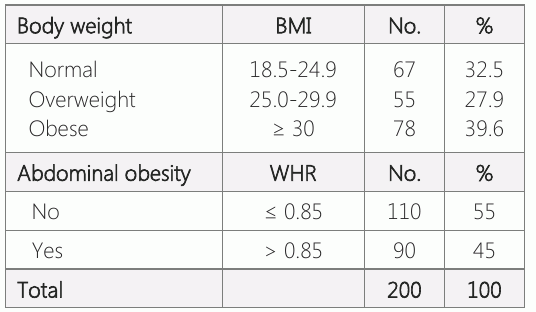
Fourty-six percent of women in the study group were between ages 20-34. The mean age of the women was 38±12.8 years. 74% of were married, 77% were housewives, 79.5% had children, 55% had an education level of under secondary. Anthropometric profiles of women were shown in Table-1. Of the study population, 32.5% were identified as normal, 27.9% were as overweight and finally 39.6% were as obese. The prevalence of abdominal obesity was 45%. It was determined that 85.6% of women were abdominal obese in those BMI≥25 kg/m2. There was found a positive significant correlation between BMI and WHR (p<0.001).
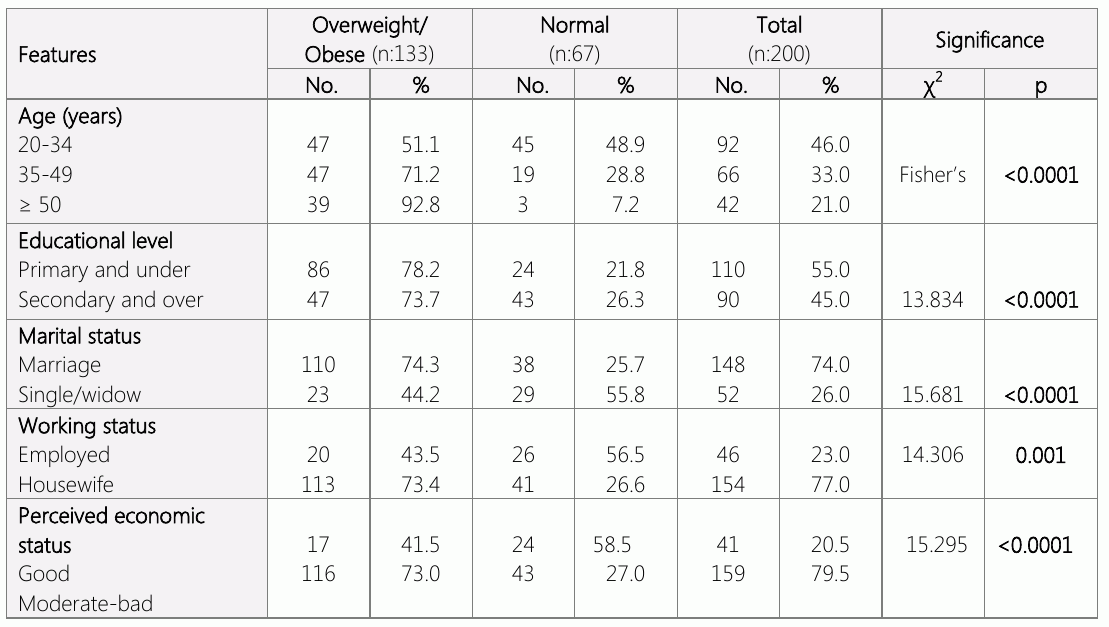
Anthropometric profile of women according to socio-demographic features were given in Table-2. 51.1% of women aged 20-34 years were overweight/obese, while this range was 71.2% between the 35-49 years and was 92.8 % in aged ≥50 (p<0.05). Overweight/obesity prevalence was 78.2% in the level of primary school and under, was 74.3% in married women, was 73.4% in housewives. 73% of women were obese who said that their economic status were in moderate-bad level. It was determined that body weights of women showed significant difference according to their educational, marital, occupational and economic status (p<0.05).
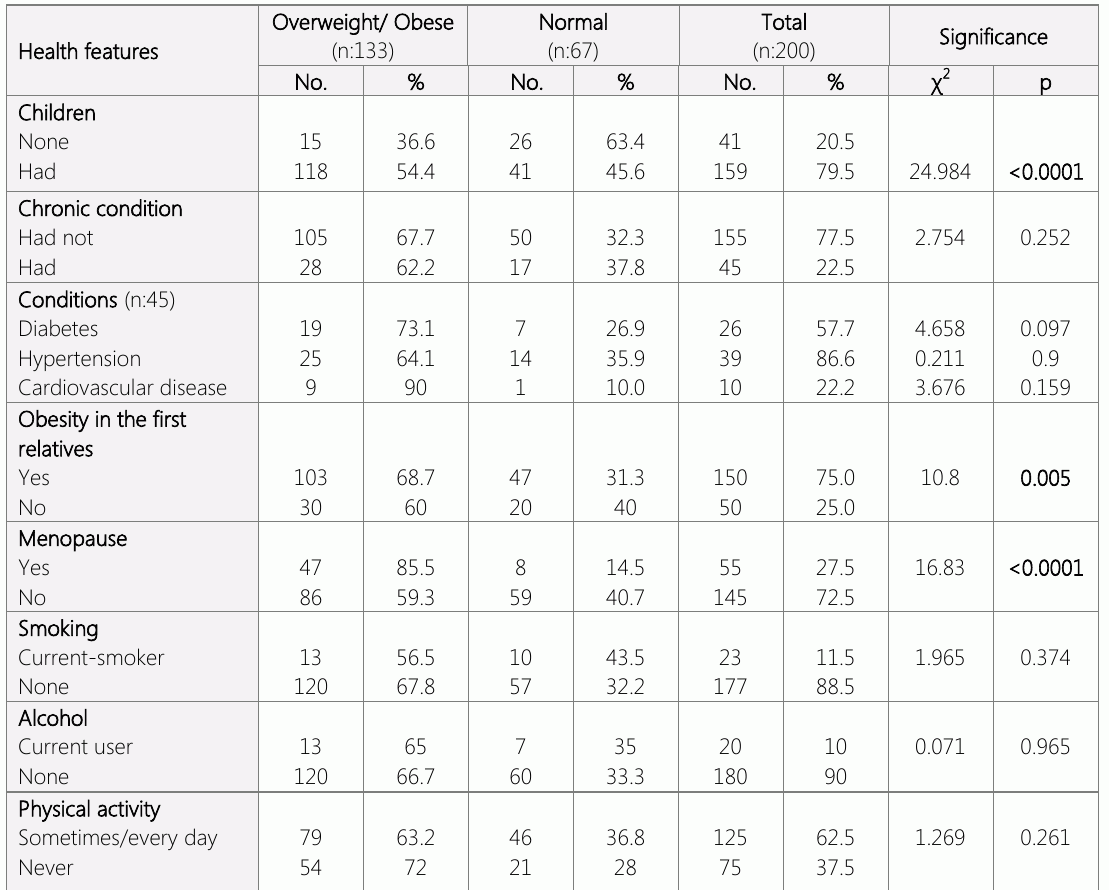
Anthropometric profile of women according to various health features were shown in Table-3. 54.4% of women who had children were overweight/obese and this rate was found statistically higher than childless women (p<0.05).Around 23% of women reported that they had dignosed any chronic disease, 62.2% of these women were overweight /obese. Diabetes, hypertension and cardiovascular diseases were the most common comorbidities to overwieght and obesity but there was no significant difference between the body weights according to chronic conditions. 25% of women stated that they had obese people among their first degree relatives and of these, around 60% were overweight/obese. There was a significant difference between the body weights of women according to their obese first relatives (p<0.05). 27.5% of stated that they were in menopause period however of these, 85.5% were overweight/obese (p<0.001). 11.5% of all women reported that they were current smoker and 10% of were current alcohol users. Nonetheless, body weights of women didn’t show significant difference according to smoking and alcohol using (p>0.05). 37.5% of women stated that they didn’t do any physical activity and 72% of these women were overweight/obese (p>0.05).
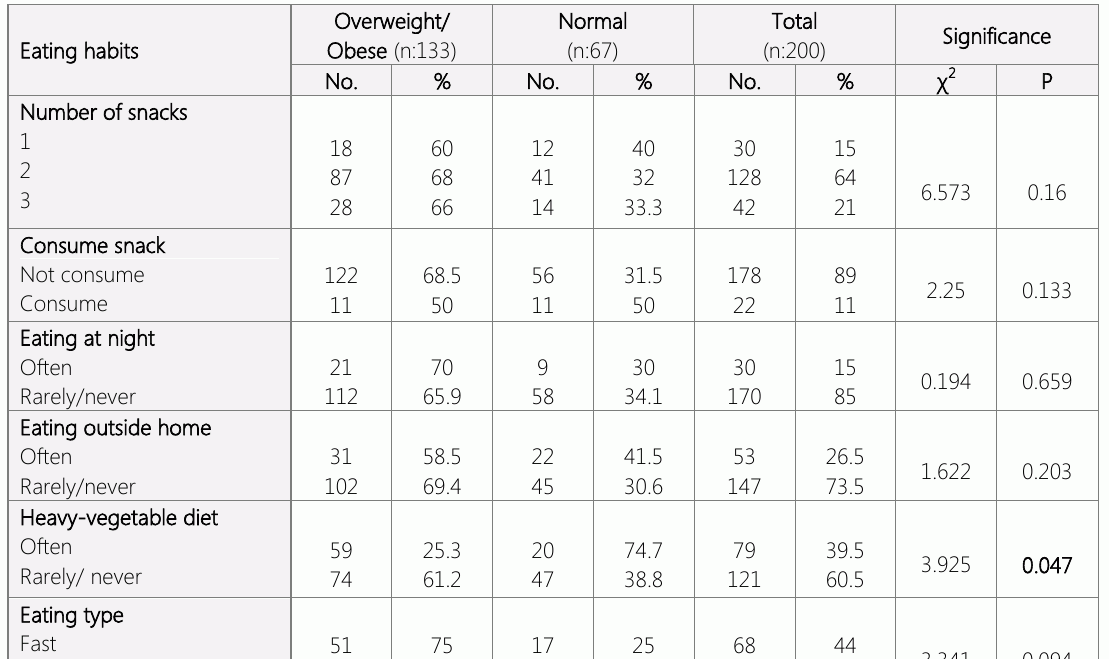
Anthropometric profiles of women according to eating habits were shown in Table-4. 64% of all women reported that they ate two main meals in a day. Also 89% of women said that they didn’t eat snacks and 68.5% of these women were overweight/obese (p>0.05). 15% of women said that they were eating at night and 70% of these women overweight/obese. However, 26.5% of women reported that they often ate outside home and 58.5% of these women were overweight/obese. The rate of women who didn’t consume heavy vegetablediet was 60.5% and 61.2% of these women were overweight/obese and this rate was found statistically higher than consuming heavy vegetable diet (p<0.05). 75% of women were overweight/obese who reported that they were eating foods fastly.
Discussion
It has been identified that obesity prevalence differs by countries. According to WHO Country Profile Report 2010, more than half of American women, about half of the Tunisian women, one fifth of Korean and Swedish women and one-tenth of Pakistani women were obese. On the other hand, according to WHO Turkey Profile Report, 64.1% of Turkish women were overweight and 34% of were obese aged ≥20 (8). In our study, approximately one in three women were overweight, two in five women were obese aged ≥20 years. Also studies from countrywide revealed high prevalence of overweight and obesity in women. A result of study, which was conducted in 18 different province selected from seven regions of Turkey, showed prevalence of overweight as 33.6% and prevalence of obesity as 16.6% in women aged ≥20 (9). In this study, rate of overweight was compatible with nationwide while the rate of obesity was found higher level.
Central obesity creates unforeseen circumstances for hypertension, cardiovascular diseases and type 2 diabetes mellitus (7, 10). In this study, approximately half of the women were identified as abdominal obese, this result estab-lished parallel with our country (Table- 1). Indeed, according to results of studies from in our country abdominal obesity prevalence ranged from 38.9%-73.8% among women (11–13). Some studies stated expressly a positive correlation between BMI and WHR (14, 15). Also similar results was obtained from this study. It has been reported that, due to changes in the endocrine structure, body composition, energy intake - consumption; obesity increase by aging so body weight reaches the highest point among the ages of 50-60 (16, 17). Noteworthy, in our study, 92.8% women aged 50 and over were overweight/ obese and this rate was found significantly higher than other age groups (p<0.05). Evidence showed that obesity was more prevalent in groups faced with social inequalities (14, 18, 19). In this study, we found that body weights of women showed diffe-rence according to their educational and economic status; women those with low education level and low economic status had statistically higher overweight /obesity rates. According to some researches, marital status associated with body weight and duration of the marriage weight showed increase in both gender (20, 21). Indeed, in our study overweight and obesity rates were significantly higher in married women than unmarried. This situation may be due to changes in nutrition habits because marriage a process that brings an established order in lives of individuals.
It was reported that obesity prevalence was higher in unemployed women than employed women (6). Similar results was found in our study. Unemployed women spend their times with household chores. This case may push women to inactive and obesogenic environment. Recent studies showed that rates of obesity were significantly higher with increasing numbers of children (22, 23). In this study, more than half of women with children were overweight/obese and this proportion was significantly higher than childless women (p<0.05). We thought that women couldn’t lose their body weight after childbirth.
Obesity, a multifactorial table, is affected by genetic and non-genetic factors. Specially first relatives transport insistent obesity in adulthood (24). In our study, more than two-thirds of women were overweight/obese who stated that they had obese individuals among their first relatives (p<0.05).
The reason for increase in weight observed in during menopause period isn’t very clear, but hormonal factors such as absence of estrogen, increase appetite are responsible (25). Accordance with literature in our study, 85.5% of women who were in menopause period were overweight/obese (p<0.05).
Physical activity is the focal point in maintaining healthy body weight. To maintain a healthy body weight total 60 minutes a daily moderate physical activity was recommended for sedentary individuals (10).We found higher rates of overweight/obesity in women who didn’t do any physical activity. Urbanization and income growth enriched nutrition pattern of communities in the direction of sugar, fat and food of animal origin (10). About half of the women in our country consume vegetables every day (4).
Conversly in the present study, three of five women didn’t consume vegetable-heavy diet and two-thirds of these women were overweight/obes (p<0.05). Overweight/obesity rates were higher insignificantly according to number of snacks and consuming snacks. This result may be explained by consuming low calories of snacks. What is surprising is that there was no significance for eating fastly and eating meal at night. Contrary to our study, it was shown that obesity was seen more often in people eating fastly (13, 19). Eating fastly can lead to excessive calorie intake and increase nutrition capasity until feeling of saturation.
Conclusions and Recommendations
This study has shown that overweight and obesity were prevalent among women. Approximately half of the women were abdominal obese.
Reproduction and menopause are the curve life cycle had valuable physiological changes on anthropometric profiles of women aged ≥20. This study was limited by a small group of women. Further studies should be under-taken on large groups of women. It is recom-mended that preventive medicine services should be undertaken in the following areas: General Practitioners (GPs) should play a key role for anthropometric screening among women in this curve life cycle. In addition to BMI, WHR measurements should be mea-sured; education and counselling services should be given to women for maintenance optimal body weight.
Declarations
- Author contributions (CRediT)
- All authors contributed equally to all 14 CRediT roles (Conceptualization, Data curation, Formal analysis, Funding acquisition, Investigation, Methodology, Project administration, Resources, Software, Supervision, Validation, Visualization, Writing – original draft, Writing – review & editing).
- Funding
-
Funding information was not reported in the published version of this article.
- Conflicts of interest
- The authors declare no conflicts of interest.
- Ethics approval
- The study was carried out in accordance with the Declaration of Helsinki and ethic committee approval was taken from Bozok University Faculty of Medicine.
- Data availability
- A data availability statement was not reported in the published version of this article.
References (25)
9 of 25 references are linked to their DOI.
- Childs 1.World Health Organization. Global Database on Body Mass Index: an interactive surveillance tool for monitoring nutrition transition. Accessed December 5, 2014, at http://apps.who.int/bmi/index.jsp. PubMed Google Scholar
- Kulie T, Slattengren A, Redmer J, Counts H, Eglash A, Schrager S. Obesity and women's health: An evidence-based review. J Am Board Fam Med 2011; 24:75-85. DOI Crossref PubMed Google Scholar
- Sağlık Bakanlığı Sağlık Araştırmaları Genel Müdürlüğü, Hacettepe Üniversitesi Sağlık Bilimleri Fakültesi Beslenme ve Diyetetik Bölümü, Ankara Numune Eğitim ve Araştırma Hastanesi. Turkey Nutrition and Health Survey (TBSA) 2010: Beslenme Durumu ve Alışkanlıklarının Değerlendirilmesi Sonuç Raporu. Sağlık Bakanlığı Yayın No: 931, Ankara 2014. PubMed Google Scholar
- Türkiye Nüfus ve Sağlık Araştırması. 1998. Hacettepe Üniversitesi Nüfus Etütleri Enstitüsü Ankara, Turkey, p:130. PubMed Google Scholar
- Hacettepe Üniversitesi Nüfus Etütleri Enstitüsü. 2014. “2013 Türkiye Nüfus ve Sağlık Araştırması” (TNSA). Hacettepe Üniversitesi Nüfus Etütleri Enstitüsü, T.C. Kalkınma Bakanlığı ve TÜBİTAK, Ankara, Türkiye, p:170. PubMed Google Scholar
- Arslan C, & Ceviz D. Evaluation of obesity prevalence and health promoting life-style profiles of housewives and working women. Fırat University Journals of Health Sciences 2007; 21: 211 – 220. PubMed Google Scholar
- World Health Organization. Waist circumference and waist–hip ratio: report of a WHO expert consultation, 2008,Geneva. PubMed Google Scholar
- World Health Orgaanization. Global Infobase. Accessed January 8, 2015, at https://apps.who.int/infobase/ Indicators.aspx. PubMed Google Scholar
- Iseri A, & Arslan N. Obesity in adults in Turkey: age and regional effects. European Journal of Public Health 2008; 19: 91–94. DOI Crossref PubMed Google Scholar
- World Health Organization. Diet, Nutrition and the Prevention of Chronic Diseases. WHO Technical Report Series 916, Geneva, 2003. PubMed Google Scholar
- Erem C, Arslan C, Hacıhasanoglu, A, Deger O, Topbas M, Ukinc K, et al. Prevalence of obesity and associated risk factors in a Turkish population (Trabzon City, Turkey). Obes Res 2004; 12: 1117–1127. DOI Crossref PubMed Google Scholar
- Oğuz A, Temizhan A, Abaci A, Kozan O, Erol C, Ongen Z, et al. Obesity and abdominal obesity; an alarming challenge for cardio-metabolic risk in Turkish adults. The Anatolian Journal of Cardiology 2008; 8: 401-406. PubMed Google Scholar
- Aykut M, & Horoz D. Prevalence of obesity among teachers employed within city town of Kayseri provinence. Erciyes Medical Journal 2011; 33: 213-218. PubMed Google Scholar
- Akman M, Budak Ş, Kendir M. Obesity and related health problems: an adult outpatient clinical setting. Marmara Medical Journal 2004; 17: 113-120. PubMed Google Scholar
- Ebrahimi-Mameghani M, Mehrabi E, Kamalifard M, Yavarikia P. Correlation between Body Mass Index and Central Adiposity with Pregnancy Complications in Pregnant Women. Health Promotion Perspectives 2013; 3(1):73-79. Obesity and Abdominal Obesity Gulay YILMAZEL, et al. PubMed Google Scholar
- Michalakisa K, Goulisb DG, Vazaiouc A, Mintziori G, Polymeris A, Abrahamian-Michalakis A. Obesity in the ageing man. Metabolism 2013; 1341-1349. DOI Crossref PubMed Google Scholar
- Hedley AA, Ogden CL, Johnson CL, Carroll MD, Curtin LR, Flegal KM. Prevalence of overweight and obesity among US children, adolescents, and adults, 1999–2002. JAMA 2004; 291: 2847–2850. DOI Crossref PubMed Google Scholar
- OECD. Obesity Update. Accessed January 25, 2015, at http://www.oecd.org/els/health-systems/Obesity-Update-2014.pdf). PubMed Google Scholar
- Koruk I, & Şahin TK. Prevalence and risk factors of obesity among 15-49 years-old house-wives in Fazilet Uluışık Health District in Konya. Genel Tıp Dergisi 2005; 15: 147-155. PubMed Google Scholar
- Sobal J & Hanson KL. Marital status, marital history, body weight and obesity. Marriage & Family Review 2011; 47: 474–504. DOI Crossref PubMed Google Scholar
- Sobal J, & Rauschenbach BS. Gender, marital status, and body weight in older U.S. adults. Gender Issues 2003; 23: 75–94. DOI Crossref PubMed Google Scholar
- Bastian LA, West NA, Corcoran C, Munger RG. Number of children and the risk of obesity in older women. Preventive Medicine 2005; 40: 99–104. DOI Crossref PubMed Google Scholar
- Gundersan EP. Childbearing and obesity in women: Weight before, during, and after pregnancy. Obstet Gynecol Clin North Am 2009; 36: 317–332. PubMed Google Scholar
- Han JC, & Kim SYS. Childhood Obesity-2010: Progress and Challenges. Lancet 2010; 375:1737-1748. PubMed Google Scholar
- Lizcano F, & Guzmán G. Estrogen deficiency and the origin of obesity during menopause. Biomed Res Int 2014; 2014: 757461. DOI Crossref PubMed Google Scholar
Respond to this article
Comments on a published article are welcome as a Letter to the Editor.
Get an e-mail when new articles in your fields are published
Questions to the authors
Questions are moderated: an editor approves each question, the authors answer, and an editor approves the answer before both appear here.
No answered questions yet.
Ask the authors a question
Discussion
Comments are moderated: they appear after the writer confirms the e-mail address and an editor approves them. Each comment carries a conflict-of-interest statement.
No comments yet.
Write a comment
Read the full text
Open the PDF here
Loading the PDF…
If the PDF does not show here, use the download button above.
How to cite this article
Yilmazel G, Cetinkaya F, Baykan Z, Nacar M, Duman NB. Anthropometric Profiles and Risk Factors of Women. Ulutas Med J. 2016;2(2):82-89. doi:10.5455/umj.20160117043419
Yilmazel, G., Cetinkaya, F., Baykan, Z., Nacar, M., & Duman, N. B. (2016). Anthropometric Profiles and Risk Factors of Women. The Ulutas Medical Journal, 2(2), 82–89. https://doi.org/10.5455/umj.20160117043419
Yilmazel, G. et al. (2016) 'Anthropometric Profiles and Risk Factors of Women', The Ulutas Medical Journal, 2(2), pp. 82–89. doi: 10.5455/umj.20160117043419.