The Ulutas Medical Journal · ISSN 2149-0430 (print), 2149-388X (online) · https://www.ulutasmedicaljournal.com/?mno=299951
Original Research · Open access
Comparison of Sleeve Surgery and Guillotine Technique in Circumcision
Also available in: العربية · Türkçe · 中文
- Mustafa Kemal University, Department of Pediatric Surgery, Hatay, Turkey ROR
- Mustafa Kemal University, Department of Pediatry, Hatay, Turkey ROR
Abstract
- Introduction
- Circumcision is the surgical removal prepisyum on the glans that is the oldest known in the history and still the most common operation in the world. Circumcision can be done with different surgical methods. We aimed to compare the two most widely used circumcision techniques in terms of the duration and complications of the operation.
- Materials and methods
- The records of 148 circumcised patients were retrospectively reviewed in the pediatric surgery clinic. 73 of the patients were circumcised by the same surgeon using the guillotine method. Seventy-five patients were surgically circumcised by another surgeon. All of the patients were circumcised under local anesthesia and sedation. Patients' operation time, complications after circumcision were compared.
- Results
- Complications seen; pain, edema, hemorrhage, abrasions on the glans, color change due to local anesthesia and infection in the circumcised area. There were no late complications in both groups. There were no significant differences between the two groups in terms of complications.
- Conclusion
- The techniques used in circumcision may vary from surgery to surgery. Eventually, they all reach the same result. The important thing is to pay attention to protect from complications.
Keywords
Full text
Introduction
Circumcision is the removal of the skin covering the glans. It is the oldest and the most common operation in the world (1, 2).
Circumcision is performed for purposes such as medical, religious, and traditional. The most common medical indications of circumcision are phimosis, balanitis xerotica obliterans, paraphimosis, recurrent balanitis and posthitis (3). The World Health Organization approves the circumcision provided that it is performed in appropriate conditions (4). It can be performed by surgical techniques (Sleeve technique, dorsal slit, and excision, guillotine technique) as well as by using special clamps (Mogen clamp, Gomco claa mp, and Plastibel device)(5). In the sleeve technique which is preferred by many surgeons, the skin is marked to identify the skin and mucosa incision borders and then incised. The mucosa and the skin between the incisions are excised all around. The leftover mucosa and skin are sutured together (6). In the guillotine technique, the straight clamp is placed in prepisium. In the meantime, it should be made sure that glans belongs the clamp, otherwise, serious injuries can occur (6).
In this study, we compared 2 most common, different circumcision techniques in terms of duration of the operation and complications.
Materials and Methods
The digital records of 148 patients who were circumcised in the Mustafa Kemal University Pediatric Surgery Clinic were retrospectively evaluated between the dates of December 2016 and January 2018. Patients who had hemophilia or any other bleeding diathesis, secondary circumcision, and who were circumcised while having another operation such as an inguinal hernia in the same session were not included in the study. The patients were divided into 2 groups. Seventy-three patients of the first group were circumcised with the guillotine technique. Seventy-five patients in the second group were circumcised by another surgeon with the sleeve technique. Physical exams were performed on all the patients one day before the operation. After hemogram tests performed and anesthesia consultations were done, starvation times of patients were determined according to the time of their operation.
All the patients were circumcised under local anesthesia and sedation. For local anesthesia, lidocaine and bupivacaine were administered together at doses appropriate to age and as a dorsal penile nerve block. The control of bleeding was done with a bipolar cautery. 5/0 or 6/0 vicryl suture was used according to the patient’s age. Pain evaluation was done by using Wong-Baker faces Pain Rating Scale. The pain complaints after a post-operative 6th hour were evaluated as positive. After the circumcision, the wounds were dressed with antibiotic lotion and vaseline. Wound dressings were removed 8-24 hours after the circumcision either by the family members at home or by us at the hospital. No prophylactic or post operative antibiotics were prescribed.
Application of antibiotic lotion 3 times a day, use of suppository with 10 mg/kg paracetamol 3-4 times a day as an analgesic in patients younger than 6 months, and ibuprofen 8mg/kg suspension of 3-4 times a day for patients older than 6 months were prescribed. All the patients were told they could take a shower 3 days later.
Results
The mean age in the group-1 was 3.09 (2 months - 12 years) while the mean age was 3.24 (1 month - 11 years) in the group-2. Complications were seen in 42 patients. 23 of these complications occurred in group-1 and 21 occurred in group-2.Complications included pain, edema, bleeding, abrasions in the glans due to opening prepisium adhesion, change of color due to local anesthesia, and infection in the circumcision area (Figure-1).
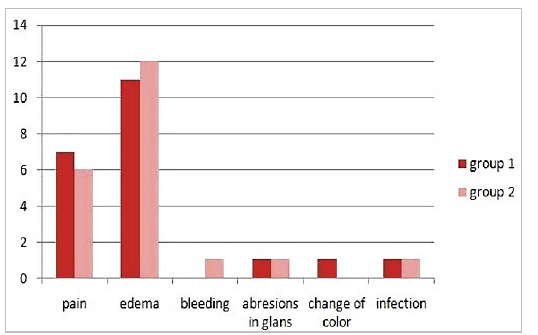
No late-term complications were seen in either of the groups. There was no significant difference between the two groups in complications. The mean operative duration was 19±4 minutes in group-1 while it was 21±5 minutes in group-2 (p>0.05). One patient in group-2 came back to the hospital the same day due to bleeding. The bleeding was stopped with a pressure dressing. No suture was needed. Wound infection was seen in one patient in each group. No systemic findings such as fever or elevated white blood cell count. The infection was treated with an antibiotic pomade application on the wound. Abrasions in the glans and the color change due to local anesthesia regressed on its own.
Discussion
The frequency of circumcision in the USA is 75% while this rate is nearly 20% in the Europe countries (4) and almost 100% in Turkey, according to WHO. The complication rate due to circumcision was reported as nearly 5%. This number increases when circumcision is performed by inexperienced people and in mass circumcisions (7). The most common complication is bleeding at a rate of 3.1% (8). These bleedings can result in a change of sex and even death (9). In our study, bleeding was seen in only one patient (%0.6) in group-2. We believe that the bleeding was due to lack of attention provided at home rather than the circumcision technique.
Although bleeding, infection, cohesion between circumcised skin and glans are the most common complications, they are minor problems and most of the time they heal by itself (10). Sometimes the circumcision skin can be left too short or too long which may result in phimosis or concealed penis and may require circumcision revision (11). Severe problems such as skin bridges, inclusion cyst, iatrogenic hypospadias and epispadias, partial glans amputation,total loss of penis, necrotizing fasciitis, sepsis, Fournier gangrene can also be seen (12). The complications seen in patients in our study were minor problems. No revision was needed in any of the patients. In the groups where sleeve technique and guillotine technique were used, although the guillotine technique lasted mildly shorter, there was no significant difference between the groups in the duration of operations. As a result, circumcision is a surgical procedure that has a low complication rate when it is performed by experienced professionals in sterile operating room conditions (13). Particularly due to the increasing demand for circumcision in the summer, circumcision requires significant time and effort in between routine and emergency procedures in tertiary health care centers.
Conclusion
Circumcision can be performed with different techniques in order to be fast, however, it is important to know that circumcision is not a simple procedure. An ideal circumcision should be performed in the sterile conditions, with a sufficient analgesia, and by the book regardless of the technique used and should have a good look cosmetically. Surgeons should use the technique that they are experienced in and they feel confident in. It is our opinion that as long as the appropriate care and attention are provided during and after a circumcision performed according to surgical rules, no severe problems should occur.
Declarations
- Author contributions (CRediT)
- All authors contributed equally to all 14 CRediT roles (Conceptualization, Data curation, Formal analysis, Funding acquisition, Investigation, Methodology, Project administration, Resources, Software, Supervision, Validation, Visualization, Writing – original draft, Writing – review & editing).
- Funding
-
Funding information was not reported in the published version of this article.
- Conflicts of interest
- The authors declare that they have no conflict of interest in the current study.
- Ethics approval
- Ethics approval details were not reported in the published version of this article.
- Data availability
- A data availability statement was not reported in the published version of this article.
References (13)
8 of 13 references are linked to their DOI.
- Dunsmuir W, Gordon E. The history of circumcision. BJU international. 1999;83(S1):1-12. DOI Crossref PubMed Google Scholar
- Massry SG. History of circumcision: a religious obligation or a medical necessity. J Nephrol. 2011;24(Suppl 17): S100-2. DOI Crossref PubMed Google Scholar
- Gargollo PC, Kozakewich HP, Bauer SB, Borer JG, Peters CA, Retik AB, et al. Balanitis xerotica obliterans in boys. The Journal of urology. 2005;174(4):1409-12. DOI Crossref PubMed Google Scholar
- Organization WH. Male circumcision: global trends and determinants of prevalence, safety, and acceptability. 2008. PubMed Google Scholar
- Vaos G. Circumcision with the Nd: YAG laser contact technique compared with conventional surgery. Photo medicine and Laser Therapy. 2004;22(4):318-22. DOI Crossref PubMed Google Scholar
- Şencan A, Çayırlı H, Şencan A. Sünnet teknikleri. CBU-SBED Celal Bayar Üniversitesi, Sağlık Bilimleri Enstitüsü Dergisi. 2015;2(4):86-90. PubMed Google Scholar
- Atikeler MK, Geçit I, Yüzgeç V, Yalçın O. Complications of circumcision performed within and outside the hospital. International urology and nephrology. 2005;37(1):97-9. DOI Crossref PubMed Google Scholar
- Ozkan A, Ozorak A, Oruc M. Retrospective investigation complications in nineteen hundred cases of circumcision. Konuralp Medical J. 2012;4:8-12. PubMed Google Scholar
- Kaplan GW. Circumcision - an overview. Current problems in pediatrics. 1977;7(5):3-33. DOI Crossref PubMed Google Scholar
- Frisch M, Aigrain Y, Barauskas V, Bjarnason R, Boddy S-A, Czauderna P, et al. Cultural bias in the AAP’s 2012 Technical Report and Policy Statement on male circumcision. Pediatrics. 2013;131(4):796-800. DOI Crossref PubMed Google Scholar
- Brisson PA, Patel HI, Feins NR. Revision of circumcision in children: report of 56 cases. Journal of pediatric surgery. 2002;37(9):1343-6. DOI Crossref PubMed Google Scholar
- Niku SD, Stock JA, Kaplan GW. Neonatal circumcision. The Urologic clinics of North America. 1995;22(1):57-65. PubMed Google Scholar
- Association CM. Neonatal circumcision revisited. Fetus and Newborn Committee, Canadian Paediatric Society. Canadian Medical Association Journal. 1996;154(6):769-80. PubMed Google Scholar
Respond to this article
Comments on a published article are welcome as a Letter to the Editor.
Get an e-mail when new articles in your fields are published
Questions to the authors
Questions are moderated: an editor approves each question, the authors answer, and an editor approves the answer before both appear here.
No answered questions yet.
Ask the authors a question
Discussion
Comments are moderated: they appear after the writer confirms the e-mail address and an editor approves them. Each comment carries a conflict-of-interest statement.
No comments yet.
Write a comment
Tell me when this article is cited
Leave your e-mail address and confirm it. These notices are not being sent yet; your confirmed address is kept for them and used for nothing else.
Read the full text
Open the PDF here
Loading the PDF…
If the PDF does not show here, use the download button above.
How to cite this article
Celikkaya ME, Atici A, El C, Akcora B. Comparison of Sleeve Surgery and Guillotine Technique in Circumcision. Ulutas Med J. 2018;4(3):148-151. doi:10.5455/umj.20180522092808
Celikkaya, M. E., Atici, A., El, C., & Akcora, B. (2018). Comparison of Sleeve Surgery and Guillotine Technique in Circumcision. The Ulutas Medical Journal, 4(3), 148–151. https://doi.org/10.5455/umj.20180522092808
Celikkaya, M.E. et al. (2018) 'Comparison of Sleeve Surgery and Guillotine Technique in Circumcision', The Ulutas Medical Journal, 4(3), pp. 148–151. doi: 10.5455/umj.20180522092808.
@article{umj299951,
  title = {Comparison of Sleeve Surgery and Guillotine Technique in Circumcision},
  author = {Celikkaya, Mehmet Emin and Atici, Ahmet and El, Cigdem and Akcora, Bulent},
  journal = {The Ulutas Medical Journal},
  year = {2018},
  volume = {4},
  number = {3},
  pages = {148--151},
  doi = {10.5455/umj.20180522092808},
  url = {https://www.ulutasmedicaljournal.com/?mno=299951},
  issn = {2149-388X}
}