The Ulutas Medical Journal · ISSN 2149-0430 (print), 2149-388X (online) · https://www.ulutasmedicaljournal.com/?mno=283976
Original Research · Open access
The Effects of Performing Salaat on the Prognosis of Calcaneal Spur
Also available in: العربية · Türkçe · 中文
- Orthopedics and Traumatology, Dr.Abdurrahman Yurtaslan Oncology Training and Research Hospital, Ankara, Turkey ROR
Abstract
- Introduction
- The place of the movements of performing salaat might be important in the etiology and/or treatment of orthopedic pathologies and the prognosis. The study aimed to search the effects of movements of performing the salaat on calcaneal spur prognosis. Material and Methods: A total of 44 patients who presented to our clinic had a history of plantar pain for at least one month, and with plantar fasciitis was detected on the lateral foot graphy, and received at least one of ESWT or simple analgesic therapies. The participant was separated into 2 groups as prayers and non-prayers. All the patients were under non-steroidal anti-inflammatory drugs and extracorporeal shock wave therapy treatment.
- Results
- The prognosis of calcaneal spurs were very similar between the groups. There was no statistically significant difference between them (p>0.05).
- Conclusion
- Performing the salaat doesn't have any effect on calcaneal spur prognosis and calcaneal spur symptoms. According to our study, plantar facies stretching movements during prayer don't have positive or negative effects on the prognosis of calcaneal spur disease
Keywords
Full text
Introduction
Plantar heel pain is one of the most commonly encountered problems of feet in adults (1). Plantar fasciitis is one of the causes of plantar heel pain, occurring in the adhesion site of the plantar fascia to the calcaneal tuberosity (2). It is more common over 40 years of age and in women. The pain is typical with the first contact of the feet with the ground (1).
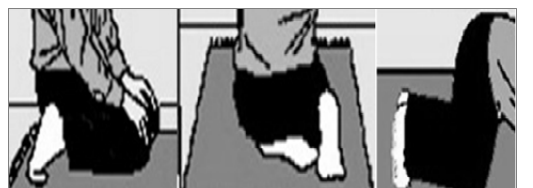
Orthopedic shoes, the use of arch support, stretching exercises, NSAID (nonsteroidal anti-inflammatory drugs), local injections of cortico steroids/analgesics, ESWT(extracorporeal shock wave therapy) and physiotherapy modalities have been described in the treatment of plantar fasciitis (2–4). For instance, whereas performing salaat sitting on the ground is recommended for the symptomatic treatment of advanced gonarthrosis, there are no sufficient data about the relationship between calcaneal spur and salaat. We believe that the place of movements of performing salaat (Figure-1) in the etiology and/or treatment of orthopedic pathologies and their effect on the prognosis should be investigated. In this study, we investigated the effect of salaat on the plantar fasciitis.
Materials and Methods
A total of 44 patients who presented to our clinic between June 2014 and June 2016, had a history of plantar pain for at least one month, and with plantar fasciitis was detected on the lateral foot graphy, and received at least one of ESWT or simple analgesic therapies were included in the study. Patients without pain during first stepping on the ground in the morning, patients who had symptoms lasting for shorter than one month, who had pain not under, but behind the foot, patients with a recent history of trauma to the heels, and those with rheumatoid arthritis were excluded.
All patients were informed face-to-face about the study and gave voluntary consent forms. The patients were questioned about age, gender, duration of the symptoms, whether they had received ESWT (15 Hz frequency, 2.0 Barr density, and 2000 pulse/session), whether analgesic therapy had been administered, whether they perform salaat and its relationship with the symptoms.The forty-four patients were divided into two groups as 30 patients who were performing salaat composed the Group- 1, and 14 patients who were not performing in the Group-2. Both groups were evaluated in themselves for demographics. Visual analog scale was used to evaluate the severity of pain. Statistical analysis Statistical calculations were made by SPSS 21 (SPSS, Chicago, IL, USA). Group comparisons were performed using Chi-square and T-test. A p<0.05 was considered statistically significant.
Results
First, it was confirmed that none of the patients discontinued performing salaat after the onset of plantar fasciitis, and none of the patients who had not performed salaat previously began to performing after plantar fasciitis. Of all patients, 30 (68%) were female and 14 (32%) were male. Plantar fasciitis was right-sided in 22 and left sided in 22 patients, as seen in table-1.
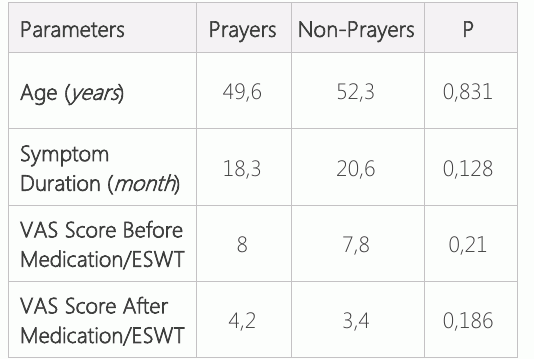
The mean age was found as 51,4 (range: 34- 72 years), 49.6 in the group performing salaat and 52.3 in the group not performing salaat. The mean duration of symptoms was 18 (2-48 months) and 20 (1-42 months) in the Group-1 and 2; respectively. No significant difference was observed between both groups in terms of the duration of symptoms (p=0,128).
It was found that 20 patients received and 10 patients did not receive ESWT therapy in the Group-1, while 6 patients received ESWT therapy and 6 patients did not receive in Group-2. VAS scores before and after medical therapy or ESWT were found as 8 and 7.8 in the Group-1; 4.2 and 3.4 in the Group-2. No significant difference was found between the two groups in terms of the follow-up pain severities.
Discussion
Physicians working in the societies where most of the people consist of Muslims, it obvious that religious sensitiveness should be considering in the treatment planning. Salaat which is one of the five imperatives of Islam is a form of worship with praying together with repeating movements. In other words, salaat is a ritual of coordinated, harmonic spiritual and physical movements. It has numerous moral benefits. Salaat is performed five times a day as fajr, midday, afternoon, sunset, and Isha prayers. The facts such as giving advice to patients with advanced knee osteoarthritis for performing salaat by sitting and extending feet forwards or benefits of salaat making people to periodically perform numerous joint movements confirms that the relationship between orthopedic issues and salaat should be separately described on each topic. The objective of this study was to investigate the effect of salaat consisting of repetitive movements on plantar fasciitis in patients who regularly perform salaat five times a day. Therefore, in addition to the group consisting of patients who perform salaat, the comparison was made with the group including the patients which do not perform salaat. The most common causes of plantar heel pain is overuse, obesity and foot deformities, inflammation of the plantar fascia, training and the use of improper shoes (3). The diagnosis of plantar fasciitis can be established in the presence of plantar pain accompanied by the inferior calcaneal spur. The patient experienced severe pain when first standing on the feet (5). Some of the most common causes of the differential diagnosis of calcaneal spur include plantar fasciitis, fat pad atrophy, and calcaneus stress fractures. Attention should be given to tumoral lesions especially in chronic plantar heel pain felt during resting in the patients evaluated for plantar heel pain (5, 6).
The incidence of plantar fasciitis increases with age (7). It is usually seen over 40 years of age (2). In our study, patients aged between 34 and 72 years were seen with a mean age of the onset being 51,4. In the present study, the prevalence of plantar fasciitis showed serious predominance in women (68%). Many previous studies reported that this disease was more common among women (4, 5). In our study, the rates of the affected right and left sides were equal.
The goal of the plantar fasciitis treatment is relieving the pain rather than resolving of the plantar fasciitis. For this purpose; orthopedic shoes, the use of insock,plantar fascia stretching exercises, NSAIDs, local injections of cortico-steroids/analgesics, ESWT, and other physio therapy modalities have been described (2–5). Calcaneal spur treatment requires surgery rarely (5). In our study, we investigated the effect of performing salaat on the prognosis, and the conservative treatments used by the patients were the use of NSAIDs or ESWT. In studies conducted about ESWT therapy for plantar fasciitis, there are differences in terms of the number of sessions, the number of pulses in each session and the duration between two ESWT sessions, and also its effectiveness differs from one study to the other (3). In our study, VAS scores were significantly improved in both groups with NSAID and ESWT treatment administered as specified. One of the plantar fasciitis conservative treatment protocols is stretching exercise. In a study by Davis et al. with 130 patients, the most effective method in the treatment of plantar fasciitis treatment was found as stretching exercises (8). This study was done considering that the movement of performing salaat may decrease the symptoms of plantar fasciitis, but no statistical difference was found. Perhaps, further studies with a larger number of patients may obtain different results.
Conclusion
No changes were observed in the symptoms of plantar fasciitis with performing the salaat. As a result, plantar fascia stretching movements during the salaat does not positively affect the prognoses and do not worsen the symptoms.
Declarations
- Author contributions (CRediT)
- All authors contributed equally to all 14 CRediT roles (Conceptualization, Data curation, Formal analysis, Funding acquisition, Investigation, Methodology, Project administration, Resources, Software, Supervision, Validation, Visualization, Writing – original draft, Writing – review & editing).
- Funding
-
Funding information was not reported in the published version of this article.
- Conflicts of interest
- The authors declare that they have no conflict of interest in the current study.
- Ethics approval
- Ethics approval details were not reported in the published version of this article.
- Data availability
- A data availability statement was not reported in the published version of this article.
References (8)
1 of 8 references are linked to their DOI.
- Kose N, Goktu rk E, Turgut A, Seber S, Hazer B. Taban cokuklugu ve topuk dikeninin topuk agrisi etiyolojisindeki rolu. Acta Ortop Traumatol Turc 1998(32): 322-324. PubMed Google Scholar
- Yuzer S, Sever A, Gurcay E, Unlu E, Cakci A. Topuk Dikeni Tedavisinde Lazer Tedavisi ve Steroid Enjeksiyonunun Etkinliginin Karsilastirilmasi. Türk Fiz Tıp Rehab Derg 2006;52: 68-71. PubMed Google Scholar
- Kaplan S, Serbest MO, Cetin C, Erdogan A. Ekstrakorporeal şok dalga tedavi (eswt) uygulamasının plantar fasiitis kaynaklı topuk ağrısına erken ve orta dönem etkisi. S.D.Ü. Tıp Fak. Derg. 2012;19:37-42 PubMed Google Scholar
- Toker S, Kılıncoglu V, Guven M, ve ark. Kalkaneal Spur'un (topuk dikeni) lokal kortikosteroid ve anestezik madde enjeksiyonu ile tedavisinin erken ve orta dönem sonuçları. Göztepe Tıp Dergisi 2008;23:59-62. PubMed Google Scholar
- Asansu MA, Yildirim Y. Topuk agrisi. TOTBİD Dergisi 2013;12: 447–454. PubMed Google Scholar
- Ozturk R. Kemik ve Yumuşak doku Tümörleri. Ortopedi ve Spor Yaralanmaları Asistan Kitabı. 1. Baskı, Ankara Derman Tıbbi Yayıncılık, 2015: 635-704. PubMed Google Scholar
- Williams PL, Smibert JG, Cox R, Mitchell R, Klenerman L. Imaging study of the painful heel syndrome. Foot Ankle. 1987;7:345. DOI Crossref PubMed Google Scholar
- Davis PF, Severud E, Bartex DE. Painful heel syndrome: Result of non-operative treatment.Foot and Ankle.1994;15:531 -35. PubMed Google Scholar
Respond to this article
Comments on a published article are welcome as a Letter to the Editor.
Get an e-mail when new articles in your fields are published
Questions to the authors
Questions are moderated: an editor approves each question, the authors answer, and an editor approves the answer before both appear here.
No answered questions yet.
Ask the authors a question
Discussion
Comments are moderated: they appear after the writer confirms the e-mail address and an editor approves them. Each comment carries a conflict-of-interest statement.
No comments yet.
Write a comment
Tell me when this article is cited
Leave your e-mail address and confirm it. These notices are not being sent yet; your confirmed address is kept for them and used for nothing else.
Read the full text
Open the PDF here
Loading the PDF…
If the PDF does not show here, use the download button above.
How to cite this article
Ozturk R, Toptas E. The Effects of Performing Salaat on the Prognosis of Calcaneal Spur. Ulutas Med J. 2018;4(3):152-155. doi:10.5455/umj.20171124110044
Ozturk, R., & Toptas, E. (2018). The Effects of Performing Salaat on the Prognosis of Calcaneal Spur. The Ulutas Medical Journal, 4(3), 152–155. https://doi.org/10.5455/umj.20171124110044
Ozturk, R. and Toptas, E. (2018) 'The Effects of Performing Salaat on the Prognosis of Calcaneal Spur', The Ulutas Medical Journal, 4(3), pp. 152–155. doi: 10.5455/umj.20171124110044.
@article{umj283976,
  title = {The Effects of Performing Salaat on the Prognosis of Calcaneal Spur},
  author = {Ozturk, Recep and Toptas, Ethem},
  journal = {The Ulutas Medical Journal},
  year = {2018},
  volume = {4},
  number = {3},
  pages = {152--155},
  doi = {10.5455/umj.20171124110044},
  url = {https://www.ulutasmedicaljournal.com/?mno=283976},
  issn = {2149-388X}
}