The Ulutas Medical Journal · ISSN 2149-0430 (print), 2149-388X (online) · https://www.ulutasmedicaljournal.com/?mno=20979
Original Article · Open access
Results of Surgery Performed on 151 Patients of Hypospadias: Single Center Experience
- Mustafa Kemal University, School of Medicine, Department of Pediatric Surgery, Hatay, Turkey ROR
- Mustafa Kemal University, School of Medicine, Department of PediatricSurgery, Hatay, Turkey ROR
- Mustafa Kemal University, School of Medicine, Department of Pediatrics, Hatay, Turkey ROR
Abstract
- Background
- Hypospadias is defined as the hypoplasia of the ventral side of the penis such as the abnormal ventral opening of urethral meatus, chordee, and abnormal distribution of circumcision skin. The purpose of this study is to share our experiences with patients who underwent hypospadias repair surgery in a university hospital.
- Materials and Methods
- After obtaining approval from the hospital's ethical review board, the files of 151 patients with hypospadias who underwent surgery between March 2013 and October 2018, were examined retrospectively. One hundred thirty-five patients (89%) had anterior, and 16 patients (10.6%) had posterior hypospadias.
- Results
- The average age of patients was 4,2 years (1-14). While 30% of the patients with anterior hypospadias had cordee below 30 degrees, 100% of patients with posterior hypospadias had chordee. In terms of complications, 15(9,9%) patients had urethro-cutaneous fistula, 20 (13,2%) patients had meatal stenosis, 3 patients (1.9%) glans dehiscence, and 1 patient (0.6%) had ventral skin necrosis.
- Conclusion
- Hypospadias surgery is still challenging due to being associated with certain complications. As one single surgery does not yield good results for any hypospadias, these patients should be managed with specific operations selected according to the patient.
Keywords
Full text
Introduction
Hypospadias is defined as the hypoplasia of the ventral side of penis such as abnormal ventral opening of urethral meatus, chordee, and abnormal distribution of circumcision skin (1). This affects 0,3-1% of male, live births (2). Hypospadias is categorized as anterior hypos padias (glanular, coronal, sub coronal, and distal penile), mid hypospadias (midpenile) and posterior hypospadias (proximal penile, penoscrotal and perineal) according to the position of abnormal urethral opening (3, 4). While ant-mid hypospadias constitute majority of the cases (80%), posterior hypospadias is rare (20%) (5, 6). In surgical treatment, the aim is to repair chordee if present and form a linear penis with natural appearance and meatus in a terminal position (4, 7). Although more than 200 surgical techniques were defined for hypospadias repair up to date, the most commonly used technique clinically recently is tubularized incised (TIPU) plate urethroplasty repair (1, 7–11).The purpose of this study is to share our experiences with patients who underwent hypospadias repair surgery in a University Hospital.
Materials and Method
After obtaining approval from the hospital’s ethical review board (08.11.2018-10), the files of 151 patients with hypospadias who underwent surgery between March 2013 and October 2018, were examined retrospectively. The age, hypospadias type, surgical technique used, and the complication rate were identified. Relapsed cases who had surgery in another institution were not included in the study. All the patients received general anesthesia. Of anterior cases, patients with glanular hypospadias received meatal advancement and glanuloplasty incorporated (MAGPI) while TIPU was performed as described by Snodgrass on patients with anterior and midshaft-hypospadias (12). A two-stage repair described by Bracka was performed on patients with posterior hypospadias (13). In these cases, the second stage repair was performed 6-8 months (6-12 months) after the first operation. In all cases, after degloving the penis, rubber tourniquet was applied with 15-minute intervals to control bleeding to the penis base. Artificial penile erection is performed by injecting saline through a brand of the yellow cannula (24G -19mm)(Beybi KIT KATH, İstanbul, Turkey) directly into one of the corpora cavernosa with a tourniquet positioned at the base of the penis. After confirming the chordee with an artificial erection, the chordee was repaired by performing a dorsal tunica albuginea plication with 5/0 non-absorbable suture. For urethro plasty, 6/0-7/0-8/0 pds or vycril was used with continuous sutures. We prescribed all post-operative antibiotics (cefotaxime), analgesic (paracetamol) and oxybutynin hydrochloride (to prevent bladder spasm) orally until they were discharged. Urethral catheters were maintained for an average of 5 days (1–7) in anterior hypospadias and 10 (7–11) days in posterior hypospadias. After the removal of catheters and confirmation of normal urination, patients were discharged the same day. The patients were scheduled for postoperative control for one week, three months, and a year later.
Results
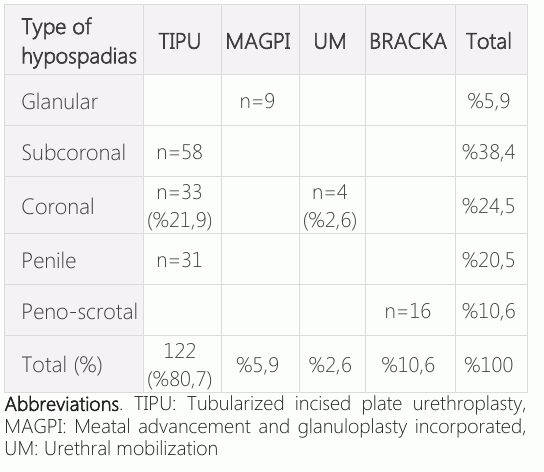
135 patients (89%) had anterior-mid and 16 patients (10,6%) had posterior hypospadias. The average age of patients was 4,2 years (1–14), and the post-operative monitoring duration was found to be 3,5 years (1–7). MAGPI was performed on all the patients with glanular hypospadias (n=9) (5,6%) while for suitable cases urethral mobilization was performed on the patients with coronal hypospadias (n=4, 2,6%) and TIPU Snodgrass repair (due to width of urethral plate, glans size, and surgical experience) was performed on rest of the patients with coronal, subcoronal, penile (80,7%). Cordee realizes performed on patients with posterior hypospadias during the first session, and Bracka repair was performed during the second session which was 6-8 months later. The types of hypospadias and surgery patients had been summarized in Table-1.
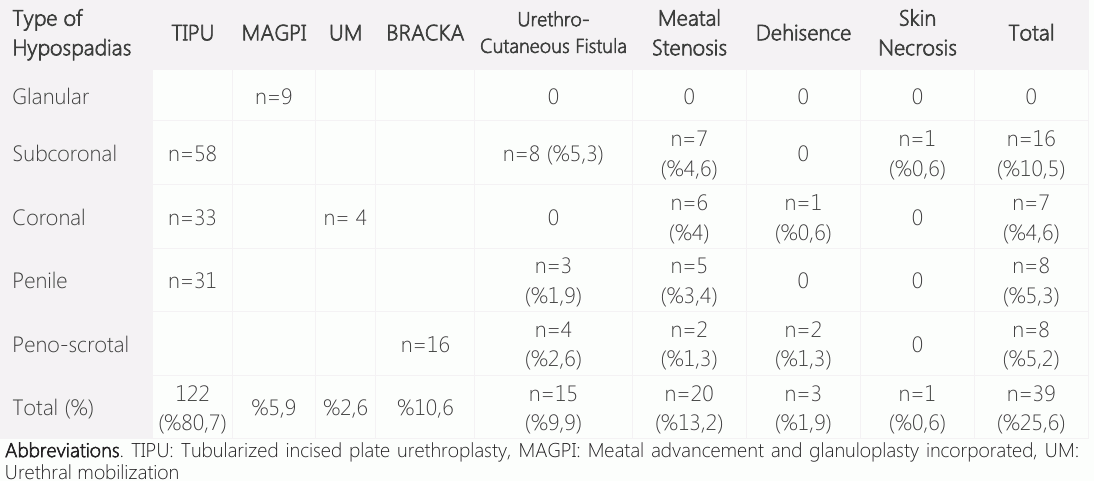
While 30% of the patients with anterior hypospadias had cordee below 30 degrees, 100% of patients with posterior hypospadias had cordee. In 20% of the patients with anterior hypospadias, chordee was seen to be repaired after degloving the skin while chordee was repaired in the rest of the patients by dorsal tunica plication (1-3 locations). In terms of complications, 15 (9,9%) patients had urethro-cutaneous fistula, 20 (13,2%) patients had dilatation due to meatal stenosis (1-3 times), 3 patients (1,9%) had glans dehiscence, and 1 patient (0,6%) had ventral skin necrosis. Graft contraction rate after Bracka procedure was found n:2(%1,3).Complications are summarized in Table-2 according to post-surgery hypos padias and the type of surgery.
Discussion
Surgical repair in hypospadias treatment started in the late 1890s, and in later years many techniques to elongate the urethra to the standard terminal were defined (4, 7, 14). Over the past century, surgical treatment continued to develop; however, not one single perfect technique was achieved for all cases. Today, the hypospadias surgery method is generally categorized as one or multi-stage procedures (2, 5, 9, 10, 15–17). The choice of hypospadias repair varies depending on the components of this anomaly that are; the size of the urethral plate, the presence of chordee, the size of the phallus, the position of the meatus, and the experience of the surgeon (3, 4, 7, 18).
Anterior hypospadias is generally managed by one-stage procedures such as Snod Gross (TIPU) repair, MAGPI, MATHIEW, while posterior hypospadias is managed by staged procedures such as AVOR BRACKA (5, 13, 15, 17). Different urethroplasty techniques in the surgeries include simple tubularization of the urethral plate, midline incision, tubularization of urethral plate, use of adjacent skin grafts, free skin grafts, buccal mucosal grafts and mobilized vascular flaps (mostly by using inner preputial skin) (4, 7, 19). We performed the TIPU method on 80% of patients. This method was described by Snodgrass in 1994 and is relatively simple, easily applied and very common for anterior cases (9, 10). Studies since 1994 showed that TIPU has better results than other one-stage methods when fistulas, meatal stenosis, urethral structures and the aesthetics of glans and meatus are compared. When the studies are examined, TIPU provides significant healing in hypospadias repair and that it continues to be a good option for most of the patients with hypospadias (9, 10, 12, 21). Although TIPU can be performed for glanular hypospadias, we used MAGPI method in glanular hypospadias cases in which we thought meatus could reach to the tip of the penis quickly.
Additionally, we used urethral mobilization method in four appropriate cases. There were no complications in patients after MAGPI and urethral mobilization. Mathieu, only an island pedicle flap procedure has been widely used in some clinics. Because of the meatus appearing rounded like a fish mouth in contrast to normal meatus was their disadvantage, the operations were not preferred in our study (1, 3, 8, 12). Chordee, which is a problematic component in hypospadias treatment, is seen in 10% of the anterior cases and 80% of the posterior cases (3, 4, 7, 14). It is generally accompanied by a fibrous tissue line that goes from abnormal meatus to glans and causes chordee by shortening the ventral direction of the penis shaft (15, 20). In hypospadias patients with severe chordee, many surgeons choose to continue with a two-stage procedure to reduce surgical complications and to improve results. They believe that the two-stage procedure provides fewer complications and superior functional and cosmetic results (5, 6, 13, 16). 100% of our patients with posterior hypos padias had chordee, and we performed a two-stage procedure defined by Bracka in 1995 on our patients (13). The choice of two-stage procedure in our study depended on the condition of the urethra, chordee, and penis. The general complication rate in hypospadias has a wide range of 0-60% (3, 20, 21). Hypos padias type, the size of penis, age, and surgical method, width of urethral plate, suture material and technique used, use of a protective layer, use of urethral stent, experience of the surgeon, protection of the circumcision skin are some of the causes described in complications (4, 7, 9, 11). However, the roles these factors play in successful results of hypospadias repair are yet to be identified (7, 16). The most common complication seen is urethro-cutaneous fistula, which constitutes 0-50% of all complications (3, 18, 20, 21). In our study, the ratio of cutaneous fistula was 9%. In Snodgrass’ series, as time passed the ratio of complications decreased and the general complication ratios decreased down to 0% - 4% (fistula and meatal stenosis) (11, 18, 22). Snow et al. reported the use of tunica vaginalis as interposition graft in 1995 and after this report; Snodgrass reported that they reduced the fistula ratio to 0% with the use of tunica vaginalis (9, 11, 18, 22). We used dartos flap in anterior cases while we used the tunica vaginalis flap in the following cases. All the fistulas were observed during the first-month control. However, almost all of the fistulas (81%) are seen during the first year, patients are monitored for at least one year (14).
The ratio of a second frequent complication, meatal stenosis, ranges between 0% and 17% (3, 8, 21). Although the meatal stenosis increases to 20% in some studies, Snodgrass reported the incidence of meatal stenosis in their series as 0-1% (2, 3, 12, 20). In our study, meatal stenosis developed with a ratio of 13,2% that was responsive to dilatations. In these cases, no other intervention than dilatation was required. Factors causing this include use of a big urethral stent creating pressure, and performing a narrow urethroplasty (3, 9, 21). In 102 of patients (67,5%) a urinary catheter of 8 fr, in 31 patients (20,5%) a 6 fr, and in 18 (11,9%) a 10 fr catheter was used. As 8 fr urinary catheters were used in most of our patients, the relationship between catheter diameter and meatal stenosis was not examined. Although diverticula and dehiscence were reported as complications in several series, no diverticula were seen in our patients (3, 21). However, dehisence was seen in three patients (1,9%). 2patients with glans dehiscence went under surgery again after six months and were discharged with no complications. Surgery is planned for the other patient.
Conclusion
Hypospadias surgery is still challenging due to being associated with certain complications. For anterior hypospadias, after confirming the chordee with an artificial erection and repair, we suggest one stage operation such as MAGPI, urethral mobilization, and TIPU Snodgrass procedure. However, posterior hypospadias should be managed by staged procedures such as Bracka procedure. Through better understanding the factors that contribute to successful repairs in hypospadias surgery, and because of the increased surgical experience, we think that the complication rate will be reduced significantly in the long-term period (4, 7). As one single surgery does not yield good results for any hypospadias, these patients should be managed with specific operations selected according to the patient. Retrospective nature of the study and not identifying the factors causing complications are considered as limitations of the study.
Declarations
- Author contributions (CRediT)
- All authors contributed equally to all 14 CRediT roles (Conceptualization, Data curation, Formal analysis, Funding acquisition, Investigation, Methodology, Project administration, Resources, Software, Supervision, Validation, Visualization, Writing – original draft, Writing – review & editing).
- Funding
-
Funding information was not reported in the published version of this article.
- Conflicts of interest
- None of the authors has a conflict of interest with the submission.
- Ethics approval
- After obtaining approval from the hospital’s ethical review board, the files of 151 patients with hypospadias who underwent surgery between March 2013 and October 2018, were examined retrospectively.
- Data availability
- A data availability statement was not reported in the published version of this article.
References (22)
20 of 22 references are linked to their DOI.
- Thapa B, Pun M. Snodgrass tubularized incised plate urethroplasty for distal and midpenile hypospadias. J Nepal Paediatr Soc. 2014;34:1 DOI Crossref PubMed Google Scholar
- Saiad MO. The Modified Multilayer Coverage of Urethroplasty for Distal Hypospadias. Journal of Indian Association of Pediatric Surgeons. 2018;23(3):140-43. doi:10.4103/jiaps.JIAPS_164_17 DOI Crossref PubMed Google Scholar
- Appeadu-Mensah W, Hesse AA, Glover-Addy H, Osei-Nketiah S, Etwire V, Sarpong PA. Complications of hypospadias surgery: Experience in a tertiary hospital of a developing country. Afr J Paediatr Surg. 2015 Oct-Dec; 12(4): 211–16 DOI Crossref PubMed Google Scholar
- Baskin LS, Ebbers MB. Hypospadias: Anatomy, etiology, and technique. J Pediatr Surg. 2006;41:463–72 DOI Crossref PubMed Google Scholar
- Shukla AK, Singh AP, Sharma P, Shukla J. Two stages repair of proximal hypospadias: Review of 700 cases. J Indian Assoc Pediatr Surg 2017; 22:158-62 DOI Crossref PubMed Google Scholar
- Joshi RS, Bachani MK, Uttarwar AM, Ramji JI. The Bracka two-stage repair for severe proximal hypospadias: A single center experience. Journal of Indian Association of Pediatric Surgeons,2015; 20(2): 72 DOI Crossref PubMed Google Scholar
- Snodgrass W.T. Hypospadias. In: Wein A.J., Kavoussi L.R., Novick A.C., Partin A.W., Peters C.A., editors. Campbell-Walsh urology. 10th ed. Elsevier Saunders; Philadelphia: 2012;3502–3536 PubMed Google Scholar
- Perlmutter AE, Morabito R, Tarry WF. Impact of patient age on distal hypospadias repair: A surgical perspective. Urology. 2006;68:648– 51 DOI Crossref PubMed Google Scholar
- Snodgrass W, Bush N. TIP hypospadias repair: A pediatric urology indicator operation. J Pediatr Urol. 2016;12:11–8 DOI Crossref PubMed Google Scholar
- Snodgrass W. Tubularized, incised plate urethroplasty for distal hypospadias. J Urol. 1994;151:464 –5 DOI Crossref PubMed Google Scholar
- Dhua AK, Aggarwal SK, Sinha S, Ratan SK. Soft tissue covers in hypospadias surgery: Is Tunica vaginalis better than dartos flap J Indian Assoc Pediatr Surg. 2012;17:16-9 DOI Crossref PubMed Google Scholar
- Snodgrass WT, Nguyen MT. Current technique of tubularized incised plate hypospadias repair. Urology 2002;60:157-62 DOI Crossref PubMed Google Scholar
- Bracka A. A versatile two-stage hypospadias repair. Br J Plast Surg. 1995;48:345– 52 DOI Crossref PubMed Google Scholar
- Snodgrass W, Bush N. Recent advances in understanding /management of hypospadias. 2014; 6 DOI Crossref PubMed Google Scholar
- Omar RG, Khalil MM, Sherif H, Elezaby H. Pedicled preputial island flap for double functions in hypospadias surgery. Turkish journal of urology. 2018;1 DOI Crossref PubMed Google Scholar
- Snodgrass WT, Bush N, Cost N. Tubularized incised plate hypospadias repair for distal hypospadias. J Pediatr Urol. 2010;6:408– 13 DOI Crossref PubMed Google Scholar
- Duckett JW. MAGPI (meatoplasty and glanuloplasty): a procedure for subcoronal hypospadias. The Urologic clinics of North America,1981;8(3): 513-19 DOI Crossref PubMed Google Scholar
- Kadian YS, Singh M, Rattan KN. The role of tunica vaginalis flap in staged repair of hypospadias. Asian journal of urology 2017;4(2): 107-10 DOI Crossref PubMed Google Scholar
- Bracka A. Hypospadias repair: The two-stage alternative. Br J Urol. 1995;76(Suppl 3):31– 41 DOI Crossref PubMed Google Scholar
- Snodgrass W, Bush N. Primary hypospadias repair techniques: A review of the evidence Urol Ann. 2016 Oct - Dec; 8(4): 403–08 DOI Crossref PubMed Google Scholar
- Braga LH, Lorenzo AJ, Salle JL. Tubularized incised plate urethroplasty for distal hypospadias: A literature review. Indian J Urol. 2008;24:219– 25 PubMed Google Scholar
- Snow BW, Cartwright PC, Unger K. Tunica vaginalis blanket wrap to prevent urethra-cutaneous fistulas an eight year experience. J Urol. 1995;153:472– 3 DOI Crossref PubMed Google Scholar
Respond to this article
Comments on a published article are welcome as a Letter to the Editor.
Get an e-mail when new articles in your fields are published
Read the full text
Open the PDF here
Loading the PDF…
If the PDF does not show here, use the download button above.
How to cite this article
Atici A, Celikkaya ME, El C, Akcora B. Results of Surgery Performed on 151 Patients of Hypospadias: Single Center Experience. Ulutas Med J. 2019;5(1):48-53. doi:10.5455/umj.20181210085830
Atici, A., Celikkaya, M. E., El, C., & Akcora, B. (2019). Results of Surgery Performed on 151 Patients of Hypospadias: Single Center Experience. The Ulutas Medical Journal, 5(1), 48–53. https://doi.org/10.5455/umj.20181210085830
Atici, A. et al. (2019) 'Results of Surgery Performed on 151 Patients of Hypospadias: Single Center Experience', The Ulutas Medical Journal, 5(1), pp. 48–53. doi: 10.5455/umj.20181210085830.