The Ulutas Medical Journal · ISSN 2149-0430 (print), 2149-388X (online) · https://www.ulutasmedicaljournal.com/?mno=19648
Original Article · Open access
Comparison of Efficacy and Tolerability of Modified Release Methylphenidate, Osmotic-Release Methylphenidate and Atomoxetine in Children with Attention Deficit Hyperactivity Disorder
- Department of Child and Adolescent Psychiatry, Hatay State Hospital, Hatay, Turkey ROR
Abstract
- Background
- Attention deficit hyperactivity disorder (ADHD) is a common psychiatric condition that affects the daily functioning of children, adolescents, and adults. In this study, we aim to determine the efficacy and tolerability of medications that frequently use in the treatment of ADHD.
- Materials and Methods
- 204 primary school-age children with documented DSM-5 ADHD diagnosis were included. Clinical characteristics of the sample were obtained from the medical records and structured psychiatric interviews. Improvement and side effects were assessed with the Clinical Global Impression-Improvement Scale (CGI-I) and the adverse effect scale developed by the authors, respectively.
- Results
- Mean age of the patients was 8.32±1.15 and 67.1% of the patients were male. 33.3% of the patients were using modified-release methylphenidate, 35.3% were using osmotic-release methylphenidate, and 31.4% were using Atomoxetine. The CGI-I was significantly different between the three groups (p=0.012). There was no significance in terms of treatment compliance. Sleep disturbances, appetite, and sadness were different between the groups.
- Conclusion
- Atomoxetine seems to be less effective and has fewer side effects than modified-release methylphenidate and osmotic-release methylphenidate. Modified release methylphenidate and osmotic-release methylphenidate appear to show similar effectiveness. Osmotic release methylphenidate may be associated with more and severe side effects.
Keywords
Full text
Introduction
Attention deficit hyperactivity disorder (ADHD) is characterized by a persistent pattern of inattention and/or hyperactivity-impulsivity that decreases development and daily functioning of children and adolescent. Attention deficit hyperactivity disorder symptoms can cause academic,social, and/or occupational problems (1). Attention deficit hyperactivity disorder is one of the most common psychiatric conditions in pediatric ages. Its prevalence is reported as 3-7% in school-age. Abnormal dopaminergic and noradrenergic pathways related with attention and hyperactivity-impulsivity are reported in the pathophysiology of ADHD (2). The major treatment methods for ADHD are pharmacotherapy, behavior therapy, and social psychotherapy (3). Stimulants like methyl phenidate (MPH) are suggested as first choice medications by some authors in the treatment of ADHD. The mechanism of action of MPH is blocking the reuptake of dopamine and noradrenaline in the presynaptic neuron (4). Modified release (MR-MPH) and osmotic release (OROS-MPH) formulations of MPH have been designed to support a long-term effect for ADHD treatment. Both MR-MPH and OROS-MPH have been shown as effective to alleviate ADHD symptoms (3). However, MPH may be associated with occurrence of mood instability, tics disorders, and anxiety symptoms (5). Non-stimulant agents like atomoxetine (ATX) is also produced as an alternative medication to MPH. Atomoxetine selectively inhibits presynaptic norepinephrine transporter and increase the density of norepinephrine in the synaptic cleft (2, 3).
Although the efficacy of MPH or ATX is better than placebo, there are controversial results in the comparison between these agents. In this study, we aimed to compare the treatment response in terms of ADHD symptoms of MR-MPH, OROS-MPH, and ATX in drug-naive children with ADHD. We also investigated the tolerability profiles of these three medications.
Materials and Methods
Sample and Design
This was a retrospective study investigated the efficacy and tolerability of MR-MPH (50% immediaterelease),OROS-MPH(22% immediate release), and ATX in drug-naive primary school-age children with ADHD. Subjects for this study were drawn from a clinical sample of primary school-age children with ADHD who were referred to Hatay State Hospital Child and Adolescent Psychiatry Clinic through January to December 2017. The study was approved by the Ethics Committee of Adana City Hospital in Adana in Turkey. The approval number was 2017/189. Demographic and characteristics of the sample were obtained from the medical records and structured psychiatric interviews. Medical records of the study subjects were reviewed for dosage and duration of medication treatments, Clinical Global Impression- Improvement Scale (CGI-I), side effects, and treatment compliance.
The children, 6-10 years of age (primary school period), who had full a medical record, documented Diagnostic and Statistical Manual of Mental Disorders, 5th edition (DSM-5) ADHD diagnosis and a CGI-I rating for the ADHD treatment were initially recruited (n:276). The subjects with the diagnosis of psychiatric disorders other than ADHD according to DSM- 5 and those who had a physical illness and who used any medications other than MR-MPH, OROS-MPH, and ATX were excluded. Subjects were also not allowed to receive behavior therapy for ADHD symptoms. Of 276 subjects initially recruited, 204 subjects met all of the study requirements and were included in the study. Attention deficit hyperactivity disorder was grouped to treatments as following:“MR- MPH”, “OROS-MPH”, and “ATX”. The dosage of MPH titrated up to 1 mg/kg/day and ATX up to 1.2 mg/kg/day based on clinical response and tolerability. The total daily dose of MPH was not to exceed 60 mg/day and ATX 80 mg/day. Methylphenidate and ATX administered as a single morning dose.
Improvement and Treatment Compliance The CGI-I, a widely used instrument in child psychiatric disorders, assesses the patient’s improvement level since the start of the treatment intervention using following scores: 1, very much improved; 2, much improved; 3, minimally improved; 4, no change; 5, minimally worse; 6, much worse; 7, very much worse. In the present study, none of the subjects had the scores of 5, 6 and 7 and only the scores of 1-4 were used in the analyses. For the secondary analyses of CGI-I, items 1 and 2 were collected and labeled as “generally improved”; while items 3 and 4 were collected and labeled as “not improved”. The CGI-I was applied at the 8th week of treatment. Treatment compliance was defined as the continuation of the selected treatment for at least eight weeks on almost every day.
Adverse Effect
An adverse effect scale, based on the patients’ medical records, was developed by the authors to assess the presence and severity of adverse effects. The adverse effects reported in the records were categorized according to the related body system as the following subtypes: “sleep”, “appetite”, “stomach ache”, “nausea-vomiting”,“sadness”and “irritability-aggression”. The severity of these adverse effects was also rated by a clinician as “any”, “mild”, “moderate”, and “severe”. For the further analyses, “any” and “mild” were collected and labeled as “no/mild adverse effect”; while “moderate” and “severe” were collected and labeled as “moderate/severe adverse effect”. The scale was applied at the 8th week of treatment.
Statistical Analysis
The collected data were analyzed by using SPSS version 21. Demographic variables and general characteristics of the patients were presented by using descriptive statistics. χ² test was used for the comparison of normally distributed the categorical variables. Post-hoc analysis was performed for further statistical evaluation. The p-value <0.05 was accepted to be statistically significant.
Results
Demographic variables of the study sample are presented in Table-1. Mean age of patients was 8.32±1.15. 67.1% (n:137) of children were male, and 32.9% (n:67) were female. The most common primary complaint of patients and families during admission was academic problems (48%, n:98). The primary complaints about inattentiveness (27.5%, n:56) and hyper activity (15.2%;n:31) were coming after academic problems. 33.3% (n:68) of the patients were using MR-MPH, 35.3%(n:72) were using OROS- MPH, and 31.4% (n:64) were using ATX.
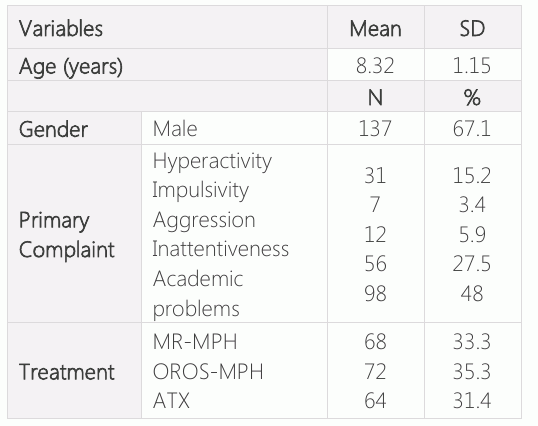
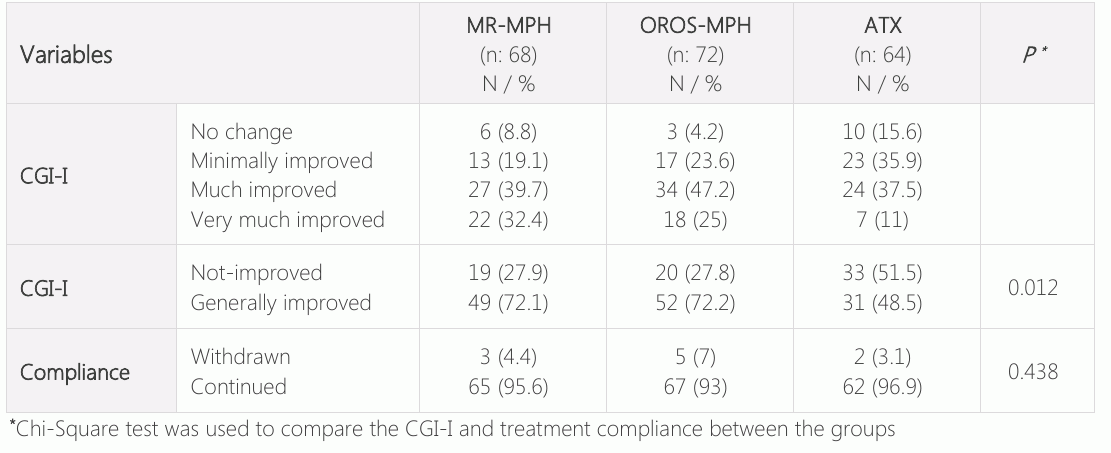
Table-2 shows improvement and compliance in treatment groups. As seen in the table, the CGI-I was significantly different between groups (p=0.012). Post-hoc analysis was performed to understand which group formed the difference. Modified release MPH and osmotic-release MPH groups were compared in terms of CGI-I, and there was no difference statistically (p=0.831). It was concluded that the statistical difference was related to the ATX group. Additionally, there was no significant difference between the groups in terms of treatment compliance.
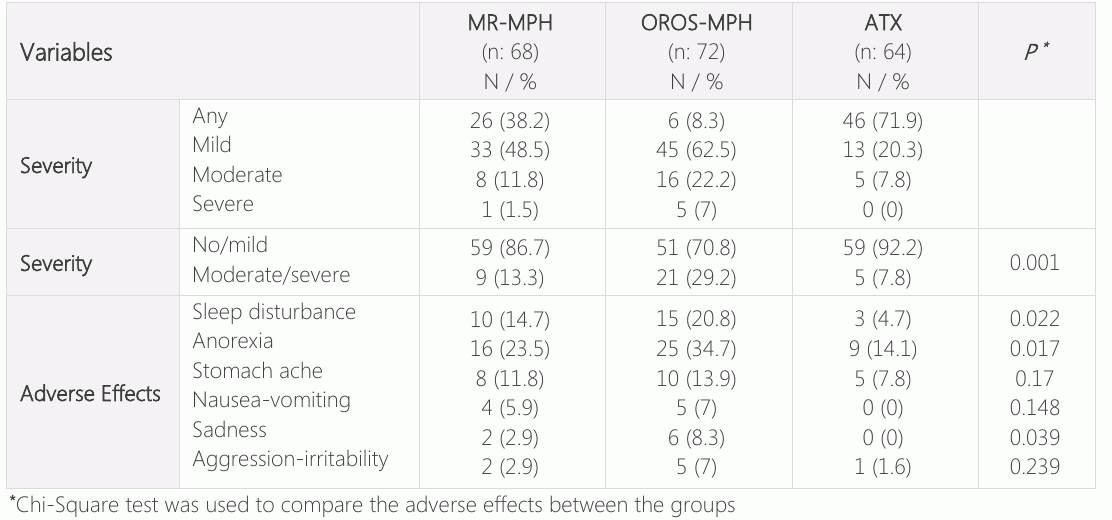
Adverse effects in treatment groups are shown in Table 3. As seen in the table, adverse effect severity differed significantly between groups (p=0.001). Post-hoc data analysis was performed to determine which group caused the difference. Modified release MPH and ATX groups were compared in terms of adverse effect severity, and there was no difference statistically (p=0.271). Hence, it was concluded that the statistical difference was related to OROS-MPH group. Table-3 also shows that sleep disturbances(p=0.02), appetite (p=0.017), and sadness (p=0.039) were meaningfully different between the groups. Post-hoc analyses were performed to understand which group made the difference. After posthoc analyses, it was found that the difference in sleep disturbances and appetite was related to the ATX group, and sadness was related to OROS-MPH group.
Discussion
This study investigates the improvement, treatment compliance, and side effects of three medications (MR-MPH, OROS-MPH, ATX) which are frequently used in the treatment of ADHD symptoms in school-age children.
Previous studies generally reported that both MPH and ATX were associated with significant improvements in ADHD symptoms, including inattentiveness and hyperactivity/impulsivity (6–8). On the other hand, Kemner et al. showed that MPH was superior to ATX in reducing the core symptoms of ADHD (9). In the present study, our findings were consistent with the results of Kemner’s study. We found that ATX was less effective than MR-MPH and OROS- MPH. Different methods in the studies might influence the observed results. As a different perspective, it could be said that the treatment duration in our study was very short (8 weeks). The short treatment duration may be inadequate to evaluate the efficacy of ATX. Because, in the first weeks after starting treatment, the efficacy of MPH might increase at a faster rate than that of ATX. Reductions in ADHD symptoms with ATX may take up to 12 weeks. In this study, CGI-I was not significantly different between MR-MPH and OROS-MPH groups. In this context, it can be speculated These two formulations may have similar effectiveness. However, there is inconsistent literature about the comparison of MR-MPH and OROS-MPH effectiveness. Similar to our study, Sonuga-Barke et al. reported no meaningful difference between the effects of these formulations on parent ratings of ADHD symptoms (10). In one study, MR-MPH (50% immediate release) was found to be superior to OROS-MPH (22% immediate release) in the treatment of ADHD (11). Another study showed that transitioning onto OROS-MPH improved the symptoms in patients with ADHD who had insufficient response to MR-MPH (12). These conflicting results demonstrate that future long-term studies are needed to clarify the subject. In the present study, there was no significant difference between the groups in terms of treatment compliance. Most of the patients continued using the medications. Modified release MPH, osmotic-release MPH, and ATX were generally well tolerated, with few discontinuations due to side effects. Shang et al. declared that OROS-MPH and ATX were safe and well tolerated, with only mild differences in tolerability between the two medications. (13). In the study of Kratochvil et al. the patients using ATX reported vomiting and somnolence more frequently than those using MPX (2). In another study, insomnia was seen more frequently in patients using MPH (14). In our study, OROS-MPH appeared to be associated with sadness. On the other hand, we found that the patients using ATX complained about sleep disturbances and appetite less frequently than the patients using MPH. In this context, choosing ATX treatment may be more appropriate in patients with sleep problems, anorexia, weight loss, and depressive symptom. The interpretation of the results of this study is limited by several factors. Treatment duration is an important limitation. The prolongation of treatment duration might increase the effectiveness of ATX. Another limitation is not using ADHD assessment scales such as Turgay DSM-IV-Based Child and Adolescent Behavior Disorders Screening and Rating Scale or Conners Parent - Teacher Rating Scale. A third limitation of the study is that it does not include a control group. The addition of a placebo group will increase the value of the findings. The awareness and prevalence of ADHD and the number of applications to child and adolescent psychiatry clinics are gradually growing. As a result, the number of children and adolescents using these medications is increasing. Therefore, it is very important to investigate the effectiveness and tolerability of these medications in pediatric ages. Choosing the most appropriate treatment method will reduce the side effects and increase the achievements and quality of life of both children and families.
Declarations
- Author contributions (CRediT)
- All authors contributed equally to all 14 CRediT roles (Conceptualization, Data curation, Formal analysis, Funding acquisition, Investigation, Methodology, Project administration, Resources, Software, Supervision, Validation, Visualization, Writing – original draft, Writing – review & editing).
- Funding
-
Funding information was not reported in the published version of this article.
- Conflicts of interest
- The author has no conflict of interest with the present article.
- Ethics approval
- Subjects for this study were drawn from a clinical sample of primary school-age children with ADHD who were referred to Hatay State Hospital Child and Adolescent Psychiatry Clinic through January to December 2017. The study was approved by the Ethics Committee of Adana City Hospital in Adana in Turkey.
- Data availability
- A data availability statement was not reported in the published version of this article.
References (14)
14 of 14 references are linked to their DOI.
- Ozbaran B, Kose S, Yuzuguldu O, Atar B, Aydin C. Combined methylphenidate and atomoxetine pharmacotherapy in attention deficit hyperactivity disorder. World J Biol Psychiatry. 2015;16(8):619–24 DOI Crossref PubMed Google Scholar
- Kratochvil CJ, Heiligenstein JH, Dittmann R, Spencer TJ, Biederman J, Wernicke J, et al. Atomoxetine and Methylphenidate Treatment in Children With ADHD: A Prospective, Randomized, Open-Label Trial. J Am Acad Child Adolesc Psychiatry. 2002;41(7):776– 84 DOI Crossref PubMed Google Scholar
- Liu Q, Zhang H, Fang Q, Qin L. Comparative efficacy and safety of methylphenidate and atomoxetine for attention-deficit hyperactivity disorder in children and adolescents: Meta-analysis based on head-to-head trials. J Clin Exp Neuropsychol.2017;39(9):854-65 DOI Crossref PubMed Google Scholar
- Madhusoodanan S, Goia D. Rapid resolution of depressive symptoms with methylphenidate augmentation of mirtazapine in an elderly depressed hospitalized patient: a case report. Clin Pract. 2014;11(3):283 DOI Crossref PubMed Google Scholar
- Garg J, Arun P, Chavan BS. Comparative short term efficacy and tolerability of methylphenidate and atomoxetine in attention deficit hyperactivity disorder. Indian Pediatr. 2014;51(7):550– 4 DOI Crossref PubMed Google Scholar
- Su Y, Yang L, Stein MA, Cao Q, Wang Y. Osmotic Release Oral System Methylphenidate Versus Atomoxetine for the Treatment of Attention-Deficit/Hyperactivity Disorder in Chinese Youth: 8-Week Comparative Efficacy and 1-Year Follow-Up. J Child Adolesc Psychopharmacol. 2016;26 (4):362– 71 DOI Crossref PubMed Google Scholar
- Yildiz O, Sismanlar SG, Memik NC, Karakaya I, Agaoglu B. Atomoxetine and Methylphenidate Treatment in Children with ADHD: The Efficacy, Tolerability and Effects on Executive Functions. Child Psychiatry Hum Dev. 2011;42(3):257–69 DOI Crossref PubMed Google Scholar
- Newcorn JH, Kratochvil CJ, Allen AJ, Casat CD, Ruff DD, Moore RJ, et al. Atomoxetine and Osmotically Released Methylphenidate for the Treatment of Attention Deficit Hyperactivity Disorder: Acute Comparison and Differential Response. Am J Psychiatry. 2008;165(6):721– 30 DOI Crossref PubMed Google Scholar
- Kemner JE, Starr HL, Ciccone PE, Hooper-Wood CG, Crockett RS. Outcomes of OROS methylphenidate compared with atomoxetine in children with ADHD: a multicenter, randomized prospective study. Adv Ther. 2005;22(5):498–512 DOI Crossref PubMed Google Scholar
- Sonuga-Barke EJS, Coghill D, DeBacker M, Swanson J. Measuring Methylphenidate Response in Attention-Deficit/Hyperactvity Disorder: How Are Laboratory Classroom-Based Measures Related to Parent Ratings? J Child Adolesc Psychopharmacol. 2009;19(6):691–8 DOI Crossref PubMed Google Scholar
- Döpfner M, Ose C, Fischer R, Ammer R, Scherag A. Comparison of the Efficacy of Two Different Modified Release Methylphenidate Preparations for Children and Adolescents with Attention-Deficit/Hyperactivity Disorder in a Natural Setting: Comparison of the Efficacy of Medikinet Retard and Concerta Randomized, Controlled, Double-Blind Multicenter Clinical Crossover Trial. J Child Adolesc Psycho pharmacol. 2011;21(5):445– 54 DOI Crossref PubMed Google Scholar
- Wolff C, Alfred A, Lindermüller A, Rettig K, Mattejat F, Gerwe M, et al. Effect of transitioning from extended-release methylphenidate onto osmotic, controlled-release methylphenidate in children/ adolescents with ADHD: results of a 3-month non-interventional study. Curr Med Res Opin. 2011;27 (sup2):35–44 DOI Crossref PubMed Google Scholar
- Shang C-Y, Pan Y-L, Lin H-Y, Huang L-W, Gau SS- F. An Open- Label, Randomized Trial of Methy lphenidate and Atomoxetine Treatment in Children with Attention-Deficit/Hyperactivity Disorder. J Child Adolesc Psycho pharmacol. 2015;25(7):566– 73 DOI Crossref PubMed Google Scholar
- Biederman J, Heiligenstein JH, Faries DE, Galil N, Dittmann R, Emslie GJ, et al. Efficacy of atomoxetine versus placebo in school- age girls with attention-deficit/hyperactivity disorder. Pediatrics. 2002;110 (6):e75 DOI Crossref PubMed Google Scholar
Read the full text
Open the PDF here
Loading the PDF…
If the PDF does not show here, use the download button above.
How to cite this article
Gunes S. Comparison of Efficacy and Tolerability of Modified Release Methylphenidate, Osmotic-Release Methylphenidate and Atomoxetine in Children with Attention Deficit Hyperactivity Disorder. Ulutas Med J. 2019;5(1):71-76. doi:10.5455/umj.20191130053404
Gunes, S. (2019). Comparison of Efficacy and Tolerability of Modified Release Methylphenidate, Osmotic-Release Methylphenidate and Atomoxetine in Children with Attention Deficit Hyperactivity Disorder. The Ulutas Medical Journal, 5(1), 71–76. https://doi.org/10.5455/umj.20191130053404
Gunes, S. (2019) 'Comparison of Efficacy and Tolerability of Modified Release Methylphenidate, Osmotic-Release Methylphenidate and Atomoxetine in Children with Attention Deficit Hyperactivity Disorder', The Ulutas Medical Journal, 5(1), pp. 71–76. doi: 10.5455/umj.20191130053404.