The Ulutas Medical Journal · ISSN 2149-0430 (print), 2149-388X (online) · https://www.ulutasmedicaljournal.com/?mno=299259
Original Research · Open access
The pattern of Virological Markers in Asymptomatic Hepatitis B Positive Patients
Also available in: العربية · Türkçe · 中文
Abstract
- Introduction
- Hepatitis B is a disease with its various complications if left untreated. Various studies have been conducted to explore the relationship between virological markers and stage of the disease. This study attempted to observe the pattern of virological markers (Hepatitis E antigen, Hepatitis B virus DNA) in Hepatitis B surface antigen positive asymptomatic patients.
- Materials and Methods
- This cross-sectional was conducted in liver center of Holy Family Hospital, Rawalpindi in 2016 and 349 patients who were HBsAg positive but asymptomatic were selected. Patients, with chronic hepatitis B but on current treatment were included while patients with acute hepatitis were excluded. Data about age, gender, HBeAg positive or negative and HBV DNA positive or negative was entered and analyzed using Statistical Package of Social Sciences and a descriptive analysis was performed whereas Pearson's Chi-square test was applied at 5% level of significance to compare proportions of virological markers based on gender.
- Results
- Among 349 patients, 254 (73%) were males and 94 (27%) were females. HBeAg was found in 67(23.5%) patients while 218 (76.5%) were negative. The gender wise distribution of HBeAg among the females was 26.3% (20) and, among the males, it was 22.5% (49). HBV DNA was presented in 211 (65.9%) while 109 (34%) were negative for HBV DNA. Among the females, 59 (69.4%) were HBV DNA positive, as 152 (65.4%) males were positive.
- Conclusion
- HBV DNA was presented in more than half of the population. Virological markers (HBeAg, HBV DNA) existed almost in equal proportion among males and females.
Keywords
Full text
Introduction
Hepatitis, the inflammation of the liver, may be self-limiting or can lead to cirrhosis and liver cancer (1). Its causes include hepatitis viruses: A, B, C, D, E, of which hepatitis A, B, and C are most common. Hepatitis B virus (HBV) which is a DNA virus, its route of transmission includes infected blood, sexual contact, and other body fluids. There is also vertical (from mother to baby) transmission. Source of infection also includes contaminated syringes. The vaccine is available to control hepatitis B (2). HBV may cause acute infection and it may lead to the development of the chronic stage. It may be symptomatic or cause nonspecific symptoms. Other causes of hepatitis include drugs, in-fections, alcohol and autoimmune (3). Hepatitis B serological markers include HBsAg, HBeAg, HBeAb, and HBV DNA (4). Two billion people have been infected throughout the world due to HBV, of which 240 million people get admittance in the chronic stage. Every year, one million people die due to hepatitis and its related complications (5). Prevalence in Pakistan among healthy people is about 2.4%(6).
An American study showed that 68.5% of asymptomatic patients were HBeAg positive (7). A study conducted in China showed results that majority (84%) of asymptomatic HBsAg positive patients have HBeAg levels (8). Another study conducted in India showed that a high proportion of patients which were chronic and remain asymptomatic have DNA >5 log copies /ml (9).
A study which was conducted in Taiwan showed that patients with chronic HBV infection who were positive for HBeAg, 96.3% of them have DNA in their serum (10). A European study showed that HBVDNA was present in the serum of 53.5% of HBsAg carriers (11). An American study showed that the prevalence of HBeAg remained unaffected in relation to the patient’s gender (7).
Hepatitis is a very serious disease with a much higher prevalence in our society. The burden of its consequences is increasing as we speak. Purpose of the study is to identify magnitude of the presence of virological markers in asymptomatic individuals, so that the disease may be identified before it reaches full impact. Objectives of the study were to determine the frequency of patients with asymptomatic, HBsAg positive patients with positive HBeAg and HBV DNA and distribution of virological markers in relation to gender in asymptomatic, HBsAg positive patients. This study is one of its kinds since no such study from this region has been reported before in literature.
Materials and Methods
This cross-sectional study was conducted in liver center of Holy Family Hospital, Rawalpindi where 349 patients of 10 to 90 years were included. These all patients were positive for HBsAg but were asymptomatic at the time of presentation. Chronic hepatitis B patients, who were currently receiving treatment, were included and while those with acute hepatitis, were excluded. Using WHO sample size calcu-lator, the sample size was calculated for both study variables but the largest sample size was considered for this study. Keeping the level of confidence 95%, absolute precision required 5% and anticipated population proportion of 0.685 for HBeAg minimally required sample size was 322. Similarly for HBV DNA minimally required sample size was 95. Taking larger sample size minimally required patients were 322. But, we included 349 patients in total.
Statistical Analysis
After an appraisal of Institutional Research Forum( IRF) of Rawalpindi Medical College, who fulfill the selection criteria were included after informed oral consent, through nonprobability consecutive sampling technique. The relevant information regarding age, gender, HBsAg (ELISA), HBeAg (ELISA) and HBV DNA(PCR) was taken from the record and to structured checklist, all the data was entered and analyzed using Statistical Package of Social Sciences (SPSS version 22) and descriptive analysis was performed.
Whereas the Pearson’s Chi-square test was applied at 5% level of significance to compare proportions of virological markers based on gender. A p-value of ≤0.05 was considered statistically significant.
Results
For all 349 patients included in this group, the mean age was calculated to be 32.54±13.47 years; while the youngest person of this study group was 10 years and eldest was 83 years with a range of 73 years. Among 349 patients 94 (26.9%) were females and 254 (72.8%) were males. All study participants were positive for Amongst 349 patients, 67(23.9%) patients were positive for HBeAg while 218(76.1%) were negative for HBeAg as shown in figure 1. Data for 64 patients regarding HBeAg serology was unavailable.
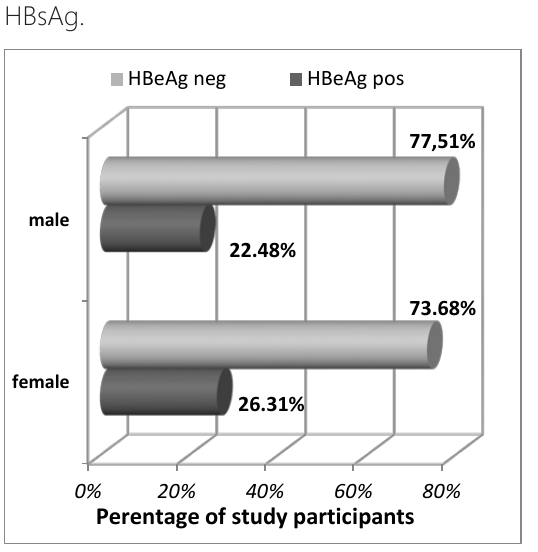
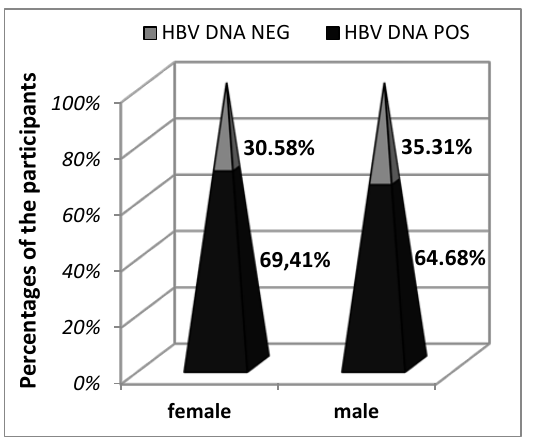
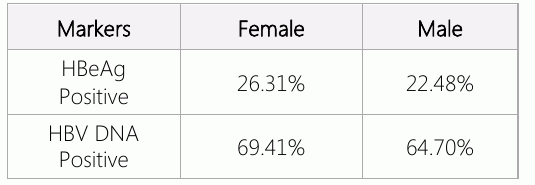
When HBeAg serology was compared in 285 patients based on gender, no statistically significant association was observed with a p-value of 0.5. As regards serology HBV DNA, available for 349 patients, 211 (65.9%) patients were positive for HBV DNA and 109 (34.1%) were negative as exhibited in the figure 2. Amongst these 349 patients, 85 were females and 235 were males and HBV DNA was present in 59 (69.4%) females and 152 (64.7%) and this difference were not statistically significant with a p-value of 0.5.
Discussion
Hepatitis is a disease with complications if left untreated. As mentioned prevalence in Pakistan is 2.4% amongst healthy individuals. This was conducted in asymptomatic HBsAg positive patients to show specific findings so that the disease can be treated in its early stages. Our study showed results that HBV DNA was present in 211 (65.9%) patients which coincide with findings of a European study by Agalar C et al which showed that more than half of patients (53.5%) were HBV DNA positive in HBsAg carrier (11). Our study findings are also consistent with findings of another study conducted in India by Kumar M et al which showed that a high proportion of patients which remained asymptomatic, have HBV DNA in their serum (9). An American study carried out by Alward WLM showed results that HBeAg level in asymptomatic hepatitis B patients was 68.5% (8), but our study showed results that most of the patients (23.9%) were negative for HBeAg. It may be due to the reason that we included patients who were in current antiviral therapy. This is a question for future studies. The study of Agalar et al (7) also showed that presence of HBeAg was not affected based on gender and results of our study also coincides in that HBeAg is present in an equal proportion between males and females. There was no statistically significant difference in HBeAg distribution based on gender.
The positive aspect of our study is that it showed a high proportion of HBV DNA in asymptomatic HBsAg positive patients. So that, aggressive treatment should be given at this stage to reduce HBV DNA level, by the way, its proliferation is stopped. But our study took only asymptomatic patients. Future studies should have both asymptomatic and symptomatic patients for comparisons and associations.
Conclusion
Almost three quarters of the patients were negative for HBeAg. HBV DNA was presented in more than half of the patients. Virological markers (HBeAg, HBV DNA) were seen most likely in equal proportion among males and females.
Declarations
- Author contributions (CRediT)
- All authors contributed equally to all 14 CRediT roles (Conceptualization, Data curation, Formal analysis, Funding acquisition, Investigation, Methodology, Project administration, Resources, Software, Supervision, Validation, Visualization, Writing – original draft, Writing – review & editing).
- Funding
-
Funding information was not reported in the published version of this article.
- Conflicts of interest
- The authors declare that they have no conflict of interest in the current study.
- Ethics approval
- Ethics approval details were not reported in the published version of this article.
- Data availability
- A data availability statement was not reported in the published version of this article.
References (11)
5 of 11 references are linked to their DOI.
- WHO | what is hepatitis, http://www.who.int/features/qa/76 /en/ (Accessed 23, 2016). PubMed Google Scholar
- WebMD. Understanding Hepatitis - the Basics. http://www. webmd.com/hepatitis/understanding-hepatitis-basics. (Accessed 26 March 2016). PubMed Google Scholar
- MedicineNet. Hepatitis (Viral Hepatitis, A, B, C, D, E, G). http: //www.medicinenet.com/script/main/hp.asp. (Accessed 26 March 2016). PubMed Google Scholar
- Hepatitis B Foundation. What are the serological markers for hepatitis B. http://www.hepb.org/expforum/media-player. aspx? speakerID (Accessed 7 April 2016). PubMed Google Scholar
- Hepatitis B Foundation. Statistics. www.hepb.org/hepb/ statistics.html (Accessed 23 March 2016). PubMed Google Scholar
- Ali SA, Donahue RMJ, Qureshi H, Vermund SH, Hepatitis B and Hepatitis C in Pakistan: prevalence and risk factors. Int J Infect Dis. 2009 Jan; 13(1):9–19 DOI Crossref PubMed Google Scholar
- Alward WLM, MacMahon BJ, Hall DB,Heyward WL, Francis DP, Bender TR. The Long-Term Serological Course of Asymptomatic Hepatitis B Virus Carriers and Development of Primary Hepatocellular Carcinoma. The journal of infectious disease. (1985); 151(4):604-9 DOI Crossref PubMed Google Scholar
- Lok M, Lai CL. A longitudinal follow -up of asymptomatic hepatitis B surface antigen-positive chinese children. Hepatology. (1988); 8(5):1130-3. DOI Crossref PubMed Google Scholar
- Kumar M, Sarin SK, Hissar S, Pande C, Sakhuja P, Sharma BC, et al. Virologic and Histologic Features of Chronic Hepatitis B Virus-Infected Asymptomatic Patients With Persistently Normal ALT. Gastroentrology (2008); 134(5): 1376-84 DOI Crossref PubMed Google Scholar
- Chu CM, Karayiannis P, Fowler MJ, Monjardino J, Liaw YF, Thomas HC. Natural history of chronic hepatitis B virus infection in Taiwan: studies of hepatitis B virus DNA in serum. Hepatology. (1985); 5(3):431-4. DOI Crossref PubMed Google Scholar
- Agalar C, Diri C, Agalar F, Usubutun S, Turkyilmaz R.The role of HBV DNA and liver histopathology in HBsAg carriers. Hepatogestroentrology. (1997); 44(16):1196-9. PubMed Google Scholar
Respond to this article
Comments on a published article are welcome as a Letter to the Editor.
Get an e-mail when new articles in your fields are published
Questions to the authors
Questions are moderated: an editor approves each question, the authors answer, and an editor approves the answer before both appear here.
No answered questions yet.
Ask the authors a question
Discussion
Comments are moderated: they appear after the writer confirms the e-mail address and an editor approves them. Each comment carries a conflict-of-interest statement.
No comments yet.
Write a comment
Tell me when this article is cited
Leave your e-mail address and confirm it. These notices are not being sent yet; your confirmed address is kept for them and used for nothing else.
Read the full text
Open the PDF here
Loading the PDF…
If the PDF does not show here, use the download button above.
How to cite this article
Awan MAJ, Amin M, Ahmad H. The pattern of Virological Markers in Asymptomatic Hepatitis B Positive Patients. Ulutas Med J. 2018;4(3):144-147. doi:10.5455/umj.20180515094138
Awan, M. A. J., Amin, M., & Ahmad, H. (2018). The pattern of Virological Markers in Asymptomatic Hepatitis B Positive Patients. The Ulutas Medical Journal, 4(3), 144–147. https://doi.org/10.5455/umj.20180515094138
Awan, M.A.J., Amin, M. and Ahmad, H. (2018) 'The pattern of Virological Markers in Asymptomatic Hepatitis B Positive Patients', The Ulutas Medical Journal, 4(3), pp. 144–147. doi: 10.5455/umj.20180515094138.
@article{umj299259,
  title = {The pattern of Virological Markers in Asymptomatic Hepatitis B Positive Patients},
  author = {Awan, Malik Abdul Jabbar and Amin, Mehvish and Ahmad, Hanan},
  journal = {The Ulutas Medical Journal},
  year = {2018},
  volume = {4},
  number = {3},
  pages = {144--147},
  doi = {10.5455/umj.20180515094138},
  url = {https://www.ulutasmedicaljournal.com/?mno=299259},
  issn = {2149-388X}
}