The Ulutas Medical Journal · ISSN 2149-0430 (print), 2149-388X (online) · https://www.ulutasmedicaljournal.com/?mno=291029
Case Report · Open access
A Case of Acute Sterile Endophthalmitis after Intravitreal Dexamethasone
Also available in: العربية · Türkçe · 中文
- Medical doctor, King Saud university, Riyadh, Saudi Arabia ROR
- Senior academic consultant, vitreoretinal and uveitis, chief of uveitis division, King Khaled Eye Specialist Hospital, Riyadh, Saudi Arabia. ROR
Abstract
- Introduction
- Intravitreal dexamethasone implant (IDI) has been recently introduced into clinical practice for the treatment of various ocular conditions including non-infectious uveitis and macular edema. Endophthalmitis following IDI is an uncommon and a serious complication.
- Case Presentation
- In this report, we present a case of sterile endophthalmitis following IDI in a fourteen-year-old female for whom IDI was indicated to treat uveitic cystoid macular edema, which was refractory to maximum systemic and local therapy. She presented within 24 hours following the implant insertion, complaining of only a decrease in vision. It was managed by emergent pars plana vitrectomy with the removal of the implant. This resulted in clinical improvement and resolution of the inflammation. Intravitreal and implant Gram stain and polymerase chain reaction came out negative. An IDI was implanted one year later without similar complications.
- Conclusion
- Our case showed that sterile endophthalmitis could occur following intravitreal dexamethasone injection. Repeated IDI does not seem to be contraindicated.
Keywords
Full text
Introduction
Cystoid macular edema is the leading cause of decreased vision in uveitis patients with incidence varying from 12 to 51 percent (1). Intravitreal dexamethasone implant (IDI) has been recently introduced into clinical practice for the treatment of various ocular conditions including non-infectious uveitis and macular edema. The IDI was approved by the United States Food and Drug Administration (FDA) in 2009 (2). Since then, numerous studies have demonstrated its efficacy and safety. Most of the studies reported a high safety profile with a few common side effects, including increased intraocular pressure and cataract formation or progression (3). To our knowledge, only a few cases of endophthalmitis after IDI were reported in the literature (4–7). We present a case of sterile endophthalmitis following IDI occurring in a fourteen-year-old female with uveitic cystoid macular edema refractory to systemic therapy and topical treatment.
Case Presentation
A 14 years female developed endophthalmitis following IDI in her right eye that was indicated for refractory cystoid macular edema. She had idiopathic intermediate uveitis complicated by uveitic glaucoma and cystoid macular edema. Uveitis investigations included complete blood count (CBC), erythrocyte sedimentation rate (ESR), renal function test, liver function test (LFT), purified protein derivative (PPD), and magnetic resonance imaging (MRI). All came back with no explanation for a systemic disease causing uveitis.
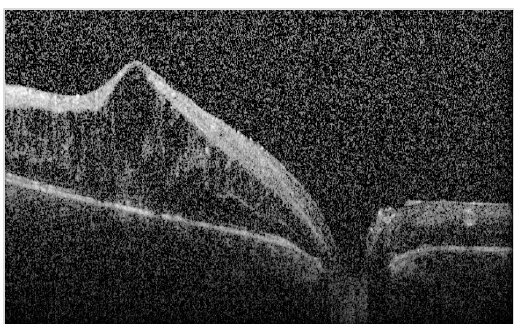
Despite the use of maximum systemic therapy of Humira, methotrexate, and prednisone, plus topical prednisolone and Lotemax, along with multiple Lucentis and Avastin injections, her huge cystoid macular edema was refractory and not improving specifically in the right eye (Figure 1). She had multiple IDI administered to the right eye, and on one occasion, she developed sterile endophthalmitis.
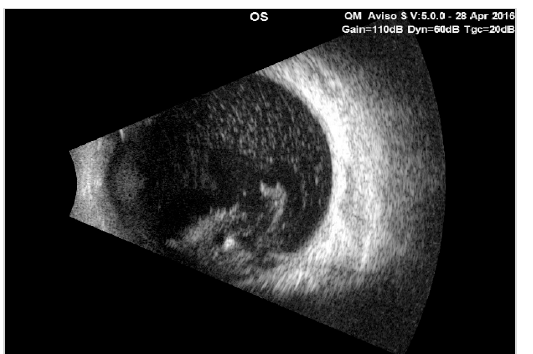
On the day of the procedure, after informed consent was obtained and risks and benefits were discussed with the patient and her family, the implant was injected in the minor operating room in a sterile manner. The patient tolerated the procedure well. Afterward, she was sent to the clinic to be examined, without complaints. One day following the injection, she presented to the emergency department complaining of a decrease in vision in the right eye, with a visual acuity of hand motion. She had no pain or tenderness. Slit-lamp examination of the right eye showed corneal epithelial edema, anterior chamber fibrinous reaction, and hypopyon. Fundus examination was difficult due to a hazy media. B-scan ultrasonography was suggestive of early endophthalmitis (Figure 2).
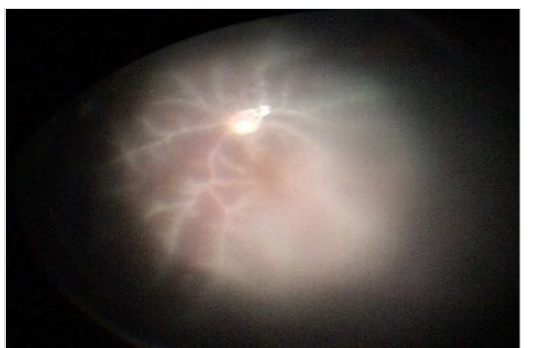
The diagnosis was acute endophthalmitis. As a result, she was admitted for pars plana vitrectomy (PPV), which was done under the general anesthesia. A vitreous sample was taken for Gram stain, polymerase chain reaction (PCR) and culture and sensitivity. The implant was removed and sent for culture and sensitivity. Fundus examination during the procedure revealed a dense vitreous opacity and diffuse vascular sheathing like frosted angiitis (Figure 3).
She clinically improved on the examination following the procedure. The vitreous Gram stain, culture and PCR came out negative. Upon discharge, her visual acuity improved to counting fingers at five feet. One IDI was indicated following endophthalmitis incident at one year for refractory macular edema that was not improving on other systemic treatment modalities. The procedure went well without any complications.
Discussion
Slow-release IDI, known as Ozurdex (Allergan Inc., Irvine, CA), provides a sustained release of 0.7 mg of micronized dexamethasone targeting the retina and the vitreous over time. As a result, it ensures high anti-inflammatory effect for several months (3). Ozurdex is used for the treatment of posterior non-infectious uveitis, macular edema (ME) resulting from vascular occlusions, and diabetic macular edema in adults (2).
Intermediate uveitis (IU) is the inflammation of the anterior vitreous, peripheral retina and the ciliary body. In children, 10 to 20 percent of patients who present with uveitis signs have IU (8). The association of IU and systemic diseases in the pediatric age group is less common in comparison to anterior uveitis. Thus, most cases are idiopathic and account for 60 percent of all IU cases (9). Patients often present with floaters and blurred vision. A more severe clinical presentation is vision loss due to cystoid macular edema (CME)(1). The main stay of treatment of CME secondary to IU is systemic, periocular or intravitreal steroids (10). Prolonged use of systemic steroids is not highly recommended, particularly in the pediatric age group, due to its serious consequences which include growth retardation, osteoporosis, glaucoma, and cataract formation (11). IDI is a promising alternative due to its high efficacy and minimal side effects. To date, two studies have focused on IDI among children. The first study was on patients with a mean age of 12 years old suffering from intermediate or posterior uveitis. The high efficacy of IDI was proven in terms of improved visual acuity, reduced inflammation, and decreased macular edema. The most commonly reported complications were elevated intra-ocular pressure (IOP) and cataract formation or progression. The results of the second study supported the first one. Similar complications occurred, in addition to migration of implant into the anterior chamber (11, 12).
Those side effects were similar to what was reported in older age groups. However, more severe complications, such as endophthalmitis, occurred in adults. Although its incidence is very low, it is a vision-threatening complication. During our literature review, we found only five published cases of acute endophthalmitis following IDI. All cases occurred in adults. IDI was indicated for retinal vascular disorders in four out of the five cases, and in the fifth case, it was indicated for diabetic macular edema. All cases presented after at least two day (4–7). Comparing our case to the published cases, we reported the first endophthalmitis case following an IDI in the pediatric age group presenting within 24 hours of the procedure. Our patient was on immunosuppressive drugs, which were challenging. She presented with only vision loss and no pain. Due to its severity, the disease was managed by emergent PPV, intravitreal antibiotics and removal of implant, which resulted in immediate improvement. Based on culture and PCR results, we believe that our patient had sterile endophthalmitis. The IDI procedure was repeated almost one year later on the same eye with neither complications nor signs of endophthalmitis recurrence.
Conclusion
In conclusion, sterile endophthalmitis is a possible complication following IDI. We advise educating patients undergoing IDI about the warning signs of endophthalmitis, including a drop of vision and pain. Management is individualized depending on the severity of the case. Repetition of the IDI does not seem to be contraindicated in patients who develop endophthalmitis.
Declarations
- Author contributions (CRediT)
- All authors contributed equally to all 14 CRediT roles (Conceptualization, Data curation, Formal analysis, Funding acquisition, Investigation, Methodology, Project administration, Resources, Software, Supervision, Validation, Visualization, Writing – original draft, Writing – review & editing).
- Funding
-
Funding information was not reported in the published version of this article.
- Conflicts of interest
- The authors declare that they have no conflict of interest in the present study.
- Ethics approval
- Ethics approval details were not reported in the published version of this article.
- Data availability
- A data availability statement was not reported in the published version of this article.
References (12)
9 of 12 references are linked to their DOI.
- Manohar Babu B, Rathinam SR. Intermediate uveitis. Indian J Ophthalmol. 2010;58(1):21-27 PubMed Google Scholar
- Ozurdex. Irvine, CA: Allergan, Inc.; 2009. PubMed Google Scholar
- Boyer DS, Yoon YH, Belfort R, et al. Three-year, randomized, sham-controlled trial of dexamethasone intravitreal implant in patients with diabetic macular edema. Ophthalmology. 2014;121(10):1904-14 DOI Crossref PubMed Google Scholar
- Marchino T, Vela JI, Bassaganyas F, Sánchez S, Buil JA. Acute-Onset Endophthalmitis Caused by Alloiococcus otitidis following a Dexamethasone Intravitreal Implant. Case Rep Ophthalmol. 2013;4:37-41 DOI Crossref PubMed Google Scholar
- Arıkan Yorgun M, Mutlu M, Toklu Y, Çakmak HB, Çağıl N. Suspected Bacterial Endophthalmitis Following Sustained-release Dexamethasone Intravitreal Implant: A Case Report. Korean J Ophthalmol: KJO. 2014;28(3):275-277 DOI Crossref PubMed Google Scholar
- Goel N. Acute bacterial endophthalmitis following intravitreal dexamethasone implant: A case report and review of literature. Saudi J Ophthalmol. 2017;31(1):51-54 DOI Crossref PubMed Google Scholar
- Esen E, Sizmaz S, Demircan N. Two cases of acute endophthalmitis after intravitreal dexamethasone implant injection. Retin Cases Brief Rep. 2016; 10(2): 154-156 DOI Crossref PubMed Google Scholar
- Annamalai R, Biswas J. Patterns of intermediate uveitis in children presenting at a tertiary eye care center in South India. Middle East Afr J Ophthalmol 2017;24:94-9 DOI Crossref PubMed Google Scholar
- Mackensen, F, Baydoun, L, Garweg, J., et al. Uveitis intermedia. The Ophthalmologist (2014) 111:1033 PubMed Google Scholar
- Rossetto J, Nascimento H, Fernandes D, Belfort Jr. R, Muccioli C. Treatment of cystoid macular edema secondary to chronic non-infectious intermediate uveitis with an intraocular dexa methasone implant. Arq Bras Oftalmol. 2015;78(3):190-193 DOI Crossref PubMed Google Scholar
- Sella R, Oray M, Friling R, et al. Dexamethasone intravitreal implant (Ozurdex®) for pediatric uveitis. Graefes Arch Clin Exp Ophthalmol (2015) 253: 1777– 1782 DOI Crossref PubMed Google Scholar
- Bratton MY, He, D. Weakley DR. Dexamethasone intravitreal implant (Ozurdex) for the treatment of pediatric uveitis. Journal of American Association for Pediatric Ophthalmology and Strabismus. 2014; 18: 110-113 DOI Crossref PubMed Google Scholar
Respond to this article
Comments on a published article are welcome as a Letter to the Editor.
Get an e-mail when new articles in your fields are published
Questions to the authors
Questions are moderated: an editor approves each question, the authors answer, and an editor approves the answer before both appear here.
No answered questions yet.
Ask the authors a question
Discussion
Comments are moderated: they appear after the writer confirms the e-mail address and an editor approves them. Each comment carries a conflict-of-interest statement.
No comments yet.
Write a comment
Tell me when this article is cited
Leave your e-mail address and confirm it. These notices are not being sent yet; your confirmed address is kept for them and used for nothing else.
Read the full text
Open the PDF here
Loading the PDF…
If the PDF does not show here, use the download button above.
How to cite this article
Aljebreen MA, Aldhibi H. A Case of Acute Sterile Endophthalmitis after Intravitreal Dexamethasone. Ulutas Med J. 2018;4(3):164-167. doi:10.5455/umj.20180213084431
Aljebreen, M. A., & Aldhibi, H. (2018). A Case of Acute Sterile Endophthalmitis after Intravitreal Dexamethasone. The Ulutas Medical Journal, 4(3), 164–167. https://doi.org/10.5455/umj.20180213084431
Aljebreen, M.A. and Aldhibi, H. (2018) 'A Case of Acute Sterile Endophthalmitis after Intravitreal Dexamethasone', The Ulutas Medical Journal, 4(3), pp. 164–167. doi: 10.5455/umj.20180213084431.
@article{umj291029,
  title = {A Case of Acute Sterile Endophthalmitis after Intravitreal Dexamethasone},
  author = {Aljebreen, Manar Ahmad and Aldhibi, Hasan},
  journal = {The Ulutas Medical Journal},
  year = {2018},
  volume = {4},
  number = {3},
  pages = {164--167},
  doi = {10.5455/umj.20180213084431},
  url = {https://www.ulutasmedicaljournal.com/?mno=291029},
  issn = {2149-388X}
}