The Ulutas Medical Journal · ISSN 2149-0430 (print), 2149-388X (online) · https://www.ulutasmedicaljournal.com/?mno=13759
Original Article · Open access
Comparison of LigaSure and the Conventional Method in Total Thyroidectomy: A Single Surgeon's Experience and Review of the Literature that LigaSure is not superior to Suture Ligation in Total Thyroidectomy
- Recep Tayyip Erdogan University, Medical Faculty, General Surgery Department, Rize, Turkey ROR
- Beykoz University, Department of Medical Services and Techniques, İstanbul, Turkey ROR
Abstract
- Background
- The objective of this study was to compare the results of the LigaSure® Precise vessel sealing system and conventional suture ligation (CSL) for total thyroidectomy in terms of complication rates, hospitalization, and surgical time.
- Materials and Methods
- This non-randomized retrospective review included 118 consecutive patients. All patients with nodular or multinodular goiter underwent total thyroidectomy by a single surgeon. The patients were divided into two subgroups: CSL was used as the conventional method together with monopolar and bipolar cautery (group 1), and LigaSure® Precise (L) was used in group 2 as a sealing system for all surrounding tissues of the thyroid gland.
- Results
- No statistically significant differences were found between the two techniques with respect to age, sex, surgical time, hospitalization, and postoperative complications (p>0.05).
- Conclusion
- Sutureless thyroid operations with Ligasure can be safely performed without the presence of higher complication risks but does not reduce surgical time or hospitalization.
Keywords
Full text
Introduction
Use of various diathermy techniques to reduce perioperative transfusions and intra operative blood loss have been recommended and a new electrothermal bipolar tissue sealing system (LigaSure) has been used in various type of surgeries. The LigaSure device uses high current, low-voltage, bipolar radiofrequency (RF) energy. Tissue is grasped and compressed within the jaws of the instrument. When sealing is completed, microprocessor-control feedback mechanism automatically terminates electrical current. This device uses body’s own collagen and elastin to create a permanent fusion zone and can fuse vessels up to and including 7 mm, lymphatics, and tissue bundles, and has an average seal cycle of two to four seconds in most surgical situations (1–4).
Total thyroidectomy is the fundamental treatment for benign and malignant thyroid diseases. However, extended resection may increase postoperative complication rates (5). Bleeding during thyroidectomy surgery may compromise the exposure of the operation site and may lead to damage of the recurrent laryngeal nerve (RLN) and difficult dissection of parathyroid glands, and can extend surgical time. Thyroid surgery requires meticulous devascularization of a large number of blood vessels and plexuses in the parenchyma of the thyroid gland. Therefore, hemostasis is of great importance when dividing various vessels before removing the gland (6).
Effective tissue hemostasis can be achieved through either conventional suture ligation (CSL) or Ligasure system (7). Postoperative hemorrhagic complications and hematoma rates are higher in total thyroidectomy as opposed to subtotal thyroidectomy because of the extended dissection and resection (5, 8, 9). The aim of this study was to compare the results of CSL and the LigaSure Precise vessel sealing system in total thyroidectomy.
Materials and Methods
This retrospective non-randomized clinical trial review included 118 consecutive patients. All patients with a diagnosis of bilateral nodular or multi nodular goiter (MNG) underwent total thyroidectomy by a single surgeon between December 2010 and December 2015. Patients with toxic MNG, thyroid malignancy, intra thorasic goiter and a history of previous thyroid surgery were not included in the study. A fine needle aspiration biopsy was performed preoperatively to exclude malignancy. Written informed consent was obtained from each patient prior to surgery. The ethical approval was obtained from the ethics committee of The Recep Tayyip Erdogan University Educational and Research Hospital in Rize. The approval number for ethic committee is 2018/168.
The data of age, sex, surgical time, length of hospital stay, transient/permanent RLN palsy, transient/permanent,postoperative hematoma, hypocalcemia, and hoarseness were received. Hypocalcaemia was defined as serum calcium level less than 8 mg/dL. Permanent hypo calcemia was defined when a medical regimen was required for longer than 12 months.
Vocal cord paralysis was defined as complete immobility of the vocal cord. If postoperative RLN palsy was detected, the patient was referred to an ear otolaryngologist. All patients with hypocalcemia and recurrent laryngeal nerve paralysis were examined at 12 months postoperatively. RLN palsy lasting more than 12 months was classified as permanent injury. Intraoperative hemorrhage and postoperative drainage volumes were not included due to the retrospective nature of the study.
The patients were divided into two subgroups; CSL was used as the conventional method together with monopolar and bipolar cautery in group 1, and LigaSure® Precise (L) (Covidien, Boulder, CO, USA) was used as a sealing system for all surrounding tissues of thyroid gland including superior and inferior pole vessels in group 2. A drain was used at the end of surgery in accordance with the nature and necessity of the surgical procedure.
Surgical Procedure
Surgery was performed under endotracheal general anesthesia with patients in the anti- Trendelenburg position with their head in dorsal extension. A standard 3-4 cm collar incision was applied 2 cm above the sternal notch. The platysma muscle was cut and upper and lower subplatysmal flaps were prepared. Thyroid cartilage and the sternal notch were the upper and lower boundaries for the skin flaps. The strap muscles were divided vertically in the midline using electrocautery and retracted laterally on both sides. An extra capsular dissection and resection was preferred for all total thyroidectomies. Lobectomy was planned first for the most pathologic side and the carotid sheath become visible with strap muscle retraction. It was not necessary to divide the strap muscles for further exposure. The middle thyroid vein and branches were dissected with using CSL and scissors in group 1 and with Ligasure in group 2. The upper pole was ligated using CSL and scissors in group 1 and with Ligasure in group 2 with careful dissection to avoid injury to the superior laryngeal nerve. The lateral parts were dissected and ligated in the same manner. The RLN was identified to avoid injury and trauma. The lower pole was dissected and ligated with CSL and scissors in group 1 and Ligasure in group 2. Same procedure was performed to the other lobe. Intraoperative neuromonitoring or RLN visualization were not applied routinely in the study.
Statistical Analysis
Data analysis was processed using the SPSS statistics package 17 (SPSS Inc., Chicago, USA). Quantitative data are expressed as mean± standard deviation (SD) and qualitative data are expressed as number and %. A statistical analysis was performed using unpaired t-tests and Fisher’s exact test to determine significant differences with a two-sided p-value of <0.05.
Results
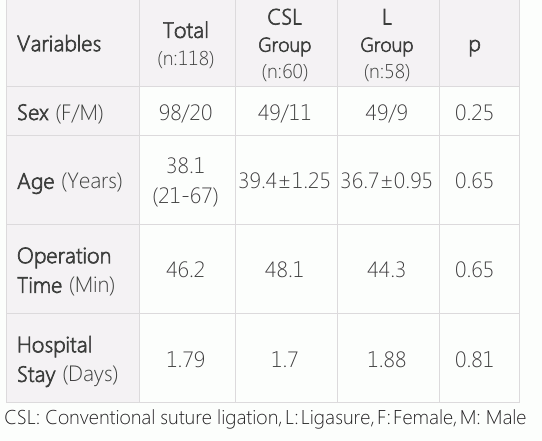
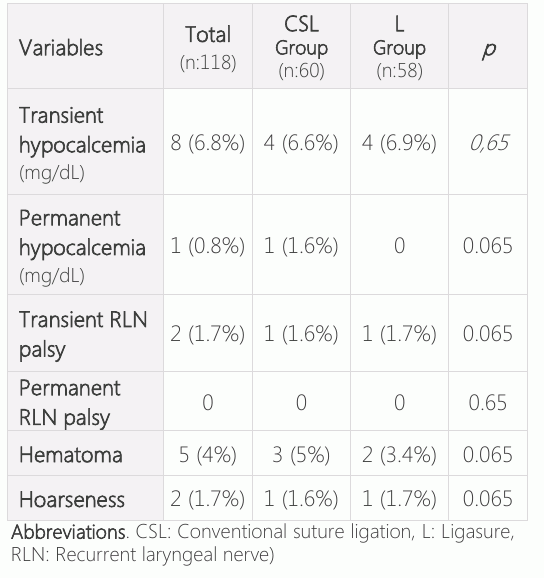
The study consisted of 118 patients [98 females (F) and 20 males (M)]. The mean age was 38.1 (range, 21-67) years. The CSL group comprised 60 patients (49F, 11M) and L group consisted of 58 patients (49F, 9M). The mean age was 39.4±1.25 years in CSL group, and 36.7±0.95 in the L group, 38.1 years across both groups. No statistically significant differences were found between the two groups with respect to age and sex. The mean surgical time was 48.1 minutes in the CSL group, 44.3 minutes in the L group, and 46.2 minutes across both groups. The mean length of hospital stay was 1.7 days in CSL group and 1.88 in the L group (Table-1). Transient hypocalcemia was seen in four patients (6.6% in the CSL group, 6.9% in the L group; 6.8% in total) in each group. Permanent hypocalcemia was observed in only one patient (1.6%) who was in the CSL group. Transient RLN palsy occurred in one patient (1.6% in the CSL group, 1.7% in the L group; 1.6% in total) in each group. No permanent RLN palsy was noted in either group. Transient and permanent hypocalcemia and RLN palsy in groups were not significantly different. Hematoma was observed in three patients (5%) in the CSL group, and 2 in (3.4%) the L group; 4% in total (p=0.065). Hoarseness was observed in one patient (1.6% in the CSL group, and 1.7% in L; 1.7%) in each group. Hematoma and hoarse ness were not statistically significant (Table-2).
Discussion
Sutureless thyroid surgeries have gained increasing importance in the last decade. The efficacy and safety of Harmonic-Scapel® and LigaSure® have been proved in various studies (10–14). Many studies showed that in modern thyroid surgeries, different clinical results are present with the use of different types of hemostatic methods. These results have clinical significance and can be useful for making guidelines for thyroidectomy. There are many studies of patients comparing L with CSL for total thyroidectomy. Much is known about safety of this relatively new technique. However, results regarding surgical time, hospital stay, and intraoperative and post operative complications are controversial. Some studies reported that the Ligasure system decreased both surgical time and hospital stay (13, 15). Unilateral or bilateral RLN injury is major and most feared complication after thyroid and parathyroid surgery (16). It can be either transient or permanent. Reported permanent RLN palsy rate in the literature is 0 to 14% (17), whereas transient injuries are observed in between 1% and 30% of cases depending on various studies and the frequency of postoperative otolaryngological controls (18–20). Furthermore, vocal cord paresis may appear without injury of the nerve. Merely intense stretching during the retraction of the thyroid gland can cause this transient paresis (21). Transient injuries usually have different healing times. Full recovery usually lasts 4 to 6 weeks. However, it can be extended up to 12 months. Non-function or dysfunction lasting more than 12 months is considered as permanent injury (22). Iatrogenic injury to the parathyroid glands resulting in hypocalcemia can occur due to damage through inappro-priate surgical dissection and manipulation of the parathyroid glands.
Postoperative hypocalcemia is the most common event following a total thyroidectomy. Transient and permanent hypocalcemia rate after total thyroidectomy has been reported as 5% to 15% (23, 24). Most of the postoperative hypo calcemia is transient, however it may causes long-term hospitalization and decreases quality of the life (25). Subnormal parathyroid hormone level and calcium replacement requirement with or without calcitriol more than one year after total thyroidectomy is defined as permanent hypoparathyroidism; otherwise it is considered as transient hypocalcemia (25). Sandonato et al. (26) were the first to describe the use of Ligasure in thyroidectomies, reporting a decrease in transient RLN injuries and hypoparathyroidism complications. There are some previous studies comparing L with STL techniques for total thyroidectomy. In one of them, Monouras et al. (27) reported that the use of Ligasure in total thyroidectomy decreased surgical time only. No statistically significant differences were found for intra operative and postoperative complications, postoperative serum calcium measurements, and hospital length of stay between their two groups. Petrakis et al. (15) observed fewer complications; a shorter surgical time and postoperative hospital stay, and decreased temporary RLN injury and hypocalcemia in their L group. Barbaros et al. (13) reported reduced hospital stay and surgical time and similar complication rates in their L group. Cakabey et al. (17) also reported shorter surgical duration and similar complication rates in their L group. According to these authors, the change in technique with Ligasure facilitates dissection of the thyroid lobes and helps to reduce surgical time. They also claimed that a decreased requirement for lateral skin retraction and the reduction in incision length in the L group probably reduced the postoperative pain (17). Postoperative pain was not evaluated in the present study. In contrast, there were no significant difference in surgical time, RLN injury, hypocalcemia, and hematoma between groups in some other reports (6, 28–31).
In the present study, two different techniques were compared at one medical center and the surgeries were performed by the same experienced surgeon. All surgeries were performed either with CSL or the LigaSure device. Both groups were eligible for the comparison of comorbidity, diagnosis, and surgical procedures. We found that the use of LigaSure did not significantly reduce surgical time or hospital stay. Moreover, postoperative hypocalcemia, RLN palsy, hematoma, and hoarseness rates were statistically similar with both techniques. We observed only one temporary RLN injury in each group (2/188, 1.7 %). RLN injury was evaluated by indirect laryngoscopy examination performed by the consultant ear, nose and throat surgeon. Temporary RLN injuries were healed at 3 and 5 postoperative months respectively. Permanent RLN palsy was not observed. Temporary hypocalcemia was observed in four patients in each group and only one permanent hypocalcemia was seen in the CSL group. Transient hypocalcemia was maintained with daily calcium carbonate+ cholecalciferol tablets and were resolved at 3,5,7 and 9 postoperative months. Calcium carbonate + cholecalciferol tablet and Calcitriol capsule were used in permanent hypocalcemia.
The use of LigaSure did not increase the risk of RLN palsy and hypocalcemia in our study. These results are consistent with the literature data (24, 26). All patients underwent surgery by the same single surgeon, one who specializes in CSL thyroid surgery and achieves quick and safe dissections owing to the acquired level of skill and experience. This probably helped in the low level of RLN palsy and hypocalcemia. A surgeon with the same level of skill and experience should have little difficulty in learning how to use the LigaSure device and accordingly would not expect to increase postoperative complications in anatomic thyroid dissection.
Postoperative hematoma rates were 1.5% in the literature (29, 31) and 5.4 % (3 in CSL and 2 in L group) in our study. We attributed this rate to the ineffectiveness of the drains. Hematomas were confirmed by ultrasound and no surgical drainage was required in these patients. Hoarseness due to nerve damage is also a feared complication. Hoarseness can resolve within months. Transient hoarseness rates are 5 to 7% and permanent hoarseness rates are 0.9 to 2.4 % (32, 33). In our study, only one patient from each group was observed to have hoarseness, which resolved after a short while. Hoarseness was probably due to compression with the intubation tube in our study. The cost effectiveness of LigaSure is another subject for investigation. We did not evaluate the cost of the Ligasure device in this study. However, some studies suggest that using Ligasure is more expensive than CSL, but this may be reduced by using one device for several patients (12, 17). Ligasure device was used in multiple cases after sterilization with ethylene oxide in our study.
We think that previous surgical experience and the applied surgical technique are very important. Studies comparing thyroidectomy techniques have conflicting results; some techniques were reported superior, whereas other researchers documented similar results. There were also similar results in the study. As is well known, millimetric thyroidal arteries and venules that are undetectable during surgery can subsequently cause hematomas and seroma. Facing these complications in the past, both in residency training and in the years of specialization, ensures caution in the following years. We suggest that experience of CSL thyroidectomy is effective for careful thyroidectomy with Ligasure.
There are certain limitations to this study. The studied group consists of a small number of patients and the study has a retrospective design. Therefore, the results of study should be evaluated by studies with large patient populations and more conclusive designs. Nevertheless, it has also some advantages; the number of patients in the groups were similar, all patients underwent surgery by the same experienced surgeon, and total thyroidectomy procedures were applied to all patients.
Using LigaSure for thyroid surgery is safe and effective when evaluated in terms of complications, but it is not superior to CSL and did not reduce the hospital stay or surgical time in the present study. We believe that the surgical products developed by the industry will certainly benefit the health system. However, we suggest that reports which claim that industrial products are indispensable or superior to conventional methods in surgery need to be reviewed and evaluated well.
Declarations
- Author contributions (CRediT)
- All authors contributed equally to all 14 CRediT roles (Conceptualization, Data curation, Formal analysis, Funding acquisition, Investigation, Methodology, Project administration, Resources, Software, Supervision, Validation, Visualization, Writing – original draft, Writing – review & editing).
- Funding
-
Funding information was not reported in the published version of this article.
- Conflicts of interest
- The authors declared no conflict of interest with the present article.
- Ethics approval
- Written informed consent was obtained from each patient prior to surgery.
- Data availability
- A data availability statement was not reported in the published version of this article.
References (33)
27 of 33 references are linked to their DOI.
- Lamberton GR, Hsi RS, Jin DH, Lindler TU, JellisonFC, Baldwin DD. Prospective comparison of four laparoscopic vessel ligation devices. J Endourol. 2008; 22: 2307-2312 DOI Crossref PubMed Google Scholar
- Ding Z, Wable G, Rane A. Use of LigaSure bipolar diathermy system in vaginal hysterectomy. J Obstet Gynaecol 2005; 25: 49-51 DOI Crossref PubMed Google Scholar
- Levy B, Emery L. Randomized trial of suture versus electrosurgical bipolar vessel sealing in vaginal hysterectomy. Obstet Gynecol 2003; 102: 147-51 DOI Crossref PubMed Google Scholar
- Person BI, Vivas DA, Ruiz D, Talcott M, Coad JE, Wexner SD. Comparison of four energy-based vascular sealing and cutting instruments: A porcine model. Surg Endosc 2008; 22: 534-8 DOI Crossref PubMed Google Scholar
- Rifaat M, Saber A, Hokkam EN. Total Versus Subtotal Thyroidectomy for Benign Multinodular Goiter: Outcome and Complications. J Curr Surg 2014;4:40-5 DOI Crossref PubMed Google Scholar
- Kiriakopoulos A, Dimitrios T. Use of a diathermy system in thyroid surgery. Arch Surg 2004; 139: 997-1000 DOI Crossref PubMed Google Scholar
- Challa. S, Sushama S. Sutureless thyroidectomy vasucular control using bipolar electrothermal cautery. J Evol Med Dent Sciences 2012; 1: 1083-6 DOI Crossref PubMed Google Scholar
- Musholt TJ. Total thyroidectomy for multinodular goiter. Chirurg 2010; 81: 603-6 PubMed Google Scholar
- Aljuraibi W, Ahmed MR, Saber A. Use of Ligasure Sealing Versus Conventional Suture Ligation in Thyroidectomy Journal of Surgery 2016; 4: 34-8 Ligasure Use in Total Thyroidectomy Demiral et al. DOI Crossref PubMed Google Scholar
- Bove A, Bongarzoni G, Palone G, Di Renzo R, Di Nicola M, Corradetti L, et al. Comparative study of an electrothermal bipolar vessel sealing system (LigaSure(R)), a harmonic curved shears (Harmonic Focus), and traditional technique in total thyroidectomy. Am Surg 2010; 76: E94– 6 DOI Crossref PubMed Google Scholar
- Garas G, Okabayashi K, Ashrafian H, Shetty K, Palazzo F, Tolley N, et al. Which hemostatic device in thyroid surgery? a network metaanalysis of surgical technologies. Thyroid 2013; 23: 1138– 50 DOI Crossref PubMed Google Scholar
- Kirdak T, Korun N, Ozguc H. Use of ligasure in thyroidectomy procedures: results of a prospective comparative study. World J Surg 2005; 29: 771–4 DOI Crossref PubMed Google Scholar
- Barbaros U, Erbil Y, Bozbora A, Deveci U, Aksakal N, Dinccag A, et al. The use of LigaSure in patients with hyperthyroidism. Langenbeck’s Archives of Surgery/ Deutsche Gesellschaft fur Chirurgie 2006; 391: 575– 9 DOI Crossref PubMed Google Scholar
- Yao HS, Wang Q, Wang WJ, Ruan CP. Prospective clinical trials of thyroidectomy with LigaSure vs conventional vessel ligation: a systematic review and metaanalysis. Arch Surg 2009; 144: 1167– 74 DOI Crossref PubMed Google Scholar
- Petrakis IE, Kogerakis NE, Lasithiotakis KG, Vrachassotakis N, Chalkiadakis GE. LigaSure versus clamp-and-tie thyroidectomy for benign nodular disease. Head Neck 2004; 26: 903-9 DOI Crossref PubMed Google Scholar
- Hayward NJ, Grodski S, Yeung M, Johnson WR, Serpell J. Recurrent laryngeal nerve injury in thyroid surgery: a review. ANZ J Surg 2013; 83: 15– 21 DOI Crossref PubMed Google Scholar
- Cakabay B, Sevinç MM, Gömceli I, Yenidogan E, Ulkü A, Koç S. LigaSure versus Clamp-and-Tie in Thyroidectomy: a Single-Center Experience. Adv Ther 2009; 26: 1035-41 DOI Crossref PubMed Google Scholar
- Rosato L, Avenia N, Bernante P, De Palma M, Gulino G, Nasi PG, et al. Complications of thyroid surgery: analysis of a multicentric study on 14,934 patients operated on in Italy over 5 years. World J Surg 2004; 28: 271– 6 DOI Crossref PubMed Google Scholar
- Bergenfelz A, Jansson S, Kristoffersson A, Mårtensson H, Reihnér E, Wallin G, et al. Complications to thyroid surgery: results as reported in a database from a multicenter audit comprising 3,660 patients. Langenbecks Arch Surg 2008; 393: 667– 73 DOI Crossref PubMed Google Scholar
- Jeannon J-P, Orabi AA, Bruch GA, Abdalsalam HA, Simo R. Diagnosis of recurrent laryngeal nerve palsy after thyroidectomy: a systematic review. Int J Clin Pract 2009; 63: 624– 9 DOI Crossref PubMed Google Scholar
- Joliat GR, Guarnero V, Demartines N, Schweizer V, Matter M. Recurrent laryngeal nerve injury after thyroid and parathyroid surgery: Incidence and postoperative evolution assessment. Medicine 2017; 96: e6674 DOI Crossref PubMed Google Scholar
- Stager SV. Vocal fold paresis: etiology, clinical diagnosis and clinical management. Curr Opin Otolaryngol Head Neck Surg 2014; 22: 444–9 DOI Crossref PubMed Google Scholar
- Cordon C, Fajardo R, Ramirez J, Herrera MF. A randomized, prospective, parallel group study comparing the Harmonic Scalpel to electrocautery in thyroidectomy. Surgery 2005; 137: 337– 41 DOI Crossref PubMed Google Scholar
- Uludag M, Yetkin G, Citgez B, Yener F, Özkaynak M, Işgör A. Tiroidektomi uygulanan hastalarda geçici hipokalsemi gelişimini etkileyen faktörler. Endokri nolojide Diyalog 2009; 6: 141-6 PubMed Google Scholar
- Seo ST, Chang JW, Jin J, Lim YC, Rha KS, Koo BS. Transient and permanent hypocalcemia after total thyroidectomy: Early predictive factors and long-term follow-up results. Surgery 2015; 158: 1492-9 DOI Crossref PubMed Google Scholar
- Sandonato L, Cipolla C, Graceffa G, Fricano S, Li Petri S, Prinzi G, et al. Bipolar electrothermic coagulation (ligasure bipolar vessel sealing system) in thyroid surgery. Chir Ital 2003; 55: 411–5 PubMed Google Scholar
- Manouras A, Lagoudianakis EE, Antonakis PT, Filippakis GM, Markogiannakis H, Kekis PB. Electrothermal bipolar vessel sealing system is a safe and time-saving alternative to classic suture ligation in total thyroidectomy. Head Neck 2005; 27: 959–62 DOI Crossref PubMed Google Scholar
- Cipolla C, Graceffa G, Sandonato L, Fricano S, Vieni S, Latteri MA. LigaSure in total thyroidectomy. Surg Today 2008; 38: 495-8 DOI Crossref PubMed Google Scholar
- Saint Marc O, Cogliandolo A, Piquard A,Fama F. LigaSure vs clamp- and-tie technique to achieve hemostasis in total thyroidectomy for benign multinodular goiter: a prospective randomized study. Arch Surg 2007;142:150-7 DOI Crossref PubMed Google Scholar
- Marrazzo A, Taormina P, Gebbiab V, David M, Riili I, et al. Is sentinel lymph node biopsy more accurate than axillary dissection for staging nodal involvement in breast cancer patients? Chir Ital 2007;59, 693–9 PubMed Google Scholar
- Parmeggiani U, Avenia N, De Falco M, Parmeggiani D, Pisaniello D, d'Ajello M et al. Major complications in thyroid surgery: utility of bipolar vessel sealing (LigaSure Precise). G Chi 2005; 26,387–94 PubMed Google Scholar
- Joosten U, Brune E, Kersting JU. Risk factors and follow-up of recurrent laryngeal nerve paralysis after first surgeries of benign thyroid diseases. Results of a retrospective analysis of 1,556 patients. Zentralbl Chir 1997; 122:236-45. PubMed Google Scholar
- Wagner HE, Seiler C. Recurrent laryngeal nerve palsy after thyroid gland surgery. British Journal of Surgery 1994; 81: 226-8 DOI Crossref PubMed Google Scholar
Respond to this article
Comments on a published article are welcome as a Letter to the Editor.
Get an e-mail when new articles in your fields are published
Read the full text
Open the PDF here
Loading the PDF…
If the PDF does not show here, use the download button above.
How to cite this article
Demiral G, Aksoy F. Comparison of LigaSure and the Conventional Method in Total Thyroidectomy: A Single Surgeon's Experience and Review of the Literature that LigaSure is not superior to Suture Ligation in Total Thyroidectomy. Ulutas Med J. 2019;5(1):77-83. doi:10.5455/umj.20191022104415
Demiral, G., & Aksoy, F. (2019). Comparison of LigaSure and the Conventional Method in Total Thyroidectomy: A Single Surgeon's Experience and Review of the Literature that LigaSure is not superior to Suture Ligation in Total Thyroidectomy. The Ulutas Medical Journal, 5(1), 77–83. https://doi.org/10.5455/umj.20191022104415
Demiral, G. and Aksoy, F. (2019) 'Comparison of LigaSure and the Conventional Method in Total Thyroidectomy: A Single Surgeon's Experience and Review of the Literature that LigaSure is not superior to Suture Ligation in Total Thyroidectomy', The Ulutas Medical Journal, 5(1), pp. 77–83. doi: 10.5455/umj.20191022104415.