The Ulutas Medical Journal · ISSN 2149-0430 (print), 2149-388X (online) · https://www.ulutasmedicaljournal.com/?mno=300896
Original Article · Open access
Burden of Emergency Exploratory Laparotomies: Sleepless Nights in Operation Rooms
- Surgical Unit-I, Holy Family Hospital, Rawalpindi Medical University, Rawalpindi, Pakistan ROR
Abstract
- Background
- Recently the burden of emergency exploratory laparotomies has increased very rapidly. Both traumatic and non-traumatic abdominal emergencies are dealt with in surgical emergency departments which not only increase financial burden to health care setup but also a physical and psychological burden to healthcare providers. The purpose of this study was to share the burden and spectrum of these laparotomies in the emergency surgical department of a tertiary care hospital in a third world country.
- Materials and Methods
- A retrospective observational study conducted at Surgical Unit-I, Holy Family Hospital, Rawalpindi, Pakistan from June 2014 to December 2016. All patients above 12 years presenting to our emergency department directly or referred from any other facility who underwent midline exploratory laparotomy in our hospital were included in our study.
- Results
- A total of 433 patients were included in our study. Out of which, 254 (58.66%) were males and 179 (41.33%) were females and male to female ratio was 1.41:1.342 (78.9%) patients presented with non-traumatic cause whereas 91 (21%) patients have the history of abdominal trauma. Peritonitis (57.6%) followed by intestinal obstruction (28.65%) were the two most common indications of laparotomy in non-trauma patients whereas road traffic accidents and falls (65%) were the most common cause of laparotomy in trauma patients. Intraoperative findings and operative management was compared between trauma and non-trauma patients.
- Conclusion
- In resource-limited countries, they are posing a great burden to emergency departments of tertiary care hospitals. More specialized trauma centers should be established to cope with this burden.
Keywords
Full text
Introduction
Abdominal surgical emergencies pose a reasonably large burden to health care set up, particularly in poorly resourced areas, with a lack of advanced medical facilities. The major causes of abdominal emergencies vary from region to region, and many factors may alter their presentation (1).
Despite of increasing burden of diseases which are amenable to surgical treatment, this field of medicine has a neglected profile in the global health priority (2). Abdominal surgical emergencies are common and often present diagnostic and treatment challenges in the resource-limited countries like Pakistan (3). Peritonitis is the most common surgical emergency all over the world. It occurs due to perforation in the gastrointestinal tract, especially duodenal and ileal perforations (4). Traumatic abdominal injury has also become a common reason for emergency admissions (5). In all cases of acute abdominal emergencies, the major work force is surgical residents. In a national survey carried out in USA, more than two thirds of general surgery residents meet the criteria for burnout, and many of them have considered leaving their residency programs (6). Emergency workload adds up to the major burden of elective procedures.
The purpose of our study was to present the work load of exploratory laparotomies and their management in the emergency department of Statistical analysis Parameters like age, demographics, etiology, preoperative and intraoperative findings, and surgical procedure performed along with treatment outcomes were recorded on a predesigned Performa. Statistical analysis was done using SPSS software. Categorical variables were reported as frequency and percentages.
Results
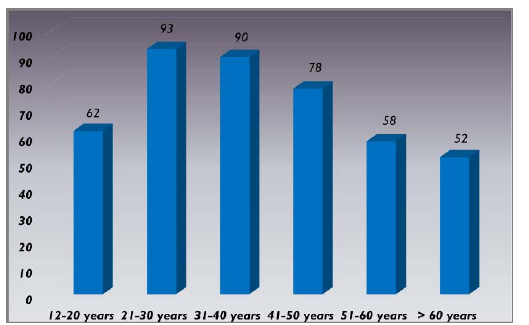
This study included a total of 433 exploratory laparotomies performed over a period of 2.5 years. Out of which, 254 (58.66%) were males and 179 (41.34%) were females. The male to female ratio was 1.41:1.342. Patient age varied from 12 years youngest to 97 years oldest. The detailed distribution is shown in Figure 1.

Materials and Methods
This retrospective observational study was conducted from June 2014 to December 2016 at Surgical Unit-I, Holy Family Hospital, Rawalpindi, Pakistan. All patients above 12 years of age, who presented to our emergency department directly or referred from any other facility and underwent midline exploratory laparotomy in our hospital, were included in our study. All those patients who were referred to our center after getting operated in any other hospital were excluded from the study.
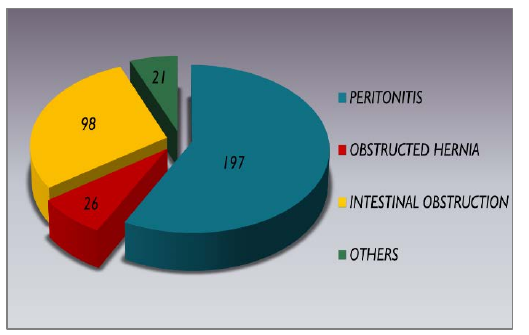
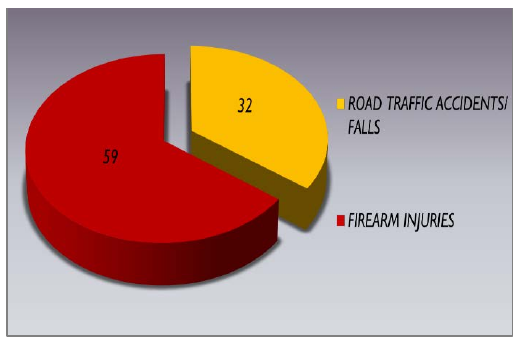
A total of 433 patients were included in our study. All patients received intravenous fluids for correction of fluid and electrolyte imba-lances, broad spectrum antibiotics, nasogastric suctioning and urethral catheterization. In case of trauma victims, management was guided according to hemodynamic status and available facilities. The informed written consent was obtained from all patients prior to surgery. 342 (78.9%) patients presented with the non-traumatic causes while 91(21%) patients have history of abdominal trauma. The indications of exploratory laparotomy in the non-trauma and trauma patients are shown in figures 2 and 3 respectively.
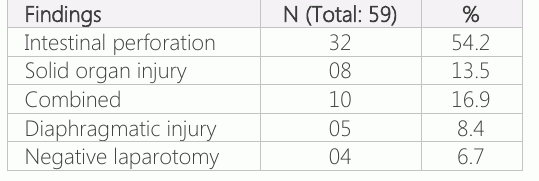
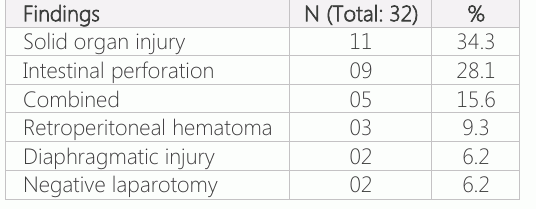
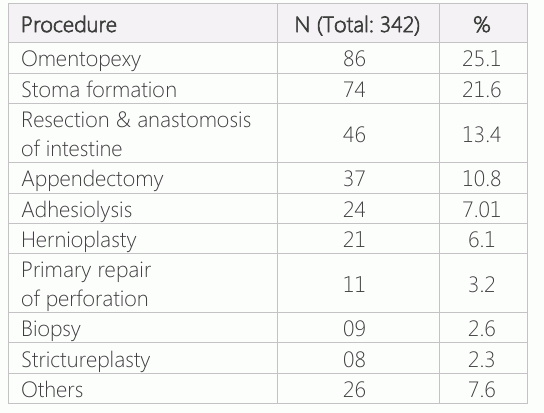
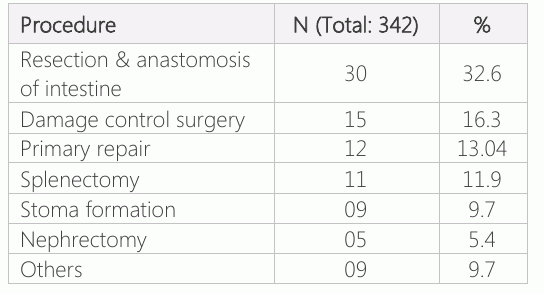
Intestinal perforation was the most common per-operative finding, both in non-traumatic (Table 1) and traumatic cases (Tables 2-3). The detailed description of operative procedures in both non-traumatic and traumatic patients is shown in tables 4 and 5 respectively.
Discussion
This study was conducted in a single unit of a tertiary care hospital of a 3rd world country. The unit has an emergency call on an alternate day basis. On an average, 173 laparotomies were performed in emergency setting each year. Compared to a similar study carried out in UK, our study showed that the burden of exploratory laparotomies done in emergency setting is far greater in the 3rd world countries as compared to the developed nations (7). Majority of the patients in our study were males, which is also the pattern seen globally (8, 9). The major burden of patients presented to our emergency department, who underwent exploratory laparotomy belonged to the age group of 20 to 50 years (10, 11).
Peritonitis (197, 57.6%) was the most common indication for laparotomy in the non-trauma patients. Many studies supported this evidence (12, 13). According to a multi-center study carried out by E Barrow et al in UK, peritonitis was also the most common cause for laparotomy, with intestinal perforation being the most common per-operative finding (7). In our study, the most common per-operative finding in non-trauma cases was intestinal perforation (32.74%), followed by adhesions/strictures (13.15%) which is comparable to the results of Barrow et al (7), In a study carried out in Pakistan by Khan TA et al, the most common per-operative finding was also intestinal perforation, followed by adhesions (14).
Intestinal obstruction was the second most common indication for surgery in our acute settings. Abdominal tuberculosis is the 4th most common site of extra pulmonary involvement and a common cause of intestinal obstruction in Pakistan (15). In our study, 7.6% of the laparotomies showed abdominal cocoon formation, suggestive of abdominal Tuberculosis. The statistics showed that intestinal tuberculosis is still a major healthcare problem in developing world, despite being uncommon in the west due to improved healthcare facilities (16).
In our study, penetrating abdominal trauma (65%) was the most common indication for exploration in majority of trauma patients. Among these, the most frequent finding was intestinal perforation (54%), followed by the combined solid organ & intestinal injury (17%). With advent of modern diagnostic modalities, the management of penetrating trauma has changed greatly in the past few years and many patients are now being managed conservatively. In a study conducted by Omari et al, stab wound caused fascial penetration in 253 patients and only 121 patients (48%) had to undergo therapeutic laparotomy (17).
Management of blunt abdominal trauma is more complex. In our study, 32 patients underwent exploratory laparotomy for blunt trauma. The most frequently observed finding was solid organ injury, followed by intestinal perforation. This is similar to the findings of a study conducted by Pande R et al in UK (18). Hollow viscus injury may present late and even in era of sophisticated diagnostic modalities; it remains a difficult entity to manage. There have been multiple case reports in which hollow viscus injury presented as late as 6 weeks after initial trauma (19). Diaphragmatic injuries (DI) are frequently missed in trauma patients. In our study, the frequency of DI was higher in penetrating abdominal trauma as compared to blunt trauma. A study conducted at trauma center in South Africa showed that penetrating trauma was the leading mechanism (94%) for DI (20).
All patients with solid organ injury i.e. liver, spleen and kidney were graded according to American Association for Surgery of Trauma (AAST) guidelines (21) and managed according to severity and hemodynamic status of patients. The incidence of negative laparotomy rate in our setup was 4.09% in non-trauma patients and 6.25% in trauma patients. This is greater as compared to the findings in developed countries. This is mainly due to the lack of diagnostic tools and imaging modalities in 3rd world countries(7). However, in trauma settings, it is prudent to intervene early to avoid missed injuries. In a study published in USA, negative laparotomies and missed injuries go hand in hand. The rate of negative laparotomies was 3.9% and missed injuries were 1.3% with the most common cause being the penetrating abdominal trauma (22).
Conclusions
With a growing world’s population, the incidence of traumatic and non-traumatic abdominal emergencies across the globe is increasing day by day. In resource limited countries, they are posing a great burden to emergency departments of tertiary care hospitals. More specialized trauma centers should be established to cope with this burden.
Declarations
- Author contributions (CRediT)
- All authors contributed equally to all 14 CRediT roles (Conceptualization, Data curation, Formal analysis, Funding acquisition, Investigation, Methodology, Project administration, Resources, Software, Supervision, Validation, Visualization, Writing – original draft, Writing – review & editing).
- Funding
-
Funding information was not reported in the published version of this article.
- Conflicts of interest
- The authors declare that there is no conflict of interests regarding publication of this paper.
- Ethics approval
- Ethics approval details were not reported in the published version of this article.
- Data availability
- A data availability statement was not reported in the published version of this article.
References (22)
13 of 22 references are linked to their DOI.
- Cook GC. Gastroenterological emergencies in the tropics. Baillieres Clin Gastroenterol. 1999 Dec;5(4):861-86 PubMed Google Scholar
- Bhangu A, Fitzgerald JE, Fergusson S, Khatri C, Holmer H, Søreide K, et al. Determining universal processes related to best outcome in emergency abdominal surgery: a multicentre, international, prospective cohort study. BMJ Open. 2014;4(10):e006239 DOI Crossref PubMed Google Scholar
- Abdullah MT, Hanif A, Waqar SH, Shah SF, Malik ZI, Zahid MA. Presentation and Outcome of Acute Abdomen in a Tertiary Care Unit. Ann. Pak. Inst. Med. Sci. 2011; 7(3):137-41 PubMed Google Scholar
- Ramakrishnan K, Salinas RC. Peptic ulcer disease. Am Fam Physician. 2007 Oct 1;76(7):1005-12 PubMed Google Scholar
- Prachalias AA, Kontis E. Isolated abdominal trauma: diagnosis and clinical management considerations. Curr Opin Crit Care. 2014 Apr;20(2):218-25 DOI Crossref PubMed Google Scholar
- Elmore LC, Jeffe DB, Jin L, Awad MM, Turnbull IR. National survey of burnout among US general surgery residents. J Am Coll Surg. 2016 Sep;223(3):440-51 DOI Crossref PubMed Google Scholar
- Barrow E, Anderson ID, Varley S, Pichel AC, Peden CJ, Saunders DI, et al. Current UK practice in emergency laparotomy. Ann R Coll Surg Engl. 2013 Nov;95(8):599 -603 DOI Crossref PubMed Google Scholar
- Jhobta RS, Attri AK, Kaushik R, Sharma R, Jhobta A. Spectrum of perforation peritonitis in India-review of 504 consecutive cases. World J Emerg Surg. 2006 Sep 5;1:26 PubMed Google Scholar
- Wani RA, Parray FQ, Bhat NA, Wani MA, Bhat TH, Farzana F. Nontraumatic terminal ileal perforation. World J Emerg Surg. 2006;1:7 PubMed Google Scholar
- Wani MM, Khan MA, Wani MM, Durrani AM, Singh B, Shafi M. Analysis of acute abdomen admissions in the surgical emergency room of a developing third world country. Int J Surg. 2006;11(2):2 DOI Crossref PubMed Google Scholar
- Kumar GK, Chakravarthi DS, Kamal VR, Arjuna G, Vijayalaxmi M. Mortality in emergency laparotomy on acute abdomen: A retrospective study in King George Hospital, Visakhapatnam. PIJR. 2015 Feb;4(2):219-21 PubMed Google Scholar
- Berhane Y, Girmay K, Gebresilassie A. Outcome of emergency surgical operations performed for non-traumatic acute abdomen among adults in Mekelle hospital, Tigray, Ethiopia, 2013. Eur J Pharm Med Res. 2016;3(4):106-11 PubMed Google Scholar
- Jain R, Gupta V. A prospective study of epidemiology and clinical presentation of non-traumatic acute abdomen cases in a tertiary care hospital of central India. Int Surg J. 2017 Jan; 4(1):242-45 DOI Crossref PubMed Google Scholar
- Khan TA, Awan SH, Khan SA, Amin S. An audit of laparotomies; carried out in combined military hospital Panno Aqil over three years period. Professional Med J. 2013;20(2):279-83 PubMed Google Scholar
- Ali N, Hussain M, Israr M. Tuberculosis as a cause of small bowel obstruction in adults. GJMS. 2011;9(2):233-35 PubMed Google Scholar
- Sulis G, Roggi A, Matteelli A, Raviglione MC. Tuberculosis: Epidemiology and Control. Mediterr J Hematol Infect Dis. 2014;6(1):e2014070 DOI Crossref PubMed Google Scholar
- Omari A, Bani-Yaseen M, Khammash M, Qasaimeh G, Eqab F, Jaddou H. Patterns of anterior abdominal stab wounds and their management at Princess Basma teaching hospital, North of Jordan. World J Surg. 2013 May;37(5):1162-8 DOI Crossref PubMed Google Scholar
- Pande R, Saratzis A, Beatty JW, Doran C, Kirby R, Harmston C. Contemporary characteristics of blunt abdominal trauma in a regional series from the UK. Ann R Coll Surg Engl. 2017 Jan;99(1):82-7 DOI Crossref PubMed Google Scholar
- Hamidian Jahromi A, Johnson L, Youssef AM. Delayed small bowel perforation following blunt abdominal trauma: A case report and review of the literature. Asian J Surg. 2016 Apr;39(2):109-12 DOI Crossref PubMed Google Scholar
- D’Souza N, Clarke D, Laing G. Prevalence, management and outcome of traumatic diaphragm injuries managed by the Pietermaritzburg Metropolitan Trauma Service. Ann R Coll Surg Engl. 2017 May;99(5):394-401 DOI Crossref PubMed Google Scholar
- Tinkoff G, Esposito TJ, Reed J, Kilgo P, Fildes J, Pasquale M, et al. American Association for the Surgery of Trauma Organ Injury Scale I: spleen, liver, and kidney, validation based on the National Trauma Data Bank. J Am Coll Surg. 2008 Nov;207(5):646-55 DOI Crossref PubMed Google Scholar
- Schnüriger B, Lam L, Inaba K, Kobayashi L, Barbarino R, Demetriades D. Negative laparotomy in trauma: are we getting better? Am Surg. 2012 Nov;78(11):1219-23 DOI Crossref PubMed Google Scholar
Read the full text
Open the PDF here
Loading the PDF…
If the PDF does not show here, use the download button above.
How to cite this article
Ahmad R, Shafique MS, Hassan SW, Khan JS, Ahmad SH, Fayyaz MU, et al. Burden of Emergency Exploratory Laparotomies: Sleepless Nights in Operation Rooms. Ulutas Med J. 2019;5(1):1-6. doi:10.5455/umj.20190602085150
Ahmad, R., Shafique, M. S., Hassan, S. W., Khan, J. S., Ahmad, S. H., Fayyaz, M. U., & Mehmood, S. (2019). Burden of Emergency Exploratory Laparotomies: Sleepless Nights in Operation Rooms. The Ulutas Medical Journal, 5(1), 1–6. https://doi.org/10.5455/umj.20190602085150
Ahmad, R. et al. (2019) 'Burden of Emergency Exploratory Laparotomies: Sleepless Nights in Operation Rooms', The Ulutas Medical Journal, 5(1), pp. 1–6. doi: 10.5455/umj.20190602085150.