The Ulutas Medical Journal · ISSN 2149-0430 (print), 2149-388X (online) · https://www.ulutasmedicaljournal.com/?mno=300723
Short Communication · Open access
The Perception and Views of Leisure-Time Runners on Marathon Running and Related Health Services in Turkey
Also available in: العربية · Türkçe · 中文
- Former Akdeniz University, Antalya, Turkey ROR
- Orthopaedic Surgeon, Atasam Private Hospital Samsun, Turkey
- Memorial Hospital, Cardiology Clinic, Antalya, Turkey ROR
Abstract
- Introduction
- The frequency and numbers of activities of marathon running in Turkey are overwhelming, but a documentation on participants is missing. We, therefore, aimed to know the perception and view of leisure-time runners (LTR) on the marathon and related health services.
- Materials and Methods
- Sixty-three LTR agreed and gave verbal consent to participate. Participants were purposefully selected (purposive sample) from the community of LTR. The survey included 22 questions. The survey was piloted with ten LTR and the results of the pilot questionnaire were not included in the final dataset.
- Results
- The mean age of participants was 37.2 (range 20-61); 11 (31%) were female and 36 (69%) were male; 20 (32%) were single, 36 (56%) were married, and 5 (8%) divorced/widowed. The reason for running was as follows: to stay healthy (49; 36%), to keep fit (34; 26%), to minimize risk factors of disease (25; 19%), to lose weight (15; 11%), and to get socialized (10; %8). Forty-six (%72) practiced sports in their youth. Ten (17%) had a chronic condition and 6 (11%) were on a drug treatment for their condition.
- Conclusion
- Since these athletes were formerly sedentary and might harbor latent risk factors, which could be provoked during after strenuous activities like marathons, the provision of a rigorous screening for this athletes should be provided.
Keywords
Full text
Introduction
Running as a leisure-time activity is increasing in popularity in adult, sedentary people and especially marathon running a marathon is a steeply growing field (1). The desportification and deinstitutionalization of the sports are continuing since the sixties and people more and more are engaged in running to become happy and a part of the adventure; rather than a competitive athlete. Nowadays running is living its high popularity (i.e. number of finishers of the largest marathons has increased from 25.000 in 1976 to 1.600.000 in 2012 (2, 3). Just in the US, in 2009, 397 marathons have been organized (4).
Besides different reasons to run, people are participating due to health and survival benefits of regular running. The belief that intense physical activity has health gaining effects has increased the participation in marathons 25 fold in the last 20 years. But the participants are not young anymore and they seem to overlook this. They get exposed to increased adverse health risks (i.e. musculoskeletal injuries, cardiac problems etc.)(1, 5).
The frequency and numbers of activities of marathon running in Turkey are overwhelming, but a documentation on participants is missing. We, therefore, were interested to know the perception and view of leisure-time runners (LTR) on the marathon and related health services in a purposeful sample in Turkey.
Materials and Methods
Leisure-time runners living in different cities were asked to participate in this study in May- October 2017. Sixty-three LTR agreed and gave verbal consent to participate. Participants were purposefully selected (purposive sample) from the community of LTR because it was expected that it would represent diverse LTR in Turkey. The survey included 22 questions (19 closed-ended and three open-ended) and was divided into 3 parts. The first part included questions on demographics. The second part included questions about running experience, and finally, the 3rd part asked questions about their personal thoughts and experience concerning health care issues of running.
The survey was piloted with ten LTR and the results of the pilot questionnaire were not included in the final dataset. Data were analyzed with descriptive statistics. The level of significance was set at alpha=0.05.
Results
Sixty-three LTR participated in this study. Their mean age was 37.2 (SD=11.62;range 20-61); 11 (31%) were female and 36(69%) were male; 20 (32%) were single, 36(56%) were married, and 5(8%) divorced/widowed. Sixteen(29%) were employed in the public sector, 31(55%) in the private sector, and 9 (16%) were students. Forty-seven (81%) participated in a marathon before. The reason for running was as follows: to stay healthy (49; 36%), to keep fit (34;26%), to minimize risk factors of disease (25;19%), to lose weight (15;11%), and to get socialized (10; %8). Forty-six (%72) practiced sports in their youth. Ten (17%) had a chronic condition and six (11%) were on a drug treatment for their condition. Thirty-two (55%) had a medical examination before participating in a marathon and 25 (39%) had periodical medical exams during their sportive activities. LTRs think, that the annual frequency of periodical physical exam should be at least twice (mean=2.8; SD: 2.67; min-max: 1-12). LTRs were satisfied with the running-related health services (median: 2; min-max:1-5) (1: very satisfied, 5: not satisfied at all). They were also satisfied with competence of their physician (median: 2; min-max: 1-5) (1: very satisfied, 5: not satisfied at all). LTRs were training six hours (min-max: 1-20 hours) a week. Sixteen (29%) had a trainer to prepare for the marathon and they were satisfied with the training services (median: 2, min-max: 1-5) (1: very satisfied, 5: not satisfied at all).
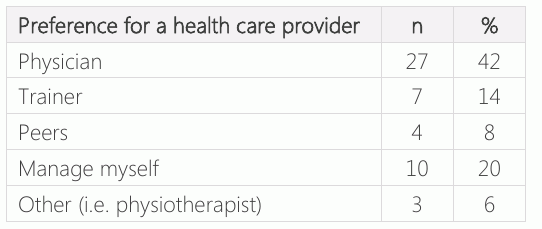
Eight (15%) received also counseling from a nutritionist and they were very satisfied with the nutritional services they receive (median:1; min-max:1-5) (1: very satisfied, 5: not satisfied at all). Eighteen (32%) LTR had a sports injury before or during the marathon. Their preference for a health care provider is displayed in Table 1. LTRs, who suffered from a running injury and received medical attention were satisfied with the healthcare services (median:2.5, min-max: 1-5) (1: very satisfied, 5: not satisfied at all). They were also satisfied with competence of their physician (median: 2; min-max: 1-5) (1: very satisfied, 5: not satisfied at all).
Discussion
Findings of our study revealed that participants and found that most were at their middle-age, male, married, private sector employed, most participated in a marathon before. Our results are comparable with the findings from Greece, where the participants were mostly over 30 years, highly educated, and dominantly working in the private sector. Their motivation was related to physical and mental benefits (6). One third had a personal coach in our study, which is comparable to a study where most served as their own coaches (4). Almost all sports-related cardiac deaths occur in people over 35. The increase of the age of runners will increase the risk of these events in participants. Most of the participants to marathons are believed to consult a physician to get advice and approval before the race (1). In our study, only half had a medical examination before participating in the marathon, some had periodical medical exams during their sportive activities, think that the annual frequency of periodical physical exam should be at least twice.
Even the attitudes concerning the need for pre-participation physical clearance in runners nothing should be left to a chance and a rigorous should be established in a systematic way (5). Because some of the participants might harbor occult coronary artery disease and might have switched from a sedentary lifestyle to a competitive one (7). In our survey, most athletes participated in a marathon before and run to stay healthy, to keep fit and to minimize risk factors of disease. Most practiced sports in their youth. But even a minority had a chronic condition and were on a drug treatment for the condition, which might make them vulnerable to acute events during training or competition. Symptoms of novice and non-professional athletes might be often misinterpreted as minor problems, which might be endorphin related. But even a slight chest pain, palpitation, dizziness, nausea should be considered as a reason for thorough clearance of a serious cardiovascular incident (1). The training pattern of professional and amateur athletes should not be overlooked either. While professional athletes are used to intense exercise since their youth and have an adapted organism to long and strenuous exercise; have professional guidance in training forms, condition, nutrition, and the sports-related injury prevention (8); amateur athletes instead might start running in middle adulthood, when the degenerative process of aging has already begun (i.e, atherosclerosis and related disease). They might train at too high intensities (9), do not change their bad lifestyle habits, and neglect their private life. Unfortunately, a small group has access to a coach or better health care, and they is under the risk of blindly copying training methods, which are especially tailored for the elite athletes (1).
Our respondents were training six hours a week (ranging 1-20 hours a week), some had a trainer to prepare for the marathon, a minority had nutritional counseling, some had before or during marathon, most seek assistance from a physician, and were satisfied with the running-related health services-the competence of their physician-training services-nutritional services-the health care services and the competence of their physician during sports injury.
Conclusion
Findingsof our study revealed that participants and found that most were at their middle-age, male, married, private sector employed participants. Their main motivation for running was health-oriented. Only half had a medical examination before participating in a marathon, some had periodical medical exams during their sportive activities, and thought that the annual frequency of periodical physical exam should be at least twice. Even there was a positive attitude toward health services, some space for improvement in health might be required. Since these athletes were mainly formerly sedentary and might harbor latent risk factors, which could be provoked after strenuous activities like marathons, provision of a rigorous screening for this athletes should be provided.
Declarations
- Author contributions (CRediT)
- All authors contributed equally to all 14 CRediT roles (Conceptualization, Data curation, Formal analysis, Funding acquisition, Investigation, Methodology, Project administration, Resources, Software, Supervision, Validation, Visualization, Writing – original draft, Writing – review & editing).
- Funding
-
Funding information was not reported in the published version of this article.
- Conflicts of interest
- The authors declare that they have no conflict of interest in the current study.
- Ethics approval
- Ethics approval details were not reported in the published version of this article.
- Data availability
- A data availability statement was not reported in the published version of this article.
References (9)
8 of 9 references are linked to their DOI.
- Burkule N. Marathon running for amateurs: Benefits and risks. J Clin Prev Cardiol 2016;5:113-24. DOI Crossref PubMed Google Scholar
- Van Dyck D, Cardon G, de Bourdeaudhuij I, de Ridder L, Willem A. Who Participates in Running Events? Socio-Demographic Characteristics, Psychosocial Factors and Barriers as Correlates of Non -Participation - A Pilot Study in Belgium. Int J Environ Res Public Health. 2017 Nov; 14(11): 1315. DOI Crossref PubMed Google Scholar
- Borgers J, Thibaut E, Vandermeerschen H, Vanreusel B, Vos S, Scheerder J. Sports participation styles revisited: A time-trend study in Belgium from the 1970s to the 2000s. Int. Rev. Sociol. Sport 2015, 50, 45– 63. DOI Crossref PubMed Google Scholar
- O'Neal EK, Wingo JE, Richardson MT, Leeper JD, Neggers YH, Bishop PA. Half-marathon and full-marathon runners' hydration practices and perceptions. J Athl Train. 2011 Nov-Dec;46(6):581-91. DOI Crossref PubMed Google Scholar
- Yaman H, Akçay İ, Günay G. Sudden Cardiac Death in Athletes: Tips for Prevention. Cyprus J Med Sci 2017;2:67-71. DOI Crossref PubMed Google Scholar
- Petridis L, Batrakoulis A. The running movement in Greece: Investigating the profile of the modern marathon runners. Hellenic Journal of Sport & Recreation Management 2013; 10(2),43– 54. PubMed Google Scholar
- Chugh SS, Weiss JB. Sudden cardiac death in the older athlete. J Am Coll Cardiol 2015;65:493‑ 502. DOI Crossref PubMed Google Scholar
- O’Keefe JH, Franklin B, Lavie CJ. Exercising for health and longevity vs peak performance: Different regimens for different goals. Mayo Clin Proc 2014;89:1171‑ 5. DOI Crossref PubMed Google Scholar
- Burtscher M, Pesta D. Absolute or relative jogging pace: What makes the difference? J Am Coll Cardiol 2015;65: 2671‑2. DOI Crossref PubMed Google Scholar
Respond to this article
Comments on a published article are welcome as a Letter to the Editor.
Get an e-mail when new articles in your fields are published
Questions to the authors
Questions are moderated: an editor approves each question, the authors answer, and an editor approves the answer before both appear here.
No answered questions yet.
Ask the authors a question
Discussion
Comments are moderated: they appear after the writer confirms the e-mail address and an editor approves them. Each comment carries a conflict-of-interest statement.
No comments yet.
Write a comment
Tell me when this article is cited
Leave your e-mail address and confirm it. These notices are not being sent yet; your confirmed address is kept for them and used for nothing else.
Read the full text
Open the PDF here
Loading the PDF…
If the PDF does not show here, use the download button above.
How to cite this article
Yaman H, Akçay I, Günay G. The Perception and Views of Leisure-Time Runners on Marathon Running and Related Health Services in Turkey. Ulutas Med J. 2018;4(3):168-171. doi:10.5455/umj.20180531103341
Yaman, H., Akçay, I., & Günay, G. (2018). The Perception and Views of Leisure-Time Runners on Marathon Running and Related Health Services in Turkey. The Ulutas Medical Journal, 4(3), 168–171. https://doi.org/10.5455/umj.20180531103341
Yaman, H., Akçay, I. and Günay, G. (2018) 'The Perception and Views of Leisure-Time Runners on Marathon Running and Related Health Services in Turkey', The Ulutas Medical Journal, 4(3), pp. 168–171. doi: 10.5455/umj.20180531103341.
@article{umj300723,
  title = {The Perception and Views of Leisure-Time Runners on Marathon Running and Related Health Services in Turkey},
  author = {Yaman, Hakan and Akçay, Ismet and Günay, Gunay},
  journal = {The Ulutas Medical Journal},
  year = {2018},
  volume = {4},
  number = {3},
  pages = {168--171},
  doi = {10.5455/umj.20180531103341},
  url = {https://www.ulutasmedicaljournal.com/?mno=300723},
  issn = {2149-388X}
}