The Ulutas Medical Journal · ISSN 2149-0430 (print), 2149-388X (online) · https://www.ulutasmedicaljournal.com/?mno=85807
Case Report · Open access
DRESS Syndrome Associated with Elevated Liver Enzyme and Acute Kidney Injury after Allopurinol Use
- Ankara Yildirim Beyazit Universitesi, Ankara City Hospital, Internal Medicine Department, Ankara, Turkey ROR
- Ministry of Health Ankara City Hospital, Internal Medicine Department, Ankara, Turkey ROR
- Ministry of Health Ankara City Hospital, Pathology Department, Ankara, Turkey ROR
Abstract
Drug reaction with eosinophilia and systemic symptoms (DRESS) is a rare, potentially life-threatening, drug-induced hypersensitivity reaction that includes skin eruption, hematologic abnormalities (eosinophilia and atypical lymphocytosis), lymphadenopathy, and internal organ involvement (liver, kidney, and lung). Moreover, retrospective studies have reported a mortality rate between 5% and 10%. In this paper, a case of DRESS with renal and hepatic organ involvement developing 2 weeks after the use of allopurinol which is among the most common drugs for DRESS will be presented.
Keywords
Full text
Introduction
Drug reaction with eosinophilia and systemic symptoms (DRESS) is a very rare, potentially life-threatening, drug-induced hypersensitivity reaction including skin eruption, hematologic abnormalities (eosinophilia and atypical lympho cytosis), lymphadenopathy, and internal organ involvement (liver,kidney, and lung)(1–3). DRESS is characterized by a long latency (2-8 weeks) between drug exposure and disease onset, a prolonged course with frequent relapses despite the discontinuation of the culprit drug, and a frequent association with the reactivation of latent human herpesvirus infections (4–6). The most frequently reported causes are anti-epileptics (e.g. carbamazepine, lamotrigine, phenytoin, and phenobarbital) and allopurinol (7). The incidence of DRESS is unknown. A 7- year prospective study in the West Indian general population estimated the incidence as 0.9/100.000 annually (8). In this case report, a case of DRESS syndrome after allopurinol use was presented.
Case Presentation
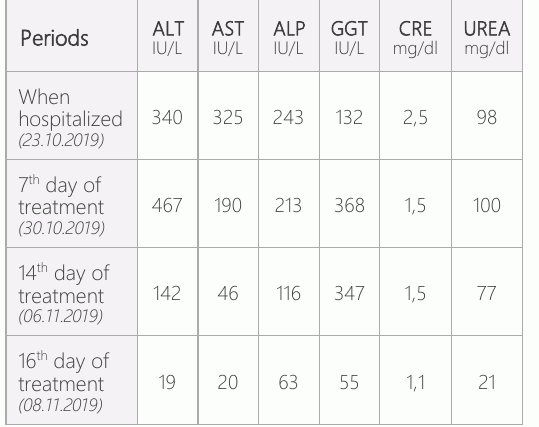
A 63-year-old patient with chronic renal disease applied to emergency service with the spill completed in all bodies after allopurinol and calcitriol used in 2 weeks. In physical examination of the patient, body temperature is measured as 39°C, and a combined maculo papular rash of head, neck, thorax, abdomen and extremities has been determined. In the laboratory review of the first application to the hospital, urea: 98mg/dl(n:19-49), CRE:2.5 mg/dl (base CRE:1.9), AST: 318 u/l (n<35), ALT: 340 u/l (n<50), ALP: 243 u/l (n:53–141), GGT: 132 u/l (n<38), amylase: 52 u/l (n:30–118), lipase: 42 u/l (n:12–53), LDH: 642u/l (120–246), total/direct bilirubin:1/0.4mg/dl, albumin:40g/l, WBC: 11.000 (n:4,300–10,300), neutrophil: 10.130 (n: 1,500–7,700), lymphocyte: 1,220 (n:1,100–4,500), eosinophil: 30 (n:50–550), Hb: 12g/dl, PLT: 207. 000 (n: 150.000–350.000), INR: 1 (n), and normal electrolyte level were detected.
Serological tests (Cytomegalovirus, Epstein– Barr, human immunodeficiency virus, hepatitis a, b, and c, toxoplasma, HSV, and rubella) and autoimmune hepatitis markers (antinuclear antibody, “liver-kidney” microsomal antibody type-1, “anti-smooth muscle” antibody, “anti-soluble liver” antibody, and “anti-double strain” DNA) that have performed to make the differential diagnosis of liver enzyme elevation were found negative. Leukocytosis, neutrophil dominance, neutrophil hypersegmentation, anisocytosis, and poikilocytosis were detected in the peripheral spread. Serum ceruloplasmin, IG G-A-M, and serum copper levels were normal. There was no reproduction in blood, urine, and throat cultures. Except for grade 1 hepatosteatosis and a decrease in kidney dimensions, no pathological findings were determined in abdominal imaging. Reactive lymph nodes were seen in two different regions in the cutaneous USG. A skin punch biopsy was performed from the patient’s maculopapular rash. The pathology result was interpreted as a drug reaction (Figure-1 and 2).
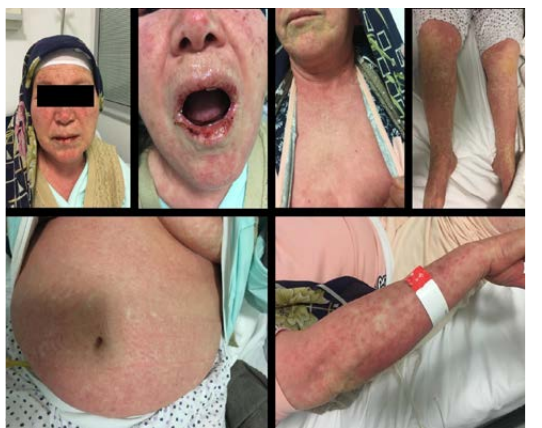
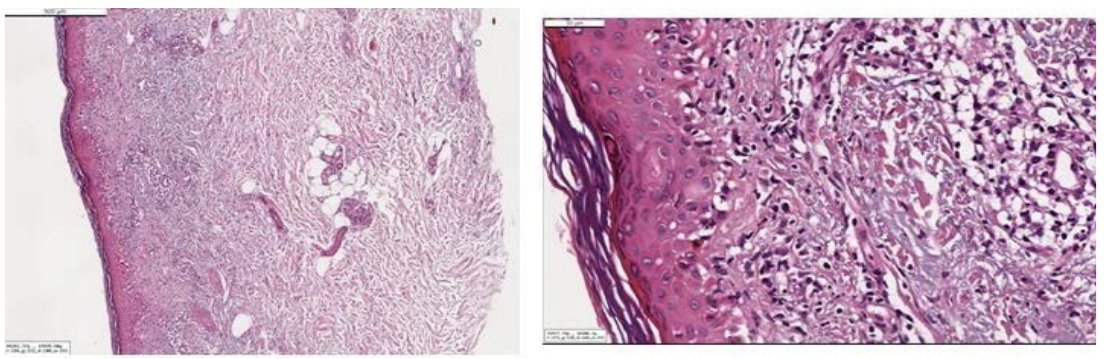
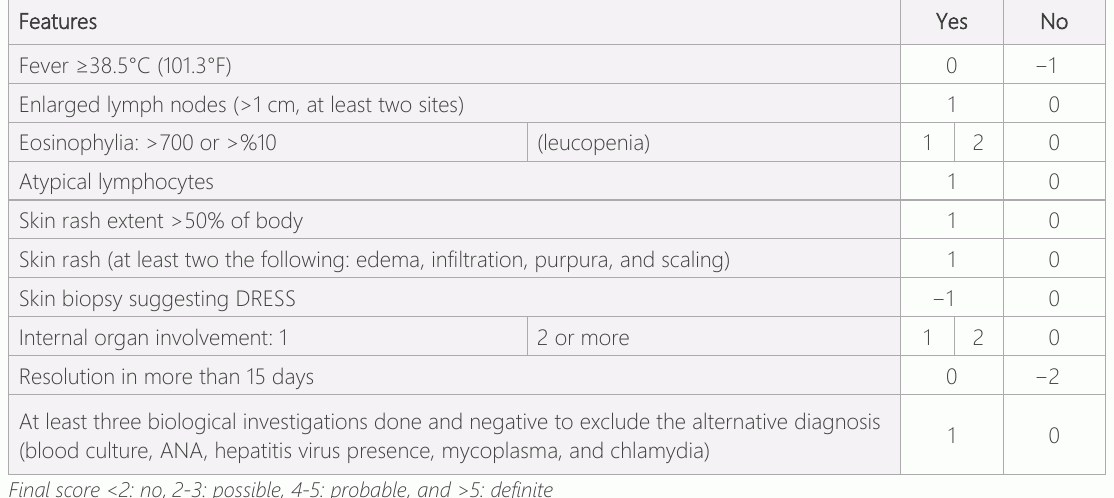
A scoring system was applied to the patient for the diagnosis of DRESS syndrome. In the scoring system, body temperature is higher than 38.5°C, lymphadenopathy greater than 1 cm in two different regions (inguinal and cervical), and a rash covering more than 50% of body surface area, facial edema+purpura, drug rash findings in skin biopsies, elimination of the liver and kidney dysfunction and other alternative causes. DRESS syndrome secondary to the use of allopurinol was diagnosed. Allopurinol treatment was discontinued. Methyl prednisolone treatment was started at 40 mg/day. The patient’s liver and creatinine levels decreased after steroid. Regression was detected in the body rash. The decrease in serum aminotransferase and creatinine values is shown in Table-1. After creatinine returned to basal rates, normalization of aminotransferase enzymes and rash regression, the cortico steroid dose was decreased gradually and discontinued and the patient was discharged.
Discussion
As in our case, DRESS diagnosis is suspected in a patient who received new drug treatment in the previous 2–6 weeks and presents symptoms and findings such as skin rash (morbilliform or diffuse, confluent and infiltrated), enlarged lymph nodes, fever [38°-40°C (100-104°F)]), and facial edema. High-risk drugs that cause this syndrome include lamotrigine, phenytoin, allopurinol, sulfasalazine, sulfamethoxazole, vancomycin, dapsone, carbamazepine, and minocycline. To help clinicians while diagnosing DRESS or making differential diagnoses, the registry of severe cutaneous adverse reaction has developed a scoring system based on clinical characteristics, the extent of skin involvement, organ involvement, and clinical course (9). DRESS is classified as definite, probable, and possible (Table-2).
Rarely, DRESS could be diagnosed without “d” (no drug cause), without “r” (there was no rash in 2 of 176 cases in literature), without “e” (eosinophilia was not present in 10%–50% of the cases), and even without systemic symptoms (9).
Stevens-Johnson syndrome / toxic epidermal necrolysis (SJS/TEN) which is considered in the differential diagnosis starts 4–28 days after exposure to the medicine. More than 90% of SJS/TEN cases include at least two sites: erosions and severe mucosal involvement with hemorrhage, whereas mucosal involvement is seen in 50% of patients with DRESS, generally includes one region (mostly the mouth or pharynx), and does not develop erosion. Eosinophilia and atypical lymphocytosis are not observed in SJS/TEN, whereas leukopenia is common and lymphopenia is almost constant. With DRESS, fever, rash, lymphadenopathy, and abnormal liver enzymes, it can imitate adults still a disease, but generally, eosinophilia is not present in the still disease. Besides, DRESS typically is seen 2–6 weeks after exposure to suspected drugs that cause this syndrome, and atypical lymphocytosis is more likely to be seen than granulocytosis. For this patient, differential diagnosis was made by not presenting arthritis and arthralgia, symptoms occurring two weeks after drug use, rash different from STILL syndrome (salmon color and non-pruritic macular and maculopapular rash on body or extremities in fever periods). The pathology result of skin biopsy was interpreted as a drug reaction. For DRESS baseline treatment, cutting responsible drug is recommended. In addition, we recommend not to use new drugs to patients with ongoing DRESS and DRESS suspected patients.
Medium or high-dose corticosteroid treatment is recommended when the liver (three or more times higher values of transaminases) and kidney (1.5 times higher base creatinine levels, hematuria, proteinuria) involvement is present (e.g., 0.5–2 mg prednisolone or prednisolone equivalent). Systemic steroids are administered until normalization of laboratory parameters and patient’s clinical wellness is provided and treatment is gradually reduced for 8–12 weeks. A faster reduction may cause recurrence. For the patient, normalization of the laboratory parameters and patient’s clinical wellness is seen after steroid treatment. Cyclosporine could be a second step treatment for patients having DRESS and severe organ involvement, and there was no response to corticosteroids. There are several reports on the rapid response of patients with DRESS with organ involvement with oral cyclosporine treatment (10, 11). Intra venous immunoglobulins (IVIGs) are useful for some patients and not for the others (12, 13). IVIG treatment is not recommended while waiting for preferable evidence. In this case, DRESS syndrome secondary to exposure to allopurinol which is frequently used in first step health services is presented. DRESS is suspected when maculopapular rash developed, especially after the drug use, and forwarding patients to the upper center should be considered for systemic steroid treatment.
Declarations
- Author contributions (CRediT)
- All authors contributed equally to all 14 CRediT roles (Conceptualization, Data curation, Formal analysis, Funding acquisition, Investigation, Methodology, Project administration, Resources, Software, Supervision, Validation, Visualization, Writing – original draft, Writing – review & editing).
- Funding
-
Funding information was not reported in the published version of this article.
- Conflicts of interest
- The authors declare that they have no conflict of interests.
- Ethics approval
- Ethics approval details were not reported in the published version of this article.
- Data availability
- A data availability statement was not reported in the published version of this article.
References (13)
10 of 13 references are linked to their DOI.
- Bocquet H, Bagot M, Roujeau JC. Drug-induced pseudo lymphoma and drug hypersensitivity syndrome (drug rash with eosinophilia and systemic symptoms: dress). Semin Cutan Med Surg 1996; -15(4):250–7 DOI Crossref PubMed Google Scholar
- Husain Z, Reddy BY, Schwartz RA. Dress syndrome: part I. Clinical perspectives. J Am Acad Dermatol 2013;68(5):693.e1 –14 PubMed Google Scholar
- Husain Z, Reddy BY, Schwartz RA Dress syndrome: part II. Management and therapeutics. J Am Acad Dermatol 2013; 68(5):709.e1–9 PubMed Google Scholar
- Cacoub P, Musette P, Descamps V, Meyer O, Speirs C, et al. The dress syndrome: a literature review. Am J Med 2011; 124(7):588–97. Epub 2011 may 17 DOI Crossref PubMed Google Scholar
- Chen YC, Chiu HC, Chu CY. Drug reaction with eosinophilia and systemic symptoms: a retrospective study of 60 cases. Arch Dermatol 2010; 146(12):1373– 9 DOI Crossref PubMed Google Scholar
- Shiohara T, Inaoka M, Kano Y. Drug-induced hypersensitivity syndrome (dihs): a reaction induced by a complex interplay among herpesviruses and antiviral and antidrug immune responses. Allergol Int 2006;55(1):1–8 DOI Crossref PubMed Google Scholar
- Kardaun SH, Sekula P, Valeyrie-allanore L, Liss Y, Chu CY, Creamer D, et al. Drug reaction with eosinophilia and systemic symptoms (dress): an original multisystem adverse drug reaction. Results from the prospective regiscar study. Br J Dermatol 2013;169(5):1071–80 DOI Crossref PubMed Google Scholar
- Muller P, Dubreil P, Mahéa A, Lamaury I, Salzer B, Deloumeaux J, et al. Drug hypersensitivity syndrome in a West - Indian population. Eur J Dermatol 2003;13(5):478– 81 PubMed Google Scholar
- Kardaun SH, Sidoroff A, Valeyrie-allanore L, Halevy S, Davidovici BB, Mockenhaupt M, et al. Variability in the clinical pattern of cutaneous side-effects of drugs with systemic symptoms: does a dress syndrome really exist? Br J Dermatol 2007;156(3):609–11 DOI Crossref PubMed Google Scholar
- Zuliani E, Zwahlen H, Gilliet F, Marone C. Vancomycin-induced hypersensitivity reaction with acute renal failure: resolution following cyclosporine treatment. Clin Nephrol 2005; 64(2):155– 8 DOI Crossref PubMed Google Scholar
- Kirchhof MG, Wong A, Dutz JP. Cyclosporine treatment of drug-induced hypersensitivity syndrome. JAMA Dermatol 2016; 152(11):1254–7 DOI Crossref PubMed Google Scholar
- Joly P, Janela B, Tetart F, Rogez S, Picard D, D'incan M, et al. Poor benefit/risk balance of intravenous immunoglobulins in dress. Arch Dermatol 2012;148(4):543–4 DOI Crossref PubMed Google Scholar
- Singer EM, Wanat KA, Rosenbach MA. A case of recalcitrant dress syndrome with multiple autoimmune sequelae treated with intravenous immunoglobulins. JAMA Dermatol 2013;149 (4):494–5 DOI Crossref PubMed Google Scholar
Read the full text
Open the PDF here
Loading the PDF…
If the PDF does not show here, use the download button above.
How to cite this article
Enli SA, Gemcioglu E, Kiran M. DRESS Syndrome Associated with Elevated Liver Enzyme and Acute Kidney Injury after Allopurinol Use. Ulutas Med J. 2020;6(1):44-48. doi:10.5455/umj.20200207110845
Enli, S. A., Gemcioglu, E., & Kiran, M. (2020). DRESS Syndrome Associated with Elevated Liver Enzyme and Acute Kidney Injury after Allopurinol Use. The Ulutas Medical Journal, 6(1), 44–48. https://doi.org/10.5455/umj.20200207110845
Enli, S.A., Gemcioglu, E. and Kiran, M. (2020) 'DRESS Syndrome Associated with Elevated Liver Enzyme and Acute Kidney Injury after Allopurinol Use', The Ulutas Medical Journal, 6(1), pp. 44–48. doi: 10.5455/umj.20200207110845.