The Ulutas Medical Journal · ISSN 2149-0430 (print), 2149-388X (online) · https://www.ulutasmedicaljournal.com/?mno=290409
Original Article · Open access
Comparison of Platelet Mass Index with Total Oxidant/Antioxidant Levels in Intensive Care Unit Patients
Also available in: العربية · Türkçe · 中文
- S.B.Ü. Sanliurfa Mehmet Akif Inan Education and Research Hospital, Biochemistry, Şanlıurfa, Turkey ROR
- S.B.Ü. Sanliurfa Mehmet Akif Inan Education and Research Hospital, Şanlıurfa, Turkey ROR
- S.B.Ü. Sanliurfa Mehmet Akif Inan Education and Research Hospital, Anesthesia Şanlıurfa, Turkey ROR
Abstract
- Introduction
- One of the key mechanisms affecting mortality and morbidity in intensive care unit (ICU) patients is oxidative stress and the accompanying antioxidant defense system. The Platelet Mass Index (PMI) has been proposed as a novel parameter associated with both disease severity and inflammation. This study sought to explore the association between platelet mass index (PMI) and the levels of total oxidant status (TOS), total antioxidant status (TAS), and oxidative stress index (OSI) in patients admitted to the intensive care unit.
- Materials and Methods
- This prospective study included 152 patients hospitalized in the ICU and 60 healthy individuals as the control group. Blood samples were analyzed to determine TOS, TAS, procalcitonin (PCT), ferritin, C-reactive protein (CRP), mean platelet volume (MPV),white blood cell count (WBC) and platelet count (PLT). Platelet mass index (PMI) was calculated using PLT and MPV values, while OSI was calculated using TOS and TAS results. The obtained data were analyzed statistically.
- Results
- Among ICU patients, levels of PMI, CRP, TOS, and OSI were elevated, while PLT and TAS levels were reduced compared to the control group. No significant clinical correlation was observed between PMI and the other measured variables.
- Conclusion
- PMI may serve as a simple and easily calculable biomarker reflecting oxidative stress levels in ICU patients. These findings suggest that PMI could be used as a supportive parameter for evaluating oxidative stress in intensive care practice.
Keywords
Full text
Introduction
Oxidative stress, resulting from an imbalance between the production of reactive oxygen species (ROS) and the antioxidant defense mechanisms, plays an essential role in the pathogenesis of many critical illnesses (1). The total oxidant status (TOS) and total antioxidant status (TAS) are commonly used biochemical parameters to evaluate oxidative stress levels. The oxidative stress index (OSI), calculated as the ratio of TOS to TAS, provides a comprehensive reflection of the oxidative balance in the organism (2, 3). Increased OSI levels indicate excessive oxidative burden and reduced antioxidant capacity (4).
Platelets are not only essential for hemostasis, but also actively participate in inflammation and oxidative processes (5). The mean platelet volume (MPV) is an indicator of platelet size and activation status (6). Larger platelets are metabolically more active and more prone to release inflammatory and oxidative mediators (5). Oxidative stress can enhance platelet reactivity by reducing nitric oxide bioavailability, while activated platelets can generate ROS, further amplifying oxidative damage (7).
Several clinical studies have demonstrated a relationship between oxidative stress markers and platelet indices. Elevated MPV levels have been associated with increased TOS and OSI, and decreased TAS levels in various inflammatory and metabolic disorders (8). In critically ill patients, TOS and OSI values are reported to be significantly higher, whereas TAS levels are markedly reduced, indicating severe oxidative imbalance (9, 10).
Taken together, these findings suggest a complex interplay between oxidative stress and platelet activation. Evaluating TAS, TOS, OSI, and MPV together may provide valuable insights into the oxidative and inflammatory status of intensive care unit (ICU) patients.
Materials and Methods
Study design
Ethical approval for this study was obtained from the Harran University Clinical Research Ethics Committee (12.04.2021-HRÜ/21.08.20). The study included 152 patients admitted to the intensive care units of S.B. Şanlıurfa Mehmet Akif İnan Training and Research Hospital after January 2022. Additionally, a control group of 60 healthy volunteers, matched for age and gender, was enrolled. Patients who had received prior antioxidant therapy or had a history of cancer were excluded.
TOS and TAS were measured as described by Erel et al. (2). OSI was calculated from TOS and TAS. Procalcitonin (PCT), ferritin, and C-reactive protein (CRP) were analyzed automatically using the Roche Cobas 6000 c system. White blood cell count (WBC), platelet count (PLT), and mean platelet volume (MPV) were measured automatically using a Sysmex XN1000 (Sysmex Inc., Japan). The platelet mass index (PMI) was calculated using PLT and MPV values (PMI = PLT×MPV) (11).
Statistical Analysis
Statistical analyses were conducted using GraphPad Prism version 8.0.0 for Windows (GraphPad Software, San Diego, CA, USA, www.graphpad.com). Data normality was evaluated with the Kolmogorov-Smirnov test. Comparisons between groups were performed using Fisher’s exact test and the unpaired t-test. Pearson’s correlation coefficient was used to assess relationships between variables, with a p-value <0.05 considered statistically significant.
Results
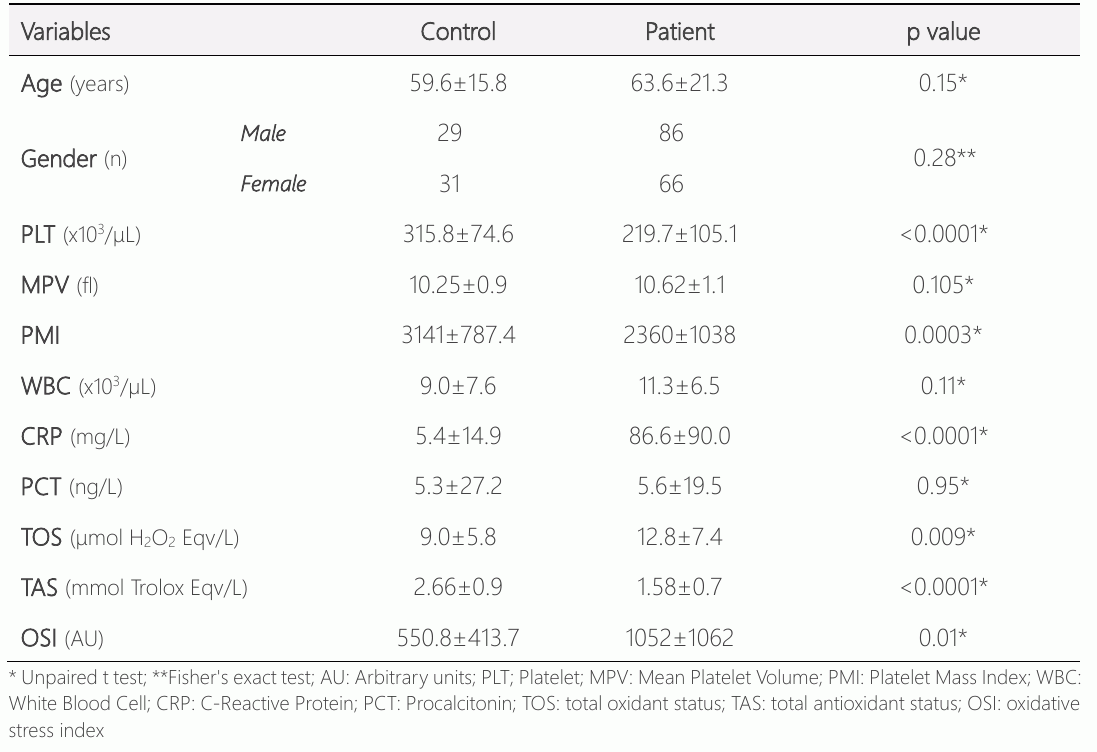
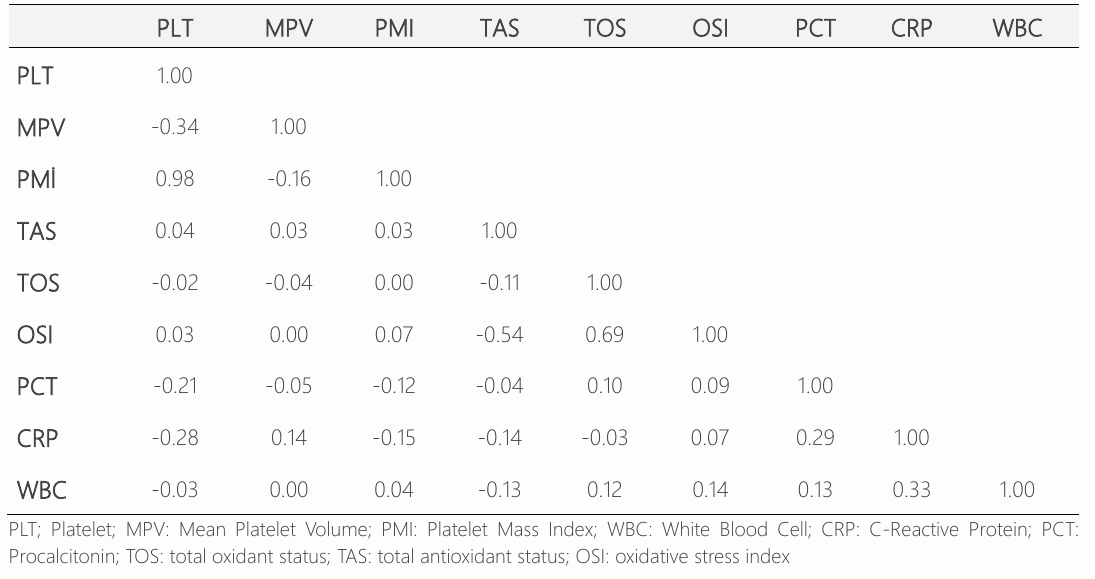
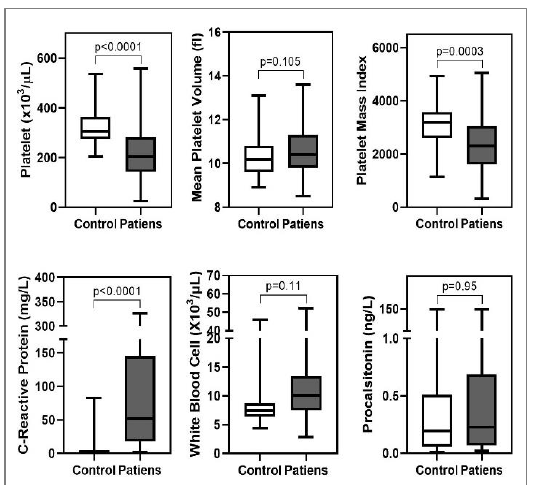
There were no significant differences between the patient and control groups in age or gender (Table 1). Compared with the control group, patients had higher PMI, CRP, TOS, and OSI, whereas PLT and TAS were lower (Table 1; Figures 1 and 2). No significant correlation was found between PMI and any of the parameters measured in this study (Table 2).
Discussion
According to this study, oxidative stress levels are elevated in intensive care patients, whereas antioxidant capacity is reduced. In these patients, platelet (PLT) counts are low, whereas the platelet mass index (PMI) is high. No significant changes were observed in mean platelet volume (MPV) values. However, no significant correlation was found between PLT or its subparameters and oxidative stress markers. Our findings suggest that high PMI values may be associated with increased oxidative stress and impaired antioxidant defense. This supports, albeit to a limited extent, the existing literature on the relationship between PMI, inflammation, and oxidative stress.
Oxidative stress leads to cellular damage and dysfunction by activating inflammatory mediators and modifying proteins, lipids, and nucleic acids (12). This process is particularly pronounced in intensive care patients, predisposing them to multiple organ and system dysfunction. Studies conducted in intensive care patients reported significantly elevated TOS levels and reduced TAS levels (13). These findings indicate that in critically ill patients, the oxidant load is increased and the antioxidant defense mechanisms are insufficient to counterbalance this burden (13).
Increased production of reactive oxygen species (ROS) intensifies the inflammatory response and accelerates tissue damage. Ayala et al. (4) reported that increased ROS production in peripheral lymphocytes of intensive care patients is associated with long-term mortality. Similarly, rapid declines in antioxidant molecules have been linked to poor prognosis (14). In a study by Çakırca et al. (15), TAS levels were also reduced in intensive care patients. A high OSI reflects both an increased oxidant load and decreased antioxidant capacity, indicating the severity of oxidative stress (13).
The relationship between inflammation and PMI has also been demonstrated in studies of inflammatory bowel disease; PMI has been reported to correlate more strongly with disease activity than platelet count or MPV, independent of these variables (16). Low PMI values have also been associated with adverse prognostic features, including increased mortality (17). However, the number of studies directly comparing PMI with oxidative stress markers is quite limited.
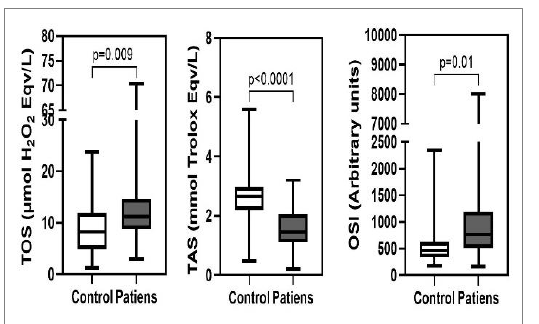
In this study, elevated CRP, OSI, and PMI levels, along with reduced TAS levels, indicate increased systemic inflammation, oxidative stress, and platelet activation. CRP reflects the acute-phase response of systemic inflammation and is associated with poor prognosis and multiple organ dysfunction in intensive care patients (18, 19). The increase in OSI supports the notion that inflammation and oxidative stress mutually reinforce each other, thereby exacerbating tissue damage (4). However, no correlation was found between CRP, OSI, and PMI. This suggests inflammatory, oxidative, and hemostatic responses do not always proceed in parallel. These mechanisms may be influenced differently depending on disease etiology, the patient’s metabolic status, and treatment response (20). Furthermore, low TAS supports the notion that the antioxidant defense system is insufficient to counteract the increased oxidative stress in critically ill patients (4).
Conclusion
In conclusion, the findings of elevated PMI, TOS, and OSI, along with reduced TAS levels, in intensive care patients indicate increased oxidative stress and impaired antioxidant defense. However, the lack of correlation among these parameters suggests that independent mechanisms may influence oxidative stress and platelet activation. These results highlight the complex interplay between inflammation, oxidative stress, and hemostatic response in critically ill patients. Prospective studies with larger sample sizes are needed to determine the prognostic value of these biomarkers more clearly.
Declarations
- Author contributions (CRediT)
- All authors contributed equally to all 14 CRediT roles (Conceptualization, Data curation, Formal analysis, Funding acquisition, Investigation, Methodology, Project administration, Resources, Software, Supervision, Validation, Visualization, Writing – original draft, Writing – review & editing).
- Funding
-
No financial support was provided by any institution or organization within the scope of the research.
- Conflicts of interest
- The authors declare no conflict of interest.
- Ethics approval
- Ethical approval for this study was obtained from the Harran University Clinical Research Ethics Committee (12.04.2021-HRÜ/21.08.20).
- Data availability
- A data availability statement was not reported in the published version of this article.
References (20)
18 of 20 references are linked to their DOI.
- Halliwell B, Gutteridge JM. Free radicals in biology and medicine: Oxford University Press, 2015. DOI Crossref PubMed Google Scholar
- Erel O. A novel automated direct measurement method for total antioxidant capacity using a new generation, more stable ABTS radical cation. J Clinical Biochemistry. 2004;37(4):277-85. DOI Crossref PubMed Google Scholar
- Erel O. A new automated colorimetric method for measuring total oxidant status. J Clinical Biochemistry. 2005;38(12):1103-11. DOI Crossref PubMed Google Scholar
- Ayala JC, Grismaldo A, Sequeda-Castaneda LG, Aristizabal-Pachon AF, Morales L. Oxidative Stress in ICU Patients: ROS as Mortality Long-Term Predictor. Antioxidants (Basel). 2021;10(12). DOI Crossref PubMed Google Scholar
- Freedman JEJA, thrombosis, biology v. Oxidative stress and platelets. 2008;28(3):s11-s6. DOI Crossref PubMed Google Scholar
- Bath P, Butterworth RJBc, fibrinolysis. Platelet size: measurement, physiology, and vascular disease. 1996;7 (2):157-61. PubMed Google Scholar
- Violi F, Loffredo L, Carnevale R, Pignatelli P, Pastori DJA, signaling r. Atherothrombosis and oxidative stress: mechanisms and management in elderly. 2017;27(14):1083-124. DOI Crossref PubMed Google Scholar
- Akbayram S, Dogan M, Akgun C, Mukul Y, Peker E, Bay A, et al. The association of oxidant status and antioxidant capacity in children with acute and chronic ITP. J Pediatr Hematol Oncol. 2010;32(4):277-81. DOI Crossref PubMed Google Scholar
- Mishra V, Baines M, Wenstone R, Shenkin A. Markers of oxidative damage, antioxidant status and clinical outcome in critically ill patients. Ann Clin Biochem. 2005;42(Pt 4):269-76. DOI Crossref PubMed Google Scholar
- Tajarernmuang P, Phrommintikul A, Limsukon A, Pothirat C, Chittawatanarat KJCcr, practice. The role of mean platelet volume as a predictor of mortality in critically ill patients: a systematic review and meta-analysis. 2016;2016(1):4370834. DOI Crossref PubMed Google Scholar
- Ilhan O, Bor M. Platelet mass index and prediction of severity of transient tachypnea of the newborn. Pediatr Int. 2019;61(7):697-705. DOI Crossref PubMed Google Scholar
- Krishnamurthy HK, Pereira M, Rajavelu I, Jayaraman V, Krishna K, Wang T, et al. Oxidative stress: fundamentals and advances in quantification techniques. Front Chem. 2024;12:1470458. DOI Crossref PubMed Google Scholar
- Segmen F, Aydemir S, Kucuk O, Dogu C, Dokuyucu R. Comparison of Oxidative Stress Markers with Clinical Data in Patients Requiring Anesthesia in an Intensive Care Unit. J Clin Med. 2024;13(22). DOI Crossref PubMed Google Scholar
- Margaritelis NV, Paschalis V, Theodorou AA, Vassiliou V, Kyparos A, Nikolaidis MG. Rapid decreases of key antioxidant molecules in critically ill patients: A personalized approach. Clin Nutr. 2020;39(4):1146-54. DOI Crossref PubMed Google Scholar
- Cakirca G, Damar Cakirca T, Ustunel M, Torun A, Koyuncu I. Thiol level and total oxidant/antioxidant status in patients with COVID-19 infection. Ir J Med Sci. 2022;191(4):1925-30. DOI Crossref PubMed Google Scholar
- Galijasevic M, Dervisevic A, Fajkic A, Avdagic N, Suljevic D. Platelet Mass Index and Other Platelet Parameters in the Assessment of Inflammatory Bowel Diseases Activity. Curr Health Sci J. 2021;47(4):566-74. Platelet Mass Index with Total Oxidant/Antioxidant Ugur Fahri Yurekli et al. PubMed Google Scholar
- Chegondi M, Vijayakumar N, Billa RD, Badheka A, Karam O. Performance of Platelet Mass Index as a Marker of Severity for Sepsis and Septic Shock in Children. J Pediatr Intensive Care. 2023;12(3):228-34. DOI Crossref PubMed Google Scholar
- Povoa P, Coelho L, Almeida E, Fernandes A, Mealha R, Moreira P, et al. C-reactive protein as a marker of infection in critically ill patients. Clin Microbiol Infect. 2005;11(2):101-8. DOI Crossref PubMed Google Scholar
- Lobo SM, Lobo FR, Bota DP, Lopes-Ferreira F, Soliman HM, Melot C, et al. C-reactive protein levels correlate with mortality and organ failure in critically ill patients. Chest. 2003;123(6):2043-9. DOI Crossref PubMed Google Scholar
- Lelubre C, Vincent JL. Mechanisms and treatment of organ failure in sepsis. Nat Rev Nephrol. 2018;14(7):417-27. DOI Crossref PubMed Google Scholar
Respond to this article
Comments on a published article are welcome as a Letter to the Editor.
Get an e-mail when new articles in your fields are published
Questions to the authors
Questions are moderated: an editor approves each question, the authors answer, and an editor approves the answer before both appear here.
No answered questions yet.
Ask the authors a question
Discussion
Comments are moderated: they appear after the writer confirms the e-mail address and an editor approves them. Each comment carries a conflict-of-interest statement.
No comments yet.
Write a comment
Tell me when this article is cited
Leave your e-mail address and confirm it. These notices are not being sent yet; your confirmed address is kept for them and used for nothing else.
Read the full text
Open the PDF here
Loading the PDF…
If the PDF does not show here, use the download button above.
How to cite this article
Yurekli UF, Yurekli M, Kaya A. Comparison of Platelet Mass Index with Total Oxidant/Antioxidant Levels in Intensive Care Unit Patients. Ulutas Med J. 2025;11(4):74-79. doi:10.5455/umj.20251015073946
Yurekli, U. F., Yurekli, M., & Kaya, A. (2025). Comparison of Platelet Mass Index with Total Oxidant/Antioxidant Levels in Intensive Care Unit Patients. The Ulutas Medical Journal, 11(4), 74–79. https://doi.org/10.5455/umj.20251015073946
Yurekli, U.F., Yurekli, M. and Kaya, A. (2025) 'Comparison of Platelet Mass Index with Total Oxidant/Antioxidant Levels in Intensive Care Unit Patients', The Ulutas Medical Journal, 11(4), pp. 74–79. doi: 10.5455/umj.20251015073946.
@article{umj290409,
  title = {Comparison of Platelet Mass Index with Total Oxidant/Antioxidant Levels in Intensive Care Unit Patients},
  author = {Yurekli, Ugur Fahri and Yurekli, Mehmet and Kaya, Ahmet},
  journal = {The Ulutas Medical Journal},
  year = {2025},
  volume = {11},
  number = {4},
  pages = {74--79},
  doi = {10.5455/umj.20251015073946},
  url = {https://www.ulutasmedicaljournal.com/?mno=290409},
  issn = {2149-388X}
}