The Ulutas Medical Journal · ISSN 2149-0430 (print), 2149-388X (online) · https://www.ulutasmedicaljournal.com/?mno=141071
Original Article · Open access
The Relationship between Serum Ferritin Level and Insulin Resistance in Metabolic Syndrome
- Şanliurfa Mehmet Akif Inan Training and Research Hospital Biochemistry TURKEY ROR
- Şanliurfa Mehmet Akif Inan Training and Research Hospital Internal Medicine Turkey ROR
Abstract
- Introduction
- Insulin resistance and metabolic syndrome (MetS) are risk factors for diabetes mellitus, and their prevalence is increasing. Ferritin has emerged as a biomarker of low-grade inflammation in addition to its role in iron metabolism. The study aims to determine the correlation between ferritin and insulin resistance (IR) in MetS.
- Materials and Methods
- In this study, ferritin, glucose (fasting), and HOMA-IR were measured from serum samples obtained from 98 MetS patients and 100 healthy volunteers. Serum ferritin, glucose, insulin, and HOMA-IR results were compared between the MetS and the control group. Correlation analysis was performed between ferritin and HOMA-IR in control and MetS patients.
- Results
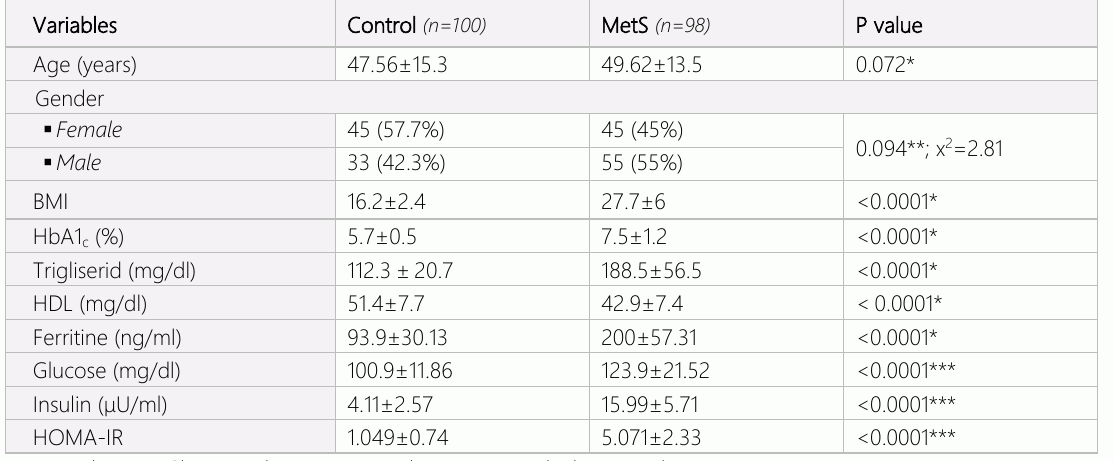
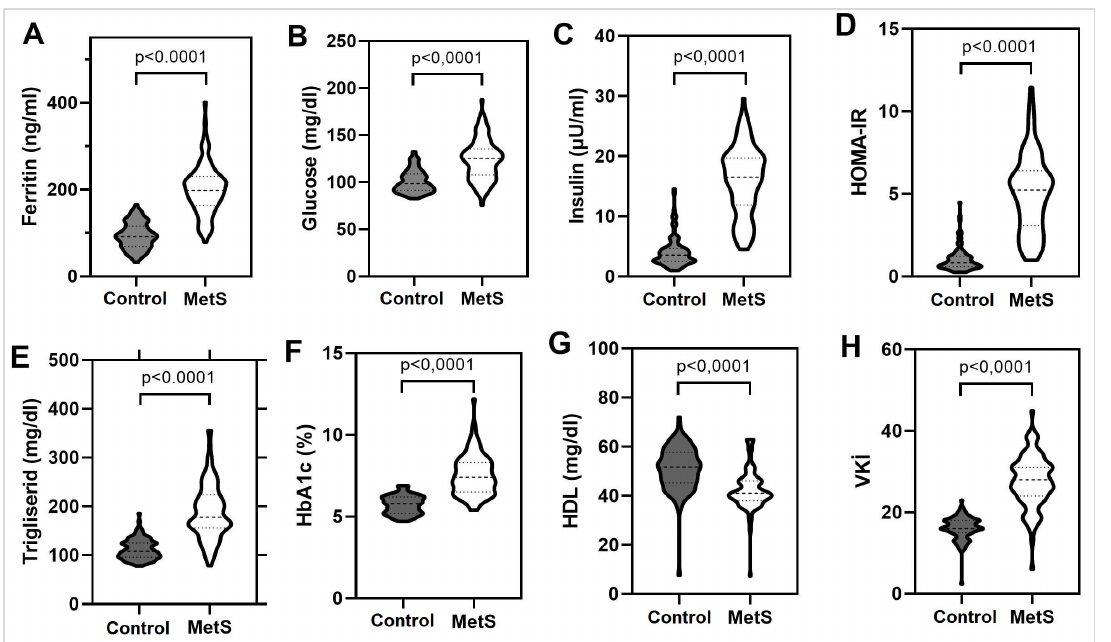
- Serum ferritin (Control: 93,9±30,13; MetS:200±57,31 ng/ml), glucose (Control: 100,9±11,86, 123,9±21,52 ng/dl), insulin (Control: 4,11±2,57; MetS:15,99±5,71 µU/ml) and HOMA-IR (Control: 1,04±0,74; MetS:5,07±2,33) revealed to be higher in MetS compared to control. The correlation between serum ferritin level and HOMA-IR in MetS patients was revealed. This correlation was not found in the control group.
- Conclusion
- In MetS, high serum ferritin level increases insulin resistance. While the positive correlation of ferritin with insulin resistance occurs at high ferritin levels, this is not observed at low ferritin levels.
Keywords
Full text
Introduction
Metabolic syndrome (MetS) affects 20-25% of the adult population of the world and is recognized as an essential factor in the emergence of type 2 diabetes (DM), cancer, and cardiovascular disease (CVD) (1). MetS are characterized by clinical findings such as resistance to insulin, obesity of abdominal, hyperlipidemia, high blood pressure, and hyperglycemia (1, 2).
Ferritin is an essential molecule in regulating iron metabolism. This molecule, an intracellular protein, is a widely used biomarker to evaluate body iron stores (2). Conversely, the increase in iron stores is correlated with many health problems (2). Studies have reported that high ferritin levels are associated with dyslipidemia, hypertension, blood glucose levels, high fasting insulin levels, and abdominal adiposity (2, 3). The study aims to reveal the relationship between ferritin levels and HOMA-IR/fasting insulin resistance in MetS patients.
Materials and Methods
Ethical Statement
The Harran University Clinical Research Ethics Committee approved the study with the date of 30.03.2020 (decision no: HRU/20.06.24).
Study Design
Ninety-eight MetS who applied to the Internal Medicine Outpatient Clinic and 100 healthy individuals were included in the control. Metabolic syndrome was diagnosed when at least tree National Cholesterol Education Program Expert Panel criteria were observed(4).
Participant Selection
Those with systemic diseases such as heart, kidney, and liver, endocrine abnormalities, such as thyroid diseases, clinical manifestations of hemochromatosis, serum ferritin >500 ng/ml, anemia (Hb<12 g/dl), blood transfusion in the last six months, iron or those with vitamin treatments, alcohol or drug abuse, any acute illness or existing inflammatory or infective disease evidence were excluded. All participants underwent a detailed clinical and physical examination. Anthropometric measurements were made according to Ozturk et al.’ study(5).
Laboratory analysis
Blood samples from the patient and control groups were centrifuged at 2500 rpm for 15-20 minutes and stored at -80 °C until measurements were made. Ferritin, glucose, insulin, triglyceride, HbA1c, and HDL levels were measured in the Roche Cobas 8000 device using commercial kits. HOMA-IR fasting glucose was calculated using the insulin (6). BMI (body mass index) was calculated according to the method of Peterson et al. (7).
Statistical analysis
The data were analyzed using the SPSS v21. Mean, standard deviation, and percentages are given as descriptive statistics. The data were analyzed using Kolmogorov-Smirnov, t-test, and Mann-Whitney tests. Pearson r correlation test was performed because it showed normal distribution. The correlation coefficient was performed as described by Koo et al. (8). P-value<0.05 was considered significant.
Results
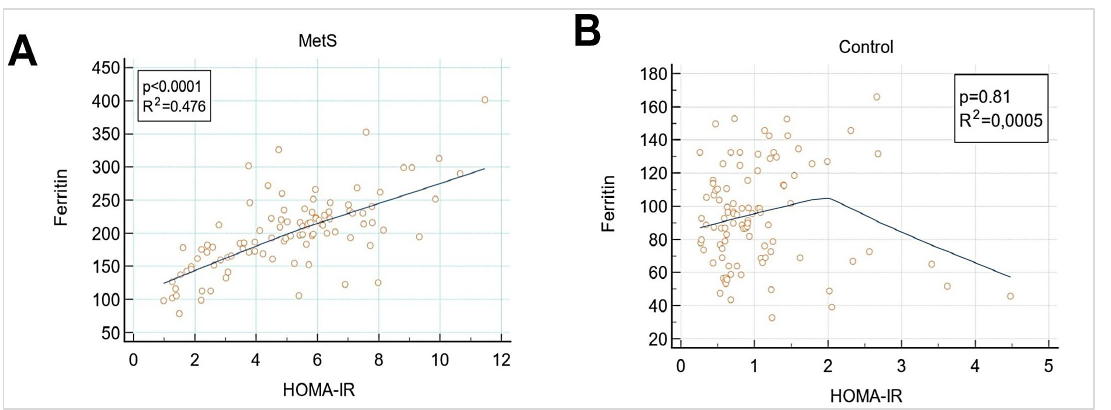
The demographic features (gender and age) of the control and patients participating in the study are given in Table 1. When the control and MetS were compared in terms of gender and age, there was no difference between them. Ferritin, glucose, insulin, HOMA-IR, triglyceride, HbA1c, and BMI were higher in MetS, while HDL was lower (Table-1 and Figure-1). A positive correlation was found between ferritin and HOMA-IR in MetS (r=0.69; p<0.0001) (Fig-2A). There was no correlation between ferritin and HOMA-IR in the control (r=-0.024) (Figure-2B). Ferritin and triglyceride(r=0.19;p=0.059), HbA1c (r=-0.025;p=0.8) HDL (r=0.121;p=0.23) and BMI (r=0.1427) was not correlated in the MetS group (p=0.15).
Discussion
In this study, serum ferritin and HOMA-IR were found to be increased in MetS patients. In addition, a positive correlation was found between increased ferritin levels and HOMA-IR in MetS patients. Significantly higher serum ferritin levels in metabolic syndrome have been reported in many studies (9, 10). In addition, It has been suggested that iron metabolism disorders in MetS affect hyperinsulinemia, insulin resistance, dyslipidemia, hyperglycemia, regional obesity, and hypertension (11). Our findings support these results. In this study, we revealed that increased insulin resistance and high ferritin act together in MetS. We think that this finding will contribute to elucidating the pathophysiology of MetS.
In clinical studies in MetS patients, it has been suggested that the increase in ferritin correlates with the increase in insulin levels (12, 13). Iron metabolism affects liver functions. Accordingly, impaired iron hemostasis has been reported to be effective in the pathogenesis of insulin resistance and Type 2 diabetes (14). Serum ferritin concentration causes insulin sensitivity by affecting beta cell function (14). The molecular mechanism related to this issue has not yet been elucidated. Iron is a transition metal that catalyzes the formation of free radicals by causing oxidative damage in cells and tissues (15). Oxidative stress disrupts the oxidant-antioxidant balance and causes abnormal changes in intracellular signal transmission and gene expression. This can lead to pathological conditions such as insulin resistance (16). However, it has been reported that an increase in ferritin levels can lead to chronic inflammatory reactions and increase body iron stores (17). Some cytokines involved in chronic inflammation are associated with the levels of NAD(P)H oxidase, which is a source of free radicals (18). An increase in NAD(P)H level increases oxidative stress. Increased oxidative stress activates intracellular signaling pathways that can produce products of cellular damage (18). Inflammation has been observed to regulate the expression and secretion of ferritin mRNA/protein levels. The increase in body iron stores produces hydroxyl radicals that lead to lipid peroxidation. This leads to DNA damage and tissue damage. Therefore, it has been suggested that the reason for the role of MetS in Type-2 DM and CVD is ferritin-mediated inflammation and oxidative stress (19). The increase in ferritin may affect insulin expression by affecting cytokine (20). However, there is not enough evidence on this subject. Further molecular studies are needed on this. In this study, it was shown that there is a positive correlation between ferritin and insulin resistance in MetS patients. In addition, this effect was not found in healthy individuals. This was interpreted as high serum ferritin levels may cause pathological effects. Because it was found that there was no correlation between low serum ferritin levels and insulin resistance, this finding demonstrates the effectiveness of ferritin-lowering treatment protocols in MetS. The limitation of this study is that the drugs used by MetS patients were not questioned. The relationship between ferritin and metabolic syndrome components is not revealed.
Conclusion
The criteria used in diagnosing MetS largely overlap with the risk factors for Type 2 DM and CVD (20). Therefore, revealing the molecules involved in the pathophysiology of MetS is essential for diabetes and CVD. This study revealed the correlation between ferritin and insulin resistance in MetS patients. While there was no correlation between ferritin and insulin resistance in healthy individuals, a correlation was found in MetS patients. This situation reveals the importance of ferritin in MetS.
Declarations
- Author contributions (CRediT)
- All authors contributed equally to all 14 CRediT roles (Conceptualization, Data curation, Formal analysis, Funding acquisition, Investigation, Methodology, Project administration, Resources, Software, Supervision, Validation, Visualization, Writing – original draft, Writing – review & editing).
- Funding
-
Funding information was not reported in the published version of this article.
- Conflicts of interest
- The authors declare no conflict of interest for the present study.
- Ethics approval
- The Harran University Clinical Research Ethics Committee approved the study with the date of 30.03.2020 ( decision no : HRU/20.06.24) .
- Data availability
- A data availability statement was not reported in the published version of this article.
References (20)
18 of 20 references are linked to their DOI.
- Gade W, Schmit J, Collins M, Gade J. Beyond obesity: the diagnosis and pathophysiology of metabolic syndrome. Clin Lab Sci. 2010;23(1):51-61; quiz 2-5 DOI Crossref PubMed Google Scholar
- Abril-Ulloa V, Flores-Mateo G, Sola-Alberich R, Manuel-y-Keenoy B, Arija V. Ferritin levels and risk of metabolic syndrome: meta-analysis of observational studies. BMC Public Health. 2014;14:483 DOI Crossref PubMed Google Scholar
- Mojiminiyi OA, Marouf R, Abdella NA. Body iron stores in relation to the metabolic syndrome, glycemic control and Figure 2. Correlation between serum ferritin level and HOMA-IR in MetS patients (A) and control group (B) 34 77 Serum Ferritin Level and Insulin Resistance Uğur Fahri Yürekli & Rıza Altunbaş complications in female patients with type 2 diabetes. Nutr Metab Cardiovasc Dis. 2008;18(8):559-66 DOI Crossref PubMed Google Scholar
- National Cholesterol Education Program Expert Panel on Detection E, Treatment of High Blood Cholesterol in A. Third Report of the National Cholesterol Education Program (NCEP) Expert Panel on Detection, Evaluation, and Treatment of High Blood Cholesterol in Adults (Adult Treatment Panel III) final report. Circulation. 2002;106(25):3143-421 DOI Crossref PubMed Google Scholar
- Ozturk EE, Yildiz H. Evaluation of different anthropometric indices for predicting metabolic syndrome. Eur Rev Med Pharmacol Sci. 2022;26(22):8317-25 PubMed Google Scholar
- Matthews DR, Hosker JP, Rudenski AS, Naylor BA, Treacher DF, Turner RC. Homeostasis model assessment: insulin resistance and beta-cell function from fasting plasma glucose and insulin concentrations in man. Diabetologia. 1985;28(7): 412-9 DOI Crossref PubMed Google Scholar
- Peterson CM, Thomas DM, Blackburn GL, Heymsfield SB. Universal equation for estimating ideal body weight and body weight at any BMI. Am J Clin Nutr. 2016;103(5):1197-203 DOI Crossref PubMed Google Scholar
- Koo TK, Li MY. A Guideline of Selecting and Reporting Intraclass Correlation Coefficients for Reliability Research. J Chiropr Med. 2016;15(2):155-63 DOI Crossref PubMed Google Scholar
- Sachinidis A, Doumas M, Imprialos K, Stavropoulos K, Katsimardou A, Athyros VG. Dysmetabolic Iron Overload in Metabolic Syndrome. Curr Pharm Des. 2020;26(10):1019-24 DOI Crossref PubMed Google Scholar
- Chand MR, Agarwal N, Nishanth D, Jhuma S. Association of Serum Ferritin Levels with Metabolic Syndrome in India: a Cross- Sectional Study. Maedica (Bucur). 2021;16(1):48-53 DOI Crossref PubMed Google Scholar
- Jehn M, Clark JM, Guallar E. Serum ferritin and risk of the metabolic syndrome in U.S. adults. Diabetes Care. 2004;27 (10):2422-8 DOI Crossref PubMed Google Scholar
- Nakamura K, Sakurai M, Morikawa Y, Nagasawa SY, Miura K, Ishizaki M, et al. Serum Ferritin, Insulin Resistance, and beta-cell Dysfunction: A Prospective Study in Normoglycemic Japanese Men. Exp Clin Endocrinol Diabetes. 2017;125(1):12- DOI Crossref PubMed Google Scholar
- Shim YS, Kang MJ, Oh YJ, Baek JW, Yang S, Hwang IT. Association of serum ferritin with insulin resistance, abdominal obesity, and metabolic syndrome in Korean adolescent and adults: The Korean National Health and Nutrition Examination Survey, 2008 to 2011. Medicine (Baltimore). 2017;96(8):e6179 DOI Crossref PubMed Google Scholar
- Huang J, Karnchanasorn R, Ou HY, Feng W, Chuang LM, Chiu KC, et al. Association of insulin resistance with serum ferritin and aminotransferases-iron hypothesis. World J Exp Med. 2015;5(4):232-43 DOI Crossref PubMed Google Scholar
- Arosio P, Levi S. Ferritin, iron homeostasis, and oxidative damage. Free Radic Biol Med. 2002;33(4):457-63 PubMed Google Scholar
- Guo H, Ling W. The update of anthocyanins on obesity and type 2 diabetes: experimental evidence and clinical perspectives. Rev Endocr Metab Disord. 2015;16(1):1 -13 DOI Crossref PubMed Google Scholar
- Zafon C, Lecube A, Simo R. Iron in obesity. An ancient micronutrient for a modern disease. Obes Rev. 2010;11(4): 322-8 DOI Crossref PubMed Google Scholar
- Lin N, Zhang H, Su Q. Advanced glycation end-products induce injury to pancreatic beta cells through oxidative stress. Diabetes Metab. 2012;38(3):250-7 DOI Crossref PubMed Google Scholar
- Fernandez-Real JM, Lopez-Bermejo A, Ricart W. Cross-talk between iron metabolism and diabetes. Diabetes. 2002;51(8): 2348-54 DOI Crossref PubMed Google Scholar
- Rochlani Y, Pothineni NV, Kovelamudi S, Mehta JL. Metabolic syndrome: pathophysiology, management, and modulation by natural compounds. Ther Adv Cardiovasc Dis. 2017;11(8): 215-25 DOI Crossref PubMed Google Scholar
Respond to this article
Comments on a published article are welcome as a Letter to the Editor.
Get an e-mail when new articles in your fields are published
Questions to the authors
Questions are moderated: an editor approves each question, the authors answer, and an editor approves the answer before both appear here.
No answered questions yet.
Ask the authors a question
Discussion
Comments are moderated: they appear after the writer confirms the e-mail address and an editor approves them. Each comment carries a conflict-of-interest statement.
No comments yet.
Write a comment
Read the full text
Open the PDF here
Loading the PDF…
If the PDF does not show here, use the download button above.
How to cite this article
Yurekli UF, Altunbas R. The Relationship between Serum Ferritin Level and Insulin Resistance in Metabolic Syndrome. Ulutas Med J. 2023;9(1):30-34. doi:10.5455/umj.20230119123818
Yurekli, U. F., & Altunbas, R. (2023). The Relationship between Serum Ferritin Level and Insulin Resistance in Metabolic Syndrome. The Ulutas Medical Journal, 9(1), 30–34. https://doi.org/10.5455/umj.20230119123818
Yurekli, U.F. and Altunbas, R. (2023) 'The Relationship between Serum Ferritin Level and Insulin Resistance in Metabolic Syndrome', The Ulutas Medical Journal, 9(1), pp. 30–34. doi: 10.5455/umj.20230119123818.