The Ulutas Medical Journal · ISSN 2149-0430 (print), 2149-388X (online) · https://www.ulutasmedicaljournal.com/?mno=165447
Original Article · Open access
Investigation of Antioxidant-Oxidant Levels in Infertile Men: A Prospective Cross-Sectional Study
- Department of Urology, Hatem Private Hospital, Gaziantep, Turkey
Abstract
- Introduction
- The escalating rate of infertility, especially with many of its causes remaining enigmatic, necessitates advanced investigative measures. This study explores the correlation between various biochemical, hormonal, hematological, and oxidative stress parameters in infertile male patients and their sperm parameters.
- Materials and Methods
- From January to July 2023, blood samples of infertile male patients from our outpatient clinic were examined for aforementioned parameters. Patients were categorized into four groups based on their sperm parameters: Group 1 (Normal), Group 2 (Asthenospermia), Group 3 (Oligospermia), and Group 4 (Azoospermia).
- Results
- Infertility duration, FSH, LH, prolactin, and testicular volume (both left and right) varied significantly among the groups (p<0.01). Significant differences were also noted in monocyte, eosinophil, TAS, TOS, OSI, CRP, and ESR levels (p<0.01). Specifically, azoospermia positively correlated with increased Monocyte, TOS, OSI, CRP, and ESR levels (p-values and correlation coefficients ranging from p=0.012, r: 0.141 to p<0.001, r: 0.551). Logistic regression pinpointed TAS, TOS, OSI, and ESR as significant differentiation risk factors. According to ROC analysis, these factors were critical prognosticators for azoospermia.
- Conclusion
- Elevated TOS and OSI, coupled with decreased TAS levels, were linked to monocytes, CRP, and ESR in azoospermia. Thus, TAS, TOS, OSI, and ESR can be pivotal diagnostic tools for infertility, and their evaluation from routine blood samples could streamline the diagnosis and treatment response assessment of infertility.
Keywords
Full text
Introduction
Infertility remains a global medical challenge, conventionally described as the inability to achieve a clinical pregnancy after one year of regular unprotected coitus (1). Globally, it affects an estimated quarter of couples, with the etiological spectrum spanning female, male, both sexes or often ambiguous causative factors (2, 3). Notably, male infertility represents nearly half of all such cases (4). Perturbingly, male factors contribute to infertility in almost half of all the affected couples, a concerning prevalence. Infertility's etiological framework is intricate, embracing hormonal dysregulations, genetic predisposition, anatomical aberrations, psychosocial determinants, and age-related decrements (5). Moreover, seminal pathologies often underscore the malefactor, detrimentally influenced by lifestyle, diet, environmental pollutants, medications, and other toxins (6). Disturbingly, an imbalance towards oxidative stress from disrupting the oxidant-antioxidant equilibrium jeopardizes spermatogenesis due to the harmful impact of testicular reactive oxygen species (ROS) (6). This, in turn, manifests in idiopathic infertility and impaired semen parameters (7). Elevated ROS and increasing oxidative stress inflict cellular, tissue, and organ damage. Seminal membranes, replete with oxidizable unsaturated fatty acids and ROS-neutralizing enzymes in scant quantities, are thus particularly vulnerable (8).
Maintenance of oxidant-antioxidant balance can engender robust, motile, well-structured sperm, potentially mitigating infertility (9, 10). Seminal plasma houses myriad enzymatic and non-enzymatic antioxidants, ranging from superoxide dismutase and catalase to vitamin E, offering protection against ROS and supporting assisted reproductive strategies (11). Given the rampant infertility rates, diagnosing, managing, and tracking the substantial subset of infertile couples with indeterminate aetiologies demand innovative markers. Given growing incidence of infertility, there's a pressing need for creative diagnostic and treatment markers for cases with unidentified causes (12–14). The study focused on biochemical, hormonal, haematological, and oxidative stress parameters in male patients who applied to our clinic due to infertility and assessed the relationship of these values with the sperm parameters of the patients.
Materials and Methods
Study design
The study was designed as a prospective, cross-sectional, single-centre research. Men who could not have children despite unprotected sexual intercourse for more than one year were included in the study.
Ethical Statement
This study protocol was approved by the clinical research ethics committee of the institution of the University (Approval:27.01.2023-52850). Written informed consent was obtained from patients for this prospective study. Infertile male patients who applied to the urology outpatient clinic between 2023 January and July were included in study. Age, infertility duration, examination findings, testicular volumes, body mass index, additional diseases, previous medications, previous treatment methods, smoking, occupation, and various hormonal disorders, especially organs such as thyroid and pituitary, were evaluated. The patients included in the study are considered primary (who never had a child) and secondary (those who have had a child before, who have not had a child for more than one year) infertility.
Process and Patient Grouping
We initiated our study by identifying and excluding potential participants based on specific criteria: those with prior surgical or medical infertility treatment, those diagnosed with varicocele or hypogonadism, smokers, and secondary infertile patients. Following a physical examination, participants underwent scrotal colour Doppler ultrasonography to assess the blood flow to both testicles. After a stipulated period of 72 hours of sexual abstinence, a semen analysis was carried out. This analysis scrutinized several parameters: semen volume, sperm count, motility, forward motile sperm rate and count, morphology following the Kruger criteria, and leukocyte count in the semen.
Concurrently, blood samples drawn from all participants were subjected to various tests. These aimed to measure hormone levels — including total testosterone, LH, FSH, oestradiol, prolactin, and TSH — inflammatory factors, hemogram, and CRP. TOS, TAS, and OSI values were determined and catalogued during the patient's standard outpatient assessment. Based on the comprehensive data from these evaluations, we classified the participants into four distinct groups: Group 1 (Normal Sperm Parameters): These patients exhibited standard sperm metrics: semen volume exceeding 1.5 cc, sperm count over 15 million/ml, total sperm motility surpassing 40%, forward motility above 32%, Kruger morphology greater than 14%, and leukocyte less than 1 million. Group 2 (Asthenospermia): This group comprised sperm motility below 40% yet maintained an average sperm count exceeding 15 million/ml. Group 3 (Oligospermia): Sperm count below 15 million/ml. Group 4 (Azoospermia): Patients whose semen lacked viable sperm cells. We embarked on comparative analyses, assessing age, body mass index, hormone levels, sperm parameters, TAS, TOS, OSI, and inflammatory markers such as leukocyte, neutrophil, platelet, CRP, and sedimentation. The correlations between OSI values, sperm parameters, and other significant variables, like hormone levels and inflammatory factors, were meticulously determined.
Total Oxidative Status (TOS) Measurement
Serum TOS level was studied with commercial Rel Assay kits developed by Erel. To measure TOS, a colorimetric method based on the oxidation of oxidant molecules contained in the samples to ferrous ion to ferric ion, as stated in the working principle of the test, was used. Results are given as µmol H2O2/L (19).
Total Antioxidant Status (TAS) Measurement
Serum TAS level was studied with commercial Rel Assay kits developed by Erel. Developed by Erel, this method is automatic and measures the body's total antioxidant capacity against potent free radicals. The TOS measurement method of the samples is based on the reduction of the colored ABTS* cationic radical by all antioxidant molecules in example and the decolorization of the coloured radical in proportion to the total concentrations of the antioxidant molecules (20). Trolox, a water-soluble analogy of vitamin E, is used as calibrator. Results are expressed as mmol Trolox Equivalent/L.
Oxidative Stress Index (OSI) Measurement
The oxidative stress index of the samples is stated as the percentage of the total oxidant status of the samples to the total antioxidant level of the samples (21). Before the calculation, the mmol value in the unit of the TAS test is converted into micromoles as in the TOS test.
Statistical Analysis
Statistical measurements were analysed using the Graph-Pad Prism 9.0 (GraphPad Software, San Diego, CA, USA) program. Descriptive statistical methods (median, min-max) were calculated while evaluating the study data. The Shapiro-Wilk test determined the distribution of the data. One-way ANOVA tests were used for normal distributions, and Kruskal Wallis were used for non-normal distributions. Univariate and multivariate regression analysis was applied for correlation analysis. Pearson correlation was used for normal distributions, and Spearman relation was used for non-normal distributions. The results were considered significant with a 95% confidence interval, p<0.05.
Results
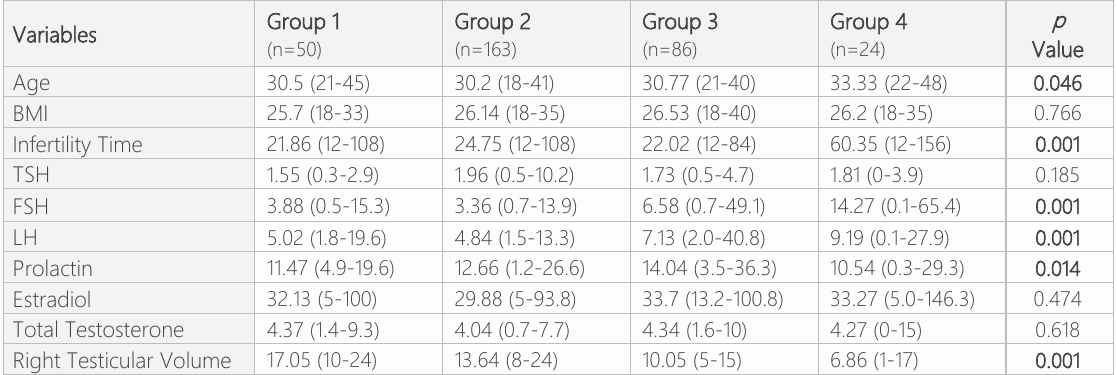
Comparisons of biochemical inflammatory, and hormonal parameters of the groups is shown in Table-1. There was a difference between the groups regarding age, infertility time, FSH, LH, prolactin, right testicular volume, and left testicular volume (p<0.05). Regarding other parameters, there was no statistically significant difference between the groups (Table-1).
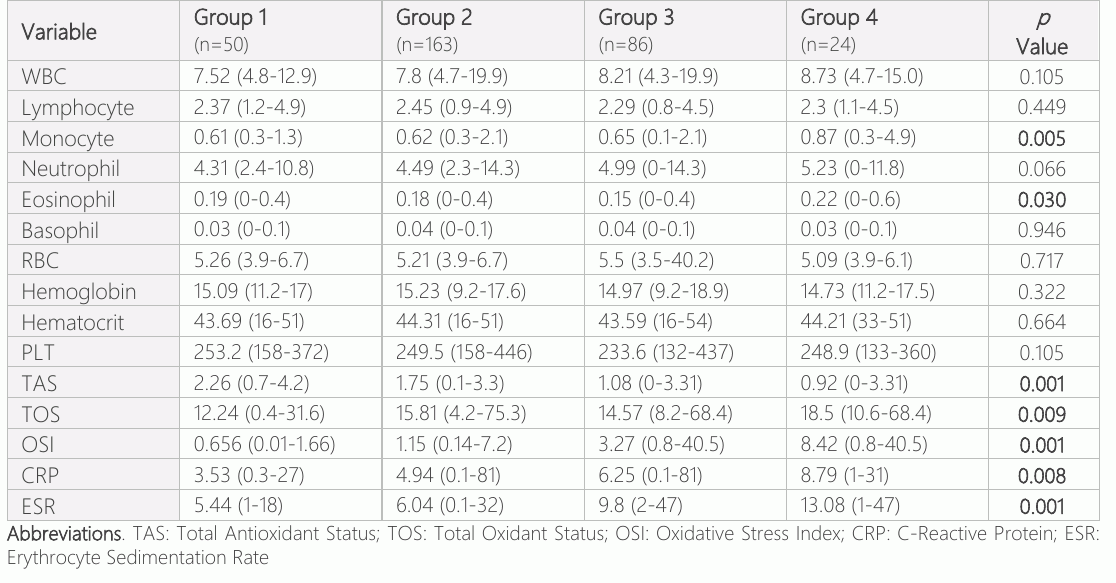
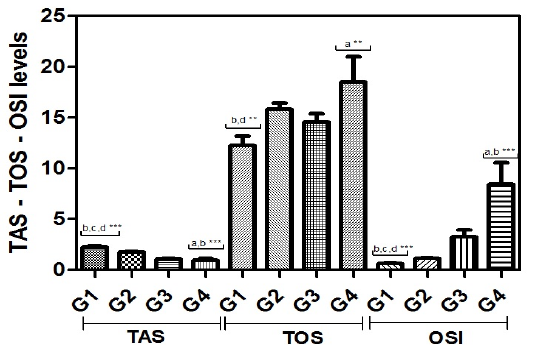
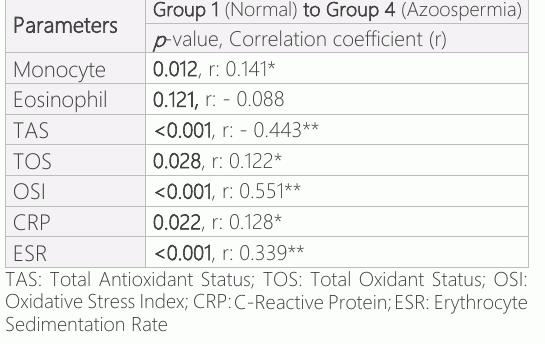
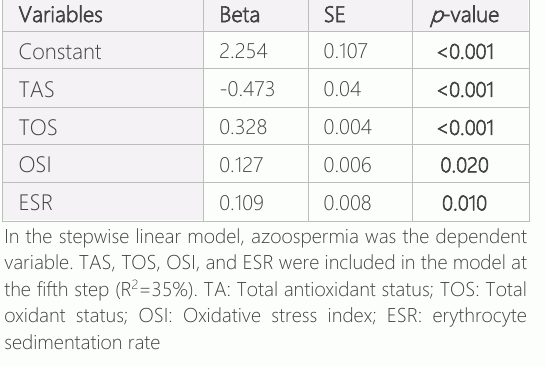
Comparisons of haematological, inflammatory, and oxidative stress parameters of the groups is shown in Table-2. There was a difference for monocyte, eosinophil, TAS, TOS, OSI, CRP and ESR (p<0.05) (Figure-1). In other parameters, groups had no difference (Table-2). Correlation was performed for parameters between the groups in terms of biochemical and hormonal parameters (Table-3). There was a significant positive correlation between the development of azoospermia and infertility time, FSH, and LH (p=0.016, r:0.134, p<0.001, r:0.368, and p<0.001, r:0.278, respectively). There was no relationship between the development of azoospermia and age, sperm volume, and prolactin parameters. A correlation analysis was performed for the significant parameters between the groups in terms of inflammatory and oxidative stress (Table-4). There was a positive correlation between the development of azoospermia and Monocyte, TOS, OSI, CRP, and ESR (p=0.012, r:0.141, p=0.028, r:0.122, p<0.001, r:0.551, p= 0.022, r:0.128, p<0.001, r:0.339, respectively). However, there was a negative correlation between the development of azoospermia and TAS level (p<0.001, r:-0.443). There was no relationship between the development of azoospermia and eosinophil level (Table-4). A stepwise linear regression was performed using variables associated with the azoospermia as a dependent variable. It showed an inverse correlation with TAS but a positive correlation with TOS, OSI, and ESR (Table-5).

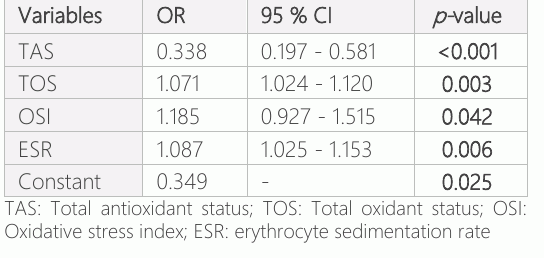
Logistic regression analysis of factors used for differentiating azoospermia from normal was shown in Table-6. The risk factors associated with differentiation in the logistic regression analysis included TAS, TOS, OSI, and ESR.
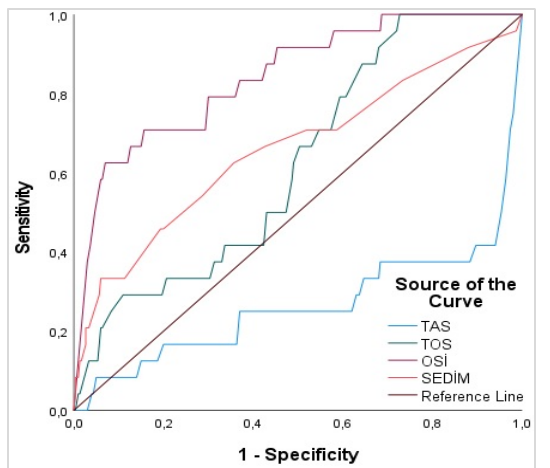
According to the results of ROC analysis in patients with azoospermia, sensitivity 33,3%, and specificity 35,3% for TAS (p =0,0001; AUC: 0.266; 95% CI:0.130-0.402); sensitivity 66,7%, and specificity 49,7% for TOS (p =0,044; AUC: 0.624; 95% CI:0.520-0.727); sensitivity 70,8%, and specificity 84,3% for OSI (p =0,0001; AUC: 0.842; 95% CI:0.759-0.924); sensitivity 62,5% and specificity 64,3% for ESR (p =0,010; AUC: 0.659; 95% CI: 0.528-0.790) were found. The cut-off point for these values was 1.11, 12.35, 1.92, and 7.5, respectively. As a result, according to ROC analysis for azoospermia, the TAS, TOS, OSI, and ESR were significant prognostic factors (Figure-2).
Discussion
Our study examined biochemical, hormonal, haematological and oxidative stress markers and their influence on male infertility. We identified the significant roles of TAS, TOS, OSI, and ESR in determining sperm characteristics. Oxidative stress, resulting from an imbalance between antioxidants and free radicals, appears crucial in affecting sperm quality. Despite varied findings in current literature, the importance of oxidative stress parameters in male infertility diagnosis and treatment efficacy is evident. This emphasizes the need for comprehensive studies to understand the relationships better. Oxidative stress, which occurs due to the imbalance between antioxidants and free oxygen radicals in the body, damages sperm and can cause infertility (22). In the seminal plasma, immature leukocytes (neutrophils and macrophages) and damaged spermatozoa are the primary endogenous sources of free oxygen radicals (23, 24). Seminal plasma has a strong antioxidant capacity to protect spermatozoa against damage induced by free oxygen radicals (25, 26). This protective system contains antioxidant molecules that stop the chain reaction of free oxygen radicals collect or neutralize oxidant radicals. Different data on free oxygen radicals and antioxidant capacity have been reported in the seminal plasma of infertile men. Sharma et al. (22) reported low TAS and high TOS in normozoospermic infertile men, while Saleh et al. (27) found no change in TAS and TOS in infertile male seminal plasmas. Shiva et al. found oxidative capacity low and antioxidant capacity high in azoospermia patients (28). According to the findings of our study, oxidative stress index and total oxidative capacity were quite high and total antioxidant capacity was relatively low in azoospermic patients. Considering the current knowledge that the primary sources of oxidative stress in the seminal plasma are leukocytes and immature, defective sperm cells, our group of azoospermic individuals without leucocytosis, low TOS values, and OSI in semen would be expected. However, we found that the high TOS and OSI values in the azoospermia group were due to blood monocyte, CRP, and ESR. Many conditions, such as systemic infection, depression, and stress, cause oxidative balance changes in the blood (3, 21, 29, 30). Many of these clinical conditions are also among the etiological causes of male factor infertility. From this point of view, we can say that pathologies that cause signs of oxidative stress in the serum may indirectly affect the seminal plasma and the production and functions of sperm. Examples of the reverse are readily available. Many studies have shown sperm production and/or functions can be improved with treatments in which the systemic antioxidant balance is corrected (31, 32). Our study Therefore, one of the reasons for the high TAS in semen can be explained by the contribution of mature sperm cells to antioxidant capacity. Different results have also been reported in studies examining the relationship between semen parameters TAS and TOS. While some authors could not find a connection between semen parameters of infertile men and TAS, TOS (33, 34), others reported a relationship (5, 8). In our study, while there was a positive correlation between semen parameters and TOS and OSI in the azoospermic group, there was a negative correlation between semen parameters and TAS. In our study, the negative correlation between OSI elevation and semen volume, sperm count, and morphology in the non-azoospermic group supports information in the literature that oxidative stress negatively affects sperm development (8, 35, 36).
This study is subject to several limitations. Firstly, it was a single-center study, which could inherently limit generalizability of our findings. Secondly, the absence of long-term follow-up data restricts our insight into the sustained diagnostic efficacy of the examined indices. Additionally, the impact of systemic oxidative balance disorders, such as those caused by depressive moods, on sperm parameters was not extensively explored. Given the varied findings in the literature on oxidative stress and its relationship with sperm count, our study's conclusions would benefit from validation in larger, multicentre studies.
Conclusion
Azoospermia exhibit pronounced oxidative stress patterns in serum plasma and blood compared to oligospermic and normospermic counterparts. Elevated TOS and OSI levels in our azoospermic cohort, characterized by seminal samples devoid of sperm cells and/or leukospermia, indicate that the predominant contributors to oxidative stress in semen may be monocytes, alongside CRP and ESR markers. Our findings underscore the pivotal role of TAS, TOS, OSI, and ESR measurements in diagnosing infertility. This research suggests the potential utility of TAS, TOS, and OSI metrics in assessing the therapeutic efficacy of the antioxidants in addressing male infertility, mainly when used concomitantly with spermiogram. Furthermore, the implications of various conditions that induce oxidative stress on semen quality warrant deeper exploration. The pressing need for broader and more methodically structured investigations is evident. Notably, the potential influence of depressive states, commonly observed in azoospermia and severe oligozo-ospermic patients, on sperm parameters via systemic oxidative imbalances presents an intriguing avenue for future inquiry.
Declarations
- Author contributions (CRediT)
- All authors contributed equally to all 14 CRediT roles (Conceptualization, Data curation, Formal analysis, Funding acquisition, Investigation, Methodology, Project administration, Resources, Software, Supervision, Validation, Visualization, Writing – original draft, Writing – review & editing).
- Funding
-
Funding information was not reported in the published version of this article.
- Conflicts of interest
- The authors declare no conflict of interest.
- Ethics approval
- This study protocol was approved by the clinical research ethics committee of the institution of the University (Approval:27.01.2023- 52850). Written informed consent was obtained from patients for this prospective study.
- Data availability
- The data that was used and analysed during this research are available from the corresponding author on reasonable request.
References (36)
33 of 36 references are linked to their DOI.
- Vayena E, Rowe PJ, Griffin PD. Current practices and controversies in assisted reproduction: report of a meeting on medical, ethical and social aspects of assisted reproduction, held at WHO Headquarters in Geneva, Switzerland: World Health Organization; 2002. PubMed Google Scholar
- Dong L, Zhang X, Yang F, Li J, Yu X, Li Y. Effect of oral alpha-lipoic acid (ALA) on the treatment of male infertility: A protocol for systematic review and meta-analysis. Medicine (Baltimore). 2019;98(51):e18453. DOI Crossref PubMed Google Scholar
- Dokuyucu R, Karateke A, Gokce H, Kurt RK, Ozcan O, Ozturk S, et al. Antioxidant effect of erdosteine and lipoic acid in ovarian ischemia-reperfusion injury. Eur J Obstet Gynecol Reprod Biol. 2014;183:23-7. DOI Crossref PubMed Google Scholar
- Gabrielsen JS, Tanrikut C. Chronic exposures and male fertility: the impacts of environment, diet, and drug use on spermatogenesis. Andrology. 2016;4(4):648-61. DOI Crossref PubMed Google Scholar
- Maurya S, Kesari KK, Roychoudhury S, Kolleboyina J, Jha NK, Jha SK, et al. Metabolic Dysregulation and Sperm Motility in Male Infertility. Adv Exp Med Biol. 2022;1358:257-73. DOI Crossref PubMed Google Scholar
- Saad AB, Rjeibi I, Brahmi N, Elaloui E, Zouari N. Nicotine-induced oxidative stress, testis injury, AChE inhibition and brain damage alleviated by Mentha spicata. Inflammopharmacology. 2020;28(4):939-48. DOI Crossref PubMed Google Scholar
- Aitken RJ, De Iuliis GN, Finnie JM, Hedges A, McLachlan RI. Analysis of the relationships between oxidative stress, DNA damage and sperm vitality in a patient population: development of diagnostic criteria. Hum Reprod. 2010;25(10):2415-26. DOI Crossref PubMed Google Scholar
- Moustafa MH, Sharma RK, Thornton J, Mascha E, Abdel-Hafez MA, Thomas AJ, Jr., et al. Relationship between ROS production, apoptosis and DNA denaturation in spermatozoa from patients examined for infertility. Hum Reprod. 2004;19(1):129-38. 172 77 Antioxidant-Oxidant Levels in Infertile Men Mehmet Taşkıran DOI Crossref PubMed Google Scholar
- Hussain T, Kandeel M, Metwally E, Murtaza G, Kalhoro DH, Yin Y, et al. Unraveling the harmful effect of oxidative stress on male fertility: A mechanistic insight. Front Endocrinol (Lausanne). 2023;14:1070692. DOI Crossref PubMed Google Scholar
- Becatti M, Cito G, Argento FR, Fini E, Bettiol A, Borghi S, et al. Blood Leukocyte ROS Production Reflects Seminal Fluid Oxidative Stress and Spermatozoa Dysfunction in Idiopathic Infertile Men. Antioxidants (Basel). 2023;12(2). DOI Crossref PubMed Google Scholar
- Dutta S, Majzoub A, Agarwal A. Oxidative stress and sperm function: A systematic review on evaluation and management. Arab J Urol. 2019;17(2):87 -97. DOI Crossref PubMed Google Scholar
- Walczak-Jedrzejowska R, Wolski JK, Slowikowska-Hilczer J. The role of oxidative stress and antioxidants in male fertility. Cent European J Urol. 2013;66(1):60-7. DOI Crossref PubMed Google Scholar
- Aprioku JS. Pharmacology of free radicals and the impact of reactive oxygen species on the testis. J Reprod Infertil. 2013;14(4):158-72. DOI Crossref PubMed Google Scholar
- Sanocka-Maciejewska D, Ciupinska M, Kurpisz M. Bacterial infection and semen quality. J Reprod Immunol. 2005;67(1-2):51-6. DOI Crossref PubMed Google Scholar
- Aydogdu I, Karaca E, Coban G, Cay A, Guler EM, Kocyigit A, et al. An investigation of the effects of amniotic fluid on experimental ischemia/reperfusion damage in rat testes. J Pediatr Urol. 2021;17(6):761 e1- e6. DOI Crossref PubMed Google Scholar
- Erdemli Z, Erdemli ME, Turkoz Y, Gul M, Yigitcan B, Gozukara Bag H. The effects of acrylamide and Vitamin E administration during pregnancy on adult rats testis. Andrologia. 2019;51(7):e13292. DOI Crossref PubMed Google Scholar
- Isbilen E, Kulaksizoglu S, Kirmizioglu M, Karuserci Komurcu O, Tabur S. Role of prolidase activity and oxidative stress biomarkers in unexplained infertility. Int J Gynaecol Obstet. 2022;156(3):430-5. DOI Crossref PubMed Google Scholar
- Kati B, Gonel A, Ordek E, Pelit ES, Ciftci H. Do inflammatory markers such as NLRP3 and IL1-beta have an effect on the prediction of testicular sperm extraction success in infertile men? Andrologia. 2022;54(11):e14572. PubMed Google Scholar
- Erel O. A new automated colorimetric method for measuring total oxidant status. Clin Biochem. 2005;38(12):1103-11. DOI Crossref PubMed Google Scholar
- Erel O. A novel automated direct measurement method for total antioxidant capacity using a new generation, more stable ABTS radical cation. Clin Biochem. 2004;37(4):277-85. DOI Crossref PubMed Google Scholar
- Dokuyucu R, Cevik C, Ozler GS, Ozgur T, Arli C, Sefil F, et al. Determination of oxidative stress and effect of erdosteine on rhinitis medicamentosa in a rat model. Eur J Pharmacol. 2014;742:153-7. DOI Crossref PubMed Google Scholar
- Sharma RK, Pasqualotto FF, Nelson DR, Thomas AJ, Jr., Agarwal A. The reactive oxygen species-total antioxidant capacity score is a new measure of oxidative stress to predict male infertility. Hum Reprod. 1999;14(11):2801-7. DOI Crossref PubMed Google Scholar
- Barati E, Nikzad H, Karimian M. Oxidative stress and male infertility: current knowledge of pathophysiology and role of antioxidant therapy in disease management. Cell Mol Life Sci. 2020;77(1):93-113. DOI Crossref PubMed Google Scholar
- Agarwal A, Rana M, Qiu E, AlBunni H, Bui AD, Henkel R. Role of oxidative stress, infection and inflammation in male infertility. Andrologia. 2018;50(11):e13126. DOI Crossref PubMed Google Scholar
- Bisht S, Faiq M, Tolahunase M, Dada R. Oxidative stress and male infertility. Nat Rev Urol. 2017;14(8):470-85. DOI Crossref PubMed Google Scholar
- Sengupta P, Roychoudhury S, Nath M, Dutta S. Oxidative Stress and Idiopathic Male Infertility. Adv Exp Med Biol. 2022;1358:181-204. DOI Crossref PubMed Google Scholar
- Saleh RA, Agarwal A, Nada EA, El-Tonsy MH, Sharma RK, Meyer A, et al. Negative effects of increased sperm DNA damage in relation to seminal oxidative stress in men with idiopathic and male factor infertility. Fertil Steril. 2003;79 Suppl 3:1597-605. DOI Crossref PubMed Google Scholar
- Shiva M, Gautam AK, Verma Y, Shivgotra V, Doshi H, Kumar S. Association between sperm quality, oxidative stress, and seminal antioxidant activity. Clin Biochem. 2011;44(4):319-24. DOI Crossref PubMed Google Scholar
- Higashi Y, Hoshijima M, Yawata T, Nobumoto A, Tsuda M, Shimizu T, et al. Suppression of oxidative stress and 5-lipoxygenase activation by edaravone improves depressive-like behavior after concussion. J Neurotrauma. 2014;31(20):1689-99. DOI Crossref PubMed Google Scholar
- Dokuyucu R, Gozukara KH, Ozcan O, Sefil NK, Nacar A, Dokuyucu A, et al. The effect of Bongardia Chrysogonum on prostate tissue in a rat model of STZ-induced diabetes. Springerplus. 2016;5(1):1322. DOI Crossref PubMed Google Scholar
- Eroglu M, Sahin S, Durukan B, Ozakpinar OB, Erdinc N, Turkgeldi L, et al. Blood serum and seminal plasma selenium, total antioxidant capacity and coenzyme q10 levels in relation to semen parameters in men with idiopathic infertility. Biol Trace Elem Res. 2014;159(1-3):46-51. DOI Crossref PubMed Google Scholar
- Kobori Y, Ota S, Sato R, Yagi H, Soh S, Arai G, et al. Antioxidant cosupplementation therapy with vitamin C, vitamin E, and coenzyme Q10 in patients with oligoasthenozoospermia. Arch Ital Urol Androl. 2014;86(1):1-4. DOI Crossref PubMed Google Scholar
- Verit FF, Verit A, Ciftci H, Erel O, Celik H. Paraoxonase-1 activity in subfertile men and relationship to sperm parameters. J Androl. 2009;30(2):183-9. DOI Crossref PubMed Google Scholar
- Pasqualotto FF, Sharma RK, Nelson DR, Thomas AJ, Agarwal A. Relationship between oxidative stress, semen characteristics, and clinical diagnosis in men undergoing infertility investigation. Fertil Steril. 2000;73(3):459-64. DOI Crossref PubMed Google Scholar
- Mancini A, Festa R, Silvestrini A, Nicolotti N, Di Donna V, La Torre G, et al. Hormonal regulation of total antioxidant capacity in seminal plasma. J Androl. 2009;30(5):534-40. DOI Crossref PubMed Google Scholar
- Kothari S, Thompson A, Agarwal A, du Plessis SS. Free radicals: their beneficial and detrimental effects on sperm function. Indian J Exp Biol. 2010;48(5):425-35. PubMed Google Scholar
Read the full text
Open the PDF here
Loading the PDF…
If the PDF does not show here, use the download button above.
How to cite this article
Taskiran M. Investigation of Antioxidant-Oxidant Levels in Infertile Men: A Prospective Cross-Sectional Study. Ulutas Med J. 2023;9(3):165-172. doi:10.5455/umj.20230815053224
Taskiran, M. (2023). Investigation of Antioxidant-Oxidant Levels in Infertile Men: A Prospective Cross-Sectional Study. The Ulutas Medical Journal, 9(3), 165–172. https://doi.org/10.5455/umj.20230815053224
Taskiran, M. (2023) 'Investigation of Antioxidant-Oxidant Levels in Infertile Men: A Prospective Cross-Sectional Study', The Ulutas Medical Journal, 9(3), pp. 165–172. doi: 10.5455/umj.20230815053224.