The Ulutas Medical Journal · ISSN 2149-0430 (print), 2149-388X (online) · https://www.ulutasmedicaljournal.com/?mno=269185
Original Research · Open access
Awareness for Diagnosis, Management and Preventive Options of Thalassemia
- Student of MBBS, Al Nafees Med Collage, Isra University, Islamabad, Pakistan ROR
- Pathology Consultant Haematologist, Al Nafees Med Collage, Isra University, Islamabad, Pakistan ROR
- Pathology Consultant Microbiologiist, Al Nafees Med Collage, Isra Univ Islamabad, Pakistan ROR
- Pathology, Consultant Histopathologist, Al Nafees Med Collage, Isra Univ, Islamabad, Pakistan ROR
Abstract
- Objective
- To assess the frequency of individuals having awareness regarding diagnosis, management, and prevention of Thalassemia.
- Method
- A simple random sampling technique was used for 130 participants in this descriptive cross-sectional study. The designed questionnaire including te demographics, awareness about diagnosis, management, and prevention was used for the study.
- Results
- Overall females had more awareness than males. 37% (n=48) males and 44% (n=57) females said they were not tested for thalassemia. 40% (n=52) males and 45% (n=58) females said they do not have thalassemia in their family. 37% (n=48) males and 49% (n=64) females responded that pre-marital screening could be beneficial. 22% (n=29) males and 42% (n=55) females responded that thalassemia could be prenatally diagnosed. Only 15% (n=19) males and 39% (n=51) females knew about chorionic villous sampling. 34% (n=44) males and 43% (n=56) females said thalassemia is treatable. 35% (n=45) males and 48% (n=62) females said thalassemia could be fatal. 34% (n=44) males and 44% (n=57) females think that thalassemic patients could lead a normal life with appropriate Management.
- Conclusion
- Awareness regarding diagnosis from blood, pre-marital screening, Management and different treatment modalities (Blood Transfusion, BMT), fatality and severity of disease among non-medical related individuals is less as compared to medical related individuals but in some cases, medical related professionals also had very less awareness like prenatal diagnosis and chorionic villus sampling.
Keywords
Full text
Introduction
One of the common hereditary autosomal recessive disorder is thalassemia that is caused due to the mutation in genes responsible in hemoglobin production. It is subdivided into 2 types α-Thalassemia and β-thalassemia (Minor, Intermediate and Major), others are Cooley's anemia and Mediterranean anemia (1, 2).
In Pakistan, its prevalence is increasing each year as around 5,000 child births are effected with β-thalassemia and the prevalence of β- Thalassemia is about 6% and about 50,000 patients are registered all over the country (3). According to WHO, around 8000 pregnancies are at risk each year in Iran and is the most prevalent in the region of Mediterranean basin, Italian, Greek, Middle Eastern, Asian and African ancestry (1, 2, 4).
WHO formed resolution on thalassemia from 118th meeting of WHO Executive board call upon the major affected counties and a resolution on prevention of birth defects, including thalassemia was adopted by 63rd World Health Assembly held in May 2010 (1, 2).
To diagnose thalassemia, different modalities are being used at different stages. In prenatal life diagnosis could be made with the help of Chorionic Villous Sampling at 10-12 weeks of gestation,to decide accordingly and on parent’s wish to continue pregnancy or to abort pregnancy of a thalassemic child. After birth, most of the patients shows signs and symptoms like anemia e.g. fatigue, weakness, pale, slowness in growth, abdominal swelling, dark urine and facial bone deformities within first 2 years of life and laboratory test like complete blood count and peripheral film is very helpful in diagnosis of thalassemia but Hb-electrophores and genetic test could also be done for diagnosis (1–3). Management of thalassemia dependson Age, overall health, medical history, Extent of severity, type of disease, tolerance for specific medications, procedures or therapies, expectations for the course of the disease, Patient’s opinion or preference. Blood transfusions sometimes followed by iron overload therapy, Surgery (splenectomy), and folic acid therapy, bone marrow transplant also known as haemopoietic stem cell transplantation (HSCT) but this is hard to find compatible donor even in family and siblings and it is an expensive treatment modality so most patients could not afford. Regular Heart and liver tests (3).
Lifestyle and home remedies, for thalassemia patients, choose a healthy diet and exercise regularly, avoid excess iron intake e.g. excess supplements and iron rich diet. Use folic acid, calcium and vitamin D rich supplements or diet. Maintain hygiene and annual vaccine shots to avoid infections, if splenectomy done (3).
Possible complications occur in thalassemia patients, iron overload, due to frequent blood transfusions which may damage heart, liver and glands. Bone deformities due to marrow hyperplasia, especially face and skull bones which in result make bones thin and brittle. Spleno-megaly due to excess destruction of RBCs which in result removal of spleen which tends patient prone to many infections. Slow growth due to affected endocrine glands and hormones. Heart diseases like CHF and arrhythmias (1, 3). To prevent thalassemia, premarital screening and prenatal diagnosis are helpful in decreasing prevalence and future incidence of thalassemia, in this we test both the partners to know whether anyone of them or both of them are thalassemic carrier and to find out the probability of the child with thalassemia.
The only way to reduce the rate of hereditary disorders in our society is to spread the health education awareness in our population like European Countries. This study is done to know the status of the awareness about thalassemia among medical students, junior doctors, nursing staff, nursing students, non-medical staff and non-medical students at Al-Nafees Medical College & Hospital, Islamabad.
Methodology
The current study is a descriptive cross sectional study conducted in Al-Nafees Medical College & Hospital over the period of 2 months from 15th May 2015 to 15 June 2015. Ethical approval was taken from the institutional ethical review board committee of Al-Nafees Medical College & Hospital. 130 patients were selected by simple random sampling technique from 2 major categories (employees & students), and 3 sub categories (medical, paramedical & non-medical) from Al-Nafees Medical College & Hospital, who fulfilled the inclusion criteria and after getting a written consent.
Authors of the current study designed the Questionnaire using previously done studies (5, 6). Questionnaire consist of five sections (demographics, general awareness, awareness of diagnosis, management and prevention of thalassemia). The Questionnaires were then distributed amongst the selected participants to get filled. The identity of each participant was kept anonymous throughout the study.
After collecting the filled questionnaire from participants, the parameters of questionnaire then were entered in a specifically designed software i.e. statistical package of social science (SPSS) version 23, and was used to calculate the frequencies in terms of percentages were commented quantitative variables for statistical inference.
Results
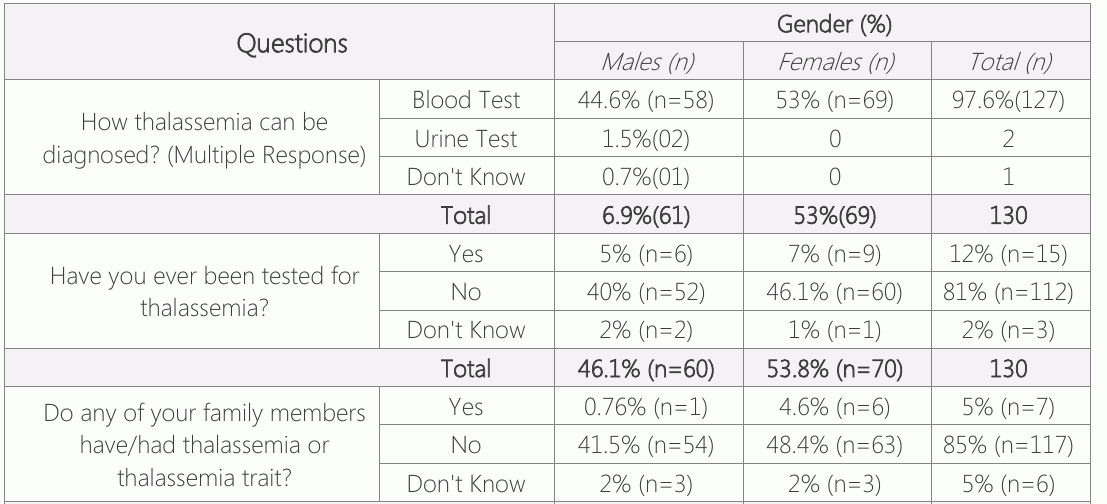
Out of the total 130 enrolled participants, table-1 depicts statistics regarding awareness for diagnostic modalities of thalassemia. In multiple response question 44.6% (n=58) males and 53% (n=69) females said it could be diagnosed from blood test, 1.5%(n=2) males said it could be diagnosed from urine test while only 0.7%(n=1) male said he didn’t know how it could be diagnosed. 5% of males and 7% of females were tested for thalassemia. 0.76% males and 4.6% females had a significant family history of thalassemia.
The statistics regarding awareness for the treatment modalities of thalassemia is shown in table-2. 37.6% (n=49) males and 43% (n=56) females said thalassemia is treatable. 23.8% males and 35.3% females said thalassemia could be treated with blood transfusions, 18.4% males and 22.3% females said thalassemia could be treated with bone marrow transplant. 35% (n=45) males and 48% (n=62) females said thalassemia could be fatal. 33.8% (n=44) males and 44% (n=57) females think that thalassemic patients could lead a normal life with Management, as shown in table-2. The statistics regarding prevention of thalassemia is shown in table-III. 39.2% (n=51) males and 52.3% (n=68) females responded that pre-marital screening could be beneficial. 24.6% (n=32) males and 45.3% (n=59) females responded that thalassemia could be prenatally diagnosed. Only 16.9% (n=22) males and 43% (n=56) females knew about chorionic villous sampling.
Discussion
In our study, 97.6% of responded participants knew that thalassemia could be diagnosed from blood test, similar results were shown in a Malaysian study where 92.8% participants which is on much higher side from another Malaysian study where only 71.2% participants knew about the diagnosis of thalassemia from blood test (5, 7).
In our study, 81% of responded participants were not tested for thalassemia, which is less from a study done in Malaysia which shows 94.2% were not tested for thalassemia, both of these studies has much higher percentages of participantsthat were not tested for thalassemia than a study done in Malaysia where 48.73% medical and 51.27% non-medical participants were not tested for thalassemia (5, 8).
In our study, 5% of responded participants had thalassemia in their family, which had similar results as a study done in Malaysia which shows 5.8% participants 5 had thalassemia in their family. Both of these studies has slightly less percentages of participants than another study in Malaysia. It had 6.3% participants with thalassemia in their family. Another study was done in Malaysia where 4% medical and 5.3% non-medical participants had thalassemia in their family (5, 7, 8).
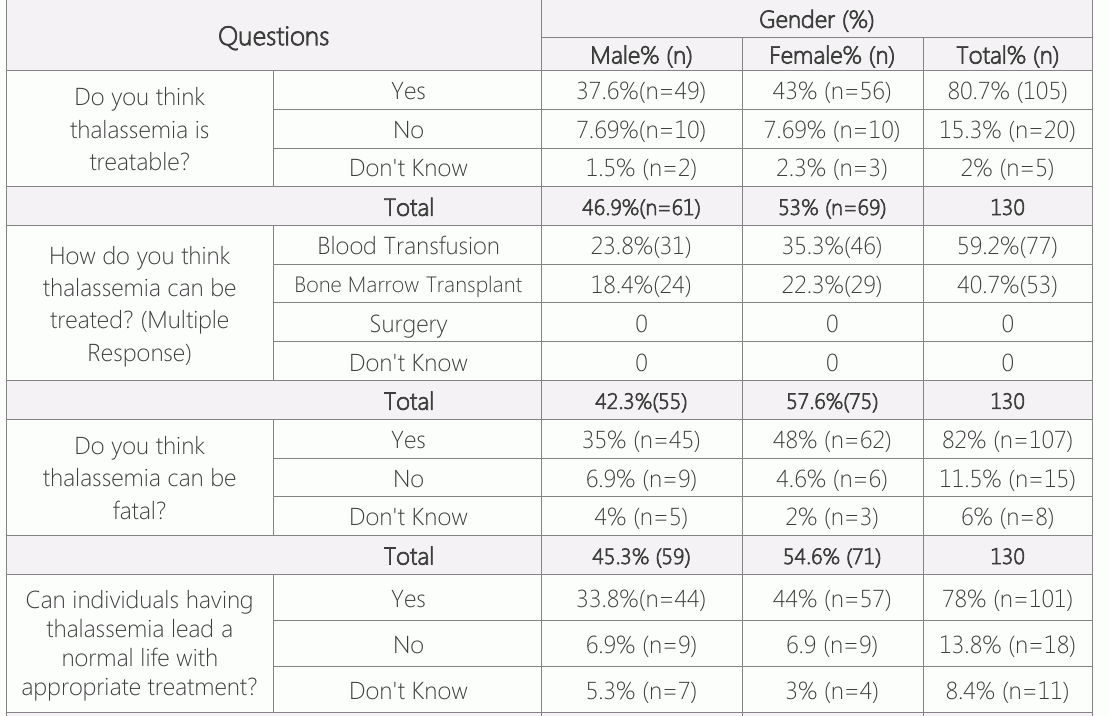
In our study, 80.7% of responded participants said that thalassemia was a treatable disease. While 15.3% respondents think that thalassemia is not a treatable disease, which is same i.e study done in Malaysia where 82.9% non-medical participants were not aware about the treatment of thalassemia (7).
In our study, 59% of responded participants said thalassemia could be treated with multiple blood transfusions which is much on higher side than other studies done in Malaysia, where 28.8% and in other 47.9% participants only knew that thalassemic patients needed blood transfusions (5, 7).
In our study, 82% of responded participants think thalassemia is a fatal disease in which is on higher side than a study done in Malaysia where 66.6% medical and 33.34% non-medical participants think that thalassemia get worsen with time. In another study, 62.4% participants think that life span of a thalassemic patient/carrier is small (7, 8). In our study, 78% of responded participants think that thalassemic patients could lead a normal life if treated appropriately, which is much on higher side than other studies done in Malaysia in which one study states that 61.5% participants and in other study where 66.06% medical participants and 33.94% non-medical participants think that thalassemic patient could lead a normal-life if treated appropriately (5, 8).
In our study, 86% of responded participants think that pre-marital screening of thalassemia would be beneficial in its prevention. Similar results were shown by some studies done in Pakistan and Malaysia where 84.3% and 90.6% participants were agreed about the pre-marital screening for the thalassemia (6, 7). A study in Malaysian population stated 89.8% participants had consensus that partner of a thalassemic carrier should undergo blood test for the preconceptional screening. Premarital screening for thalassemia is so much beneficial that few countries added it as a standard practice like Greece, Iran, Italy and successful in controlling the rate by identify and counselling couples that are at risk. In Iran this screening leads to 70% reduction in annual birth rate of affected infants and medical expenses.
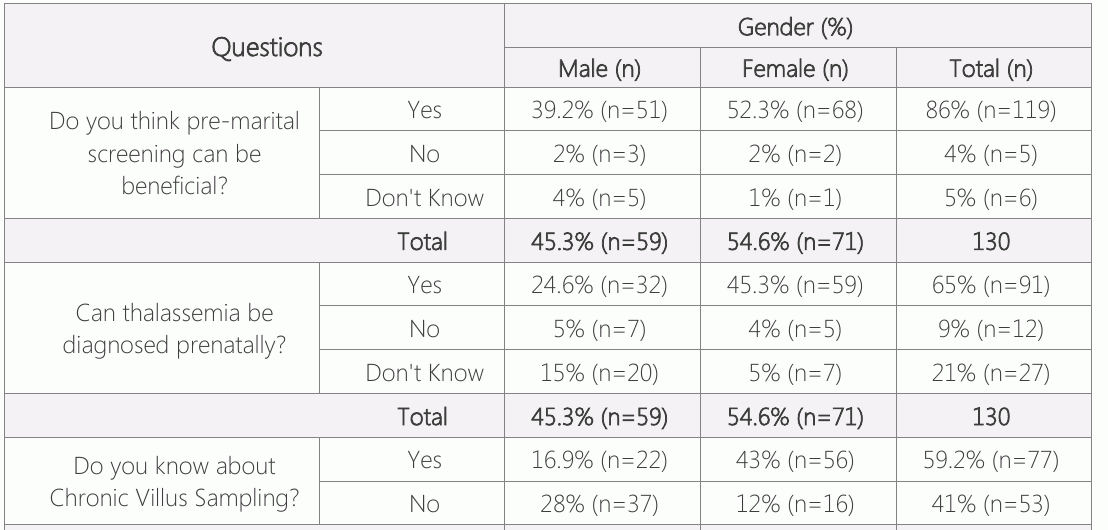
In our study, 21% of responded participants did not know that thalassemia could be prenatally diagnosed, which is on lower side than previously done studies in Pakistan (Lahore & Bhawalpur) which had similar results i.e. 23.5%, and about 86.1% participants respectively, had knowledge about termination of thalassemic pregnancy but only 60% had consensus to terminate pregnancy due to religious beliefs (6). In a study done in Malaysia where 15.6% participants think that pre-natal diagnosis is unnecessary for couples who are thalassemic carriers and 36.6% participants think that pregnancy with thalassemic major should be terminated (7). In our study, 41% of responded participants did not have any idea of Chorionic Villous Sampling which also includes participants related to medical profession which is much less than another study done in Pakistan where 91.3% participants had no idea about chorionic villous sampling.
The prenatal diagnosis, transfusion therapy and allogenic bone marrow transplant (BMT) based upon human leucocyte antigen (HLA) typing, 9 are considered to be the commonest management options. However, various studies had also highlighted that the success rates for thalassemia free survival can only be improve by establishing standard protocols for specific localities based upon WHO guidelines (10–13).
Conclusion
Awareness regarding diagnosis from blood, Management, premarital screening and different treatment modalities (Blood Transfusion, BMT), fatality and severity of disease among non-medical related individuals is less as compared to medical related individuals but in some cases medical related professionals also had very less awareness like prenatal diagnosis and chorionic villous sampling.
The study was conducted in a medical college and hospital and the sample size was small as compared to other studies done on a larger sample or on general population. It is recommended that the awareness campaigns related to thalassemia should also focus on education about prevention through premarital screening and prenatal diagnosis and its signs and symptoms. This can help in decreasing the incidence of thalassemia in the country. The awareness campaigns should also focus on the diagnosis and Management of thalassemia. The awareness campaigns should target medical and non-medical related individuals’ including general population as well.
Declarations
- Author contributions (CRediT)
- All authors contributed equally to all 14 CRediT roles (Conceptualization, Data curation, Formal analysis, Funding acquisition, Investigation, Methodology, Project administration, Resources, Software, Supervision, Validation, Visualization, Writing – original draft, Writing – review & editing).
- Funding
-
Funding information was not reported in the published version of this article.
- Conflicts of interest
- The authors have no conflict of interest.
- Ethics approval
- Ethics approval details were not reported in the published version of this article.
- Data availability
- A data availability statement was not reported in the published version of this article.
References (13)
6 of 13 references are linked to their DOI.
- WHO. Global epidemiology of haemoglobin disorders and derived service indicators. Website: [www.who.int/ bulletin/ volumes/86/6/06-036673/en] Retrieved on 2nd June 2016. PubMed Google Scholar
- WHO. Genes and human disease (Thalassemia). Website: [http://www.who.int/genomics/public/geneticdiseases/en/ index2.html#Thalassaemia] Retrieved on 2nd June 2016. PubMed Google Scholar
- Thalassemia - Thalassemia Federation of Pakistan: [tfp.org.pk/what-is-thalassaemia] Retrieved on 2 nd 2016. PubMed Google Scholar
- Thalassemia- Mayo Clinic Website: [http://www.mayoclinic. org/diseases- conditions/thalasemia/home/ovc-20261825] Retrieved on 2nd June 2016. PubMed Google Scholar
- Kukreja A, Khan A, Xian L, Razley A, Rahim Z. Awareness of Thalassemia Among Rural Folks in Penang, Malaysia. Internet J Heal. 2009;12(1): 8016 Awareness for Thalassemia Humaira Zafar, et al. PubMed Google Scholar
- Ishaq F, Abid H, Kokab F, Akhtar A, Mahmood S. Awareness among parents of β-thalassemia major patients, regarding prenatal diagnosis and premarital screening. J Coll Physicians Surg Pak. 2012 Apr;22(4):218-21 PubMed Google Scholar
- Wong LP; George E; Tan JAMA. Public perceptions and attitudes toward thalassemia: Influencing factors in a multi - racial population. BMC Public Health. 2011;11(2): 193. DOI Crossref PubMed Google Scholar
- Murthy VCR, Zarif M, Zulkeffle AB, Venkateswaran SP, Barua A. Knowledge, awareness and participation of medical and non-medical students in the Malaysia National Thalassemia Prevention Programme. Int J Human Genetics, 2015; 15(2): 61-72. PubMed Google Scholar
- Burgess-Beusse B, Farrell C, Gaszner M, Litt M, Mutskov V, Recillas-Targa F, et al. The insulation of genes from external enhancers and silencing chromatin. Proc Natl Acad Sci U S A. 2002;99(Suppl 4):16433– 7. DOI Crossref PubMed Google Scholar
- Calmels B, Ferguson C, Laukkanen MO, Adler R, Faulhaber M, Kim HJ, et al. Recurrent retroviral vector integration at the Mds1/Evi1 locus in nonhuman primate hematopoietic cells. Blood. 2005;106:2530– 3. DOI Crossref PubMed Google Scholar
- Carey BW, Markoulaki S, Hanna J, Saha K, Gao Q, Mitalipova M, et al. Reprogramming of murine and human somatic cells using a single polycistronic vector. Proc Natl Acad Sci U S A. 2009;106:157–62. DOI Crossref PubMed Google Scholar
- Chin JY, Kuan JY, Lonkar PS, Krause DS, Seidman MM, Peterson KR, et al. Correction of a splice-site mutation in the beta-globin gene stimulated by triplex-forming peptide nucleic acids. Proc Natl Acad Sci U S A. 2008;105:13514–9. DOI Crossref PubMed Google Scholar
- Dave UP, Akagi K, Tripathi R, Cleveland SM, Thompson MA, Yi M, et al. Murine leukemias with retroviral insertions at Lmo2 are predictive of the leukemias induced in SCID -X1 patients following retroviral gene therapy. PLoS Genet. 2009;5: 491. DOI Crossref PubMed Google Scholar
Respond to this article
Comments on a published article are welcome as a Letter to the Editor.
Get an e-mail when new articles in your fields are published
Questions to the authors
Questions are moderated: an editor approves each question, the authors answer, and an editor approves the answer before both appear here.
No answered questions yet.
Ask the authors a question
Discussion
Comments are moderated: they appear after the writer confirms the e-mail address and an editor approves them. Each comment carries a conflict-of-interest statement.
No comments yet.
Write a comment
Read the full text
Open the PDF here
Loading the PDF…
If the PDF does not show here, use the download button above.
How to cite this article
Ahmed D, Bukhari KT, Zafar H, Lakhnana NK, Nawaz MN. Awareness for Diagnosis, Management and Preventive Options of Thalassemia. Ulutas Med J. 2018;4(2):66-72. doi:10.5455/umj.20180612070836
Ahmed, D., Bukhari, K. T., Zafar, H., Lakhnana, N. K., & Nawaz, M. N. (2018). Awareness for Diagnosis, Management and Preventive Options of Thalassemia. The Ulutas Medical Journal, 4(2), 66–72. https://doi.org/10.5455/umj.20180612070836
Ahmed, D. et al. (2018) 'Awareness for Diagnosis, Management and Preventive Options of Thalassemia', The Ulutas Medical Journal, 4(2), pp. 66–72. doi: 10.5455/umj.20180612070836.