The Ulutas Medical Journal · ISSN 2149-0430 (print), 2149-388X (online) · https://www.ulutasmedicaljournal.com/?mno=90340
Original Article · Open access
Comparison of Demographic and Clinical Characteristics of Severe Covid-19 Patients with and without Chest Pain
- Bakırçay University Çiğli Training and Research Hospital Department of Anesthesiology and Reanimation, İzmir, Turkey ROR
- Bakırçay University Çiğli Training and Research Hospital General Surgery, İzmir, Turkey ROR
- Bakırçay University Department of Microbiology, İzmir, Turkey ROR
Abstract
- Introduction
- We wanted to evaluate the comparison of clinical and demographic structures of patients admitted to the intensive care unit according to whether they have chest pain or not.
- Materials and Methods
- Clinical records of 134 patients who were hospitalized in the tertiary ICUs of Our Hospital due to COVID-19 between October 1 and November 30, 2020 were reviewed retrospectively.
- Results
- Mortality occurred in 56.7% of the patients. All of these patients were aged over 65 years and hypertension was the most common comorbidity. Mean length of ICU stay was 8 (range, 2-49) days. Eighty-two (61.2%) patients were oxygenated with noninvasive, high-flow nasal oxygen and facemask oxygenation. The remaining 52 (38.8%) patients were ventilated invasively. All patients received antibiotic treatment and 47.8% of them received antiviral (favipiravir) treatment.
- Conclusion
- Mortality occurred in 56.7% of the patients admitted to ICU with the complaint of chest pain. Further studies are needed to substantiate our findings.
Keywords
Full text
Introduction
Coronavirus disease 2019 (Covid-19) emerged in China in 2019 and has since caused a widespread pandemic all over the world (1). Covid-19 is more contagious and has a higher mortality risk compared to other viral diseases. In addition to significant economic losses, it has also resulted in mortality as well as chronic disease and psychiatric problems worldwide (2). Chest pain can be considered among the symptoms of covid-19. The etiopathogenesis of chest pain is unclear (3). Chest pain is one of the most important clinical symptoms of acute myocardial infarction (4). Percutaneous coronary angiography intervention decreased by 35.4% during the Covid-19 pandemic period and the diagnosis of myocardial infarction decreased (5). In one study, they looked at the rate of chest pain research from Google between 2019-2021 and found that there was an increase. It is not clear whether chest pain may be the underlying cause of anxiety and other psychiatric diseases (6). On the contrary, chest pain has been identified as one of the symptoms in patients with Covid-19-related cardiac injury (3). Troponin is a biochemical marker that is frequently elevated in Covid-19 patients (7). Troponin elevation can oftenbe associated with covid-19 in covid patients. Diagnosis of acute myocardial infarction may be difficult (8, 9). We wanted to follow the intensive care and hospital processes of these patients. There is no data on co-morbidities and mortality and intensive care processes of patients presenting with chest pain.
Materials and Methods
Ethical Statement
After the approval from the ethic committee of the University (No:191/2021), we retrospectively analyzed the clinical records of 134 patients who were hospitalized in the tertiary intensive care units (ICUs) of the Hospital due to the Covid-19 between October 1 and November 30, 2020. ARDS was diagnosed based on the Berlin definition published in 2011 (10). Patient care in our ICUs is performed by anesthesiologists, nurses, and ICU specialists on a 24-h shift basis. In the monthly work plan, one nurse provides ICU care for two patients. Patient records were retrieved from the database. From the records, demographic and characteristics including age, gender, comorbidities, vital signs at the time of ICU admission, APACHE II score, airway status (invasive mechanical ventilation, noninvasive mechanical ventilation, high-flow nasal cannula, facemask oxygenation), and duration, the severity of ARDS, length of ICU stay, treatments and clinical outcomes were reviewed.
Statistical Analysis
Data were analyzed using SPSS22 for Windows (Armonk, NY, IBM Corp). Normal distribution of data was assessed using histograms, Q-Q plots, and the Shapiro-Wilk test. Homogeneity of variance was tested using Levene’s test. Continuous variables with normal distribution were compared using the Independent Sample t-test and continuous variables with non-normal distribution were compared using the Mann-Whitney U. Categorical variables were compared using Pearson’s chi-square test and Fisher’s exact test. In normal distribution, 3 or more groups were compared by One-Way ANOVA. A p<0.05 was considered significant.
Results
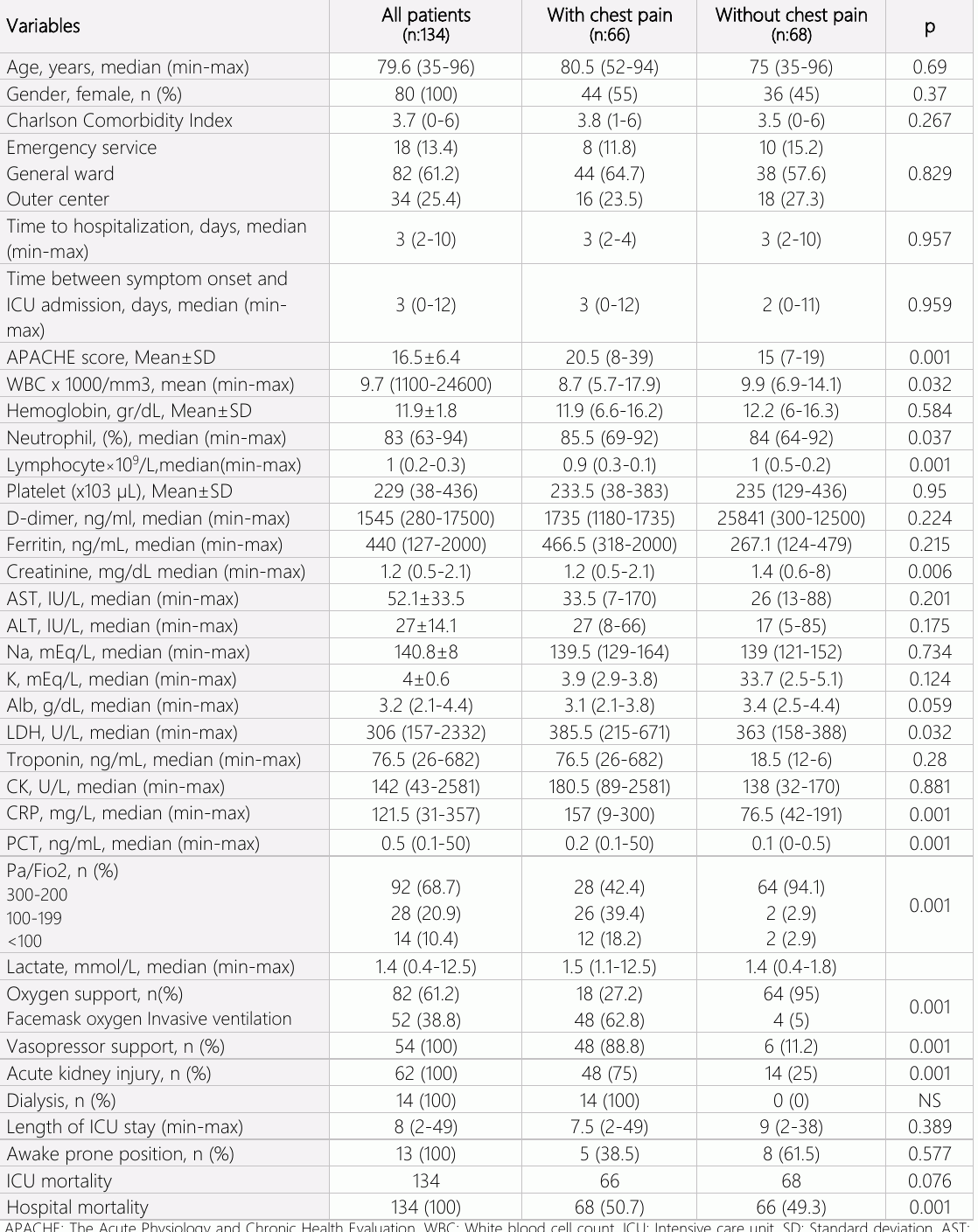
The 134 patients comprised 80 (59.7%) women and 54 (40.3%) men with a mean age of 79.6 years. There was no difference in mortality between those who had chest pain and those who did not (p=0.089). Intensive care mortality was found to be 56.7%. Of this, 47.3% were those with chest pain complaints and the remaining 52.7% were those without chest pain (Table). Hypertension was the most common comorbidity (n=78; 58.2%). Of these patients, 64.1% (n=50) died during the follow-up period. All patients underwent thoracic tomography (CT) and the most common radiological finding was bilateral diffuse ground-glass opacity (n= 56; 41.7%). Among medications, 47.8% (n=64) of the patients were using favipiravir and all the patients (100%) received empirical antibiotic therapy, with the most commonly used antibiotic being moxifloxacin (n=96, 71.6%). The number of patients with mild ARDS (n=92; 68.7%) was higher than that of patients with moderate and severe ARDS. Twelve (85.7%) patients with severe ARDS died during the follow-up period. The mean age was 74.4±15.4, 73.9±16.2, and 71.4±10.6 in mild, moderate, and severe ARDS, respectively (p=0.88). All data of the patients were given in Table-1.
Discussion
In our study, the majority of patients admitted to ICU were over 65 years of age, and the mean age was 79.6 years, which was lower than those reported in the USA and higher than those reported in China (11, 12). On the other hand, hypertension (58.2%) was the most common comorbidity in our study. This rate was found to be 44.6% in a study conducted in China, 45.2% in Italy, and 56.6% in the USA (13–15). Literature indicates that although it is not clear as to whether hypertension is a risk factor for Covid- 19, the disease can progress more severely in patients with hypertension (16).
Moradi et al. reported a relationship between white blood count and mortality (16). Similarly, the relationship between absolute neutrophil count and lymphopenia and mortality has been investigated in larger-scale studies. A previous meta-analysis by Zhao et al. reported a correlation between lymphocyte count below 1.5×10⁹/L and disease severity (17). In our study, the lymphocyte count of non-surviving patients was lower than that of surviving patients and the mean lymphocyte count was below 1×10⁹/L. In our study, the number of patients with mild ARDS (n=92; 68.7%) was higher than that of patients with moderate and severe ARDS. Eighty-two (61.2%) patients were oxygenated with noninvasive, high-flow nasal oxygen and facemask oxygenation. Twelve (85.7%) of the patients with severe ARDS died during the follow-up period. The rate of mortality from Covid-19-related ARDS was reported as 39% in China, while the highest mortality rate in Europe was reported as 73% in Poland and as 13% in Germany. On the other hand, a study in Poland reported a lower mortality rate compared to the rate in our study. However, the authors did not only include patients hospitalized in ICU but also those in other units (18). During our study period, some of the patients were still receiving inpatient care, which might have prevented the investigation of true mortality. In a study conducted by Richardson et al., the mortality rate in patients with severe Covid-19 aged older than 65 years who required invasive ventilation was determined as97%(15). This rate was higher than the mortality rate in our ARDS patients who underwent invasive ventilation.
Zhou et al. suggested that the APACHE II score could predict mortality in Covid-19 (19). As might be expected, in our study, the APACHE II score was higher in non-surviving patients compared to surviving patients. Nevertheless, the mortality rate of patients presenting with chest pain was not higher than that of patients without chest pain.
The most important limitation of our study was that it was conducted in a single center with a local population.
Conclusion
Mortality and general characteristics of patients presenting with chest pain were not different from those without chest pain. Further studies are needed to substantiate our findings.
Declarations
- Author contributions (CRediT)
- All authors contributed equally to all 14 CRediT roles (Conceptualization, Data curation, Formal analysis, Funding acquisition, Investigation, Methodology, Project administration, Resources, Software, Supervision, Validation, Visualization, Writing – original draft, Writing – review & editing).
- Funding
-
Funding information was not reported in the published version of this article.
- Conflicts of interest
- A conflict of interest statement was not reported in the published version of this article.
- Ethics approval
- After the approval from the ethic committee of the University (No:191/2021), we retrospectively analyzed the clinical records of 134 patients who were hospitalized in the tertiary intensive care units (ICUs) of the Hospital due to the Covid-19 between October 1 and November 30, 2020.
- Data availability
- A data availability statement was not reported in the published version of this article.
References (19)
16 of 19 references are linked to their DOI.
- Damme WV, Dahake R, Delamou A, Ingelbeen B, Wouters E, Vanham G, et al. The COVID-19 pandemic: diverse contexts; different epidemics—how and why? BMJ Global Health.2020; 5(7):e003098 PubMed Google Scholar
- Rio C, Collins LF, Malani P. Long-term Health Consequences of COVID-19. JAMA. 2020;324(17):1723 PubMed Google Scholar
- Weng LM, Su X, Wang XQ. Pain Symptoms in Patients with Coronavirus Disease (COVID-19): A Literature Review. J Pain Res. 2021;14:147-159 192 77 Severe Covid-19 Gonullu et al. DOI Crossref PubMed Google Scholar
- Benjamin EJ, Muntner P, Alonso A, Bittencourt MS, Callaway CW, Carson AP, et al. Heart disease and stroke statistics - 2019 update: a report from the American Heart Association. Circulation. 2019;139(10):e56– 528 DOI Crossref PubMed Google Scholar
- Ramakrishnan S, Jabir A, Jayagopal PB, Mohanan PP, Nair VK, Das MK, et al. Pattern of acute MI admissions in India during COVID-19 era: A Cardiological Society of India study Rationale and design. Indian Heart J. 2020 Nov-Dec;72(6):541-546 DOI Crossref PubMed Google Scholar
- Hee Kong Fong, Sandeep Singh, Jilmil S. Raina, Vikram B. Itare, Violeta Spasova, Rupak Desai. Alarmingly Increased Public Interest in “Chest Pain” During the COVID-19 Pandemic: Insights From Google Trends Analysis. Cureus 13(4):e14292 DOI Crossref PubMed Google Scholar
- Khan S, Rasool ST, Ahmed SI. Role of Cardiac Biomarkers in COVID-19: What Recent Investigations Tell Us? Curr Probl Cardiol. 2021;100842. doi:10.1016/j.cpcardiol.2021.100842 DOI Crossref PubMed Google Scholar
- Cannata F, Bombace S, Stefanini GG. Marcadores cardiacos en pacientes con COVID-19: un instrumento práctico en tiempos difíciles [Cardiac biomarkers in patients with COVID - 19: pragmatic tools in hard times]. Rev Esp Cardiol. 2021 Jul;74(7):566-568 DOI Crossref PubMed Google Scholar
- Mahajan K, Chand Negi P, Ganju N, Asotra S. Cardiac biomarker-based risk stratification algorithm in patients with severe COVID-19. Diabetes Metab Syndr. 2020 Sep-Oct;14(5):929-931 DOI Crossref PubMed Google Scholar
- Force ADT, Ranieri V, Rubenfeld G, Thompson B, Ferguson N, Caldwell E. Acute respiratory distress syndrome. Jama. 2012;307(23):2526–33 DOI Crossref PubMed Google Scholar
- Guan W, Ni Z, Hu Y, Liang W, Ou C, He J, et al. Clinical Characteristics of Coronavirus Disease 2019 in China. N Engl J Med 2020; 382:1708-1720 DOI Crossref PubMed Google Scholar
- Yang BY, Barnard LM, Emert JM, Drucker C, Schwarcz L, Counts CR, et al. Clinical Characteristics of Patients With Coronavirus Disease 2019 (COVID-19) Receiving Emergency Medical Services in King County, Washington. JAMA Netw Open. 2020;3(7):e2014549 DOI Crossref PubMed Google Scholar
- Wang Z, Chen Z, Zhang L, Wang X, Hao G, Zhang Z, et al. Status of hypertension in China: results from the China hypertension survey, 2012 –2015. Circulation. 2018;137(22):2344 –56 DOI Crossref PubMed Google Scholar
- Tocci G, Nati G, Cricelli C, Parretti D, Lapi F, Ferrucci A, et al. Prevalence and control of hypertension in the general practice in Italy: updated analysis of a large database. Journal of Human Hypertension. 2017;31(4):258–62 DOI Crossref PubMed Google Scholar
- Richardson S, Hirsch JS, Narasimhan M, Crawford JM, McGinn T, Davidson KW, et al. Presenting characteristics, comorbidities, and outcomes among 5700 patients hospitalized with COVID-19 in the New York City area. JJAMA. 2020;323(20):2052-2059 DOI Crossref PubMed Google Scholar
- Kulkarni S, Jenner BL, Wilkinson I. COVID -19 and hypertension. J Renin Angiotensin Aldosterone Syst. 2020;21(2): 12-24 DOI Crossref PubMed Google Scholar
- Zhao Q, Meng M, Kumar R, Wu Y, Huang J, Deng Y, et al. Lymphopenia is associated with severe coronavirus disease 2019 (COVID-19) infections: A systemic review and meta-analysis. Int J Infect Dis. 2020;96:131-135 DOI Crossref PubMed Google Scholar
- Hasan SS, Capstick T, Ahmed R, Kow CS, Mazhar F, Merchant H a, et al. Mortality in COVID-19 patients with acute respiratory distress syndrome and corticosteroids use: a ity covid-19 center experience. Erciyes Med J 2020;42(4):436-440 PubMed Google Scholar
- Zou X, Li S, Fang M, Hu M, Bian Y, Ling J, et al. Acute Physiology and Chronic Health Evaluation II Score as a Predictor of Hospital Mortality in Patients of Coronavirus Disease 2019. Crit Care Med. 2020;48(8):e657–65 DOI Crossref PubMed Google Scholar
Respond to this article
Comments on a published article are welcome as a Letter to the Editor.
Get an e-mail when new articles in your fields are published
Questions to the authors
Questions are moderated: an editor approves each question, the authors answer, and an editor approves the answer before both appear here.
No answered questions yet.
Ask the authors a question
Discussion
Comments are moderated: they appear after the writer confirms the e-mail address and an editor approves them. Each comment carries a conflict-of-interest statement.
No comments yet.
Write a comment
Read the full text
Open the PDF here
Loading the PDF…
If the PDF does not show here, use the download button above.
How to cite this article
Gonullu E, Kebapci E, Bahar I, Berktas M. Comparison of Demographic and Clinical Characteristics of Severe Covid-19 Patients with and without Chest Pain. Ulutas Med J. 2021;7(3):188-192. doi:10.5455/umj.20210624084330
Gonullu, E., Kebapci, E., Bahar, I., & Berktas, M. (2021). Comparison of Demographic and Clinical Characteristics of Severe Covid-19 Patients with and without Chest Pain. The Ulutas Medical Journal, 7(3), 188–192. https://doi.org/10.5455/umj.20210624084330
Gonullu, E. et al. (2021) 'Comparison of Demographic and Clinical Characteristics of Severe Covid-19 Patients with and without Chest Pain', The Ulutas Medical Journal, 7(3), pp. 188–192. doi: 10.5455/umj.20210624084330.