The Ulutas Medical Journal · ISSN 2149-0430 (print), 2149-388X (online) · https://www.ulutasmedicaljournal.com/?mno=88290
Original Article · Open access
Evaluation of Nasociliary Clearance in Covid-19 Patients
- Department of Otorhinolaryngology, Dicle University, Faculty of Medicine, Diyarbakır, Turkey ROR
- Department of Otorhinolaryngology, Yaşargil Training and Research Hospital, Diyarbakır, Turkey ROR
Abstract
- Introduction
- The new coronavirus 2019 (COVID-19), which rapidly turned into a global pandemic, progresses with mild flu-like symptoms, suggesting that there may be damage to the nasociliary clearance. The study aimed to evaluate whether nasociliary clearance in individuals with Covid-19 is affected or not using the saccharin test.
- Materials and Methods
- Saccharin test was applied to 47 PCR positive active COVID-19, 42 recovered PCR negative COVID-19, and 42 healthy groups to evaluate their nasociliary functions and the result was calculated in minutes.
- Results
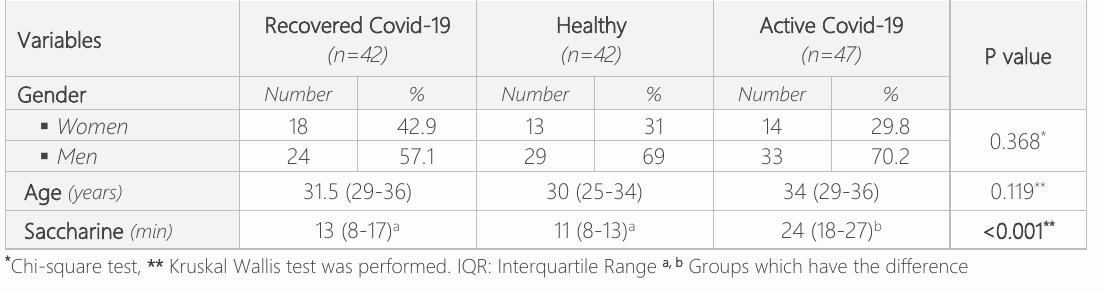
- 42 (32.1%) recovered patients, 42 (32.1%) healthy, and 47 (35.9%) COVID-19 patients were included in the study. There were 13 women (31%), 29 men (69%) in the healthy, 18 women (42.9%), 24 men (57%) in the recovered group, 14 women (29.8%), and 33 men (70%) in the active patients. The mean times of saccharin nasociliary clearance were 24 (18-27) min in the active covid-19 patient group, 13 (8-17) min in the recovered covid-19 group, and 11 (8-13) min in the healthy. There was a difference between the groups in terms of the Saccharine test (p<0.001).
- Discussion
- We observed that COVID-19 patients showed a negative effect on nasociliary clearance time in the early period, similar to viral infections that cause other upper respiratory tract infections. We detected rapid healing in nasociliary clearance after the COVID-19 disease effect wore off.
Keywords
Full text
Introduction
The new coronavirus disease 2019 (COVID-19), which emerged in Wuhan, a city of China's Hubei province in December 2019 and rapidly transformed into a global pandemic, shows a deadly course as well an asymptomatic course (1). The most common ways of transmission are shown as human-to-human respiratory droplet and direct contact transmission, but also the fecal-oral transmission, fomite transmission (by object), and perinatal (intrauterine) transmission are observed (1–3).
The most common symptoms in the disease, which have a wide clinic from asymptomatic or mild symptoms to severe dyspnea, are dry cough, fever, and fatigue (3). In some cases, loss of taste, diarrhea and smell were seen (4). According to the studies conducted in China, almost 80% of the cases overcome the disease with mild symptoms, severe symptoms develop in 15%, and intensive care is required in 5% of cases (4, 5). The definitive diagnosis is made by applying PCR (polymerase chain reaction) test to the swab taken from nasopharynx (3). The upper and lower respiratory tracts have developed a very effective defense system to protect themselves against pathogens, toxins, and particle matter (6). Mucociliary clearance is the primary defense mechanism of the upper and lower respiratory tracts. Acquired or hereditary impairment of this process can cause some serious respiratory infections (7, 8). Mucociliary clearance, measured as the inhaled aerosol elimination time, serves as one of the cornerstones of this defense and is used to evaluate the combined effect of the mucosa-ciliary system (8). Since it does not require topical anesthesia, is non-invasive, low cost, inexpensive, reliable, and easy to apply, the most preferred method to evaluate mucociliary clearance is the saccharin test (6, 7, 9–11).
The coronavirus that causes COVID-19 disease can extend mucociliary clearance time and increase nasal resistance. This study aimed to evaluate the nasal mucociliary clearance time (NMCC) with the saccharin test in COVID-19.
Materials and Methods
Ethical Statement
Ethics committee approval was received from the Dicle University clinical research ethics committee (meeting date 26.11.2020 number 07). Informed consent was obtained from all participants who participated in the study. This prospective study was conducted on 47 active covid-19 patients who were admitted to the Dicle University Pandemic Hospital flu policlinic between October and December 2020, who were diagnosed with RT-PCR positivity without taste and odor-related symptoms, 42 recovered Covid-19 groups who had two consecutive negative real-time RT-PCR tests at least with 24- hour intervals and who do no longer need isolation in the absence of relevant clinical or epidemiological criteria, and 42 healthy group. Nurses, physicians and healthcare professionals who were healthy, well-fed, without a history of smoking, working at similar room temperatures and relative humidity, and in the similar environment, who agreed to be part of the study were includedin the study. We performed the saccharine test for all hospitalized patients suspected of COVID-19 on day 1 of their hospitalization before receiving any treatment.
Exclusion Criteria
Patients younger than 18 years and older than 45 years, patients with complaints about smell and taste in COVID-19 infection, patients with nasal surgery history, patients with a previous history of smell and taste dysfunction, smokers, individuals with nasal polyp and allergic rhinitis have been excluded. The saccharin test was performed by the only rhinolaryngologist experienced in this field, wearing protective clothing, glasses, visor, and an N95 mask. While the patient was sitting in an upright position, a saccharine (1/4 saccharine tb) of approximately 1 mm in diameter was placed on the medial side of the inferior turbinate using bayonet forceps. Patients were instructed not to snuffle, to try to clear their nose, or to sneeze during the test. The total time (in minutes) from saccharine administration to the first sweet taste sensation is measure of mucociliary clearance. Transport time longer than twenty minutes indicates impaired mucociliary transport. The average saccharine time varies between 7 - 15 minutes. Values of time longer than 20 minutes were considered pathological in our study (12). If the patient did not taste any sweetness after 20 minutes, an additional saccharin particle was placed in the anterior part of the subject's tongue to exclude loss of taste. In addition, patients with affected taste and odor levels were excluded from the study because they may affect the saccharin test.
Statistical Analysis
Analyzes were evaluated in the SPSS (Statistical Package for Social Sciences; SPSS Inc. Chicago, IL) 22 package programs. Descriptive data in the study were shown as n, % values in categorical data, and as median, interquartile range (25-75 percentile values) values in continuous data. Chi-square analysis (Pearson Chi-square) was used to compare categorical variables between groups. The suitability of continuous variables to normal distribution was evaluated with the Kolmogorov- Smirnov Test. Since continuous variables were seen to be incompatible with normal distribution, the Kruskal Wallis test was used for comparison between more than two groups. The statistical significance level in the analysis was accepted as p<0.05.
Results
47(35.9%) COVID-19, 42(32.1%) healed Covid- 19 patients, and 42 (32.1%) healthy individuals were included. There were 13 women (31%), 29 men (69%) in the healthy, 18 women (42.9%), 24 men (57%) in the recovered, 14 women (29.8%), and 33 men (70%) in the active patient group. No difference was found in terms of gender (p=0.368). The mean age of the healthy group was 30 (25-34) years, the mean age of the recovered group was 31.5 (29-36) years, and the mean age of the active patients' group was 34 (29-36) years. No significant difference was observed in terms of age (p=0.119).
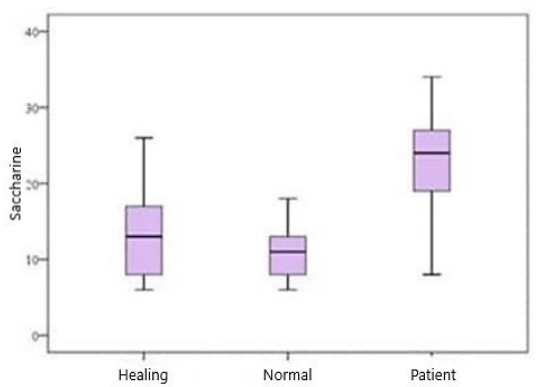
There was a difference between the groups in terms of the Saccharine test (p<0.001). The difference was due to the difference between the patient and the healthy group, and the patient and the recovered (Table-1, Figure-1). No significance was determined between the recovered covid-19 and the healthy group.
Discussion
The function of the mucus and ciliary system can be assessed by mucociliary clearance (13). Mucociliary clearance is the most important defense mechanism of the nasal respiratory epithelium, which plays a key role in the defense mechanism of the upper and lower respiratory tracts (14). Mucociliary clearance is the measurement of the elimination of inhaled aerosols (15). Effective mucociliary clearance requires proper functioning of cilia and adequate mucus quantity. The abnormal ciliary function can cause chronic sepsis of the upper and lower respiratory tracts, and this has been reported to cause severe respiratory tract infections in susceptible individuals (9, 13). Potentially harmful substances are kept in this mucus layer and are removed from the nasal cavity towards the nasopharynx by the movements of the cilia (8, 13). Acute upper respiratory tract infections are known to disrupt the structure of ciliary cells and cause a deficiency in clearance. The incidence and variability of abnormal hair may be related to the severity and duration of clinical symptoms such as cough and rhinorrhea (16, 17).
The most common method for measuring mucociliary clearance is the saccharin test because it is practical, easy, and low cost (8, 17). Fever, cough, fatigue, and muscle pain are often the main symptoms of COVID-19 patients. Nasal congestion, headache, nasal flow, sore throat, vomiting, and diarrhea are considered as fewer common symptoms (18–23). In Europe, younger patients applied with symptoms related to otolaryngology more often than older patients (24). European patients had a higher rate of odor-related disorders than Asian patients (24, 25). It has been suggested that olfactory dysfunction in COVID-19 infection may be associated with the involvement of the olfactory bulb or peripheral damage of olfactory receptor cells in the nasal neuro-epithelium (26). It has been proposed that this may be more common in European due to higher ACE2 expression in the nasal mucosa (24–26). The elderly can have an irreversible course with sepsis, respiratory failure, heart failure, and septic shock when they present underlying chronic diseases such as heart disease and diabetes (27, 28). Cardiac disease and diabetes have been found to increase the risk of death twice more than other risk factors (27). Patients with mild to moderate symptoms have the opportunity to manage symptoms at home without the need for hospitalization, while patients with severe features should be followed up in intensive care units (19–21).
The damage caused by COVID-19 on the nasal mucosa is not known. In a study performed using the Nasal Schirmer test, no significant difference was found between the control group and COVID-19 patients in terms of nasal secretion. It states that anosmia is not affected by nasal mucosal secretions (29). We did not find any study evaluating nasociliary clearance in the literature. In this study, we evaluated the active patient group with COVID-19 infection who did not have any complaints about odor and taste, the patient group who had COVID- 19 and were accepted as recovered, and the healthy control group in terms of nasociliary clearance with the saccharin test.
In our study, we found a significant difference between the active COVID-19 patient and the recovered patient group, and the control group. No significant difference was observed between the recovered patient group and the healthy control group. In this study, we showed that COVID-19 disease shows a negative effect on nasociliary clearance and that nasociliary clearance has improved over time.
The limitation of our study was the fact that the saccharin test was performed on the day the patient was hospitalized for active patients. If it could be done on the days when the first symptoms started, it could provide us with more accurate data. In addition, the fact that we have a small ill patient group is considered a limitation of our study. We believe that studies evaluating more cases and earlier nasociliary clearance will be useful.
Conclusions
COVID-19 patients showed a negative effect on nasociliary clearance time in the early period, similar to viral infections that cause other upper respiratory tract infections and we detected rapid healing in nasociliary clearance after COVID-19 effect wore off. More studies are needed to clarify the pathogenesis of the disorder in nasal mucosa of COVID-19.
Declarations
- Author contributions (CRediT)
- All authors contributed equally to all 14 CRediT roles (Conceptualization, Data curation, Formal analysis, Funding acquisition, Investigation, Methodology, Project administration, Resources, Software, Supervision, Validation, Visualization, Writing – original draft, Writing – review & editing).
- Funding
-
Conflict of Interest The authors declare no conflict of interest and financial support.
- Conflicts of interest
- The authors declare no conflict of interest and financial support.
- Ethics approval
- Ethics committee approval was received from the Dicle University clinical research ethics committee (meeting date 26.11.2020 number 07). Informed consent was obtained from all participants who participated in the study.
- Data availability
- A data availability statement was not reported in the published version of this article.
References (29)
26 of 29 references are linked to their DOI.
- Meng L, Hua F, Bian ZJJodr. Coronavirus disease 2019 (COVID-19): emerging and future challenges for dental and oral medicine. 2020;99(5):481-487 DOI Crossref PubMed Google Scholar
- Chan KW, Wong VT, Tang SCWJTAjoCm. COVID-19: An update on the epidemiological, clinical, preventive and therapeutic evidence and guidelines of integrative Chinese– Western medicine for the management of 2019 novel coronavirus disease. 2020;48(03):737-762 DOI Crossref PubMed Google Scholar
- Zhou D, Zhang P, Bao C, Zhang Y, Zhu N. Emerging understanding of etiology and epidemiology of the novel coronavirus (COVID19) infection in Wuhan, China. DOI Crossref PubMed Google Scholar
- Wu Z, McGoogan JJJ. of and important lessons from the coronavirus disease 2019 (COVID-19) outbreak in China: summary of a report of 72314 cases from the Chinese Center for Disease Control and Prevention. 2020 DOI Crossref PubMed Google Scholar
- Grag K, Shubhanshu KJIJoO, Head, Surgery N. Effect of Covid-19 in Otorhinolaryngology Practice: A Review. 2020:1-4 DOI Crossref PubMed Google Scholar
- Stannard W, O'Callaghan CJJoam. Ciliary function and the role of cilia in clearance. 2006;19(1):110-115 DOI Crossref PubMed Google Scholar
- Mahmut D, Celil U, Evren O, Davut A, Suleyman GJEAO. Nasal mucociliary clearance in total laryngectomised patients. 2006; 263(12):1099-1104 PubMed Google Scholar
- Valía PP, Valero FC, Pardo JM, Rentero DB, Monte CGJAdB. Saccharin for the study of mucociliary clearance: reference values for a Spanish population. 2008;44(10):540-545 DOI Crossref PubMed Google Scholar
- Sakakura Y, Ukai K, Majima Y, Murai S, Harada T, Miyoshi YJAo-l. Nasal mucociliary clearance under various conditions. 1983;96(1-2):167-173 DOI Crossref PubMed Google Scholar
- Rusznak C, Devalia J, Lozewicz S, Davies RJRm. The assessment of nasal mucociliary clearance and the effect of drugs. 1994;88(2):89-101 DOI Crossref PubMed Google Scholar
- Uslu H, Uslu C, Varoglu E, Demirci M, Seven BJIjocp. Effects of septoplasty and septal deviation on nasal mucociliary clearance. 2004;58(12):1108-1111 DOI Crossref PubMed Google Scholar
- Greenstone M, Cole PJBjodotc. Ciliary function in health and disease. 1985;79:9-26 DOI Crossref PubMed Google Scholar
- Lale A, Mason J, Jones NJCO. Mucociliary transport and its assessment: a review. 1998;23(5):388-396 DOI Crossref PubMed Google Scholar
- Naxakis S, Athanasopoulos I, Vlastos IM, Giannakenas C, Vassilakos P, Goumas PJEaoo-r-l. Evaluation of nasal mucociliary clearance after medical or surgical treatment of chronic rhinosinusitis. 2009;266(9):1423-26 DOI Crossref PubMed Google Scholar
- Cauwenberge PV, Ingels KJAo-l. Effects of viral and bacterial infection on nasal and sinus mucosa. 1996;116 (2):316-321 DOI Crossref PubMed Google Scholar
- Carson JL, Collier AM, Hu S-CSJJour. Ultrastructural studies of hamster tracheal epithelium in vivo and in vitro. 1980;70(1):70-81 DOI Crossref PubMed Google Scholar
- Sun S, Hsieh J, Tsai S, Ho Y, Kao CJNmc. The role of rhino scintigraphy in the evaluation of nasal mucociliary clearance function in patients with sinusitis. 2000;21(11): 1029-1032 DOI Crossref PubMed Google Scholar
- Wu Y, Fan Z, Jin H. Assessment of bone metabolism in male patients with benign paroxysmal positional vertigo. Front Neurol 2018:9:742 DOI Crossref PubMed Google Scholar
- Zu ZY, Jiang MD. Coronavirus disease 2019 (COVID-19): a perspective from China. 2020;296(2):E15-E25 DOI Crossref PubMed Google Scholar
- Xu Z, Shi L, Wang YJLRM. Pathological findings of COVID-19 associated with acute respiratory distress syndrome, 2021 DOI Crossref PubMed Google Scholar
- Guan W- j, Ni Z- y, Hu Y, et al. Clinical characteristics of coronavirus disease 2019 in China. 2020;382(18): 1708-1720 DOI Crossref PubMed Google Scholar
- Pascarella G, Strumia A, Piliego C, et al. COVID‐19 diagnosis and management: a comprehensive review. 2020;288(2):192-206 DOI Crossref PubMed Google Scholar
- NaserGhandi A, Allameh SF, Saffarpour RJNm, infections n. All about COVID-19 in brief. 2020;35 DOI Crossref PubMed Google Scholar
- Lechien JR, Chiesa-Estomba CM, Place S, et al. Clinical and epidemiological characteristics of 1420 European patients with mild-to-moderate coronavirus. 2020 PubMed Google Scholar
- Shi Y, Wang Y, Shao C, et al. COVID-19 infection: the perspectives on immune responses. Nature Publishing Group; 2020 DOI Crossref PubMed Google Scholar
- Agyeman AA, Chin KL, Landersdorfer CB, Liew D, Ofori-Asenso R. Smell and taste dysfunction in patients with COVID-19: a systematic review and meta- analysis. Elsevier; 2020:1621-1631 DOI Crossref PubMed Google Scholar
- Li B, Yang J, Zhao F, Zhi L, Wang X. Prevalencia e impacto de las enfermedades cardiovasculares y metabólicas en COVID-19 en China. 2020;109(10) PubMed Google Scholar
- Zhou F, Yu T, Du R, et al. Clinical course and risk factors for mortality of adult inpatients with COVID-19 in Wuhan, China: a retrospective cohort study. 2020;395 (10229):1054-1062 50 77 Nasociliary Clearance in Covid-19 Ayral et al. DOI Crossref PubMed Google Scholar
- Islamoglu Y, Gemcioglu E, Ates IJIJoMS. Objective evaluation of the nasal mucosal secretion in COVID-19 patients with anosmia. 2020:1-3 DOI Crossref PubMed Google Scholar
Read the full text
Open the PDF here
Loading the PDF…
If the PDF does not show here, use the download button above.
How to cite this article
Ayral M, Dedeoglu S, Toprak SF. Evaluation of Nasociliary Clearance in Covid-19 Patients. Ulutas Med J. 2022;8(1):45-50. doi:10.5455/umj.20211220121456
Ayral, M., Dedeoglu, S., & Toprak, S. F. (2022). Evaluation of Nasociliary Clearance in Covid-19 Patients. The Ulutas Medical Journal, 8(1), 45–50. https://doi.org/10.5455/umj.20211220121456
Ayral, M., Dedeoglu, S. and Toprak, S.F. (2022) 'Evaluation of Nasociliary Clearance in Covid-19 Patients', The Ulutas Medical Journal, 8(1), pp. 45–50. doi: 10.5455/umj.20211220121456.