The Ulutas Medical Journal · ISSN 2149-0430 (print), 2149-388X (online) · https://www.ulutasmedicaljournal.com/?mno=246748
Original Article · Open access
Epilepsy Seizures in Hyponatremic COVID-19/SARS-CoV-2: A Comprehensive Single-Center Analysis
- Emergency Medicine, İstanbul İstinye University, Faculty of Medicine, Bahçeşehir Liv Hospital, Istanbul, Türkiye ROR
Abstract
- Background
- The pandemic of COVID-19/SARS-CoV-2 has revealed new complexities in the management of neurological complications, including epilepsy seizures. The study investigates the association between hyponatremia and the exacerbation of seizures in COVID-19/SARS-CoV-2-positive patients.
- Methods
- This retrospective observational research analyzed 206 hyponatremic COVID-19 epilepsy patients, with (n:46) and without seizures (n:160). It assessed clinical and laboratory parameters, including sodium levels, and utilized statistical tools like ROC analysis and logistic regression to explore the role of hyponatremia in seizure occurrence.
- Results
- Our analysis showed a correlation between active COVID-19 infection and seizures (P=0.001). Sodium, potassium, chloride, neutrophils, and white blood cells differed between groups (p=0.005, 0.046, 0.002, 0.028, and 0.053, respectively). Sodium levels behaved as a predictor of seizure occurrence, with its lower levels associated with a higher likelihood of seizures in hyponatremia. ROC analysis showed a moderate discrimination capability (AUC: 0.319; p=0.002), with a sodium level below 130.2 mmol/L being a critical cutoff for increased seizure risk, at sensitivity of 71% and specificity of 74.3%. In logistic regression, the Exponential value of 0.878 suggested that for each unit increase in sodium levels, the likelihood of having a seizure decreases by 12.2% (p<0.001).
- Conclusion
- Hyponatremic conditions can have a crucial effect on the exacerbation of seizures, indicating the need for diligent electrolyte management in COVID-19 patients.
Keywords
Full text
Introduction
The COVID-19/SARS-CoV-2 pandemic has unleashed unprecedented challenges in the medical field, particularly in understanding and managing its diverse clinical manifestations (1–3). The nexus between viral infections and neurological complications is well-established, yet SARS-CoV-2 has presented novel clinical challenges (4, 5). One emerging concern is the neurological impact of COVID-19, especially in patients presenting with hyponatremia – a condition characterized by abnormally low sodium levels in the blood (6–8).
Hyponatremia intersection and neurological disorders, particularly within the context of the pandemic, presents a critical area of medical research (9). Hyponatremia, characterized by reduced sodium levels in the blood, is recognized as a significant risk factor in hospitalized patients and is known to extend hospital stays and increase resource utilization (10). Its correlation with epilepsy complications is an emerging field of study (11). Research has consistently shown that the improvement of hyponatremia is associated with decreased mortality (12, 13). The link between low sodium levels and an increased likelihood of epileptic seizures has been documented, highlighting a transparent risk gradient associated with varying levels of hyponatremia (8, 14). This concern is especially pertinent in epilepsy undergoing treatment with certain antiseizure medications, some of which have been identified as potential contributors to lowered sodium levels (15, 16). Previous research has suggested that certain medicines, such as benzodiazepines and antipsychotics, might be linked to an increased risk of hyponatremia in epilepsy (14, 17). Additionally, they have indicated a connection between the initiation of specific epilepsy treatments and a rise in hospitalizations due to hyponatremia (13).
Preliminary studies suggest an association between severe SARS-CoV-2 cases and an increased risk of seizures for patients with epilepsy. However, the role of hyponatremia as a contributing factor in these neurological outcomes remains underexplored. This study aims to delve deeper into the incidence and characteristics of epilepsy in patients with SARS- CoV-2 who develop hyponatremia. The study aimed to quantify the incidence of epilepsy seizures in patients with COVID-19-related hyponatremia.
Materials and Methods
Study Design
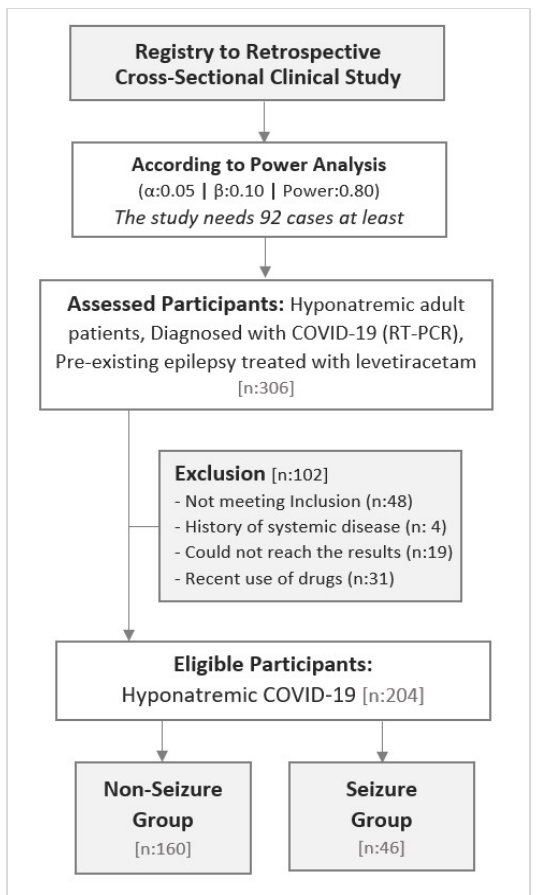
This observational retrospective research aimed to compare clinical and laboratory parameters in patients who experienced epilepsy seizures (n:46) and those who did not (n:160), with a focus on epilepsy cases with hyponatremic COVID-19 positive (Figure-1).
Ethical Statement
The protocol was reviewed and approved by the Institutional Review Board of the University [18/10/2023 - 2017-KAEK-120/10/2023.G-74 ]. The Informed consent was waived due to the study's retrospective nature, following the ethical standards of the Declaration of Helsinki.
Patient Inclusion
The study included only hyponatremic adults diagnosed with COVID-19, as confirmed by RT-PCR tests (Rotor-Gene, Qiagen, USA). The patients in the study consisted only of those who received levetiracetam as routine therapy for the prevention of their epilepsies before COVID-19. Epilepsy patients using other drugs with the Area Under Curve (AUC) measuring without levetiracetam were excluded. the model's diagnostic ability. The logistic Participants were divided into two groups: those who experienced epilepsy seizures (seizure group) and those who did not (non-seizure group) during COVID-19 illness.
Data Collection and Seizure Classification
Clinical data, including demographic data, medical history, epilepsy seizure occurrence, and laboratory findings, were collected from electronic medical records. The variables of interest included age, gender, history of epilepsy, comorbidity profiles, and specific treatments administered. Seizures were classified as either new-onset or pre-existing based on the medical history and clinical presentation. For the treatment of new-onset seizures, midazolamwas administered following established guidelines. Patients with a history of epilepsy were only included if they were not currently using levetiracetam to ensure uniformity in the study. Laboratory parameters, including sodium, potassium, chloride levels, and other biochemical markers, were measured using standard laboratory procedures.
Statistical Analysis
Statistical analyses were performed using SPSS (IBM Corp., Armonk, NY, USA). A P-value of less than 0.05 indicated significance in all tests. All continuous variables, representing measurements that inherently exhibit a range of values, such as age, were expressed as mean ± standard deviation. Chi-square test presented categorical variables representing distinct categories or classifications as numbers and percentages. Regarding continuous data, the independent t-test and ANOVA were used. Logistic regression was utilized to explore the correlation between active COVID-19 and the occurrence of seizures. For the specific task of assessing the predictive value of sodium levels for epileptic seizures, Receiver Operating Characteristic (ROC) analysis was conducted, model assessed COVID-19, epilepsy seizures, and various clinical and laboratory parameters.
Results
Demographic Characteristics
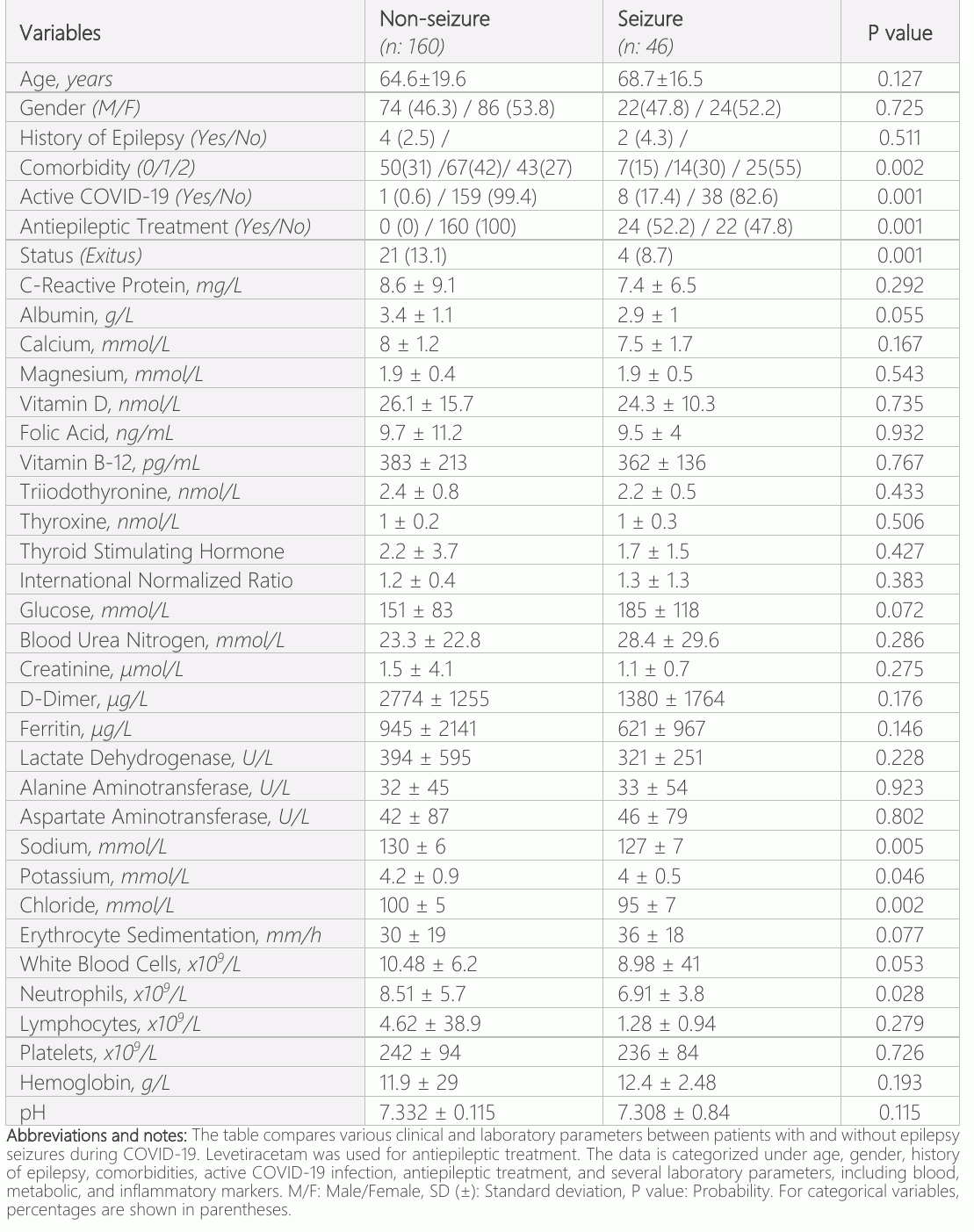
The present study revealed no difference in the age of patients with and without epilepsy seizures during COVID-19, with averages of 64.6 (±19.6) and 68.7 years (±16.5), respectively (p=0.127). Gender distribution between male and female patients in both groups also showed no difference (p=0.725). The history of epilepsy did not differ between those with and without seizures (p=0.511). However, a notable variance was observed in the prevalence of comorbidities. As seen in Table-1, patients with seizures had a higher incidence of multiple comorbidities (p=0.002).
COVID-19 Infection and Clinical Details
A significant correlation was found between active COVID-19 and the occurrence of epilepsy seizures (p=0.001). Likewise, antiepileptic treatment history was more common in patients who experienced seizures (p=0.001). The mortality, represented as exitus, showed a significant difference, lower in patients with seizures (p=0.001).
Laboratory Parameters
In terms of laboratory parameters (Table-1), there were no differences in C-reactive protein, Albumin, Calcium, Magnesium, Vitamin D, Folat, Vitamin B12, Triiodothyronine, Thyroxine, Thyroid Stimulating Hormone, International Normalized Ratio, Glucose, Blood Urea Nitrogen, Creatinine, D-Dimer, Ferritin, Lactate Dehydrogenase, Alanine Amino transferase, Aspartate Aminotransferase, Hemoglobin, and pH levels between the two groups. However, Sodium, Potassium, Chloride, Neutrophils, and White Blood Cell counts showed differences between groups (P=0.005, 0.046, 0.002, 0.028, 0.053, respectively).
ROC Analysis for Natrium Levels
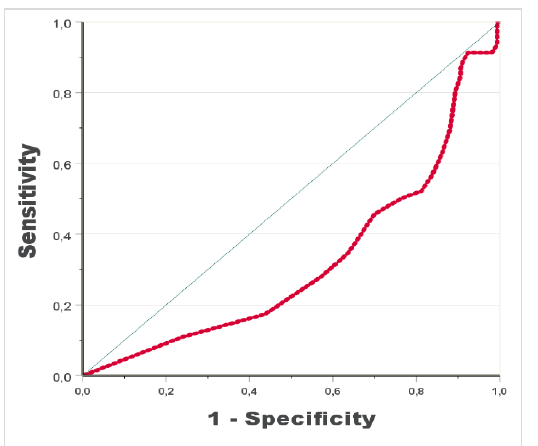
Upon analysis of the ROC generated from sodium data for predicting epileptic seizures (Figure-2), the model demonstrated moderate discrimination capability with an AUC of 0.319. This performance indicates an improvement over random chance, as evidenced by the asymptotic significance (p=0.002). A cutoff value of sodium below 130.2 mmol/L yielded a sensitivity of 71% and specificity of 74.3%. The 95% confidence interval for the AUC (0.232- 0.407) suggests uncertainty in the model's predictive accuracy across populations.
Logistic regression
In this logistic model, we observed an overall fit, evidenced by a Nagelkerke’s R(2) value of 0.153, indicating that the model explains 15.3% of the variance in the occurrence of seizures. Sodium stands out as a unique predictor within the model. The negative coefficient, marked at -0.131, implies that an increase in sodium levels correlates with a decreased probability of experiencing seizures. The Exp(B) value of 0.878 suggests that for each unit increase in sodium, the likelihood of having a seizure decreases by 12.2%. Evaluating the model's predictive accuracy, the classification table reveals an overall correct classification rate of 78.2%.
Discussion
The present research explored the intricate relationship between epilepsy seizures and hyponatremia in COVID-19, uncovering critical insights into how the pandemic influences neurological complications. A standout finding is the pivotal role of sodium levels in predicting seizure occurrence. Contrary to demographic indicators, sodium emerged as a significant predictor, with lower levels associated with a higher likelihood of seizures in hyponatremic COVID-19 patients. This discovery underscores the potential of sodium as a critical parameter in understanding epilepsy in the context of the COVID-19 pandemic.
In COVID-19, various factors can contribute to the development of seizures. Common causes include fever, hypoxia or metabolic imbalances. However, these triggers are relatively rare and typically lead to a less severe form of seizures. As a result, these patients often respond well to treatment and have favorable outcomes. There are multiple theories regarding the specific mechanisms by which COVID-19 might lead to seizures. One debated theory suggests that a direct attack by the SARS-CoV-2 on the central nervous system might be responsible, based on clinical research demonstrating the virus's ability to affect the central nervous system (18, 19). An epidemiological study in Salzburg revealed that seizures during the pandemic were comparable to the general incidence of seizures observed in the preceding five years (20). Another theory posits that seizures could be a consequence of the systemic inflammatory response triggered by SARS-CoV-2 (21). Inflammatory parameters, including C-reactive protein and erythrocyte sedimentation, are frequently elevated in these cases. Our research also involved a comprehensive analysis of these parameters concerning COVID-19, drawing on various studies that have established a connection between these factors and the disease. However, among all these parameters, hyponatremia was the most valuable predictor of seizures for SARS-CoV-2 positives. Some study highlighted a link between hyponatremia and COVID-19 related pneumonia (22, 23). The occurrence of hyponatremia in these patients correlates with mortality, underscoring the importance of prompt identification and effective treatment to enhance outcomes (24). Notably, an analysis involving 4,452 patients, all confirmed SARS-CoV-2 positive, revealed that 30% experienced hyponatremia, with severe cases constituting 1% of this group (25, 26). This electrolyte imbalance often results from multiple factors and represents the most prevalent electrolyte abnormality in clinical settings, linked to heightened mortality (27, 28). A primary cause is the inappropriate secretion of antidiuretic hormone (29). Ho and associates documented the inaugural instance of COVID- 19-related hyponatremia presenting as new-onset seizures (30).
Our study underscores the critical role of hyponatremia in the context of epilepsy seizures. Despite no difference in demographic characteristics, the correlation between active COVID-19 and seizure occurrence was notable. Particularly striking is the association of hyponatremia with increased seizure risk. Laboratory analyses revealed that while most parameters did not differ significantly between groups, sodium stood out, indicating that hyponatremia could be a key predictor of seizure risk in COVID-19. The ROC for sodium reinforced this issue, demonstrating moderate effectiveness in using sodium levels to predict seizures. A lower sodium level threshold was associated with seizures, emphasizing the need for careful monitoring and management of sodium, especially for those with a history of epilepsy or at risk for seizures.
The study's strength is notably enhanced by including a cohort using levetiracetam for epilepsy management, reducing potential bias from varied antiepileptic drugs. This uniformity provides a more controlled environment to assess the interplay between hyponatremic COVID-19 positive cases and epilepsy seizures. Despite the strengths, the study faces limitations. While useful for explorations, the retrospective design may not capture the full spectrum of clinical nuances. Additionally, the study's reliance on a single-center cohort and relatively small sample can limit the generalizability, as it may not reflect diversity of populations. Despite its limitations, our research offers important insights into the intricate dynamics of epilepsy and hyponatremic COVID-19, paving the way for further research in this critical area of medicine.
Conclusion
Lower sodium showed a significant warner and predictor of seizure occurrence, with higher levels being protective against seizures, in contrast to clinical demographic factors. The model demonstrates moderate effectiveness in predicting seizures, with a notable strength in identifying non-seizure cases. Monitoring it in assessing and understanding the increased seizure risk of epilepsy in COVID-19-positive patients is essential, particularly for those experiencing hyponatremia. This observation marks a shift in focus from traditional indicators to natrium in the context of the pandemic.
Declarations
- Author contributions (CRediT)
- All authors contributed equally to all 14 CRediT roles (Conceptualization, Data curation, Formal analysis, Funding acquisition, Investigation, Methodology, Project administration, Resources, Software, Supervision, Validation, Visualization, Writing – original draft, Writing – review & editing).
- Funding
-
Funding information was not reported in the published version of this article.
- Conflicts of interest
- The author declares no conflicts of interest relevant to this article.
- Ethics approval
- The protocol was reviewed and approved by the Institutional Review Board of the University [ 18/10/2023 - 2017-KAEK-120/10/2023.G-74 ]. The Informed consent was waived due to the study's retrospective nature, following the ethical standards of the Declaration of Helsinki.
- Data availability
- A data availability statement was not reported in the published version of this article.
References (30)
27 of 30 references are linked to their DOI.
- Shanthanna H, Nelson AM, Kissoon N, Narouze S. The COVID-19 pandemic and its consequences for chronic pain: a narrative review. Anaesthesia. 2022;77(9):1039-50. PubMed Google Scholar
- Lee CJ, Woo W, Kim AY, Yon DK, Lee SW, Koyanagi A, et al. Clinical manifestations of COVID-19 breakthrough infections: A systematic review and meta-analysis. J Med Virol. 2022;94(9):4234-45. DOI Crossref PubMed Google Scholar
- Koupaei M, Mohamadi MH, Yashmi I, Shahabi AH, Shabani AH, Heidary M, et al. Clinical manifestations, treatment options, and comorbidities in COVID-19 relapse patients: A systematic review. J Clin Lab Anal. 2022;36(5):e24402. Epilepsy Seizures and Hyponatremia in COVID-19 Ali Sağlık DOI Crossref PubMed Google Scholar
- Castanares-Zapatero D, Chalon P, Kohn L, Dauvrin M, Detollenaere J, Maertens de Noordhout C, et al. Pathophysiology and mechanism of long COVID: a comprehensive review. Ann Med. 2022;54(1):1473-87. DOI Crossref PubMed Google Scholar
- Kuroda N, Kubota T. Psychological impact of the COVID-19 pandemic for patients with epilepsy: A systematic review and meta-analysis. Epilepsy Behav. 2021;124:108340. DOI Crossref PubMed Google Scholar
- Kuroda N. Epilepsy and COVID-19: Updated evidence and narrative review. Epilepsy Behav. 2021;116:107785. DOI Crossref PubMed Google Scholar
- Nikbakht F, Mohammadkhanizadeh A, Mohammadi E. How does the COVID-19 cause seizure and epilepsy in patients? The potential mechanisms. Mult Scler Relat Disord. 2020;46:102535. DOI Crossref PubMed Google Scholar
- Asadi-Pooya AA, Attar A, Moghadami M, Karimzadeh I. Management of COVID-19 in people with epilepsy: drug considerations. Neurol Sci. 2020;41(8):2005-11. DOI Crossref PubMed Google Scholar
- Lucijanic M, Krecak I, Cicic D, Milosevic M, Vukoja D, Kovacevic I, et al. Hypoosmolar and hyperosmolar COVID-19 patients are predisposed to dismal clinical outcomes. Scand J Clin Lab Invest. 2023;83(6):397-402. DOI Crossref PubMed Google Scholar
- Han J, Dickinson J, Elnaggar MN. Hyponatraemic seizure secondary to primary polydipsia following urological surgery. BMJ Case Rep. 2022;15(3). DOI Crossref PubMed Google Scholar
- Yamamoto Y, Ohta A, Usui N, Imai K, Kagawa Y, Takahashi Y. Incidence trends and risk factors for hyponatremia in epilepsy patients: A large-scale real-world data study. Heliyon. 2023;9(8):e18721. DOI Crossref PubMed Google Scholar
- Lu X, Wang X. Hyponatremia induced by antiepileptic drugs in patients with epilepsy. Expert Opin Drug Saf. 2017;16(1):77-87. DOI Crossref PubMed Google Scholar
- Winzeler B, Jeanloz N, Nigro N, Suter-Widmer I, Schuetz P, Arici B, et al. Long-term outcome of profound hyponatremia: a prospective 12 months follow-up study. Eur J Endocrinol. 2016;175(6):499-507. DOI Crossref PubMed Google Scholar
- Yamamoto Y, Takahashi Y, Imai K, Ohta A, Kagawa Y, Inoue Y. Prevalence and risk factors for hyponatremia in adult epilepsy patients: Large-scale cross-sectional cohort study. Seizure. 2019;73:26-30. DOI Crossref PubMed Google Scholar
- Pellinen J, Holmes MG. Evaluation and Treatment of Seizures and Epilepsy During the COVID-19 Pandemic. Curr Neurol Neurosci Rep. 2022;22(1):11-7. DOI Crossref PubMed Google Scholar
- Jeon JY, Lee H, Shin JY, Moon HJ, Lee SY, Kim JM. Increasing Trends in the Incidence and Prevalence of Epilepsy in Korea. J Clin Neurol. 2021;17(3):393-9. DOI Crossref PubMed Google Scholar
- Lawless SJ, Thompson C, Garrahy A. The management of acute and chronic hyponatraemia. Ther Adv Endocrinol Metab. 2022;13:20420188221097343. DOI Crossref PubMed Google Scholar
- Dos Santos MF, Devalle S, Aran V, Capra D, Roque NR, Coelho- Aguiar JM. Neuromechanisms of SARS-CoV-2: A Review. Frontiers in Neuroanatomy. 2020;14:37. PubMed Google Scholar
- Meinhardt J, Radke J, Dittmayer C. Olfactory transmucosal SARS-CoV-2 invasion as a port of central nervous system entry in individuals with COVID-19. Nature Neuroscience. 2020. DOI Crossref PubMed Google Scholar
- Leitinger M, Poppert KN, Mauritz M, Rossini F, Zimmermann G, Rohracher A. Status epilepticus admissions during the COVID-19 pandemic in Salzburg-A population-based study. Epilepsia. 2020;61(12):e198-e203. DOI Crossref PubMed Google Scholar
- Nikbakht F, Mohammadkhanizadeh A, Mohammadi E. How does the COVID-19 cause seizure and epilepsy in patients? The potential mechanisms. Multiple Sclerosis and Related Disorders. 2020;46:102535. DOI Crossref PubMed Google Scholar
- Butt I, Sawlani V, Geberhiwot T. Prolonged confusional state as first manifestation of COVID-19. Annals of Clinical and Translational Neurology. 2020;7(8):1450-2. DOI Crossref PubMed Google Scholar
- Yousaf Z, Al-Shokri SD, Al-Soub H. COVID- 19-associated SIADH: A clue in the times of pandemic! American Journal of Physiology - Endocrinology and Metabolism. 2020;318(6):E882- E5. DOI Crossref PubMed Google Scholar
- Carlos de la Flor Merino J, Amado FV, Rodil BB, Marschall A, Rodeles del Pozo M. Hyponatremia in COVID- 19 infection: Possible causal factors and management. J Allergy Infect Dis. 2020;1:53-6. DOI Crossref PubMed Google Scholar
- Frontera JA, Valdes E, Huang J. Prevalence and impact of hyponatremia in patients with Coronavirus Disease 2019 in New York City. Critical Care Medicine. 2020;48(12):e1211-e7. DOI Crossref PubMed Google Scholar
- Choi KW, Chau TN, Tsang O, Tso E, Chiu MC, Tong WL, et al. Outcomes and prognostic factors in 267 patients with severe acute respiratory syndrome in Hong Kong. Ann Intern Med. 2003;139:715-23. DOI Crossref PubMed Google Scholar
- Corona G, Giuliani C, Parenti G, Norello D, Verbalis JG, Forti G, et al. Moderate hyponatremia is associated with increased risk of mortality: Evidence from a meta analysis. PLoS ONE. 2013;8:e80451. DOI Crossref PubMed Google Scholar
- Elkind MSV, Cucchiara BL, Koralnik IJ. Coronavirus Disease 2019 (COVID-19): Neurologic Complications and Management of Neurologic Conditions. 2019. PubMed Google Scholar
- Berni A, Malandrino D, Parenti G, Maggi M, Poggesi L, Peri A. Hyponatremia, IL-6, and SARS- CoV-2 (COVID-19) infection: May all fit together? J Endocrinol Investig. 2020;43:1137-9. DOI Crossref PubMed Google Scholar
- Ho KS, Narasimhan B, Kumar A, Flynn E, Salonia J, El-Hachem K, et al. Syndrome of inappropriate antidiuretic hormone as the initial presentation of COVID-19: A novel case report. Nefrologia. 2020. DOI Crossref PubMed Google Scholar
Respond to this article
Comments on a published article are welcome as a Letter to the Editor.
Get an e-mail when new articles in your fields are published
Questions to the authors
Questions are moderated: an editor approves each question, the authors answer, and an editor approves the answer before both appear here.
No answered questions yet.
Ask the authors a question
Discussion
Comments are moderated: they appear after the writer confirms the e-mail address and an editor approves them. Each comment carries a conflict-of-interest statement.
No comments yet.
Write a comment
Read the full text
Open the PDF here
Loading the PDF…
If the PDF does not show here, use the download button above.
How to cite this article
Saglik A. Epilepsy Seizures in Hyponatremic COVID-19/SARS-CoV-2: A Comprehensive Single-Center Analysis. Ulutas Med J. 2025;11(1):15-21. doi:10.5455/umj.20250310080640
Saglik, A. (2025). Epilepsy Seizures in Hyponatremic COVID-19/SARS-CoV-2: A Comprehensive Single-Center Analysis. The Ulutas Medical Journal, 11(1), 15–21. https://doi.org/10.5455/umj.20250310080640
Saglik, A. (2025) 'Epilepsy Seizures in Hyponatremic COVID-19/SARS-CoV-2: A Comprehensive Single-Center Analysis', The Ulutas Medical Journal, 11(1), pp. 15–21. doi: 10.5455/umj.20250310080640.