The Ulutas Medical Journal · ISSN 2149-0430 (print), 2149-388X (online) · https://www.ulutasmedicaljournal.com/?mno=2751
Case Report · Open access
The Impact of Greek Financial Crisis on Pregnancy: A Case Report of a Fetus Papyraceus in a Dichorionic Diamniotic Twin Pregnancy
Also available in: العربية · Türkçe · 中文
- Democritus University of Thrace ROR
- General Hospital of Korinth
- Bodosakio General Hospital of Ptolemaida
- National and Kapodistrian University of Athens ROR
Abstract
- Introduction
- Vanishing twin syndrome was first described by Stoeckel et al. in 1945 and represents a multigestational pregnancy, characterized by abnormal formation of one of the fetuses, either completely reabsorbed, or mummified, or even being an amorphous mass attached to the placenta. The economic crisis in Greece has led to a high percentage of unemployment during the past decade that directly affects the decision-making of health providers and patients, reducing the quality of health of the Greek population in general.
- Case Presentation
- We report a case of a fetus papyraceus in a dichorionic diamniotic (DCDA) twin pregnancy, in a 19-year-old primigravida of Greek origin, without complications for the mother and the living fetus that due to socioeconomic factors was unable to monitor her pregnancy.
Keywords
Full text
Introduction
Vanishing twin syndrome was first described by Stoeckel et al. in 1945 and represents a multigestational pregnancy, characterized by abnormal formation of one of the fetuses, either completely reabsorbed, or mummified, or even being an amorphous mass attached to the placenta. The economic crisis in Greece has led to a high percentage of unemployment during the past decade that directly affects the decision-making of health providers and patients, reducing the quality of health of the reek population in general (1, 2).
Case Presentation
A 19-year-old primigravida presented to our clinic in labor at 35+1 weeks of gestation. She reported a normal antenatal course with excessive nausea only during the first trimester. Her hemoglobin was 9,2 g% and her blood group was AB Rh(-). Previous investigations were normal. She had a second level ultra sonography at 22 weeks that revealed singleton gestation with a viable fetus, with normal development of its anatomy, with a single placenta anterior in the upper uterine segment and a severe cervical insufficiency, confronted with a cervical cerclage at 22+2 weeks of gestation that was removed prior to delivery. The fetal heart rate of the fetus was 141 bpm, BPD-56 mm, FL-40 mm; maturity of 22 weeks. Clotting studies were normal.
Early contractions were the initiating event to end gestation at 35+2 weeks. Corticosteroids were administered to safely guard the maturity of the respiratory. Cesarean section (CS) was performed and a healthy baby boy of 2,8 kg was delivered.
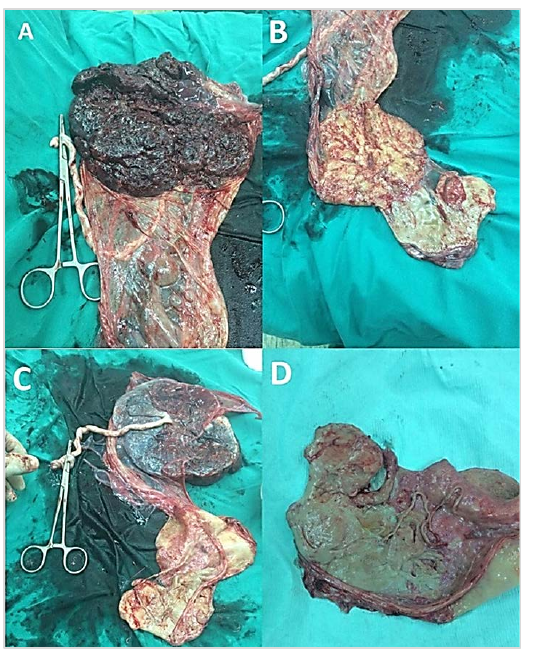
During placenta delivery, we identified a second mass (≈10cm) attached to placenta’s membranes that with minor handling was easily detached and revealed a second placenta with a non-viable fetus of ≈16 weeks (Figure 1). The pregnancy was identified as dichorionic-diamniotic twin pregnancy with a viable fetus and a fetus papyraceus.
Discussion
Multiple pregnancies exhibit increased fetal and maternal complication rates. Different studies report risk of specific complications which include neonatal distress syndrome, hyaline membrane disease, transient tachypnea of newborn, neonatal jaundice, necrotizing enterocolitis, neonatal sepsis, patent ductus arteriosus, twin to twin transfusion syndrome (TTTS), intrauterine growth restriction, defor-mational plagiocephaly, and other physical and mental disabilities (1, 2). In monochorionic pregnancies, single intrauterine fetal Demise (IUFD) is associated with elevated perinatal mortality and serious neurological disabilities for the vital embryo. Congenital anomalies are also reported in the literature (3, 4). Evaluation of the vital fetuses’ brain in a single fetal death of a monochorionic pregnancy should be performed after delivery. Fetal magnetic resonance imaging and neonatal cranial ultra sound are both recommended and provide detailed information about brain lesions and developmental delay in the surviving twin (5). In our case, the mother claimed that due to financial reasons, she wasn’t able to be monitored through her whole pregnancy. It is commonly accepted that regular pregnancy monitoring and screening reduces and prevents adverse perinatal outcomes (6). The economic crisis in Greece over the past decade has proven to directly affect the quality of health and medical care.
Greek Statistic Society released a research in 2014 that reported the percentage of patients that didn’t receive any medical care during the previous year. The long waiting lists of examination (12,9%), long distances from state hospitals and the patient mobility problems (6%, including lack of ambulances and financial difficulties for private transfer), lack of health-care workers (9,4%, such as doctors, nurses etc.) and medical care and treatment that was unable to be completed due to economic weakness (13,6% - 11,3% respectively), reduced the medical care quality of Greek (7). Also, unemployment levels (20,6% - 23,2%) reaching such high levels, directly affect patients' decisions on screening and/or on receiving treatment, as in our patient's case(8). She stated that she didn’t experience any problems, however, the dead fetus seems to had a normal development until the 16th week-of-gestation and a better monitoring and regular examination from the beginning of the pregnancy could have revealed both the twin pregnancy and a possible pathology that led To vanishing twin syndrome. It is commonly accepted that in many cases of multiple pregnancies with a dead fetus there are no adverse outcomes for the surviving fetus or the mother. Even though there are no reports of pregnancies that well monitoring forecasted and prevented a fetus papyraceus situation, and even though the economic problem seems to have a major participation in such cases, frequent-close maternal and fetal surveillance is essential, parental information for possible complications is highly recommended and pregnant women must be advised for the possible adverse outcomes of a gestation without monitoring.
Declarations
- Author contributions (CRediT)
- All authors contributed equally to all 14 CRediT roles (Conceptualization, Data curation, Formal analysis, Funding acquisition, Investigation, Methodology, Project administration, Resources, Software, Supervision, Validation, Visualization, Writing – original draft, Writing – review & editing).
- Funding
-
Funding information was not reported in the published version of this article.
- Conflicts of interest
- The authors declare that they have no conflict of interest in the current study.
- Ethics approval
- Ethics approval details were not reported in the published version of this article.
- Data availability
- A data availability statement was not reported in the published version of this article.
References (8)
5 of 8 references are linked to their DOI.
- Elster, N. (2000). Less is more: the risks of multiple births. Fertility and Sterility, 74(4), 617-623. DOI Crossref PubMed Google Scholar
- AlBasri, S. F., Shouib, G. M., Bajouh, O. S., Nasrat, H. A., Ahmad, E., & AlGreisi, F. M. (2017). Maternal and neonatal outcomes in twin and triplet gestations in Western Saudi Arabia. Saudi Medical Journal, 38(6), 657 DOI Crossref PubMed Google Scholar
- Mittal P, Khanna M. Two papyraceous fetuses in a triplet pregnancy. J Obstet Gynecol India 2007;57:77-78 PubMed Google Scholar
- Upadhyaya I, Pradhan M, Sharma R. Twin pregnancy with fetus papyraceous. JNMA J Nepal Med Assoc 2009. Jul-Sep;48(175):246-248 DOI Crossref PubMed Google Scholar
- Righini A, Salmona S, Bianchini E, Zirpoli S, Moschetta M, Kustermann A, et al. Prenatal magnetic resonance imaging evaluation of ischemic brain lesions in the survivors of monochorionic twin pregnancies: report of 3 cases. J Comput Assist Tomogr 2004. Jan-Feb;28(1):87-92 DOI Crossref PubMed Google Scholar
- Haws, R. A., Yakoob, M. Y., Soomro, T., Menezes, E. V., Darmstadt, G. L., & Bhutta, Z. A. (2009). Reducing stillbirths: screening and monitoring during pregnancy and labor. BMC Pregnancy and Childbirth, 9(Suppl 1), S5 DOI Crossref PubMed Google Scholar
- Health Research. Greek Statistic Society 2014. Available at: https://www.statistics.gr/statistics/-/publication/SHE22 PubMed Google Scholar
- Research on Unemployment Levels. Greek Statistic Society 2018. Available at: http://www.statistics.gr/el/statistics/ -/publi cation /SJO02 PubMed Google Scholar
Respond to this article
Comments on a published article are welcome as a Letter to the Editor.
Get an e-mail when new articles in your fields are published
Questions to the authors
Questions are moderated: an editor approves each question, the authors answer, and an editor approves the answer before both appear here.
No answered questions yet.
Ask the authors a question
Discussion
Comments are moderated: they appear after the writer confirms the e-mail address and an editor approves them. Each comment carries a conflict-of-interest statement.
No comments yet.
Write a comment
Tell me when this article is cited
Leave your e-mail address and confirm it. These notices are not being sent yet; your confirmed address is kept for them and used for nothing else.
Read the full text
Open the PDF here
Loading the PDF…
If the PDF does not show here, use the download button above.
How to cite this article
Kontomanolis EN, Papamanolis V, Kalagasidou S, Fasoulakis ZN. The Impact of Greek Financial Crisis on Pregnancy: A Case Report of a Fetus Papyraceus in a Dichorionic Diamniotic Twin Pregnancy. Ulutas Med J. 2018;4(3):156-158. doi:10.5455/umj.20180802074926
Kontomanolis, E. N., Papamanolis, V., Kalagasidou, S., & Fasoulakis, Z. N. (2018). The Impact of Greek Financial Crisis on Pregnancy: A Case Report of a Fetus Papyraceus in a Dichorionic Diamniotic Twin Pregnancy. The Ulutas Medical Journal, 4(3), 156–158. https://doi.org/10.5455/umj.20180802074926
Kontomanolis, E.N. et al. (2018) 'The Impact of Greek Financial Crisis on Pregnancy: A Case Report of a Fetus Papyraceus in a Dichorionic Diamniotic Twin Pregnancy', The Ulutas Medical Journal, 4(3), pp. 156–158. doi: 10.5455/umj.20180802074926.
@article{umj2751,
  title = {The Impact of Greek Financial Crisis on Pregnancy: A Case Report of a Fetus Papyraceus in a Dichorionic Diamniotic Twin Pregnancy},
  author = {Kontomanolis, Emmanuel N and Papamanolis, Valentinos and Kalagasidou, Sofia and Fasoulakis, Zacharias N},
  journal = {The Ulutas Medical Journal},
  year = {2018},
  volume = {4},
  number = {3},
  pages = {156--158},
  doi = {10.5455/umj.20180802074926},
  url = {https://www.ulutasmedicaljournal.com/?mno=2751},
  issn = {2149-388X}
}