The Ulutas Medical Journal · ISSN 2149-0430 (print), 2149-388X (online) · https://www.ulutasmedicaljournal.com/?mno=156847
Original Article · Open access
Auricular Parameters: A Tool for Stature, Gender and Ethno-facial Determination in a Nigerian Population
- Anatomy, Faculty of Basic Medical Sciences, College of Medicine, the University of Nigeria Enugu Campus, Enugu State, Nigeria ROR
- Anatomy, Faculty of Basic Medical Sciences, Enugu State University of Science and Technology, Enugu State, Nigeria ROR
- Anatomy, Faculty of Basic Medical Sciences, College of Health Sciences, Nile University of Nigeria, Abuja, Nigeria ROR
- Anatomy, Faculty of Basic Medical Sciences, College of Health Sciences, Benue State University Makurdi, Makurdi, Nigeria ROR
Abstract
- Background
- The auricle is a defining feature with the capacity for facial identification, age estimation, and gender determination. This study was designed to establish auricular parameters as a possible tool for identification.
- Methods
- The purposive sampling method was used to randomly select 150 males and 150 females such that each of the three major ethnic groups in Nigeria: Igbo, Hausa, and Yoruba was represented by 100 individuals.
- Results
- Sexual dimorphism was established in all auricular parameters except right lobular length. Auricular parameters varied significantly among the ethnic groups. All the auricular parameters except left lobular length correlated significantly with stature, no significant correlation was noted between auricular parameters and nasal parameters. Facial height correlated significantly with both right and left auricular lengths.
- Conclusion
- Auricular parameters are good predictors of ethnicity, stature, and gender. They can also be used to determine some facial parameters.
Keywords
Full text
Introduction
Anthropologic measurements, fingerprints, DNA, dental records, and are various methods for identifying individuals (1). Due to the growth and the advancement of various means of anthropometric measurement, analysis of the ear can be appropriately harnessed to augment other anthropometric measurements used in identifying individuals, crime solving, and forensic science. The size and shape of the auricle have been reported to vary across nations, ethnicities, and even among individuals (2), and the auricle reaches its maturity in males at about age 13 and age 12 in females (3). It is also part of the defining feature of the face with pertinent information about sex and age (4). The variation in auricular shape, size, and lack of the effect of expression change on ears makes it more valuable than many other facial parameters as a tool for forensic investigation. Regardless of the advanced and vast choices in biometric applications, identifying non-cooperative persons in public spaces and other unconstrained environments is an enormous present-day security challenge (5). In most cases, successful attempts are made to cover most of the facial features and fingerprints, and sometimes only partial or corrupted biometric information might be sourced, such as surveillance video images of only a portion of an individual’s face but with well-exposed auricles. Various authors described auricular prints as essential in identifying persons, criminals, and natural disasters or accidents (5). Kapilet al. (6) note a paucity of data for variations between inter-ethnic groups, which serve as an essential tool in forensic science to identify persons. Several studies exist on auricular parameters in various populations; however, there is a paucity of data on the three main ethnic groups in Nigeria (Igbo, Hausa, and Yoruba), and none of these studies have explored auricular parameters as a tool for racial, ethnic identification, stature, and gender determination.
Materials and Methods
Study Design & Ethical Statement
This was a purposive study conducted among members of the National Youth Service Corps serving in the Enugu North Local Government Area, Southeast of Nigeria. The study was conducted on 300 (150 males and 150 females) adults; 100 volunteers were selected from each of the three major ethnic groups in Nigeria: Igbo, Hausa, and Yoruba. The age difference was between 23-38 years. Each ethnic group consisted of 50 males and 50 females. All data were collected ethically according to the Helsinki Declaration on biomedical ethics. Ethical clearance was sought and granted by the College of Medicine, Enugu State University of Science and Technology, and approval from the National Youth Service Scheme, Enugu State-Nigeria, before the study was conducted.
Protocols and Procedures
The procedure was well explained to the subjects to get maximum cooperation, and objective measurements were made with the volunteers' heads in a Frankfort horizontal plane. Measurements using the standardized auricular landmarks are shown in Figure 1 (7). All dimensions from both sides (Right and Left) of the ears, such as ear length (EL), ear breadth (EW), lobular length (LL), and lobular breadth (L) were measured. Facial parameters like nasal length and breadth, lip length, facial height, and stature were also measured.
Parameters Investigated
• Ear Length (EL): This is a dimension that is obtained by measuring the highest point (super-aural) of the auricle to the lowest point (sub-aural) of the lobe.
• Ear Breadth (EW): this dimension is measured as the straight distance between pre-aural and post-aural.
• Lobular breadth (L and R): measured as the distance between the anterior and the posterior lobule.
• Lobular Length (L and R): measured as the distance between incis inferior and subaurale. • Nasal Length: measured as the distance between the nasion and subnasale.
• Nasal Breadth: measured as the distance between two alaria.
• Lip Length: measured as the distance between two chelion landmarks.
• Face Height: measured as the distance between the nasion to the gnathion.
• Stature: measured as the distance from the bottom of the feet to the top of the head Exclusion and Inclusion Determinants Participants with ear deformities, congenital abnormalities, ear tumors, and a history of ear trauma were noted and excluded from the study.
Statistical Analysis
Data were subjected to statistical analysis using SPSS Version 20 (Microsoft Corporation Inc., Chicago, IL, USA). The mean and standard deviation for these parameters were derived; differences between variables were determined using paired T-test and one-way ANOVA followed by Scheffeʼs post hoc test. A significant difference was set at *P<0.001. Pearson’s coefficient correlation test was performed to determine relationships between variables. The level of significance was set at p<0.05.
Results
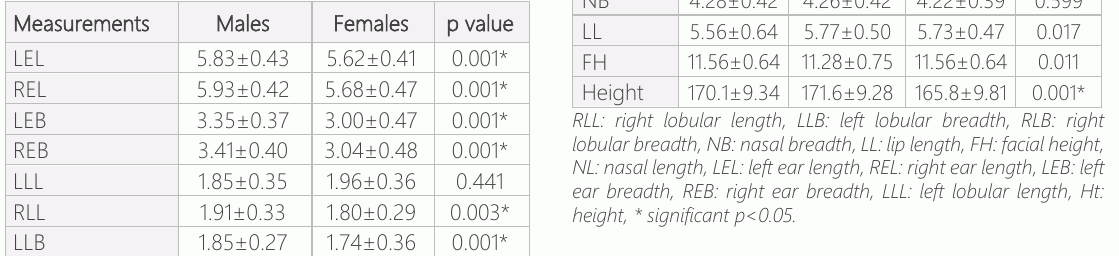
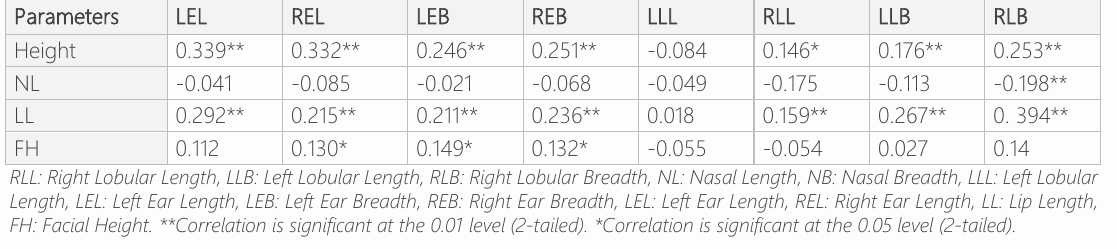
The measured anthropometric parameters distributed according to gender are given in The Yoruba females had the tallest stature and highest mean right lobular length and breadth values. Hausa women had the highest values of LEL and LLL. Table-3 presents mean distributions of the measured anthropometric variables categorized based on ethnicity and gender. Comparative analysis of right and left values of the auricular parameters using paired sample T-test has been summarized in Table 4. At the same time, significant differences were established for both sides of auricular length and breadth, but none were established for lobular length and breadth. Table 5 shows the correlation matrix of the auricular parameters with face and stature.


Discussion
Reports on the anthropometric variation of auricular parameters abound (4, 8–10). This makes it imperative to establish normative values of these auricular values across races, nationalities, and ethnic lines. Before now, A handful of studies on Nigerians' auricular parameters have been noted to be focused on the general population living in different parts of the country (11, 12). Others have just targeted isolated minority ethnic (7, 13). This report has not only established the normative values of the Nigerian population. Still, it has also gone further to establish the normative values of auricular parameters of the three main ethnic groups in Nigeria, considering the multi-ethnic complexity of Nigeria.
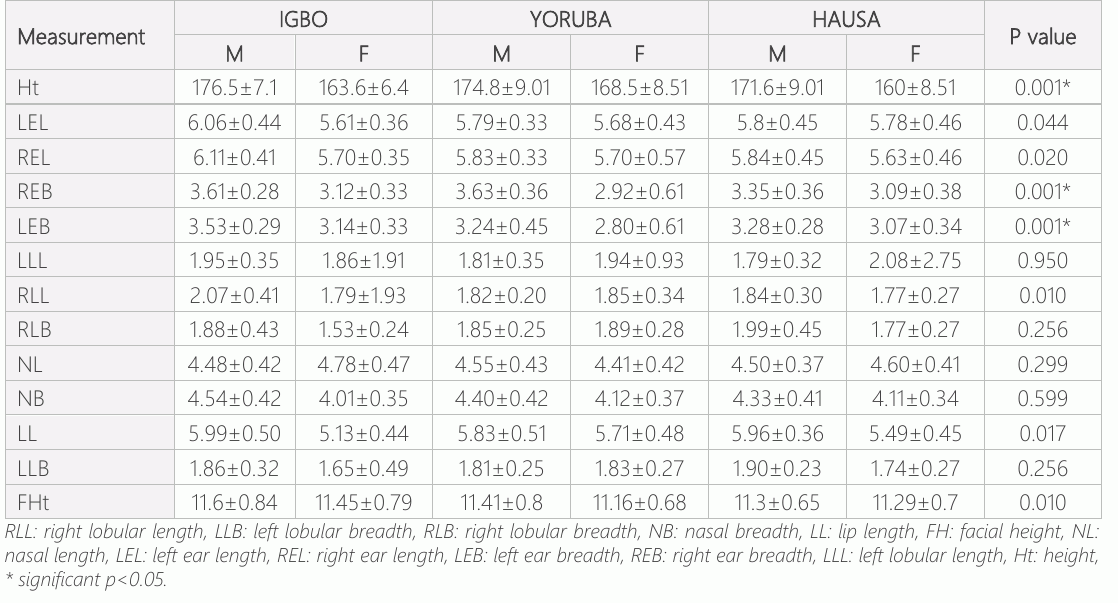
Our report showed significant differences in the auricular parameters of these dominant ethnic groups in the country. Ethnic-based variations in the morphology of the pinna have been observed in earlier reports (14, 15). The mean auricular parameters of this study varied significantly between the three ethnic groups focused on and varied with similar studies within the country amongst different ethnic groups (7, 11–13). Therefore, this report makes the auricular parameter one of the tools for grouping and identifying individuals from these major groups in the country.
The racial discrimination in the morphology of the auricular parameters was very clearly demonstrated in the reports of Abeysekera and Shahnavaz (16), in their report; they noted that the earpieces designed for males of the United States fitted only 95% Germans, 75% Frenchmen, 60% Italians, 45% Japanese, and 10% Thais. Similar reports have corroborated this difference, as seen in the differences between the ear morphology of the Nepalese and Indians (18), Turkish, and the collection of African students (17). The results of our study show that Nigerians have shorter but broader ears compared with the Turkish population (17). The Turkish population was also seen to have both longer and broader ear lobules. This contradicts Indian and Nepalese populations that showed smaller auricular parameters than Nigerians (17–20). Earlier reports made concerning the differing ear morphologies of individuals from across the nations and continents, suchas Italian, European, Caucasian, Turkish, Dutch, German, North American, etc. (4, 8–10, 21). As significant sexual dimorphism has been noted in many anthropometric measurements, the same was valid and significant in our study. Our study noted more extensive auricular parameters in the males for all the auricular parameters studied in all the ethnic groups, except for the lobular length and breadth, which were significantly higher for the Yoruba female population. Earlier studies within Nigerians (7, 11, 13) and amongst samples from other countries (17–20, 22) corroborated sexual dimorphic component of the auricular dimension.
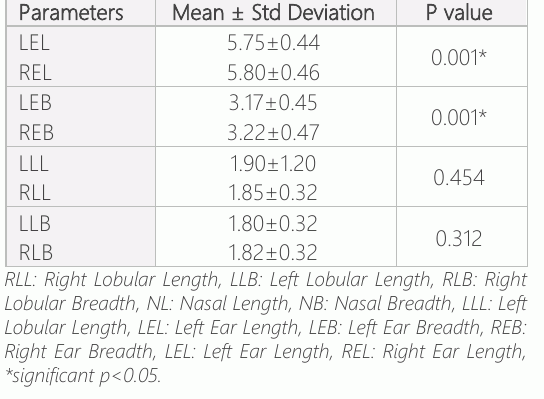
In addition to the sexually dimorphic nature of the ear and its bilateral asymmetric component, our study noted larger right ear dimensions than the left. In all the ear parameters studied, only ear length and breadth differed between the right and left ears. Osunwoke et al. (17) also noted larger ears amongst studied males and African females. Murgod et al. (19) indicated that the most suitable auricular parameters were considerably higher than the left in the Indian population studied. Other studies with similar results include the reports of Osunkwoke et al.(17) 12 in Nigerian population, Mutewe and Muguti (23) in Zimbabwean school children, and many others. Auricular parameters are noted to be a tool for forensic identification (6).
Conclusion
The auricles are prominent features of the head and distinctive for individuals, and their uniqueness can be crucial for anthropometrical analysis. Auricular parameters are showed here as a veritable means for establishing human variation and estimating stature.
Declarations
- Author contributions (CRediT)
- All authors contributed equally to all 14 CRediT roles (Conceptualization, Data curation, Formal analysis, Funding acquisition, Investigation, Methodology, Project administration, Resources, Software, Supervision, Validation, Visualization, Writing – original draft, Writing – review & editing).
- Funding
-
Funding information was not reported in the published version of this article.
- Conflicts of interest
- A conflict of interest statement was not reported in the published version of this article.
- Ethics approval
- Ethical clearance was sought and granted by the College of Medicine, Enugu State University of Science and Technology, and approval from the National Youth Service Scheme, Enugu State-Nigeria, before the study was conducted.
- Data availability
- A data availability statement was not reported in the published version of this article.
References (23)
14 of 23 references are linked to their DOI.
- Shekar BC, Reddy CVK. Role of dentist in person identification. Indian J Dent Res. 2009;20(3):356. PubMed Google Scholar
- Kumar P, Singla A. Ear biometric: sex, bilateral and ethnic differences among Brahmin and Yadav communities of Bundelkhand region using PCA technique. Int J Sci Eng Res. 2013;4(10):799-805. PubMed Google Scholar
- Ito I, Imada M, Ikeda M, Sueno K, Arikuni T, Kida A. A morphological study of age changes in adult human auricular cartilage with special emphasis on elastic fibers. Laryngoscope. 2001;111(5):881-886. DOI Crossref PubMed Google Scholar
- Bozkır MG, Karakaş P, Yavuz M, Dere F. Morphometry of the external ear in our adult population. Aesthetic Plast Surg. 2006;30:81-85. DOI Crossref PubMed Google Scholar
- Meijerman L, Van Der Lugt C, Maat GJ. Cross-sectional anthropometric study of the external ear. J Forensic Sci. 2007;52(2):286-293. DOI Crossref PubMed Google Scholar
- Kapil V, Bhawana J, Vikas K. Morphological variation of ear for individual identification in forensic cases: A study of an Indian population. Res J Forensic Sci. 2014;2(1):1. PubMed Google Scholar
- Ugochukwu EG, Ifechukwude BJ, Raymond UA, Obun OC. An anthropometric study of the normal auricle of Cross River State indigenes of Nigeria. J Anat Soc India. 2017;66(1):26-30. DOI Crossref PubMed Google Scholar
- Kalcioglu MT, Toplu Y, Ozturan O, Yakinci C. Anthropometric growth study of auricle of healthy preterm and term newborns. Int J Pediatr Otorhinolaryngol. 2006;70(1):121-127. DOI Crossref PubMed Google Scholar
- Sforza C, Dellavia C, Tartaglia GM, Ferrario VF. Morphometry of the ear in Down's syndrome subjects: A three -dimensional computerized assessment. Int J Oral Maxillofac Surg. 2005;34(5):480-486. DOI Crossref PubMed Google Scholar
- Sforza C, Grandi G, Binelli M, Tommasi DG, Rosati R, Ferrario VF. Age-and sex- related changes in the normal human ear. Forensic Sci Int. 2009;187(1-3):110.e1. DOI Crossref PubMed Google Scholar
- Garba SH. Anthropometric study of the pinna (Auricle) among adult Nigerians resident in Maiduguri metropolis. J Med Sci. 2010;10(6):176-180. PubMed Google Scholar
- Osunwoke EA, Vidona WB, Atulegwu GC. Anthropometric study on the anatomical variation of the external ear amongst Port Harcourt students, Nigeria. Int J Anat Var. 2018;11(4):143-146. PubMed Google Scholar
- Alabi AS, Adeola A, Kareem SB, Lewu SF, Olawepo A, Arogundade TT, Yawson EO. Anthropometric analysis of auricular indices for sex and stature determination among Okun and Igala ethnic groups of Kogi State, Nigeria. J Environ Toxicol Public Health. 2019;4:6-14. PubMed Google Scholar
- Alexander KS, Stott DJ, Sivakumar B, Kang N. A morphometric study of the human ear. J Plast Reconstr Aesthet Surg. 2011; 64(1):41-47. DOI Crossref PubMed Google Scholar
- Gualdi-Russo E. Longitudinal study of anthropometric changes with aging in an urban Italian population. Homo. 1998;49(3):241-259. PubMed Google Scholar
- Abeysekera JD, Shahnavaz H. Body size variability between people in developed and developing countries and its impact on the use of imported goods. Int J Ind Ergon. 1989;4(2):139-149. DOI Crossref PubMed Google Scholar
- Osunwoke EA, Vidona WB, Atulegwu GC. Anthropometric study on the anatomical variation of the external ear amongst Port Harcourt students, Nigeria. Int J Anat Var. 2018;11(4):143-146. PubMed Google Scholar
- Purkait R, Singh P. Anthropometry of the normal human auricle: a study of adult Indian men. Aesthetic Plast Surg. 2007;31:372-379. DOI Crossref PubMed Google Scholar
- Murgod V, Angadi P, Hallikerimath S, Kale A. Anthropometric study of the external ear and its applicability in sex identification: assessed in an Indian sample. Aust J Forensic Sci. 2013;45(4):431-444. DOI Crossref PubMed Google Scholar
- Sharma A, Sidhu NK, Sharma MK, Kapoor K, Singh B. Morphometric study of ear lobule in northwest Indian male subjects. Anat Sci Int. 2007;82(2):98-104. DOI Crossref PubMed Google Scholar
- Ferrario VF, Sforza C, Ciusa V, Serrao G, Tartaglia GM. Morphometry of the normal human ear: a cross-sectional study from adolescence to mid-adulthood. J Craniofac Genet Dev Biol. 1999;19(4):226-233. PubMed Google Scholar
- Gupta AK, Ambekar MN. Anthropometric Study of External Ear: A Comparative Study in Medical Students of Nepalgunj Medical College in Nepal. J Nepalgunj Med Coll. 2017;15(2):49-52. DOI Crossref PubMed Google Scholar
- Muteweye W, Muguti GI. Prominent ears: anthropometric study of the external ear of primary school children of Harare, Zimbabwe. Ann Med Surg. 2015;4(3):287-292. DOI Crossref PubMed Google Scholar
Read the full text
Open the PDF here
Loading the PDF…
If the PDF does not show here, use the download button above.
How to cite this article
Anyanwu GE, Didigu R, Chia T, Obasi KK, Kiekwe V. Auricular Parameters: A Tool for Stature, Gender and Ethno-facial Determination in a Nigerian Population. Ulutas Med J. 2023;9(4):227-232. doi:10.5455/umj.20230609085715
Anyanwu, G. E., Didigu, R., Chia, T., Obasi, K. K., & Kiekwe, V. (2023). Auricular Parameters: A Tool for Stature, Gender and Ethno-facial Determination in a Nigerian Population. The Ulutas Medical Journal, 9(4), 227–232. https://doi.org/10.5455/umj.20230609085715
Anyanwu, G.E. et al. (2023) 'Auricular Parameters: A Tool for Stature, Gender and Ethno-facial Determination in a Nigerian Population', The Ulutas Medical Journal, 9(4), pp. 227–232. doi: 10.5455/umj.20230609085715.