The Ulutas Medical Journal · ISSN 2149-0430 (print), 2149-388X (online) · https://www.ulutasmedicaljournal.com/?mno=223996
Original Research · Open access
Association of the Zwolle Score with Fragmented QRS Complex: A Combined Prognostic Tool for Primary Angioplasty in ST Elevation Myocardial Infarctions
- Department of Cardiology, Kafkas University, Faculty of Medicine, Kars, Turkey ROR
- Private Clinic, Department of Psychiatry, Gaziantep, Turkey
- Instituto de Investigacións Mariñas: Vigo, Galicia, ES, Sivas Cumhuriyet Üniversitesi, Technical University of Munich, Yeditepe University ROR
- Karamanoğlu Mehmetbey University, Karaman, TR ROR
Abstract
- Introduction
- We aimed to introduce the prognostic value of simultaneously calculated fragmented QRS and Zwolle scores as a new scoring system in primary PCI of the STEMI patients.
- Method
- Two hundred fifty-nine STEMI patients were classified as fragmented QRS complex group (fQRS) and non-fragmented QRS complex group (non-fQRS) according to the fragmentation of QRS complex in electrocardiography. These two groups according to whether Zwolle score ≥3 were also classified as high Zwolle score with fQRS complex, high Zwolle score with the non-fQRS complex, the low Zwolle score with fQRS complex, and low Zwolle score with the non-fQRS complex group. The hospitalization data of the patients were analyzed.
- Results
- In the fQRS group compared with the non-fQRS group, wider QRS (105.2±9.7 vs. 88±7.1, p<0,001) as well as the higher Creatin Kinase-MB [med (IQR): 174 (123-199) vs. 102 (96-147), p<0,001] and creatinine (0.99 (0.87-1.2) vs. 0.83 (0.78-0.83), p<0.001) levels were detected. Killip scores of<1 [18(69.2) vs. 8(30.8),p<0.001] were more frequent. Adverse cardiac events were significantly higher in high Zwolle score with fQRS complex group.
- Conclusion
- Clinically, fQRS was associated with high adverse cardiac events ratio. Thus, utilization of Zwolle score along with the fragmented QRS is prognostically significant in primary PCI patients admitted with STEMI.
Keywords
Full text
Introduction
Acute myocardial infarction (AMI) usually occurs as a result of atherosclerotic plaque rupture. ST-elevation myocardial infarction (STEMI) is the most dangerous type clinically. Major adverse cardiac events (MACE), defined as death, Q-wave myocardial infarction (MI) and the need for repeat revascularization by repeat percutaneous intervention (PCI) or coronary artery bypass surgery (CABG) are still 8.7% and revealed no satisfactory decline despite the innovations in different therapeutic modalities (1).
Although various risk scores for STEMI have been established so far, most of them had developed before the evolution of primary PCI (2–5). The Zwolle score (Zs) is a scoring system having angiographic, and clinical variables used in prognostic evaluation of STEMI (3).
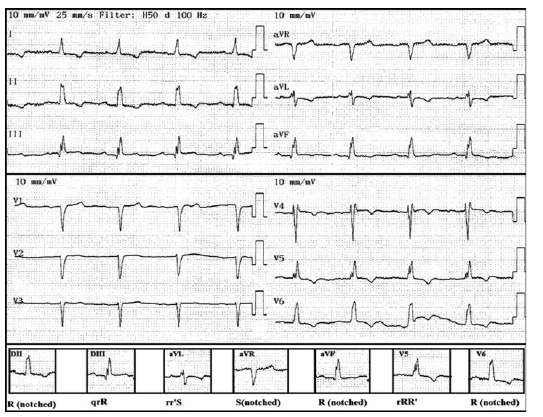
Fragmented QRS complex (fQRS) is an easily evaluated non-invasive electrocardiographic parameter. It’s narrow or wide complexes on electrocardiogram (ECG) which are seen in paced rhythm, bundle branch block or a premature ventricular systole (6). fQRS was defined as having the other R wave (R’) or notching in the nadir of the S wave. The presence of >1 R’ in two contiguous leads, corresponding to a significant coronary artery territory on the resting twelve-lead ECG with filter range of 0.16-100 Hz, with a paper speed of 25mm/s under 10 mm/mV (7). Patho-physiology of fQRS describes a myocardial scar and it associates with the ventricular dysfunction and congestive heart failure. In CAD, fQRS is formed by the myocardial infarction and represents a risk of subsequent occurrence of ischemic events (8). Indeed, ECG fragmentation is showed to be associated with increased morbidity and mortality, sudden cardiac arrest, and adverse cardiovascular events with poor prognosis in the previous publications (8–12).
In this article, we aimed to develop a better scoring system by combining Zs with fQRS. In this way, the clinical, angiographic and electrocardiographic parameters associated to evolve a simple, practical and sensitive risk scoring regarding the STEMI patients undergoing PCI.
Study Design
Study group include the retrospective analysis of 847 STEMI patients who underwent primary PCI in our department between 2010 and 2013. Among them, 259 patient [156 (63.2%) male, 103 (39.7%) female] were eligible for the study according to the inclusion and exclusion criteria. Inclusion criteria included the acute onset of typical chest pain (>30 min in the last 12 h), ST- segment elevation (>1 mm), and treatment with primary PCI. Exclusion criteria included the history of previous AMI, pathologic Q wave on ECG (≥ 0.04 seconds in duration than 1/4 of the following R wave in voltage), and left or right bundle branch block (QRS duration <120 ms and RSR patterns in V1-two precordial leads). The patients with a dilated cardiomyopathy or a prior history of revascularization (coronary artery bypass grafting or percutaneous coronary intervention), as well asa significant comorbidity such as pulmonary or renal failure were also excluded the study. Patient were classified as fragmented (fQRS) and non-fragmented (non-fQRS) group according to the fragmentation of QRS complex in electrocardiography and then this groups divided into HighZs (>3) and LowZs (≤3) according to Zs scoring. Finally, fragmen- ted (fQRS) and non-fragmented groups were classified into two subgroups as fragmented (High Zs+fQRS and LowZs+fQRS) and non- fragmented QRS complexes (HighZs+nonfQRS and LowZs+nonfQRS).
Coronary angiography
Emergency coronary angiography was performed by the percutaneous femoral approach. In all cases, a non-ionic lowosmolarity contrast media was used. All patients received 300 mg chewable acetyl- salicylic acid and 600 mg loading dose of clopidogrel before coronary angiography. Unfractionated heparin (100 U/kg) was administered intravenously. The usage of tirofiban was reserved for the decision of the operator. Evaluation of angiographies (Axiom Artis, Siemens, Germany) was performed by two experienced cardiologists who were blinded to the study.
ECG criteria for fQRS
A 12 derivation surface ECG was obtained from all patients immediately after their admission to the emergency care unit. The 12 lead ECG (Nihon Kohden, filter range 0.5 Hz to 150 Hz, alternating current (AC) filter 60 Hz, 25 mm/s, 10 mm/mV) was analyzed by an independent cardiologist who was blinded to the study.
The fQRS was defined as the presence of a new R-wave (R’) or notching of R or S wave or the presence of fragmentation (more than one R’) in two successive leads corresponding to a major coronary artery area (Figure-1).
Zwolle Score
Zwolle score was calculated according to the risk factors. Killipclass 1, 2 and 3-4 were scored as zero, four points, and nine points respectively. Post-TIMI flow grade 3, 2, and 1 were scored as zero, one point, and two points respectively. Age (≥60, 2 points), three-vessel disease (one point), anterior myocardial infarction (one point) and ischemic time >4 hours (one point) (3).
Analysis of patient data
Clinical features of all patients like diabetes mellitus (DM),hyperlipidemia(HL), and smoking were registered. Killip score, which is used in AMI patients for risk stratification, of each patient was determined by classification (13).
Laboratory tests on admission were recorded. Biochemical and hematologic blood tests were measured using standard methods. Echocardiography (Phillips Envisor, P2-4 MHz probe) was performed according to American Association of Echocardiography guidelines (14). Left ventricle ejection fraction (LVEF) was calculated using biplane modified Simpson’s method.
Definitions
Heart failure was defined according to the New York Heart Association (NYHA) classification. Cardiovascular mortality was defined as death due to AMI, heart failure or arrhythmia and as sudden death. Reinfarction was defined as an AMI that occurs during the hospitalization period of an incident or recurrent MI that was confirmed by elevation of serum troponin enzyme levels with the other evidence of myocardial necrosis. Target vessel revascularization (TVR) was defined as either percutaneous or surgical revascularization of the target vessel after the initial intervention. Contrast-induced nephropathy (CIN) was defined as a relative increase in baseline serum creatinine of greater than 25% and an absolute increase of 0.5 mg/dL within 72 hours after contrast administration.(15)Hypertension was defined as the active use of antihypertensive drugs or the determination of blood pressure greater than 140/90 mmHg. Diabetes mellitus (DM) was defined as fasting glucose levels over 126 mg/dL or glucose level over 200 mg/dL at any measurement or active use of antidiabetic drugs or insulin.
Follow-up
Cardiovascular mortality, reinfarction, repeat TVR, stroke, ventricular tachycardia/fibrillation (VT/VF), advanced heart failure, transient pace intervention, intra-aortic balloon pump, new atrial fibrillation, renal failure requiring dialysis, inotropic agent infusion, mechanical ventilator usage and the complications of MI were recorded during the in-hospital stay.
Statistical Design
SPSS for Windows software was used for statistical analysis (SPSS Inc. Chicago, Illinois, USA). The Kolmogorov-Smirnov test was used to determine the distribution of data from continuous variables. Categorical variables were expressed as absolute frequencies and percentages, continuous parametric variables were expressed as the mean and standard deviation, and continuous non-parametric variables were expressed as the median value and 25th-75th percentile. Categorical variables were compared by the likelihood-ratio x(2) test. Comparison of parametric values between the two groups was performed using a two-tailed Student’s t-test. The mean values of quantitative parametric variables more than two groups were compared by one-way analysis of variance (ANOVA) test. Mann-Whitney U was used to compare the non-parametric values between the two groups. Kruskal Wallis-H test was used to test for differences in non-parametric continuous variables in the more than two groups. Binary logistic regression analysis was used to detect the factors influencing occurrence. All confidence intervals are 95%. A p value less than 0.05 was considered statistically significant.
Results
Twelve-leads ECG revealed the presence of fragmentation of QRS in 80 patients named as (fQRS) and 179 patients with no QRS fragmentation and named as (non-fQRS). Baseline clinical characteristics for two groups were shown in Table-1. Patients with fQRS were found to have more coronary risk factors (DM, HT HL, and smoking) than the patients with non-fragmented QRS complexes (non-fQRS). There were no differences between two groups with respect to systolic and diastolic blood pressure, Hb, WBC count, FBG, LDL-C, HDL-C, and TG levels. Mean heart rate of the fQRS group was significantly higher than normal (60-90 bpm/min) and that of in the non-fQRS group. Likewise, creatinine and CK- MB level were higher in the fQRS group as compared to the that in non-fQRS group. Angiographic and procedural characteristics comparisons of between fQRS and non-fQRS groups were given in Table-2. Both Pain-balloon time and door to balloon time were longer in fQRS group. In fQRS group, QRS duration was longer as the Q wave was augmented. Echocardiographic findings in both groups were revealed a significant decrease in left ventricular ejection fraction in the fQRS group than the non-fQRS group and Killip score >1 was detected more.
The left main coronary artery (LMCA) was found to be responsible for the myocardial infarction in 15 patients of the fQRS group (18.8%) and 4 patient of the non-fQRS group (2.2%). The left anterior descendent artery (LAD) was found to be responsible in 58 patient of the fQRS group (72.5%) and 62 patients of the non-fQRS group (45.5 %). The circumflex artery (CxA) was found to be responsible in 38 patient of the fQRS group (47.5 %) and 65 patients of the non-fQRS (36.3%). The right coronary artery (RCA) was found to be responsible in 24 patients of the fQRS group (30%) and 74 patients of the non- fQRS group (41.3%). As shown in Table-2, Chi-square analysis for descriptive values revealed significant differences between both groups at LMCA and LAD but showed no difference between the CxA and RCA. In the fQRS group, the responsible coronary artery was determined as LAD, CxA, and the RCA respectively. Diseased vessel quantity were significantly higher in patient with fragmentation (fQRS: 2.2±0.75 and non-fQRS: 1.68±0.7 p<0.001).
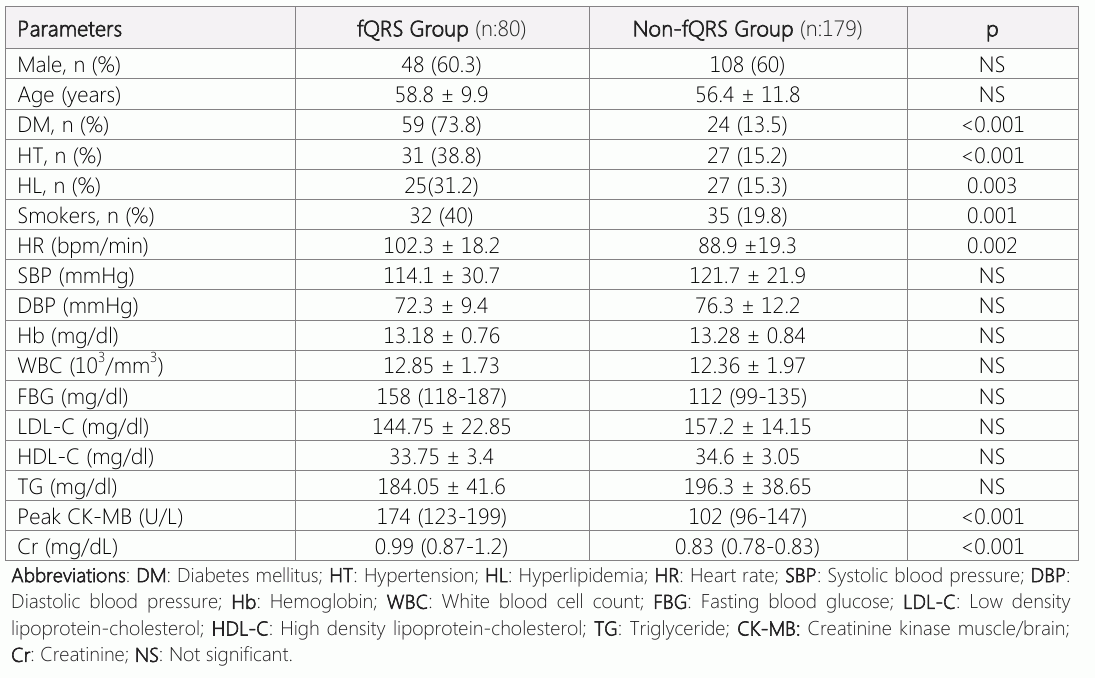
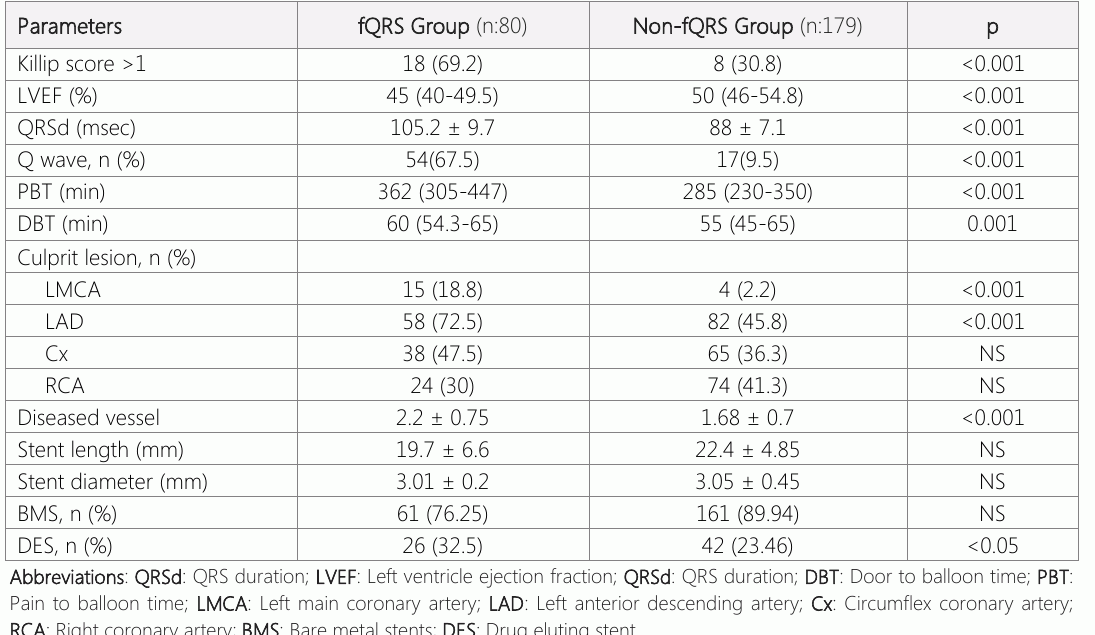
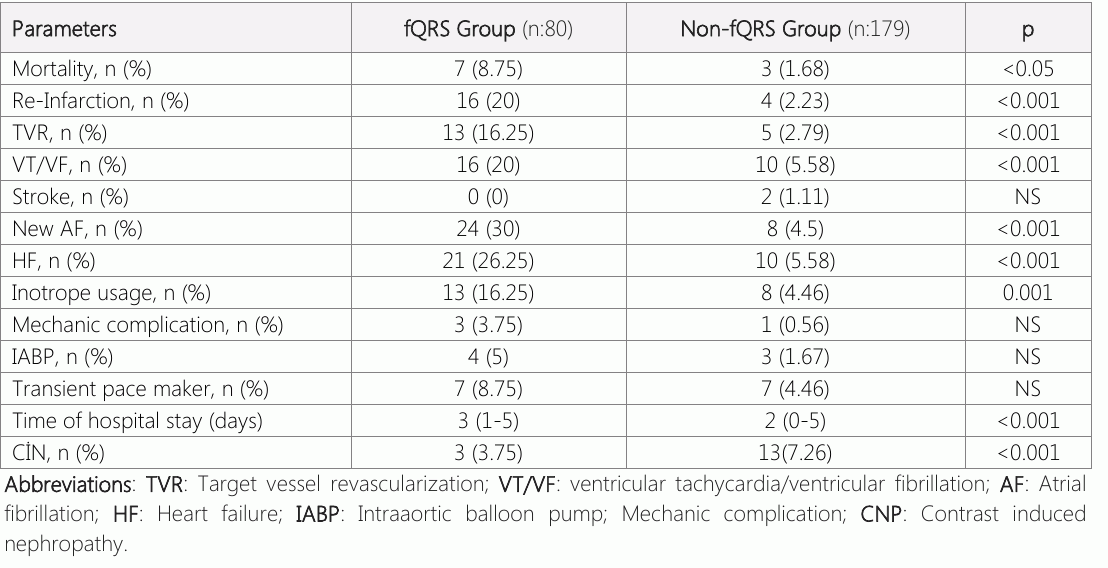
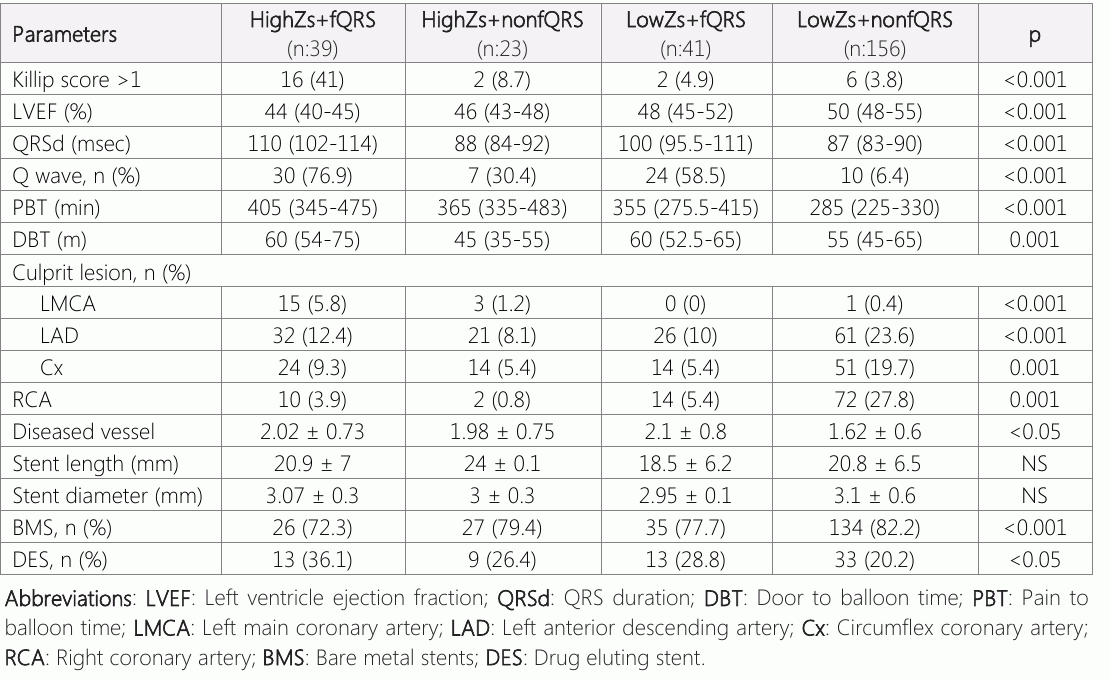
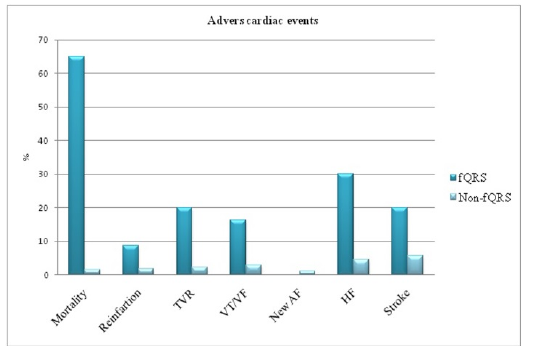
Table-3 was demonstrating the adverse cardiovascular events during hospitalization. In the fQRS group, mortality, reinfarction, targeted vessel revascularization during hospitalization and the frequency of MACE, which is the sum of all, meaningfully higher than the non-fQRS group. Also, in the fQRS group, the incidence of heart failure, inotropic agent usage, atrioventricular block needing a temporary pacemaker, development of new atrial fibrillation (AF) and hospitalization duration during hospitalization were found higher (Figure-2).
Pateints were divided into four groups according to their Zwolle scores: HighZs+ fQRS group (n:39), HighZs+nonfQR group (n:23), LowZs+fQRS group (n:41) and LowZs+ nonfQR group (n:156). Comparisons of the angiographic and procedural characteristics among HighZs+fQRS, HighZs+nonfQR, LowZs +fQRS, LowZs+nonfQR groups were given in Table-4. Pain to balloon time was longer than normal in four groups. QRS duration was longer, Q wave was augmented, and LVEF was significantly lower in HighZs+fQRS group compared to other three study groups. In addition, patients in the HighZs+fQRS group were higher in Killip class compared to other study groups. In LowZs+fQRS group, the responsible coronary artery was determined as LAD, cir-cumflex artery (Cx) and right coronary artery (RCA) respectively. Fragmentation localization on ECG was detected mostly on anterior derivations followed by the lateral and inferior leads. Diseased vessel quantity were signifi-cantly higher in patient with fragmentation (LowZs+fQRS: 2.1±0.8 and LowZs+nonfQRS: 1.62±0.6 p<0.004).
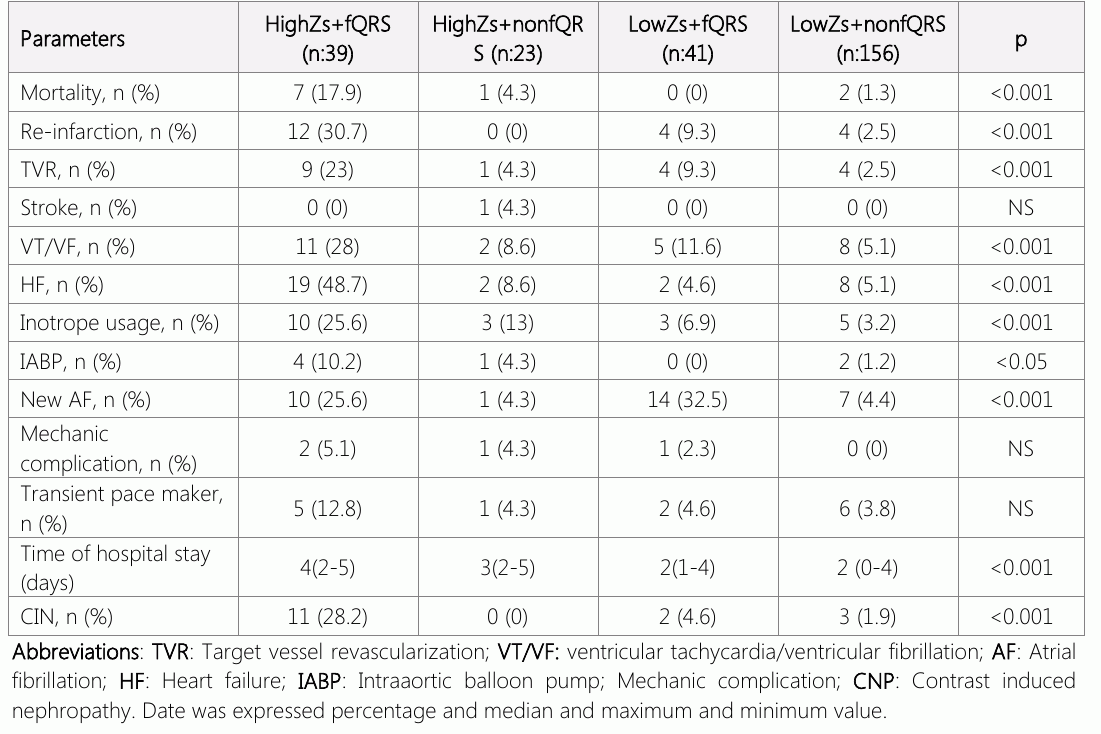
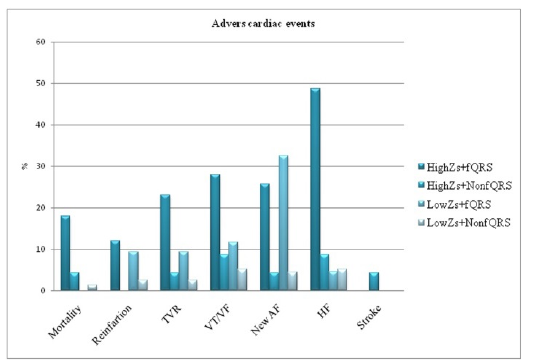
Table-5 was demonstrating the adverse cardiovascular events during hospitalization. In LowZs+fQRS group, mortality, reinfarction, targeted vessel revascularization during hospitalization and the frequency of MACE, which is the sum of all, meaningfully higher than LowZs+nonfQRS group. In fragmented group (LowZs+fQRS), the incidence of heart failure, inotropic agent usage, atrioventricular block needing temporary pacemaker and development of new AF during hospitalization were found higher. Hospitalization duration was also longer in the fragmented group (LowZs+ fQRS) (Figure-3).
According to the Binary logistic regression analysis, the presence of the fQRS complex in 12-lead electrocardiography strongly correlates (44%) with adverse cardiovascular effects. Also, a significant association between the fQRS complex and AF related stroke was identified. This suggests that the presence of the fQRS complex may be a predictor of stroke in acute AF.
Discussion
The presence of fragmented QRS represents within the ventricles mass that is related to myocardial scar/myocardial ischemia or myocardial fibrosis (15). It has been shon that, the presence of fQRS in patients with coronary artery disease increase the risk of adverse cardiac events and all-cause mortality (7). In patient with STEMI, the occurrence of a major cardiac event in hospital and association of Zwolle score is still unknown. In this study, we investigated the relationship between presence fQRS complex on surface 12-lead derivation ECG and Zwolle score in patient whit STEMI. Emphasized outcomes can be listed under four main headings in this study; 1. The fQRS is significantly associated with the adverse cardiac events than is the non-fQRS. In fact, the fQRS may be a predictor of the prior adverse cardiac event, which has a significantly high incidence in the fQRS group. The adverse cardiac events include mortality, reinfarction, TVR, VF/VT, new AF, HF and stroke in a patient with fQRS of STEMI.
2. Patients, who have fragmented QRS in their ECG despite the presence of low Zwolle score (LowZs+fQRS), carry a high risk of mortality during hospitalization and risk of ACE. This increased risk is similar to the patients having high Zwolle score and non-fragmented QRS complexes (HighZs+nonfQRS). Regarding the low Zwolle score with non-fragmented QRS complexes (LowZs+nonfQRS) group of patients, the risk is even less.
3. The presence of fragmented QRS complexes in high Zwolle score patients (HighZs+fQRS) reveals the highest hospital mortality and ACE. Patients with high Zwolle score and non-fragmented QRS complexes (HighZs+ nonfQRS) present lower hospital mortality and MACE.
4. Patients with low Zwolle score and fragmented QRS (LowZs+fQRS) revealed higher peak levels of CK-MB and leucocyte. This may be the indicator of a larger necrotic area in LowZs+fQRS group. Additionally, these patients in LowZs+fQRS group had higher peak levels of CK-MB and leucocyte than the HighZs+nonfQRS group.
In the era of primary PCI, several different clinical scores have been used. These include the Global Registry of Acute Coronary Events (16), PAMI (4), TIMI-STEMI (2), Zs (3), and controlled abciximab and device investigation to lower late angioplasty complications (CA- DILLAC) risk score (5).
Subsequently, different scores were combined to develop new scoring systems. Therefore, early and late MACE ratios and cardiovascular mortality ratios could be calculated more accurately. SYNTAX score (Ss) and PAMI (primary angioplasty in myocardial infarction) score, which is a clinically based scoring system, were combined (4). In another study, clinical Ss was developed by the addition of age, creatinine clearance and LVEF parameters to the original Ss. Using the data from the Fractional Flow Reserve Versus Angiography for Multivessel Evaluation (FAME) study, Nam et al. (17) calculated Ss by incorporating only ischemia-producing lesions that determined by a fractional flow reserve (FFR)≤0.80. They named this score as the functional Ss (FSs). Capodanno et al. (18) produced another risk score called the global risk classification system, which was created by combining the Ss and EuroSCORE strata.
However, fragmented QRS complexes had never been used as a prognostic parameter in these scoring systems. Although the parameters like Zwolle score, age, anterior MI, Killip classification, post TIMI flow, three-vessel disease, and pain-balloon time were all previously taken into consideration as prognostic parameters, ECG fragmentation is initially considered as a prognostic tool in this study. fQRS is defined as unexpected deviations in the QRS morphology due to regional myocardial fibrosis or scar. Data suggest that ischemia might cause fQRS via nonhomogeneous myocardial electrical activation (19–23). Previous studies revealed that the presence of fQRS is mostly associated with extensive coronary artery disease and myocardial necrosis, high leucocyte counts and CK-MB levels and higher Killip score. Additionally, these patients usually exhibited an infraction in the anterior region and were often related to a lesion in the proximal LAD and the larger jeopardized myocardium. Successful reperfusion rates following PCI and lower Blush score were reported in these cases. In previous studies, fQRS was shown to have an association with increased mortality and morbidity in hospital stay and long-term follow-up. It was also demonstrated that, cardiac arrhythmia, cardiac arrest decreased LVEF, increased MACE may additionally coexist. Therefore, we used the fragmented QRS, which is a simple parameter, in association with Zwolle score for prognostic evaluation in STEMI patients undergoing PCI. Depending to our results, we recommend that the fragmented QRS complex should be included the Zwolle scoring parameters. The fragmented QRS should be considered together with Killip classification, TIMI flow grade following angioplasty, tree-vessel di-sease, anterior infarction and ischemic time that constitutes the Zwolle scoring system. Thus, we also recommend to increase the total Zwolle score from 16 to 17 by adding an extra 1 point for the presence of the fragmented QRS complex.
There are some limitations to this study. The quantity of the patient population was low. The research was retrospective and conducted in a single center. Therefore, multi centered and prospective studies on a larger scale are needed to validate our findings and to show the clinical implications of fQRS complexes more definitely. The follow-up time during hospitalization was limited. For this reason, the evaluation of the patients with the intervals of 3, 6 and 12 months would reveal more accurate results. Moreover, the patients with ECG evidence of bundle branch block have not enrolled the study, as we compare the QRS interval in scar formation related to the myocardial infarction. QRS interval elongation in left or right bundle branch block was excluded as it would affect the study outcomes.
Finally, fQRS is not unique only to coronary artery disease. It may also be seen in electrical disorders as Burgada syndrome. Thus, this study would be more accurate in the patients with a known coronary artery disease with the existence of the scar/infarct tissue that was verified by the test methods like myocardial perfusion scintigraphy (MPS).
Conclusion
This study suggests that the fragmented QRS on admission is predictive of subsequent cardiovascular events during hospitalization. Despite the presence of clinically low Zwolle score, additionally, determined fQRS reveals higher MACE rates. Therefore, concomitant assessment of the fQRS and Zs as a ‘new prognostic score’ for primary PCI in the case of STEMI may be useful in predicting the ACE during hospitalization. On the other hands, multi centered cross-sectional studies with high population are strongly needed to evaluate the presence of correlation between the number of fragmentations and the ACE development in primary PCI as well as the inclusion of fQRS in Zwolle score risk stratification.
Declarations
- Author contributions (CRediT)
- All authors contributed equally to all 14 CRediT roles (Conceptualization, Data curation, Formal analysis, Funding acquisition, Investigation, Methodology, Project administration, Resources, Software, Supervision, Validation, Visualization, Writing – original draft, Writing – review & editing).
- Funding
-
There is no funding for the current study.
- Conflicts of interest
- The authors declare that there is no conflict of interests to publish this article.
- Ethics approval
- Ethics approval details were not reported in the published version of this article.
- Data availability
- A data availability statement was not reported in the published version of this article.
References (23)
23 of 23 references are linked to their DOI.
- Räber L, Kelbæk H, Ostojic M, Baumbach A, Heg D, Tüller D, et al. Effect of biolimus-eluting stents with biodegradable polymer vs bare-metal stents on cardiovascular events among patients with acute myocardialinfarction: the COMFORTABLE AMI randomized trial. JAMA 2012;308:777-787. DOI Crossref PubMed Google Scholar
- Morrow DA, Antman EM, Charlesworth A, Cairns R, Murphy SA, de Lemos JA, et al. TIMI Risk Score for ST-elevation myocardial infarction: a convenient, bedside, clinical score for risk assessment at presentation. Circulation. 2000;102:2031-2037. DOI Crossref PubMed Google Scholar
- De Luca G, Suryapranata H, van 't Hof AW, de Boer MJ, Hoorntje JC, Dambrink JH, et al. Prognostic assessment of patients with acute myocardial infarction treated with primary angioplasty: implications for early discharge.Circulation 2004;109:2737-2743. DOI Crossref PubMed Google Scholar
- Addala S, Grines CL, Dixon SR, Stone GW, Boura JA, Ochoa AB, et al. Predicting mortality in patients with ST-elevationmyocardial infarction treated with primary percutaneous coronary intervention (PAMI riskscore). Am J Cardiol 2004; 93:629 -632. DOI Crossref PubMed Google Scholar
- Halkin A, Singh M, Nikolsky E, Grines CL, Tcheng JE, Garcia E, et al. Prediction of mortality after primary percutaneouscoronary intervention for acute myocardial infarction: the CADILLAC risk score. J Am CollCardiol 2005;45:1397-1405. DOI Crossref PubMed Google Scholar
- Das MK, Suradi H, Maskoun W, Michael MA, et al. Fragmented wide QRS on a 12-lead ECG: a sign of myocardial scar and poor prognosis.CircArrhythmElectrophysiol.2008;1:258-268. DOI Crossref PubMed Google Scholar
- Das MK, Khan B, Jacob S, Kumar A, Mahenthiran J. Significance of a Fragmented QRS Complex Versus a Q Wave in Patients with Coronary Artery Disease. Circulation 2006;113:2495-2501. DOI Crossref PubMed Google Scholar
- Das MK, Michael MA, Suradi H, Peng J, Sinha A, Shen C, et al. Usefulness of fragmented QRS on a 12-lead electrocardiogram in acute coronary syndrome for predicting mortality. Am J Cardiol 2009;104:1631-1637. DOI Crossref PubMed Google Scholar
- Korhonen P, Husa T, Konttila T, Tierala I, Mäkijärvi M, Väänänen H, et al. Fragmented QRS in prediction of cardiac deaths and heart failure hospitalizations after myocardial infarction. Ann Non invasive Electrocardiol2010;15:130 -137. DOI Crossref PubMed Google Scholar
- Das MK, Saha C, El Masry H, Peng J, Dandamudi G, Mahenthiran J, et al. Fragmented QRS on a 12-lead ECG: a predictor of mortality and cardiac events in patients with coronary artery disease. Heart Rhythm 2007;4:1385-1392. DOI Crossref PubMed Google Scholar
- Pietrasik G, Goldenberg I, Zdzienicka J, Moss AJ, Zareba W. Prognostic significance of fragmented QRS complex for predicting the risk of recurrent cardiac events in patients with Q-wave myocardial infarction. Am J Cardiol 2007;100:583-586. DOI Crossref PubMed Google Scholar
- Torigoe K, Tamura A, Kawano Y, Shinozaki K, Kotoku M, Kadota J.The number of leads with fragmented QRS is independently associated with cardiac death or hospitalization for heart failure in patients with prior myocardial infarction. J Cardiol. 2012;59:36-41. DOI Crossref PubMed Google Scholar
- Killip T 3rd, Kimball JT. Treatment of myocardial infarction in a coronary care unit. A two year experience with 250 patients.Am J Cardiol1967;20:457-464. DOI Crossref PubMed Google Scholar
- Pearlman AS, Gardin JM, Martin RP, Parisi AF, Popp RL, Quinones MA, et al. Guidelines for optimal physician training in echocardio graphy. Recommendations of the American Society of Echocardio graphy Committee for Physician Training in Echocardiography. Am J Cardiol 1987;60:158-163. DOI Crossref PubMed Google Scholar
- Take Y, Morita H. Fragmented QRS: What Is The Meaning? Indian Pacing Electrophysiol J 2012; 12: 213– 225. DOI Crossref PubMed Google Scholar
- Granger CB, Goldberg RJ, Dabbous O, Pieper KS, Eagle KA, Cannon CP, et al. Global Registry of Acute Coronary Events Investigators.Predictors of hospital mortality in the global registry of acute coronary events.Arch Int Med 2003;163:2345-2353. DOI Crossref PubMed Google Scholar
- Nam CW, Mangiacapra F, Entjes R, Chung IS, Sels JW, Tonino PA, et al. FAME Study Investigators. Functional SYNTAX score for risk assessment in multivessel coronary arterydisease. J Am Coll Cardiol 2011;58:1211-1218. DOI Crossref PubMed Google Scholar
- Capodanno D, Miano M, Cincotta G, Caggegi A, Ruperto C, Bucalo R,et al. EuroSCORE refines the predictive ability of SYNTAX score in patients undergoing left main percutaneous coronary intervention. Am Heart J 2010;159:103-109 DOI Crossref PubMed Google Scholar
- Flowers NC, Horan LG, Thomas JR, Tolleson WJ. The anatomic basis for high-frequency components in the electrocardiogram. Circulation 1969;39:531-539. DOI Crossref PubMed Google Scholar
- Lesh MD, Spear JF, Simson MB. A computer model of the electrogram: what causes fractionation? J Electrocardiol 1988; 21:69-73. DOI Crossref PubMed Google Scholar
- Friedman PL, Fenoglio JJ, Wit AL. Time course for reversal of electrophysiological and ultrastructural abnormalities in suben docardial Purkinje fibers surviving extensive myocardial infarction in dogs. Circ Res 1975;36:127-144. DOI Crossref PubMed Google Scholar
- Wiener I, Mindich B, Pitchon R. Fragmented endocardial electrical activity in patients with ventricular tachycardia: a new guide to surgical therapy. Am Heart J 1984;107:86-90. DOI Crossref PubMed Google Scholar
- Basaran Y, Tigen K, Karaahmet T, Isiklar I, Cevik C, Gurel E, et al. Fragmented QRS complexes are associated with cardiac fibrosis and significant intraventricular systolic dyssynchrony in nonische mic dilated cardiomyopathy patients with a narrow QRS interval. Echocardiography 2011;28:62-68. To submit your manuscript, please click on http://ulutasmedicaljournal.com DOI Crossref PubMed Google Scholar
Read the full text
Open the PDF here
Loading the PDF…
If the PDF does not show here, use the download button above.
How to cite this article
Karakurt A, Yildiz A, Yildiz C, Basbug HS. Association of the Zwolle Score with Fragmented QRS Complex: A Combined Prognostic Tool for Primary Angioplasty in ST Elevation Myocardial Infarctions. Ulutas Med J. 2016;2(1):66-76. doi:10.5455/umj.20160424111257
Karakurt, A., Yildiz, A., Yildiz, C., & Basbug, H. S. (2016). Association of the Zwolle Score with Fragmented QRS Complex: A Combined Prognostic Tool for Primary Angioplasty in ST Elevation Myocardial Infarctions. The Ulutas Medical Journal, 2(1), 66–76. https://doi.org/10.5455/umj.20160424111257
Karakurt, A. et al. (2016) 'Association of the Zwolle Score with Fragmented QRS Complex: A Combined Prognostic Tool for Primary Angioplasty in ST Elevation Myocardial Infarctions', The Ulutas Medical Journal, 2(1), pp. 66–76. doi: 10.5455/umj.20160424111257.