The Ulutas Medical Journal · ISSN 2149-0430 (print), 2149-388X (online) · https://www.ulutasmedicaljournal.com/?mno=217563
Original Article · Open access
INOS Gene Rs2297518 Polymorphism Increases Risk in Male Patients with Acute Pancreatitis
- Department of Internal Medicine, Adana City Hospital, Adana, Turkey ROR
- Department of Gastroenterology, Cukurova University Balcalı Hospital, Adana, Turkey ROR
- Department of Pharmacy, Ibrahim Cecen University Patnos Vocational School, Patnos, Agriı, Turkey ROR
Abstract
- Introduction
- Although acute pancreatitis is usually mild, it is severe in 15-20% of patients. Nitric oxide (NO) is formed due to the expression of the Inducible Nitric Oxide Synthetase (INOS) gene, which is essential in inflammatory events. This study investigated the relationship between acute pancreatitis and the INOS gene rs2297518 polymorphism and whether it is a risk factor in acute pancreatitis.
- Method
- In this case-control study, INOS gene polymorphism was analyzed through the real-time polymerase chain reaction (RT-PCR) method in 99 individuals with acute pancreatitis and 99 healthy. The real-time PCR reaction was conducted using the LightCycler 480 (Roche) device, followed by End Point Analysis to identify the rs2297518 polymorphism alleles and genotypes. This analysis determined the alleles (A/G) and genotypes (GG, GA, AA).
- Results
- Although no significant difference could be found in the general study population when patients carrying the INOS gene rs2297518 polymorphism A allele or AA genotype were compared with patients with G allele or GG genotype (OR=1.57 95% 0.98-2.50, p=0.06 and OR=2.96 95% 0.88-9.98, p=0.08, respectively) males carrying the A allele and the GA genotype were at a significantly increased risk of developing acute pancreatitis (OR=2.41; 95% 1.07-5.41, p=0.03, OR =2.9; 95% 0.99-8.47, p=0.05).
- Conclusion
- The INOS gene rs2297518 polymorphism, specifically the A allele and GA genotype, is associated with an increased risk of acute pancreatitis in male patients.
Keywords
Full text
Introduction
Acute pancreatitis (AP) is a clinical picture that leads to local, regional and systemic reflections and complications in the organism characterized by the digestive enzymes, which are normally inactive in the pancreas, activated by etiological factors, digesting the pancreatic tissue and surrounding tissues, and as a result, the development of a widespread inflammation (1).Acute pancreatitis is diagnosed at the Atlanta symposium in 2012, when 1) abdominal pain consistent with the disease, 2) amylase or lipase levels increased more than three times of the normal value, 3) two of the three characteristic abdominal imaging findings are present.
According to this symposium, acute pancreatitis is divided into three groups as mild, moderate and severe pancreatitis. Acute pancreatitis is seen as 80-85% mild-moderate, 15-20% severe (2). Althoughetiology differs between countries, gallstones are responsible for 40-70% of AP cases and alcohol is responsible for 25-35% (3). With the understanding that inflammation and cytokines play a role in the pathogenesis of AP, studies have increased in this direction in recent years. While short-term and low amount of NO synthesized by the effect of endothelial NOS and neural NOS is secreted in normal and pathological events, sometimes long-term and excessive amount of NO is secreted by INOS due to cytokine stimulation in cases such as endotoxemia and burns (4). NO resulting from INOS plays a role in pathological conditions such as inflammation, ischemia-reperfusion injury, septic shock, atherosclerosis, myocardial contractility disorders, hypertension, diabetes, auto-immune diseases, carcinogenesis and neuro-degenerative diseases, where excessive nitric oxide production contributes. Reducing NO has beneficial effects on the organism (5, 6). NO is produced excessively by INOS during this process exacerbates inflammation and increases the severity of pancreatitis. The INOS gene polymorphism is situated on the long arm of chromosome 17 (17q) (7). The INOS gene polymorphism plays a significant role in the pathogenesis of many diseases (8–10). To our knowledge, there is only one study in the literature examining the relationship between INOS polymorphism and acute pancreatitis (AP), which identified INOS polymorphism as a potential risk factor for AP (11). In our view, further studies are necessary to determine whether the rs2297518 polymorphism of the INOS gene could be a risk factor for AP.
The study aimed to investigate whether INOS gene rs2297518 polymorphism contributes to the risk in patients with acute pancreatitis and its relationship with disease severity.
Materials and Methods
Patient population
In this study, peripheral blood collected from 99 patients diagnosed clinically, laboratory, and radiologically with acute pancreatitis and 99 healthy individuals 188 individuals who applied to the University Hospital Emergency Service and Gastroenterology Department were used as material. Two different experimental groups were formed: the group diagnosed with acute pancreatitis and the control group consisting of healthy individuals. University Ethics Committee approval was obtained for the study (Decision date: February 26/15; Decision:24). The blood sample for the study and control individuals participating in the research was collected on a voluntary basis within the framework of ethical rules. Volunteers in both the patient and control groups were clearly informed about the purpose and content of the study before participating in the study.
Probe and Master Mix Used in Real Time-PCR Two ml of peripheral blood was collected from the groups included in the study into vacuum tubes (BD Vacutainer®, UK) containing 0.5 molar (M) ethylenediaminetetraacetic acid (EDTA) (5.4 mg). Peripheral blood taken from patient and control individuals was stored at +4 °C until DNA isolation. Genomic DNA was isolated from peripheral blood and the isolated DNAs were stored at -80 ºC until the study day. In the real-time PCR reaction using LightCycler 480 (Roche), single nucleotide polymorphism was determined by TaqMan®SNP Genotyping Universal Master Mix II kit purchased from Life Technology. Probes labeled with VIC and FAM dye, were used to determine the alleles of the rs2297518 polymorphism (A/G) (7, 12, 13).
Determination of INOS Gene Polymorphism Alleles and Genotypes by End Point Analysis As a result of real-time PCR using LightCycler 480 (Roche) device, the End Point Analysis was used to determine rs2297518 polymorphism allele and genotypes.
Statistical Analysis
Statistical analysis of the data was performed using the IBM SPSS 20 software package for Microsoft Windows. Descriptive statistics were reported as frequencies and percentages (%) for categorical variables, and as mean and standard deviation (or median and minimum-maximum where appropriate) for continuous variables. The normality of continuous variables between groups was assessed using the Kolmogorov-Smirnov. For comparisons, One-way ANOVA was used for normally distributed variables, while non-parametric Mann-Whitney U and Kruskal-Wallis tests were applied for non-normally distributed continuous variables. Chi-square test statistics were used to compare categorical variables. The impact of INOS gene rs2297518 polymorphism genotypes on disease risk was evaluated using logistic regression.
Results
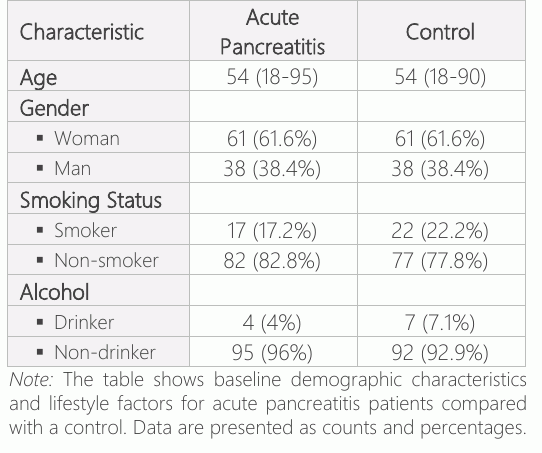
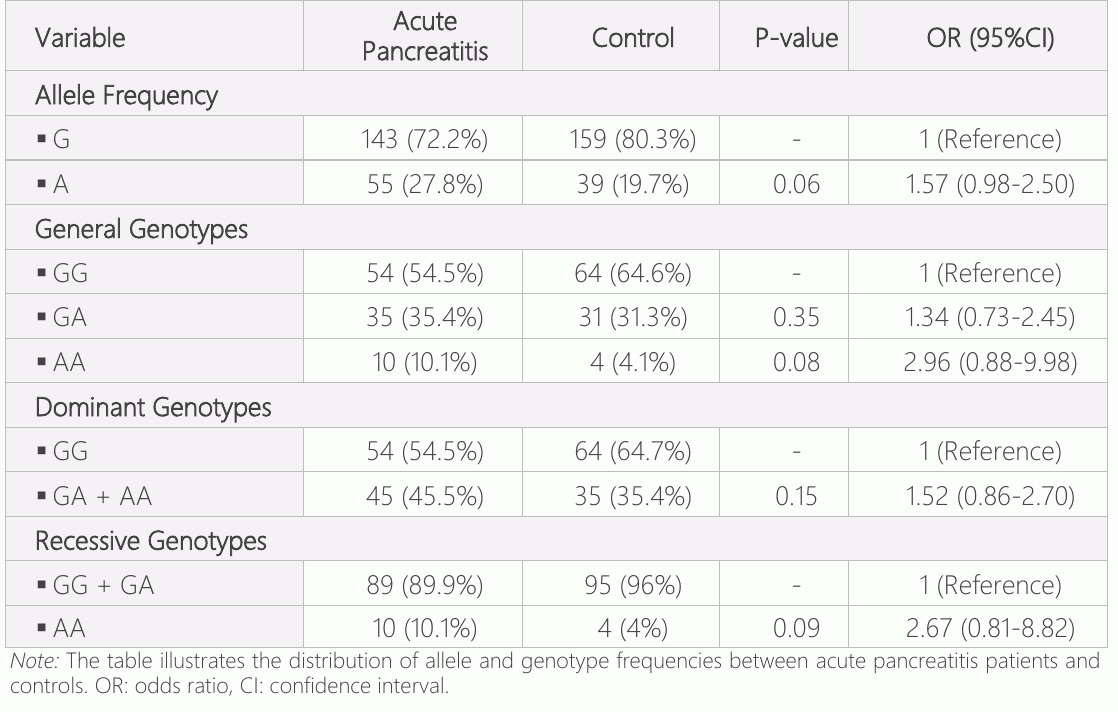
The etiology was as follows: cholelithiasis in 55 (55.6%), unknown in 12 (12.1%), post-ERCP in 11 (11.1%), hyperlipidemia in 9 (9.1%), ductal occlusion in 6 (6.1%), both cholelithiasis and post-ERCP in 3 (3%), drug-related in 2 (2%), and alcohol-related in 1 (1%) patient. Among the participants, 61 (61.6%) were women, and 38 (38.4%) were men, with a mean age of 54 years (18-95). The number of individuals who smoked was 17 (17.2%), and the number of individuals who consumed alcohol was 4 (4%) (Table 1). G allele frequency of the INOS gene rs2297518 polymorphism was 72.2% in the patient group, whereas the G allele frequency was 80.3% in the healthy control group. The A allele frequency was 27.8% in the patient group, compared to 19.7% in the healthy group. When groups were compared for allele frequencies, no difference was observed (p=0.06). Genotype frequency of the INOS gene rs2297518 polymorphism in the patient group was 54.5% for the GG genotype and 10.1% for the AA genotype, whereas in the healthy, the GG genotype frequency was 64.6% and AA genotype frequency was 4.1%. No difference was found between the two groups in terms of genotype frequency (Table 2).
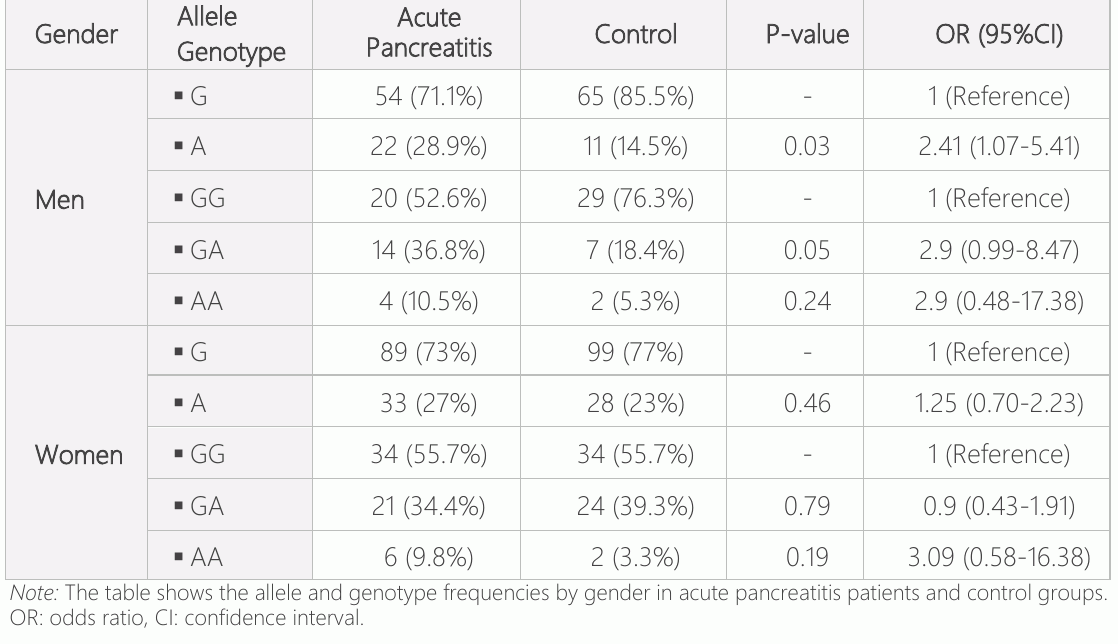
The frequency of alleles and genotypes of the INOS rs2297518 polymorphism according to gender in men who had acute pancreatitis, compared to the control, was higher in those carrying the A allele, and A allele increased the disease risk 2.41 times (p=0.03). GA hetero-zygous genotype increased the risk of disease 2.90 times in men(p=0.05). No other genotypes showed an effect on the risk. In women, the increase in disease risk due to alleles and genotypes was not significant (Table 3).
Discussion
According to the present study, the probability of developing AP may be higher in males carrying the INOS gene rs2297518 A allele and the GA genotype.
Wang Z. et al. reported their findings from a case-control study in the Chinese population, analyzing 299 and 280 sepsis cases in Liaoning and Jiangsu provinces. They found that the INOS gene GA+AA genotype (rs2297518, G>A) was significantly associated with an increased susceptibility to septic shock in sepsis patients studied 13 single-nucleotide changes from 10 genes involved in oxidative stress to explore the relationship between non-Hodgkin lymphoma from Liaoning when compared to the GG genotype. However, this genotype was not linked to disease susceptibility in patients from Jiangsu (14). Wang SS et al. (NHL) and oxidative stress. The study included 1172 NHL patients and 982 healthy controls. INOS gene rs2297518 polymorphism increased the risk of disease by 2.2 times in the AA genotype NHL group, which was significant. It was linked to a 2.1-fold higher risk of B-cell lymphoma. Although the risk was suggested to increase by 3.7 times in T-cell lymphoma, it was not significant. However, individuals with the GA+AA genotype had a 1.8- fold increased risk of T-cell lymphoma. When analyzing NHL subtypes and INOS rs2297518 polymorphism, the AA genotype raised the disease risk by 3.3 times in diffuse large B-cell lymphoma. In follicular lymphoma, the risk of disease was found to be 2.6 times higher in those with the AA genotype compared to those with the GG+GA genotype (15).
Dhillon S.S. et al examined the relationship between INOSpolymorphism and inflammatory bowel disease in their meta-analysis. In their analysis, 159 very early-onset inflammatory bowel disease (VEO-IBD) (91 Crohn’s and 68 ulcerative colitis) and 913 healthy individuals diagnosed under the age of 10 according to the Montreal classification Paris modification were included in the first study and 17 INOS gene polymorphisms were studied. rs2297518 and rs1137933 polymorphisms in VEO-IBD patients were significant compared to the control. rs2297518 polymorphism was associated with diffuse pancolitis in IBD patients under 6 years of age. The second study included 153 VEO-IBD patients and 480 healthy individuals. The INOS rs2297518 polymorphism was significant in VEO-IBD patients compared to the healthy group. In the third study, 498 patients with IBD (351 Crohn and 147 ulcerative colitis) aged 11-17 years and 918 patients with IBD (419 Crohn’s and 499 ulcerative colitis) patients over 17 years of age were included in the study. INOS rs2297518 polymorphism was significant in ulcerative colitis patients aged 11-17 years (10).
Jiang J et al. explored the predisposition of children with Henoch-Schönlein purpura (HSP) to develop HSP nephritis (HSPN) within the Chinese Han population. The study involved 532 healthy and 513 children diagnosed with HSP. The investigation focused on a penta-nucleotide repeat (CCTTT)n in the INOS gene promoter and 10 functional single-nucleotide polymorphisms (SNPs). The results suggested a nominal association between the allelic and genotypic frequencies of the rs3729508 polymorphism and susceptibility to the HSP. Furthermore, a significant difference was found in the distribution of the INOS gene (CCTTT) 12 repeat and rs2297518 alleles between children with HSP who developed nephritis and those who did not. Specifically, children with nephritis had significantly higher occurrences of the 12- repeat (CCTTT) and one allele of rs2297518 compared to those without nephritis (16).
Ozhan G et al. investigated the relationship between the INOS gene and acute pancreatitis. The study included 93 individuals diagnosed with acute pancreatitis and 60 healthy controls. The INOS gene rs2297518 polymorphism was found to be notably associated with the patient group in comparison to the healthy. It was reported that the presence of the rs2297518 G>A variant increased the risk of the disease by 2.88 times. Interestingly, no rs2297518 GG genotype was detected in the control group. Consequently, the researchers suggested that the rs2297518 polymorphism in the INOS might act as a biomarker for acute pancreatitis (11). No significant correlation was found between disease severity and rs2297518 polymorphism genotypes (GG, GA, AA). However, a significant correlation was found between disease severity and CRP, albumin and neutrophil/lymphocyte ratio (p<0.0001, p<0.001, p=0.017, respectively). NO, generated through INOS expression, contributes to inflammatory process. Auto-immunity, tumor development and increases the severity of inflammatory diseases. Although the relationship between the development of acute pancreatitis and INOS polymorphism was not significant, those with A allele and GA genotype in males increased the risk of the disease. In studies conducted in different populations for different types of disease those carrying INOS gene polymorphism A allele have a higher risk of disease (10, 14–18).
Our most important limitation was the small number. INOS polymorphism A allies may be a risk factor for AP in women if the number of patients would increase. In our study, it was not noted at what time the patients applied to the hospital after abdominal pain started. The earlier the admission to the hospital, the less the severity and complications of AP.
Conclusion
Males with INOS rs2297518 polymorphism A allele and GA genotype was identified as a risk factor for AP. Males with AP carrying this gene polymorphism should be followed closely.
Declarations
- Author contributions (CRediT)
- All authors contributed equally to all 14 CRediT roles (Conceptualization, Data curation, Formal analysis, Funding acquisition, Investigation, Methodology, Project administration, Resources, Software, Supervision, Validation, Visualization, Writing – original draft, Writing – review & editing).
- Funding
-
Funding information was not reported in the published version of this article.
- Conflicts of interest
- A conflict of interest statement was not reported in the published version of this article.
- Ethics approval
- University Ethics Committee approval was obtained for the study (Decision date: February 26/15; Decision:24).
- Data availability
- A data availability statement was not reported in the published version of this article.
References (18)
14 of 18 references are linked to their DOI.
- Yadav D and Lowenfels AB. Trends in the epidemiology of the first attack of acute pancreatitis: a systematic review. Pancreas 2006; 33:323-330. DOI Crossref PubMed Google Scholar
- Banks PA, Bollen TL, Dervenis C et al. Classification of acute pancreatitis 2012: revision of Atlanta classifi cation and definitions by international consensus. Gut 2013; 62:102–11. DOI Crossref PubMed Google Scholar
- Cruz-Santamaria DM, Taxonera C, Giner M. Update on pathogenesis and clinical management of acute pancreatitis. World journel of Gastrointest Pathophysiol 2012; 3:60-70 DOI Crossref PubMed Google Scholar
- Szabo C.alterations in Nitric Oxide Production in Various Forms of Circulatory Shock. New. Horiz,3:2-32,1995. PubMed Google Scholar
- Yang G Y, Taboada S, Liao J. Induced nitric oxide synthase as a major player in the oncogenic transformation of inflamed tissue. Methods Mol. Biol.2009; 512:119-56. DOI Crossref PubMed Google Scholar
- Li H and Forstermenn U. Nitric oxide in the pathogenesis of vascular disease. The Journal Pathology. 2000; 190:244-254. DOI Crossref PubMed Google Scholar
- ncbi.nlm.nih.gov/projects/SNP/snp_ref.cgi?rs=2297518 PubMed Google Scholar
- Mannick EE, Bravo LE, Zarama G et al. Inducible nitric oxide synthase, nitrotyrosine, and apoptosis in Helicobacter pylori gastritis: effect of antibiotics and antioxidants. Cancer Res 1996; 56:3238– 43. PubMed Google Scholar
- Wee A, Kang JY, Teh M. Helicobacter pylori and gastric cancer: correlation with gastritis, intestinal metaplasia, and tumour histology. Gut 1992; 33:1029–32. DOI Crossref PubMed Google Scholar
- Dhillon SS, Mastropaolo LA, Murchie R, et al. Higher activity of the inducible nitric oxide synthase contributes to very early onset inflammatory bowel disease. Clin Transl Gastroenterol 2014;5:e46. DOI Crossref PubMed Google Scholar
- Özhan G, Sari FM, Vefai M, et al. Acute pancreatitis is associated with Ser608Leu INOS polymorphism. Folia Biol (Praha). 2012;58:256-60. DOI Crossref PubMed Google Scholar
- https://www.thermofisher.com/order/genomedatabase/bro wse/genotyping/keyword/rs2297518?ICID=uc-snp-rs2297518. PubMed Google Scholar
- Morris T, Robertson B, Gallagher M. Rapid reverse transcription-PCR detection of hepatitis C virus RNA in serum by using the TaqMan fluorogenic detection system. J. Clin. Microbiol. 1996; 34:2933-2936. DOI Crossref PubMed Google Scholar
- Wang Z, Feng K, Yue M, Lu X, et al. A non- synonymous SNP in the NOS2 associated with septic shock in patients with sepsis in Chinese populations. Hum Genet. 2013; 132:337-46. DOI Crossref PubMed Google Scholar
- Wang SS, Davis S, Cerhan JR, et al. Polymorphisms in oxidative stress genes and risk for non-Hodgkin lymphoma. Carcinogenesis. 2006; 27:1828-34. DOI Crossref PubMed Google Scholar
- Jiang J, Duan W, Shang X, et al. Inducible nitric oxide synthase gene polymorphisms are associated with a risk of nephritis in Henoch-Schönlein purpura children. Eur J Pediatr. 2017 Aug;176(8):1035-1045. doi: 10.1007/s00431 -017-2945-5. DOI Crossref PubMed Google Scholar
- Montesanto A, Crocco P, et al. Common polymorphisms in nitric oxide synthase (NOS) genes influence quality of aging and longevity in humans. Biogerontology. 2013; 14:177-86. DOI Crossref PubMed Google Scholar
- Ryk C, Wiklund NP, Nyberg T, De Verdier PJ. Ser608Leu polymorphisms in the nitric oxide synthase-2 gene may influence urinary bladder cancer pathogenesis. Scand J Urol Nephrol.2011;45:319-25. DOI Crossref PubMed Google Scholar
Respond to this article
Comments on a published article are welcome as a Letter to the Editor.
Get an e-mail when new articles in your fields are published
Questions to the authors
Questions are moderated: an editor approves each question, the authors answer, and an editor approves the answer before both appear here.
No answered questions yet.
Ask the authors a question
Discussion
Comments are moderated: they appear after the writer confirms the e-mail address and an editor approves them. Each comment carries a conflict-of-interest statement.
No comments yet.
Write a comment
Read the full text
Open the PDF here
Loading the PDF…
If the PDF does not show here, use the download button above.
How to cite this article
Ay N, Uskudar O, Akgollu E. INOS Gene Rs2297518 Polymorphism Increases Risk in Male Patients with Acute Pancreatitis. Ulutas Med J. 2024;10(3):53-58. doi:10.5455/umj.20240827031744
Ay, N., Uskudar, O., & Akgollu, E. (2024). INOS Gene Rs2297518 Polymorphism Increases Risk in Male Patients with Acute Pancreatitis. The Ulutas Medical Journal, 10(3), 53–58. https://doi.org/10.5455/umj.20240827031744
Ay, N., Uskudar, O. and Akgollu, E. (2024) 'INOS Gene Rs2297518 Polymorphism Increases Risk in Male Patients with Acute Pancreatitis', The Ulutas Medical Journal, 10(3), pp. 53–58. doi: 10.5455/umj.20240827031744.