The Ulutas Medical Journal · ISSN 2149-0430 (print), 2149-388X (online) · https://www.ulutasmedicaljournal.com/?mno=287331
Case Report · Open access
Acute Inferolateral Myocardial Infarction Due to Electrical Injury
Also available in: العربية · Türkçe · 中文
Abstract
- Background
- Electrical injuries are relatively infrequent but carry high morbidity and mortality. The spectrum of the injuries is wide, ranging from minimal injuries to life-threatening internal organ damage and death. The heart is one of the organs of the human body most susceptible to damage by electrical injury. Arrhythmias, conduction disturbances, and myocardial infarction are among the complications encountered in populations of patients with electrical injuries.
- Case Presentation
- Herein we present a case of acute inferolateral myocardial infarction after a high-voltage electrical injury.
Keywords
Full text
Introduction
Although electrical injuries are relatively uncommon, it causes significant morbidity and mortality. Electrical injuries are traditionally classified as high voltage (>1000 V) and low voltage (<1000 V) exposures. The most susceptible organ to electrical injuries is the heart. Low voltage current usually causes ventricular fibrillation, whereas high voltage current usually causes asystole. Myocardial infarction (MI) is a rare complication of electrical exposure and its pathogenesis remains a matter of discussion. In this article, we report a case of inferolateral MI after high-voltage electrical exposure.
Case Presentation
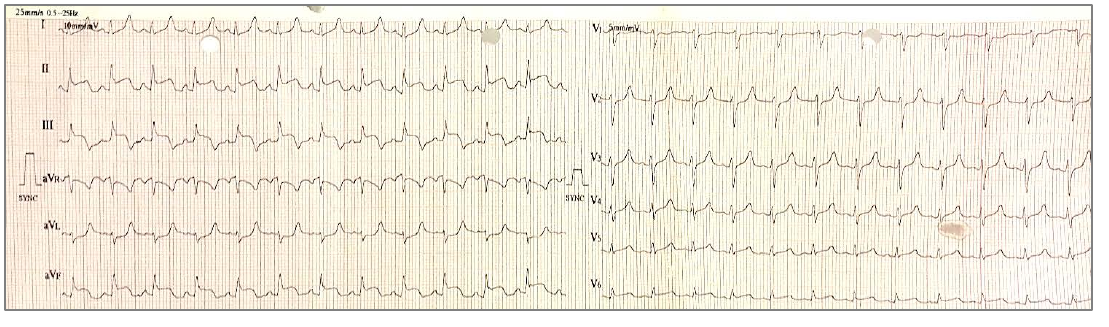
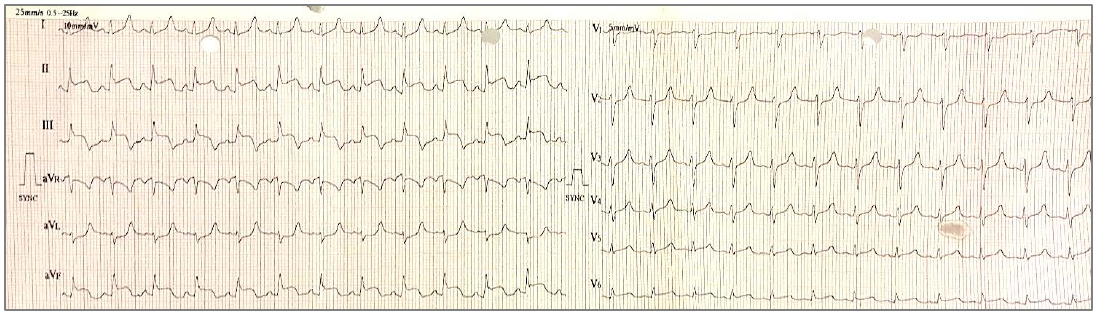
28-years male was admitted to emergency following high voltage electrical exposure. On examination, he was confused with a blood pressure of 160/100 mmHg. There was a burn injury on the right ankle. He had right thigh and leg ecchymoses. There was complete paralysis of both arms with a burn of the first degree of left forearm. On presentation his WBC count was 22.28 103/ml, Hb concentration 20g/dl, hct 54%, platelet count 404.103/ml, glucose 102 mg/dl, BUN 21 mg/dl creatinine 1.4 mg/dl, Na 136 mmol/L, K 5.3 mmol/L, CK-MB 353 U/L and cTroponin-I (cTnI) 0.305 ng/ml. His oxygen saturation at room air was 92%. Initial electrocardiogram (ECG) taken at the emergency department showed ST-segment elevation over the lead II, III, aVF, V5 and V6 with reciprocal ST-segment depression in leads I aVL and V1. After an initial examination, the patient was transferred to intensive care unit. Because of persistent ST-elevation, aspirin 300 mg, clopidogrel with 600mg bolus dose, metoprolol 50mg and enoxaparin 2×0.8 cc subcutaneously were given as an initial treatment. Due to circulatory compromise, he went under both arms and right leg fasciotomy in order to decompress the compartments. His coronary angiogram was normal. After 24 hours, blood chemistry analysis showed that cTnI level markedly increased to 15.73 ng/dl. The patient's serum creatinine level increased from 1.4 mg/dl to 2.8 mg/dl over 2 days and he underwent hemodialysis.
The transthoracic echocardiography revealed inferior and lateral wall hypokinesia, with ejection fraction 54%. There were no morphologic abnormalities of heart valves. Twenty-four hours later ECG showed that ST-segment elevations disappeared with a negative T-wave in aVF (Figure-2). Following cardiac stabilization, the patient was transferred to a burn unit.
Discussion
Electrical exposure may cause adverse effects in almost all organs. These adverse events can range from slight symptoms like simple burns, to severe symptoms of ventricular fibrillation and respiratory arrest and death. One organ that is particularly affected by electrical exposure is the heart. Presence of vertical pathway and the magnitude of percent surface burns are the clinical predictors of myocardial damage after high voltage electrical injury (1). Nonspecific ECG changes, prolonged QT-interval, myocardial/valvular rupture, structural changes in coronary arteries, pericardial effusion and arrhythmias may be seen following electrical exposure (2). If the electrical current passes through the heart it can interfere with normal internal electrical activity and induce fatal arrhythmias.
Types of arrhythmias include: premature ventricular contractions, ventricular fibrillation, ventricular tachycardia, atrial tachycardia, atrial fibrillation, complete heart block (3), MI is a rare complication after electrical exposure. Most of these patients have normal coronary arteries at the angiography. Various hypotheses have been proposed for the development of MI after electrical injury. Electrical injury induces endothelial dysfunction through free radical formation (4), it can cause a severe arterial vasospasm from catecholamine release (5). Xenopoulos et al. suggested that thermally or electrically induced vasospasms of the coronary arteries would result in severe myocardial ischemia and MI (6). Myocardial injury due to arrhythmia induced hypotension or as a part of general vascular damage has also been hypothesized as a possible explanation (7). However, coronary artery thrombosis has been detected in a small number of patients (8). It has been suggested that ischemia and necrosis due to electrical injury mostly affect the distribution of the right coronary artery because of its proximity to the anterior chest wall (9). Gursul et al. reported inferior ST elevation MI and atrial fibrillation after an electrical shock (10). The patient had normal coronary arteries at angiogram. Celebi et al. presented a case of MI with normal coronary arteries after an electrical shock. The patient discharged after a hospital stay and had uneventful follow-up at one year later with nonspecific ECG changes (11). Our patient had inferior MI after high voltage electrical current. He had elevated CK, CK-MB and cTnI levels and inferior wall hypokinesia on echocardiography. After 24 hours his ECG returned normal. Since coronary artery spasm was considered as a possible reason, no fibrinolytic therapy was given to the patient.
Conclusion
Infarct after electrical injury is a rare clinical condition. Right coronary artery spasm would constitute the best possible explanation for the mechanism underlying the MI. Since skeletal muscle damage could lead to CK-MB level elevation, measurement of cTnI allows differentiation between skeletal muscle injury and myocardial damage.
Declarations
- Author contributions (CRediT)
- All authors contributed equally to all 14 CRediT roles (Conceptualization, Data curation, Formal analysis, Funding acquisition, Investigation, Methodology, Project administration, Resources, Software, Supervision, Validation, Visualization, Writing – original draft, Writing – review & editing).
- Funding
-
Funding information was not reported in the published version of this article.
- Conflicts of interest
- A conflict of interest statement was not reported in the published version of this article.
- Ethics approval
- Ethics approval details were not reported in the published version of this article.
- Data availability
- A data availability statement was not reported in the published version of this article.
References (11)
9 of 11 references are linked to their DOI.
- Chandra NC, Siu CO, Munster AM. Clinical predictors of myocardial damage after high voltage electrical injury. Crit Care Med. 1990 Mar; 18(3):293-7. DOI Crossref PubMed Google Scholar
- Rangaraj R, Moorthy N, Patil SS, Manjunath C. Brugada-type electrocardiographic pattern induced by electrocution. Indian Pacing Electrophysiol J. 2009;9(1):56-9. PubMed Google Scholar
- Akdemir R, Gunduz H, Erbilen E, Ozer I, Albayrak S, Unlu H, Uyan C. Atrial fibrillation after electrical shock: a case report and review. Emerg Med J 2004; 21(6):744–6. DOI Crossref PubMed Google Scholar
- Oltman CL, Clark CB, Kane NL, Zhang Y, Gutterman DD, Dellsperger KC, Kerber RE. Coronary vascular dysfunction associated with direct current shock injury. Basic Res Cardiol. 2003 Nov;98(6):406-15. DOI Crossref PubMed Google Scholar
- Fish R. Electric shock, part II: nature and mechanisms of injury. Journal of Emergency Medicine. 1993; 11(4):457–62. DOI Crossref PubMed Google Scholar
- Xenopoulos N, Movahed A, Hudson P, Reeves WC. Myocardial injury in electrocution. Am Heart J. 1991 Nov;122(5):1481-4. DOI Crossref PubMed Google Scholar
- Fish R. Electric shock, Part II: Nature and mechanisms of injury. J Emerg Med. 1993 Jul-Aug;11(4):457-62. DOI Crossref PubMed Google Scholar
- Kinney TJ. Myocardial infarction following electrical injury. Ann Emerg Med. 1982;11(11):622-5. DOI Crossref PubMed Google Scholar
- James TN, Riddick L, Embry JH. Cardiac abnormalities demonstrated postmortem in four cases of accidental electrocution and their potential significance relative to nonfatal electrical injuries of the heart. Am Heart J. 1990 Jul;120(1):143-57. DOI Crossref PubMed Google Scholar
- Gursul E, Bayata S, Aksit E, Ugurlu B. Development of ST Elevation Myocardial Infarction and Atrial Fibrillation after an Electrical Injury. Case Rep Emerg Med. 2015;2015:953102. doi: 10.1155/2015/953102. DOI Crossref PubMed Google Scholar
- Celebi A, Gulel O, Cicekcioglu H, Gokaslan S, Kututcularoglu G, Ulusoy V. Myocardial infarction after an electric shock: a rare complication.Cardiol J. 2009;16(4):362-4. PubMed Google Scholar
Respond to this article
Comments on a published article are welcome as a Letter to the Editor.
Get an e-mail when new articles in your fields are published
Questions to the authors
Questions are moderated: an editor approves each question, the authors answer, and an editor approves the answer before both appear here.
No answered questions yet.
Ask the authors a question
Discussion
Comments are moderated: they appear after the writer confirms the e-mail address and an editor approves them. Each comment carries a conflict-of-interest statement.
No comments yet.
Write a comment
Read the full text
Open the PDF here
Loading the PDF…
If the PDF does not show here, use the download button above.
How to cite this article
Yildiz C. Acute Inferolateral Myocardial Infarction Due to Electrical Injury. Ulutas Med J. 2018;4(1):47-49. doi:10.5455/umj.20180104041822
Yildiz, C. (2018). Acute Inferolateral Myocardial Infarction Due to Electrical Injury. The Ulutas Medical Journal, 4(1), 47–49. https://doi.org/10.5455/umj.20180104041822
Yildiz, C. (2018) 'Acute Inferolateral Myocardial Infarction Due to Electrical Injury', The Ulutas Medical Journal, 4(1), pp. 47–49. doi: 10.5455/umj.20180104041822.
@article{umj287331,
  title = {Acute Inferolateral Myocardial Infarction Due to Electrical Injury},
  author = {Yildiz, Cennet},
  journal = {The Ulutas Medical Journal},
  year = {2018},
  volume = {4},
  number = {1},
  pages = {47--49},
  doi = {10.5455/umj.20180104041822},
  url = {https://www.ulutasmedicaljournal.com/?mno=287331},
  issn = {2149-388X}
}