The Ulutas Medical Journal · ISSN 2149-0430 (print), 2149-388X (online) · https://www.ulutasmedicaljournal.com/?mno=83896
Original Article · Open access
Investigation of Port Catheter-Associated Infections in Childhood Acute Leukemia Patients
- Pediatrics and Child Health, Diyarbakır Egil County State Hospital ROR
- Dicle University School of Medicine, Department of Pediatric Infectious Diseases ROR
- Dicle University School of Medicine, Department of Pediatric Hematology and Oncology ROR
Abstract
- Introduction
- Port catheters are essential for optimal and comfortable treatment of hematological malignancy.
- Materials and Methods
- Two hundred and ninety-five patients with acute leukemia were analyzed retrospectively. Eighty-five patients with a port catheter (Group-1) who suffered a total of 151 infection attacks and 80 patients without a port catheter (Group-2) who suffered a total of 107 infection attacks were included in the study.
- Results
- The mean age of the patients was 54.80±33.51 months in Group-1 (n:85) and 80.61±45.42 months in Group-2 (n:80) (p<0.001). The mean duration of the G-CSF requirement was 2.77±4.07 days/attack in Group-1 and 0.86±1.96 days/attack in Group-2. The patients without a port catheter required Granulocyte Colony-Stimulating Factor (G-CSF) for a shorter time during an infection attack (p<0.001). An analysis of the blood cultures taken during infection attacks of Group-1 revealed 23 (15.2%) attacks by Staphylococcus epidermidis and 19 (12.6%) attacks by Staphylococcus hominis as causative agents. In Group-2, nine (8.5%) attacks were caused by Staphylococcus epidermidis, and 5 (4.7%) attacks were caused by Staphylococcus hominis as causative agents. Staphylococcus epidermidis was significantly more common in Group-1 than Group-2 (p<0.001). In Group-1, the Neutrophil/Lymphocyte Ratio (NLR) and Platelet/Lymphocyte Ratio (PLR) showed a significant difference between pre-treatment and post-treatment period of infection attacks (p=0.025, p=0.008).
- Conclusion
- The duration of the use of port catheters may increase the incidence of bloodstream infection, but if appropriate patient care is provided, port catheters can be used safely during the treatment of acute leukemia. Besides, we suggest that CRP, NLR, and PLR values during an infection attack of patients with port catheters provide valuable information about the duration and severity of the infection attack and are useful in clinical follow-up.
Keywords
Full text
Introduction
Leukemias are the most common pediatric cancers in childhood, constituting 25-30% of pediatric cancers. Acute leukemias account for 75-85% of cases (1). Intensive chemotherapy during long-term treatment in acute leukemias is difficult and challenging for patients (2). The discovery of central venous catheters (CVC) facilitates the administration of chemotherapy, antibiotic, blood product, fluids, and parenteral nutrition in children with hematological or oncological diseases. Port catheters are the most common CVC in leukemia patients.
Systemic and local infections due to port catheters' widespread use continue to be an important problem despite all preventive measures (3). Possible infections due to port catheters may lead to discontinuation of treatment protocols, prolonged treatment time, and a delay of treatment.
Diagnosis of catheter-induced bloodstream infection (CIBI) is based on epidemiological, clinical, and laboratory criteria. The Center for Disease Control and Prevention (CDC) has used the term laboratory approved bloodstream infection (LABI) (4). A LABI should meet at least one of the following criteria; 1. Bacterial or fungal pathogen growth that is known to be relevant with one or more blood cultures of the patient and not relevant with an infection in another region.
2. A commensal organism (e.g., coagulase-negative staphylococci) growth in at least two blood cultures of the patient on 2 different days; this organism is not relevant with an infection in another region of the body, and the growth is accompanied either with fever (>38.0°C), chills, or hypotension.
3. Fever, bradycardia, hypothermia, or apnea with the above clinical signs in patients who are 1 year old or younger.
The presence of at least one of the LABI criteria within 2 or more consecutive days in a patient with a central venous catheter suggests that the primary infection is catheter-induced (4, 5). In our study, a retrospective evaluation of catheter-induced bloodstream infections was performed in patients who were under follow-up for acute leukemia and who used a port catheter as a vascular access device. The aim of our study was to compare the pooled data with those of patients without a port catheter and other studies in this field and to determine the incidence of bacteremia, a significant complication of port catheters.
Materials and Methods
We retrospectively analyzed the medical records of 295 patients with acute leukemia who were under follow-up at Dicle University Faculty of Medicine, Department of Pediatric Hematology and Oncology between 2012- 2019. We excluded 41 patients who continued their treatment at another center after diagnosis, 34 patients whose data could not be accessed or were found to be inadequate for our study, 18 patients who died before acute leukemia treatment was completed, 21 patients without catheter-induced infection despite having a port catheter in place, and 16 patients who did not have an infection attack with an unknown etiological agent and who did not use a port catheter.
Eighty-five patients with a port catheter (Group- 1) who suffered a total of 151 infection attacks and 80 patients without a port catheter (Group- 2) who suffered a total of 107 infection attacks, making a total of 165 patients with a total of 258 infection attacks were included in the study. Several patients had more than one infection attacks at different times in both groups.
Infection attacks meeting CDC's LABI criteria and infection attacks without an identifiable focus were included in our study. The patients' demographic characteristics (age, sex), medical history, and laboratory assays (C-reactive protein (CRP), peripheral blood cultures, catheter blood cultures, catheter tip cultures, culture antibiograms) were screened from the patient files. Blood cultures were studied with an automated system (BACTEC) in the microbiology laboratory.
All routine care and interventions for port catheters were carried out by nurses experienced in the use of port catheters to prevent contamination. All port catheters are locked with heparin when not in use. In those not used for a long time, the catheter was washed once a month and locked again.
The study was conducted in compliance with the criteria of the Declaration of Helsinki and approved by the Institutional Ethics Committee of Dicle University (Date: 02.10.2019, No: 205).
Data Analysis
Statistical Package for the Social Science (SPSS) version 21.0 for Windows statistical package program was used for the statistical analyses of our study data. Quantitative variables were presented as mean ± standard deviation (SD), and categorical variables with number and percentage (%). The suitability of variables to normal distribution was tested with Kolmogorov-Smirnov test. The Student's t-test was used to compare the two groups with respect to variables meeting the criteria of normal distribution. Mann-Whitney-U Test was used to compare the two groups with respect to variables not meeting the criteria of normal distribution. Spearman's correlation test was used to perform the correlation analyses between the two groups with respect to variables not meeting the criteria of normal distribution. Chi-square (χ2) test was used to compare qualitative variables. Hypotheses were evaluated bilaterally, and p≤0.05 was accepted statistically significant.
Results
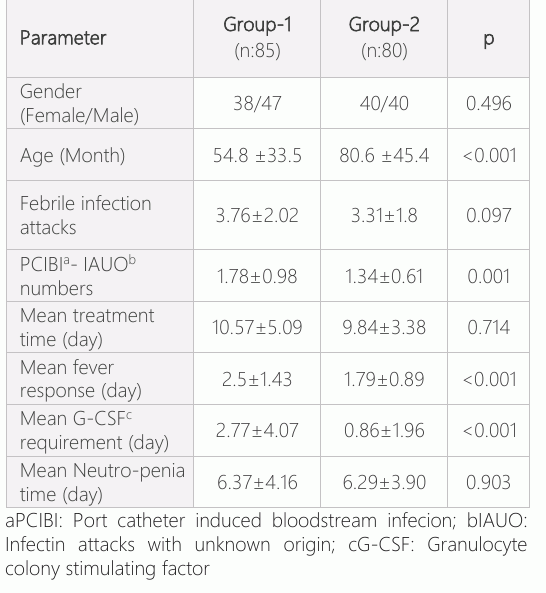
The mean age was 54.80±33.51 months (min. 15, max. 179) in Group-1 (n:85) and 80.61±45.42 months (min. 12, max. 212) in Group-2 (n:80) (p<0.001). In Group-1, 47 (55.3%) patients were male and 38 (44.7%) were female; 40 (50%) patients in Group-2 (n:80) were male and 40 (50%) patients were female (p>0.05).
A comparison of port catheter-induced blood stream infection (PCIBI) attacks in Group-1 and infection attacks with unknown origin (IAUO) in Group-2showed a mean of 1.78±0.98 attacks /patient in Group-1 and 1.34±0.61 attacks/patient in Group-2, with the mean number of infection attacks being significantly greater in Group-1 (p=0.01).
The time to fever response to treatment was 2.5±1.43 days/attack in Group-1, and 1.79±0.89 days/attack in Group-2, indicating that the patients in Group-2 responded to empirical antimicrobial treatment more rapidly (p<0.01). An analysis of the mean duration of the requirement of granulocyte colony-stimulating factor (G-CSF) per attack showed that the mean duration of G-CSF requirement was 2.77±4.07 days/attack in Group-1 and 0.86±1.96 days/attack in Group-2, indicating that the patients without port catheters required G-CSF for a significantly shorter duration during infection attack (p<0.01). The comparison of Group-1 and Group-2 was shown in Table 1.
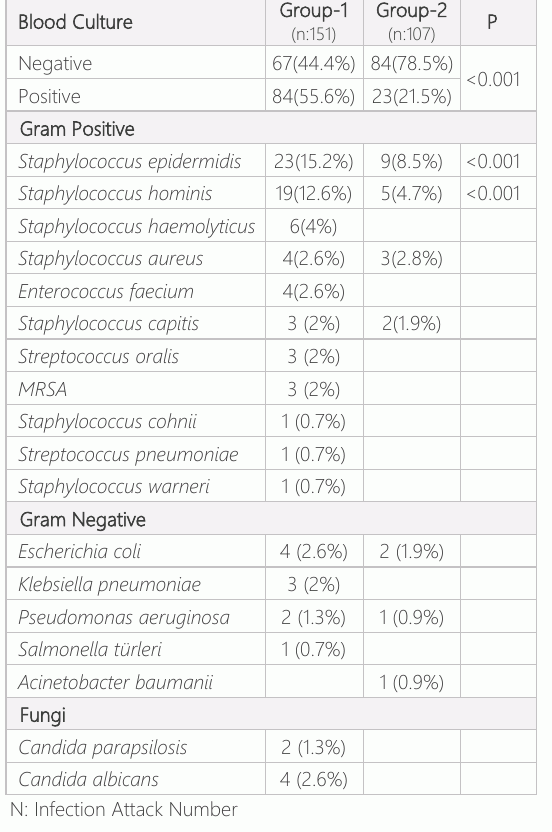
According to a comparison of the infection attacks of the groups by blood culture growth, the two groups showed a significant difference regarding the culture growth results (p<0.01). An analysis of the blood cultures taken during infection attacks of Group-1 showed that 23 (15.2%) attacks were due to Staphylococcus epidermidis, and 19 (12.6%) attacks were caused by Staphylococcus hominis as common agents. In Group-2, 9 (8.5%) attacks were caused by Staphylococcus epidermidis, and 5(4.7%) attacks were due to Staphylococcushominis as common agents. There was more growth in Group-1 compared with Group-2; also, Staphylococcus epidermidis grew significantly more commonly in Group-1than Group-2(p<0.01).Table-2 shows the other agents' growth in blood cultures during infection attacks on.
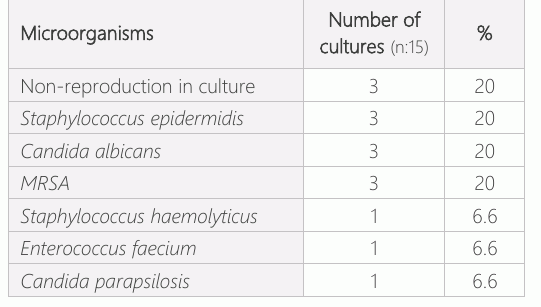
Since there was no response to antimicrobial therapy in 15 PCIBI attacks in Group-1, the port catheter was removed, and a catheter tip culture was sent. No growth was oberved in 3 port catheter tip cultures; there were 3 (20%) attacks due to Staphylococcus epidermidis as the isolated agent, 3(20%) attacks due to Candida albicans, 3(20%) attacks due to Meticillin-Resistant Staphylococcus aureus, 1(6.6%) attacks due to Staphylococcus haemolyticus, 1(6.6%) attack due to Entero coccus faecium, and 1 (6.6%) attack due to Candida parapsilosis (Table 3). However, the revision of the port catheter due to infection was not required in the other 136 PCIBI attacks in Group-1, and the infection was successfully treated while the catheter was in place.
A comparison of the laboratory parameters of Group-1 between the pre-treatment and post-treatment periods of infection attacks revealed significant differences regarding white blood cell count (WBC), hemoglobin (HGB), platelet count (PLT), absolute neutrophil count (ANC), lymphocyte count(LYM), C-reactive protein (CRP), Neutrophil/Lymphocyte ratio (NLR), and Platelet/Lymphocyte ratio (PLR) (p<0.001, p=0.003, p<0.001, p<0.001, p<0.001, p<0.001, p=0.025, p=0.008, respectively). Significant differences were found between the pre-treatment and post-treatment values of WBC, PLT, ANC, LYM, and CRP in Group 2 (p<0.001, p<0.001, p=0.006, p<0.001, p<0.001, respectively) (Table 4).
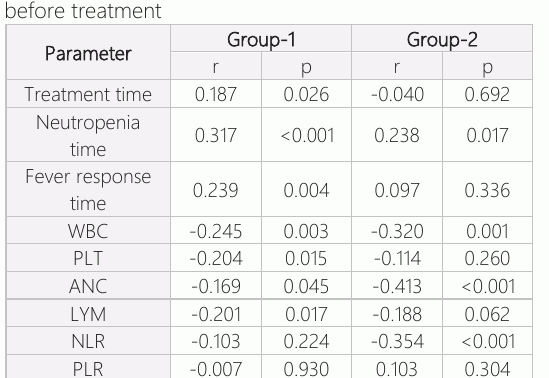


An analysis of the relationship between CRP value and other parameters before the initiation of antibiotic treatment showed a positive correlation between CRP and neutropenia duration and a negative correlation between WBC and ANC in both groups. The correlation
Discussion
Port catheter-induced bloodstream infections may delay chemotherapy, hospitalization, lead to recurrent hospitalizations, and repeated surgical interventions for catheter revision in patients with cancer (4, 5). A prolonged treatment period in leukemia patients leads to the frequent use of peripheral veins for vascular access, resulting in vascular injuries. Since peripheral venous access is more difficult in younger patients, port catheters are used more frequently in younger age groups (3, 6). The incidence of catheter-induced infection is lower with port catheters compared with other central venous catheters (7, 8). The incidence of port catheter-induced bloodstream infections is expressed as the number of infection attacks per 1000 catheter days.
Sarper et al. reported an infection incidence of 2.46 attacks/1000 catheter days in 31 patients with haemato-oncological malignancies using port catheter was while Pektaş et al. reported an (3, 9) incidence of 2.6 attacks/1000 catheter days In a study performed by Miliaraki et al., 40 CIBI attacks were evaluated, and an infection incidence of 2.62 attacks per 1000 catheter days was reported (10). In line with the literature, our study showed an infection incidence of 3.04 attacks/1000 catheter days.
Microbiological documentation of infection attacks is not always possible in patients with a port catheter. Whether these attacks are caused by a port catheter is determined by specific definitions (11, 12). In our study, a comparison of the PCIBI attacks in Group-1 and the IAUO attacks in Group-2 were compared after excluding infection attacks with a known focus revealed 1.78±0.98 PCIBI attacks per patient in Group-1 and 1.34±0.61 IAUO attacks per patient in Group-2. Our patients without port catheters experienced significantly fewer IAUO attacks compared with PCIBI attacks in patients with port catheters. This suggests that the incidence of bacteremia increases in patients using totally implantable port catheters.
After the empirical treatment was initiated, a positive fever response to treatment was considered as having a body temperature below 38.5°C for at least 24 hours without the need for revision of the antimicrobial treatment (111) . In our study, the time to fever response to treatment was 2.5±1.43 days in Group-1 and 1.79±0.89 days in Group-2. The analysis of the duration of antimicrobial treatment showed no significant difference between the treatment duration of patients with or without a port catheter. Sarper et al. reported that the time to treatment response and the duration of the febrile period did not change significantly in patients with a port catheter; however, to the contrary, our study showed that fever response to antimicrobial therapy occurred in a shorter time in the patients without a port catheter. Sarper et al. reported that the patients with a port catheter remained in neutropenia for approximately 9.6 days and patients without a port catheter for approximately 7.4 days (9). We found that most of the patients in our study groups were neutropenic during the attacks. The mean duration of neutropenia during an infection attack was 6.37±4.16 days per attack in Group-1 and 6.29±3.90 days per attack in Group-2. Our study suggests that the use of port catheters do not significantly increase the duration of neutropenia during infection attacks. Pektaş et al. reported that the mean number of days lived with a port in place was 375.1±340.1 days in acute leukemia; Sarper et al. reported a corresponding duration of 185 days (3, 9). Our patients had port catheters in place for a longer period (mean 584.24 ± 361.16 days), while the number of infection attacks per 1000 days was similar with both of the above-mentioned studies.
Several studies have shown that pathogens responsible for CIBIs are coagulase-negative staphylococci (Staphylococcus epidermidis, Staphylococcus hominis) and enterobacteria (12, 13). In addition, Walz et al. showed that candida species are also common agents causing CIBIs, especially in patients with malignancies(14). In their surveillance study on pediatric cancer patients, Simon et al. reported that the most common Gram-negative agents causing CIBI were Escherichia coli and Pseudomonas aeruginosa (15). In line with the literature, our study showed Staphylococcus epidermidis and Staphylococcus hominis were the most common isolated agents in infection attacks (responsible for 41% of total attacks in both groups). Pektaş et al. reported that the port catheter needed to be removed to improve the clinical signs of infection in 9 (18.7%) of 48 patients (3). The catheters of 15 (17.5%) patients were removed due to port catheter-induced infection, while the other patients received medical treatment without removing the port catheter. In line with the literature, our data showed that the catheter should be removed, and the treatment should be continued if catheter infection proves resistant to optimal treatment.
White blood cells, neutrophils, and their subtypes are among the markers of systemic inflammation in the body (16). Proportional changes occur in the amount of circulating white blood cells during the inflammatory response in the body. As the number of white blood cells increases, the number of neutrophils increases while there occurs a relative decrease in lymphocytes. NLR is a simple, cost-effective technique calculated by proportioning the number of neutrophils and to the number of lymphocytes in full blood count. NLR generally increases in response to inflammation and infection (17, 18). Neutropenic inflammations are commonly observed in patients with acute leukemia since primary diagnoses of patients with port catheters are related to bone marrow, and chemotherapy suppresses bone marrow (19). Our literature review failed to find any study that examined the relationship between NLR, port catheter-induced infections, and infection attacks in acute leukemia patients. As far as we know, our study is the first to study this relationship. We found that the post-treatment NLR and PLR values were significantly lower compared with the pre-treatment values in Group-1.
In most diseases, CRP is used as an acute phase reactant to evaluate treatment response in patients with clinical signs of infection. Our study found that the pre-treatment and post-treatment CRP values were significantly lower in both Group-1 and Group-2 as expected; thus, CRP was considered a parameter indicating treatment response. An analysis of the relationship between the pre-treatment values of CRP and other parameters in Group-1 demonstrated a positive significant correlation between higher pre-treatment CRP levels, the mean duration of antimicrobial treatment for infection attacks, mean time to fever response, and neutropenia rate time during the attacks.
Conclusion
Staphylococcus epidermidis and hominis bacteria are the most common isolated agents in port catheter infections; therefore, empirical treatment should be directed to these agents. We think that the duration of the use of port catheters may increase the incidence of bloodstream infection, but if appropriate patient care is provided, port catheters can be used safely during the treatment of acute leukemia. Besides, we suggest that in patients with port catheters, CRP, NLR, and PLR values during an infection attack provide valuable information about the duration and severity of the attack and are useful in clinical follow-up.
Declarations
- Author contributions (CRediT)
- All authors contributed equally to all 14 CRediT roles (Conceptualization, Data curation, Formal analysis, Funding acquisition, Investigation, Methodology, Project administration, Resources, Software, Supervision, Validation, Visualization, Writing – original draft, Writing – review & editing).
- Funding
-
Funding information was not reported in the published version of this article.
- Conflicts of interest
- The authors declared no conflict of interest for the present article No financial benefits have been received or will be received from any party related directly or indirectly to the subject.
- Ethics approval
- The study was conducted in compliance with the criteria of the Declaration of Helsinki and approved by the Institutional Ethics Committee of Dicle University (Date: 02.10.2019, No: 205).
- Data availability
- A data availability statement was not reported in the published version of this article.
References (19)
15 of 19 references are linked to their DOI.
- Spector L, Ross J. Epidemiology and etiology: in Pui CH ed. Childhood Leukemias 2nd ed. Cambridge. Cambridge University Press. 2006;48-66 DOI Crossref PubMed Google Scholar
- Seiter K. Acute Lymphoblastic Leukemia [İnternet]. 2019 [a.yer 20 Haziran 2019]. Erişim adresi: https://emedicine.medscape. com/article/207631 156 77 Port Catheter Associated Infections Darakci et al. PubMed Google Scholar
- Pektaş A, Kara A. Cohort Study: Central Venous Catheter-Related Complications in Children with Hematologic Diseases at a Single Center. Tjh. 05 Haziran 2015;32(2):144-51 DOI Crossref PubMed Google Scholar
- Coco I, Casale F, Indolfi P. Infections from CVC in the pediatric neoplastic patient. Single institution experience. Minerva Pediatr. Ağustos 2012;64(4):385-94 PubMed Google Scholar
- Cecinati V, Brescia L, Tagliaferri L, Giordano P, Esposito S. Catheter-related infections in pediatric patients with cancer. Eur J Clin Microbiol Infect Dis. Kasım 2012;31(11):2869-77 DOI Crossref PubMed Google Scholar
- Ares G, Hunter CJ. Central venous access in children: indications, devices, and risks. Current Opinion in Pediatrics. Haziran 2017;29(3):340-6 DOI Crossref PubMed Google Scholar
- Crnich CJ, Maki DG. The promise of novel technology for the prevention of intravascular device-related bloodstream infection. II. Long-term devices. Clin Infect Dis. 15 Mayıs 2002;34(10):1362-8 DOI Crossref PubMed Google Scholar
- Henderson D. Infections due to percutaneous intravascular devices. İçinde: Mandell G, Bennet J, Dolin R, editörler. Principles and Practice of Infectious Diseases,. 5. bs Philadelphia; 2000 PubMed Google Scholar
- Sarper N, Zengin E, Çorapçioglu F, Tugay M. Totally implantable central venous access devices in children with hemato-oncologic malignancies: Evaluation of Complications and Comparison of Incidence of Febrile Episodes with Similar Patients Without Central Venous Access Devices. Pediatric Hematology and Oncology. Ocak 2006;23(6):459-70 DOI Crossref PubMed Google Scholar
- Miliaraki M, Katzilakis N, Chranioti I, Stratigaki M, Koutsaki M, Psarrou M, vd. Central line-associated bloodstream infection in childhood malignancy: Single-center experience. Pediatrics International. Temmuz 2017;59(7):769-75 DOI Crossref PubMed Google Scholar
- Centers for Disease Control and Prevention (CDC). Vital signs: central line-associated blood stream infections--United States, 2001, 2008, and 2009. MMWR Morb Mortal Wkly Rep. 04 Mart 2011;60(8):243-8 DOI Crossref PubMed Google Scholar
- Tsai H-C, Huang L-M, Chang L-Y, Lee P-I, Chen J-M, Shao P-L, vd. Central venous catheter-associated bloodstream infections in pediatric hematology-oncology patients and effectiveness of antimicrobial lock therapy. J Microbiol Immunol Infect. Aralık 2015;48(6):639-46 DOI Crossref PubMed Google Scholar
- Adler A, Yaniv I, Solter E, Freud E, Samra Z, Stein J, vd. Catheter-associated bloodstream infections in pediatric hematology-oncology patients: factors associated with catheter removal and recurrence. J Pediatr Hematol Oncol. Ocak 2006;28(1):23-8 PubMed Google Scholar
- Walz JM, Memtsoudis SG, Heard SO. Prevention of central venous catheter bloodstream infections. J Intensive Care Med. Haziran 2010;25(3):131-8 DOI Crossref PubMed Google Scholar
- Simon A, Furtwängler R, Graf N, Laws HJ, Voigt S, Piening B, vd. Surveillance of bloodstream infections in pediatric cancer centers – what have we learned and how do we move on? GMS Hyg Infect Control [İnternet]. 12 Mayıs 2016 [a.yer 20 Aralık 2019];11. Erişim adresi: 10.3205/dgkh000271 DOI Crossref PubMed Google Scholar
- Zahorec R. Ratio of neutrophil to lymphocyte counts--rapid and simple parameter of systemic inflammation and stress in critically ill. Bratisl Lek Listy. 2001;102(1):5-14 DOI Crossref PubMed Google Scholar
- Imtiaz F, Shafique K, Mirza SS, Ayoob Z, Vart P, Rao S. Neutrophil lymphocyte ratio as a measure of systemic inflammation in prevalent chronic diseases in Asian population. Int Arch Med. 26 Ocak 2012;5:2 DOI Crossref PubMed Google Scholar
- Gao Y, Wang W-J, Zhi Q, Shen M, Jiang M, Bian X, vd. Neutrophil/lymphocyte ratio is a more sensitive systemic inflammatory response biomarker than platelet/lymphocyte ratio in the prognosis evaluation of unresectable pancreatic cancer. Oncotarget. 27 Eylül 2017;8(51):88835-44 DOI Crossref PubMed Google Scholar
- Vioral AN, Wentley D. Managing oncology neutropenia and sepsis in the intensive care unit. Crit Care Nurs Q. Haziran 2015;38(2):165-74 DOI Crossref PubMed Google Scholar
Read the full text
Open the PDF here
Loading the PDF…
If the PDF does not show here, use the download button above.
How to cite this article
Darakci SM, Yilmaz K, Uzel VH, Soker M. Investigation of Port Catheter-Associated Infections in Childhood Acute Leukemia Patients. Ulutas Med J. 2021;7(3):149-156. doi:10.5455/umj.20210526071647
Darakci, S. M., Yilmaz, K., Uzel, V. H., & Soker, M. (2021). Investigation of Port Catheter-Associated Infections in Childhood Acute Leukemia Patients. The Ulutas Medical Journal, 7(3), 149–156. https://doi.org/10.5455/umj.20210526071647
Darakci, S.M. et al. (2021) 'Investigation of Port Catheter-Associated Infections in Childhood Acute Leukemia Patients', The Ulutas Medical Journal, 7(3), pp. 149–156. doi: 10.5455/umj.20210526071647.