The Ulutas Medical Journal · ISSN 2149-0430 (print), 2149-388X (online) · https://www.ulutasmedicaljournal.com/?mno=209909
Letter to the Editor · Open access
Letter to the Editor: Cavitary Pulmonary Aspergillosis in Heart Transplantation Recipient
Also available in: العربية · Türkçe · 中文
- Department of Surgery, Chi Mei Medical Center, Tainan, Taiwan ROR
- Department of Intensive Care Medicine, Chi Mei Medical Center, Liouying, Tainan, Taiwan ROR
Abstract
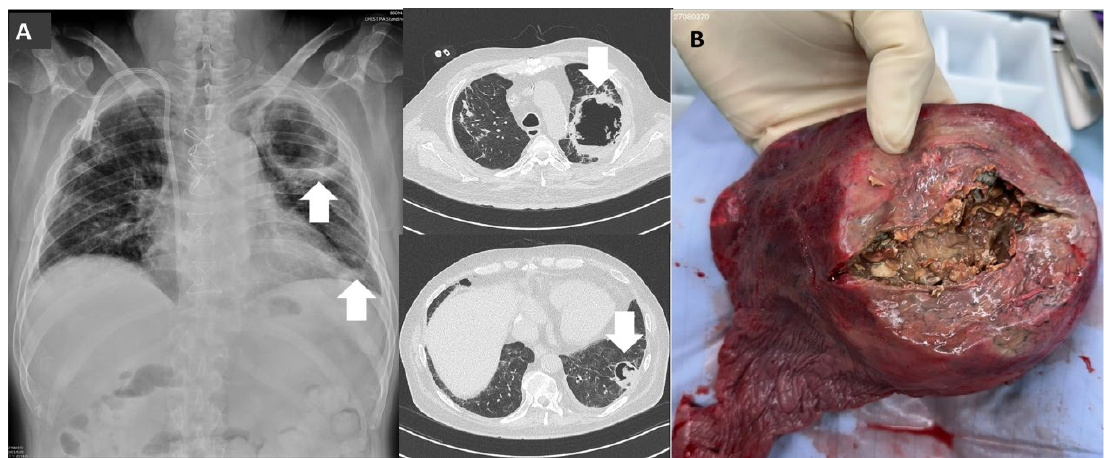
A 53-year-old male, a heart transplantation recipient for dilated cardiomyopathy under immunosuppressants and with a history of diabetes mellitus, presented with a productive cough and chest pain for days. Additionally, he had a low-grade fever and progressive dyspnea. Chest imaging revealed multiple cavitary lesions, the largest being 8.8 x 6.4 cm over the left upper lobe (Figure 1A, arrows), indicative of fungal infections. Microbiological analysis detected Aspergillus fumigatus in sputum, alongside elevated galactomannan optical density index levels in bronchoalveolar fluid (18) and serum (3.7). Voriconazole was administered, and surgical resection of the large cavity (Figure 1B) was performed, confirming cavitary pulmonary aspergillosis upon histopathological examination. Despite antifungal therapy, the patient's condition deteriorated, resulting in death two weeks later. This case highlights the challenging management of cavitary pulmonary aspergillosis in immunocompromised patients, particularly in the context of heart transplantation and diabetes mellitus. Despite aggressive antifungal therapy and surgical intervention, the poor prognosis underscores the need for early detection and targeted treatment strategies in complex clinical scenarios.
Keywords
Full text
Dear Editor, A 53-year-old male, a heart transplantation recipient for dilated cardiomyopathy under immunosuppressants and with a history of diabetes mellitus, presented with productive cough and chest pain for days. Additionally, he had low-grade fever and progressive dyspnea. Chest imaging revealed multiple cavitary lesions, the largest being 8.8 x 6.4 cm over the left upper lobe (Figure 1A, arrows), indicative of fungal infections. Microbiological analysis detected Aspergillus fumigatus in sputum, alongside elevated galactomannan optical density index levels in bronchoalveolar fluid (18) and serum (3.7). Voriconazole was given, and surgical resection of the large cavity (Figure 1B) was performed, confirming cavitary pulmonary aspergillosis (CPA) upon analysis of histopathology.
Despite antifungal therapy, the patient's condition deteriorated, resulting in death two weeks later. This case highlights the challenging management of CPA in immunocompromised patients, particularly in the context of heart transplantation and diabetes mellitus. Despite aggressive antifungal therapy and surgical intervention, the poor prognosis underscores the need for early detection and targeted treatment strategies in such complex scenarios. The presented case of a 53-year-old male heart transplant recipient with a history of diabetes mellitus underscores the intricate management challenges associated with CPA in immunocompromised patients. Early diagnosis of invasive pulmonary aspergillosis (IPA) is crucial in addressing this serious condition (1). In this case, the presence of multiple cavitary lesions on chest imaging in an immune-compromised host suggests the diagnosis of invasive fungal infections, prompting clinicians to conduct further work-up for IPA.
Furthermore, confirming the diagnosis of IPA typically requires microbiological assessment (2). In the present case, culture of respiratory specimens yielded Aspergillus fumigatus, accompanied by elevated galactomannan in bronchoalveolar fluid and serum, supporting the diagnosis of CPA. Histological findings further confirmed the diagnosis. However, it's important to note that obtaining tissue proof for the diagnosis of IPA is not always feasible. In many cases, non-invasive examinations, such as the galactomannan test, play a crucial role in aiding diagnosis (3).
Despite the prompt initiation of voriconazole therapy and surgical resection of the large cavity, the patient's condition continued to deteriorate, ultimately resulting in death two weeks later. This outcome underscores the aggressive nature of infection and the limited efficacy of the current treatment approaches in severe cases. Managing CPA in immunocompromised individuals, especially those with a history of organ transplantation and underlying comorbidities, necessitates early detection and targeted treatment strategies. However, despite advances in the antifungal therapy and the surgical interventions, the prognosis for such patients remains poor.
Declarations
- Author contributions (CRediT)
- All authors contributed equally to all 14 CRediT roles (Conceptualization, Data curation, Formal analysis, Funding acquisition, Investigation, Methodology, Project administration, Resources, Software, Supervision, Validation, Visualization, Writing – original draft, Writing – review & editing).
- Funding
-
Funding information was not reported in the published version of this article.
- Conflicts of interest
- Authors declare no conflict of interest.
- Ethics approval
- Ethics approval details were not reported in the published version of this article.
- Data availability
- Data sharing is not applicable to this article as no new data were created or analysed in this study.
References (3)
3 of 3 references are linked to their DOI.
- Klein J, Rello J, Dimopoulos G, Bulpa P, Blot K et al. Invasive pulmonary aspergillosis in solid-organ transplant patients in the intensive care unit. Transpl Infect Dis 2022;24(1):e13746 DOI Crossref PubMed Google Scholar
- Machado M, Fortún J, Muñoz P. Invasive aspergillosis: A comprehensive review. Med Clin (Barc). 2024;163(4):189-198 DOI Crossref PubMed Google Scholar
- Chao CM, Lai CC, Chan KS, Yang CC, Chen CM, Ho CH, et al. Characteristics and outcomes for pulmonary aspergillosis in critically ill patients without influenza: A 3-year retrospective study. J Infect Public Health 2023; 16(12):2001-9 Author’s Details Chao-Kun Chen: Department of Surgery, Chi Mei Medical Center, Tainan, Taiwan DOI Crossref PubMed Google Scholar
Respond to this article
Comments on a published article are welcome as a Letter to the Editor.
Get an e-mail when new articles in your fields are published
Questions to the authors
Questions are moderated: an editor approves each question, the authors answer, and an editor approves the answer before both appear here.
No answered questions yet.
Ask the authors a question
Discussion
Comments are moderated: they appear after the writer confirms the e-mail address and an editor approves them. Each comment carries a conflict-of-interest statement.
No comments yet.
Write a comment
Read the full text
Open the PDF here
Loading the PDF…
If the PDF does not show here, use the download button above.
How to cite this article
Chen CK, Chao CM. Letter to the Editor: Cavitary Pulmonary Aspergillosis in Heart Transplantation Recipient. Ulutas Med J. 2024;10(3):51-52. doi:10.5455/umj.20240715063204
Chen, C. K., & Chao, C. M. (2024). Letter to the Editor: Cavitary Pulmonary Aspergillosis in Heart Transplantation Recipient. The Ulutas Medical Journal, 10(3), 51–52. https://doi.org/10.5455/umj.20240715063204
Chen, C.K. and Chao, C.M. (2024) 'Letter to the Editor: Cavitary Pulmonary Aspergillosis in Heart Transplantation Recipient', The Ulutas Medical Journal, 10(3), pp. 51–52. doi: 10.5455/umj.20240715063204.
@article{umj209909,
  title = {Letter to the Editor: Cavitary Pulmonary Aspergillosis in Heart Transplantation Recipient},
  author = {Chen, Chao-Kun and Chao, Chien-Ming},
  journal = {The Ulutas Medical Journal},
  year = {2024},
  volume = {10},
  number = {3},
  pages = {51--52},
  doi = {10.5455/umj.20240715063204},
  url = {https://www.ulutasmedicaljournal.com/?mno=209909},
  issn = {2149-388X}
}