The Ulutas Medical Journal · ISSN 2149-0430 (print), 2149-388X (online) · https://www.ulutasmedicaljournal.com/?mno=65602
Meta-Analysis · Open access
Clinical and Microbiological Efficacy of CSE-1034 in Treatment of Acute Bacterial Infections: A Systematic Review and Meta-Analysis of Randomized Controlled Trials
Also available in: العربية · Türkçe · 中文
- School of Pharmaceutical Sciences and Medical Technology, Putian University, Putian, China ROR
- Department of Intensive Care Medicine, Chi Mei Medical Center, Liouying, Taiwan ROR
- Department of Pharmaceutical Sciences, Yijia Pharmacy, Tainan, Taiwan
- School of Management, Putian University, Putian, China ROR
- Department of Orthopedic Surgery, Tung’s Taichung MetroHarbor Hospital, Wuqi District, Taichung City, Taiwan ROR
Abstract
This study aimed to conduct a meta-analysis to assess the clinical and microbiological efficacy of CSE-1034 for treating acute bacterial infections in adult patients. PubMed, Embase, ClinicalTrials.gov, and Cochrane databases were searched from their inception until April 2022 for relevant randomized controlled trials (RCTs). Only RCTs evaluating CSE-1034 and comparators for treating acute bacterial infections in adult patients were included. The primary outcome was the clinical response rate at the end of treatment (EOT) evaluation. Five RCTs were included. A total of 950 patients (n:638 in the UTI group, n:186 in the lower respiratory tract infection group, n:70 in the bone and joint infection group, and n:56 in SSSI) were included in this meta-analysis; 478 and 472 patients received CSE-1034 and comparators, respectively. Overall, CSE-1034 had a higher clinical cure rate at EOT than did the comparators (95.3% [384/403] vs. 81% [319/394], RR, 1.2; 95%CI, 1.04-1.39; I2=92%). Moreover, the clinical failure rate of CSE-1034 was lower than that of the comparators (RR, 0.04; 95%CI, 0.01-0.13; I2=0%). CSE-1034 also had a higher microbiological eradication rate than the comparators (92.9% [315/339] vs. 71.1% [216/304], RR, 1.53; 95%CI, 1.06-2.21; I2=97%). The clinical and microbiological efficacy of CSE-1034 is comparable or even superior in treating acute bacterial infections.
Keywords
Full text
Introduction
CSE-1034, known as Elores, is a combination of ceftriaxone, sulbactam, and ethylenediamine tetraacetic acid (EDTA) and was developed as a novel antibiotic for treating multidrug-resistant organism (MDRO) infections (1, 2). Ceftriaxone inhibits bacterial cell wall synthesis, sulbactam inhibits β-lactamase activity, and the non-antibiotic adjuvant EDTA serves as a catalyst; the synergistic interaction between these agents has been suggested to enhance the activity of CSE-1034 against most bacteria, including MDROs. Retrospective studies have demonstrated the clinical efficacy of CSE-1034 (2–4). In one retrospective study including 59 patients with nosocomial infection, the clinical response to CSE-1034 was 96% (3). Another large surveillance study including 2487 patients reported that the clinical cure rate of CSE-1034 in the treatment of various bacterial infections was 79.4% (n:1977) and that 501 (20.1%) patients showed clinical improvement (4). Recently, several randomized controlled trials (RCTs) have assessed the clinical efficacy and safety of CSE-1034 for urinary tract infection (UTI), lower respiratory tract infection, and community-acquired bacterial pneumonia (CAP) in adult patients (5–7). However, an updated meta-analysis comparing the efficacy and safety of CSE-1034 and other comparator drugs for treating acute bacterial infection is lacking. Accordingly, we conducted this meta-analysis to provide real-time evidence of the efficacy and safety of CSE-1034 in adult patients with an acute bacterial infection.
Materials and Methods
Study Search and Selection
All clinical studies were identified through a systematic search of the PubMed, Embase, ClinicalTrials.gov, and Cochrane databases from their inception until April 2022; the following search terms were used: “CSE-1034,” “Elores,” and “RCT.” Randomized controlled studies that compared the clinical efficacy and adverse effects of CSE-1034 and comparators in treating adult patients with acute bacterial infections were included. Articles published in all languages were eligible for inclusion. However, we excluded articles that reported in pharmacokinetic-pharmacodynamic, vitro study, or conference papers. Two reviewers (Lan and Chang) searched and examined publications independently to avoid bias. Any disagreement was resolved and decided by a third reviewer (Lai). The following data were extracted from the included studies: authorship, year of publication, study design, countries, antibiotic regimens of CSE-1034 and comparators, and clinical and microbiological outcomes. This study was conducted following the Preferred Reporting Items for Systematic Reviews and Meta-Analyses guidelines. The protocol of the review and meta-analysis was registered at PROSPERO [CRD42022308798].
Definitions and outcomes
The primary outcome was the clinical cure rate at the end of treatment ([EOT], 5-14 days after randomization); the clinical cure was defined as the resolution of clinical signs and symptoms of acute bacterial infection without the necessity of further antimicrobial therapy. The secondary outcomes were clinical cure rate at test-of-cure ([TOC], 8-12 days after EOT) and at late follow-up ([LFU], 5-9 days after TOC) and microbiological eradication rate at EOT (defined as the absence of admission pathogens).
Data Analysis
We used the Cochrane risk-of-bias tool to assess the quality of the included RCTs and the risk of bias (8). Statistical analyses were conducted through random-effect model analysis using Review Manager (version 5.3). The degree of heterogeneity was evaluated with the Q statistic generated from the χ(2) test. The proportion of statistical heterogeneity was assessed using the I(2) measure. Heterogeneity was considered significant when P was <.10 or I(2) was >50%. Pooled risk ratios (RRs) and the corresponding 95% confidence intervals (CIs) were calculated for outcome analyses.
Results
Study Selection and Characteristics
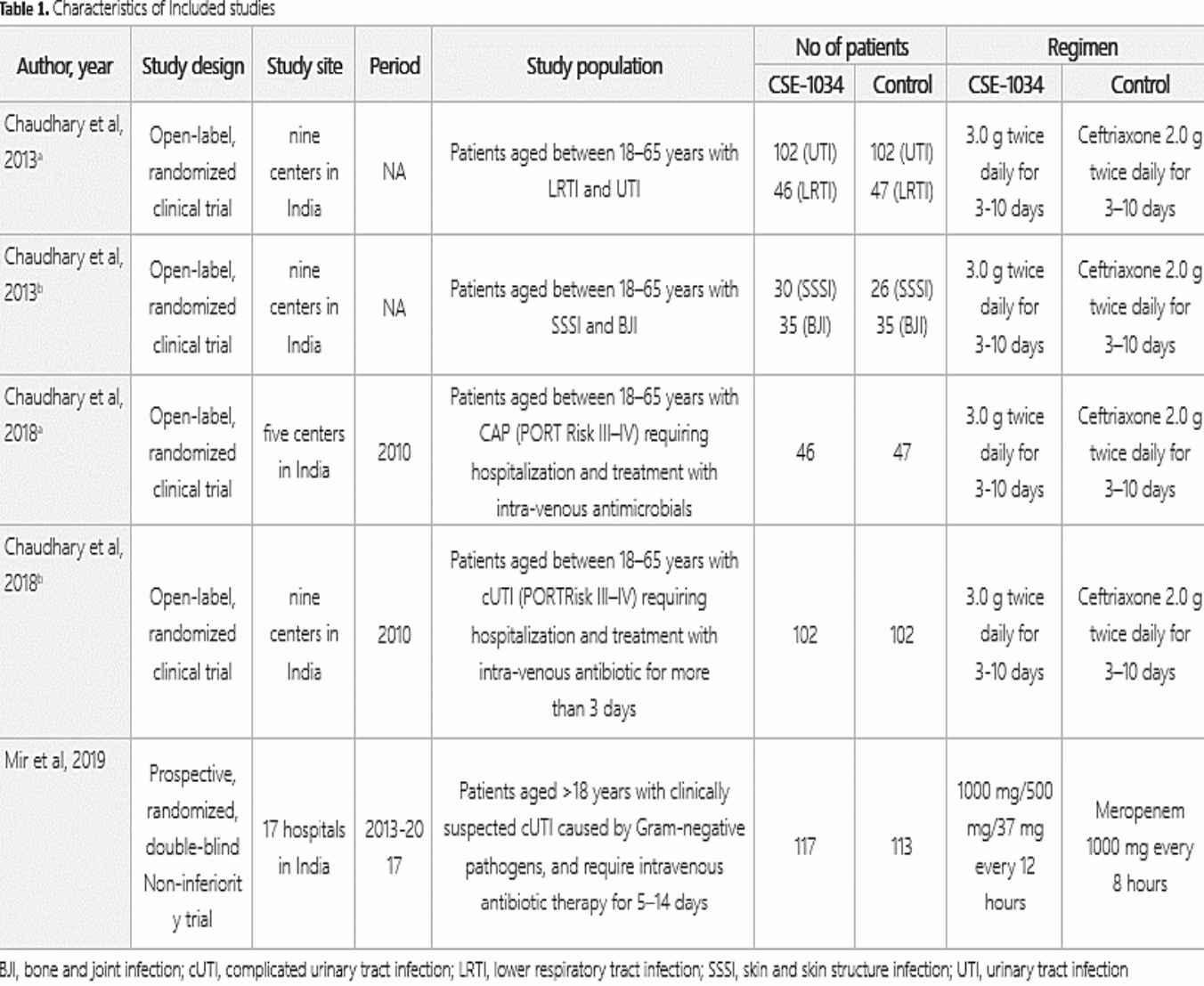
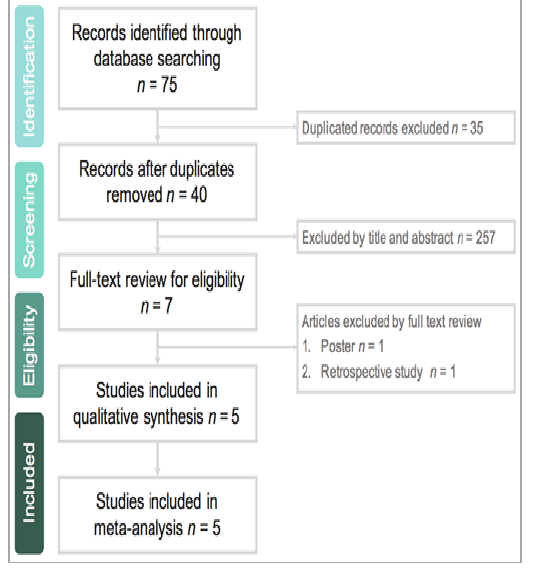
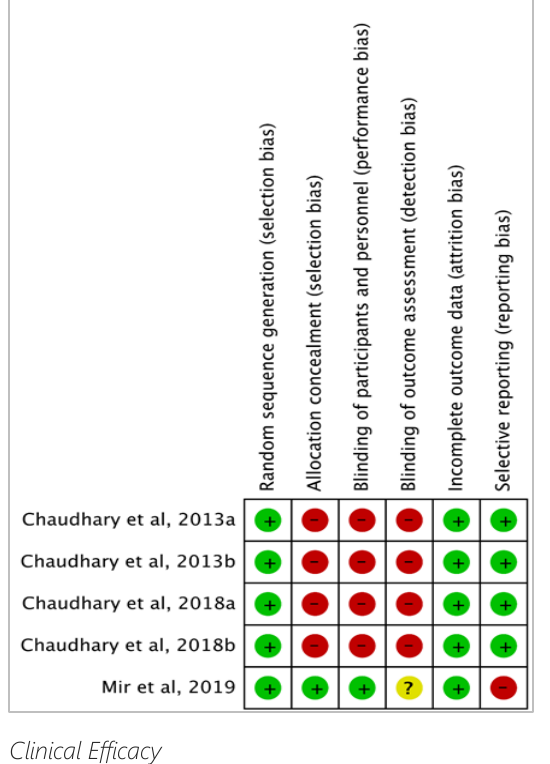
The present search yielded 75 references. After excluding 35 duplicates, we screened the remaining 40 references. Among the screened references, we retrieved 7 for full-text review. Finally, 5 studies (5–7, 9, 10) fulfilling the inclusion criteria were included in this meta-analysis (Figure-1). All the studies involved multicenter designs and were conducted in India to compare the clinical efficacy and safety of CSE- 1034 and other comparators for adult patients with acute bacterial infection (Table-1). Two studies (5, 6) focused on UTIs, one of which used ceftriaxone as a comparator, and the other used meropenem. Each study (7, 10) compared the usefulness of CSE-1034 and ceftriaxone in treating community-acquired pneumonia, skin and skin structure infection (SSSI), and bone and joint infection (BJI). Another study (9) assessed the efficacy of CSE-1034 in managing lower respiratory tract infections and UTIs. Overall, a total of 950 patients (n:638 in the UTI group, n:186 in the lower respiratory tract infection group, n:70 in the BJI group, and n:56 in SSSI) were included in this meta-analysis, and 478 and 472 patients received CSE-1034 and the relevant comparator, respectively. Four studies had a high risk of bias in the following domains, including allocation concealment, blinding of participants and personnel, and blinding of outcome assessment (Figure-2). Overall, CSE-1034 had a higher clinical cure rate at EOT than did its comparator (95.3% [384/403] vs. 81.0% [319/394], RR, 1.20; 95% CI, 1.04-1.39; I(2) = 92%; Figure 3). Additionally, the clinical cure rates of CSE-1034 at LFU and TOC were higher than those of the comparator (LFU: RR, 4.32; 95%CI, 2.21-10.55; I(2)=0%; TOC: RR, 7.54; 95%CI, 1.90-29.97; I(2)=44%) in the pooled analysis of 3 studies that reported these outcomes. This trend was observed in the subgroup analysis of patients with lower respiratory tract infections (100% [92/92] vs. 89.8% [74/91], RR, 1.22; 95%CI, 1.10-1.35; I(2)=0%). In the patients with BJIs and SSSIs, CES-1034 was associated with a higher cure rate than the comparator (Figure-3). However, in the subgroup with UTIs, no significant difference in clinical cure rate was observed between CSE- 1034 and the comparator (99.1% [234/246] vs. 89.8% [225/242], RR,1.15; 95%CI, 0.97-1.14; I(2)=81%; Figure 3). In contrast, the overall clinical failure rate of CSE-1034 was also lower than that of the comparators (RR, 0.04; 95%CI, 0.01-0.13; I(2)=0%). Additionally, in the pooled analysis of 4 studies using ceftriaxone as a comparator, CSE- 1034 exhibited a higher clinical cure rate (94.8% (312/329) vs. 77.2% 251/325), RR, 1.25; 95%CI, 1.07-1.45; I(2)=86%).
Microbiological Eradication
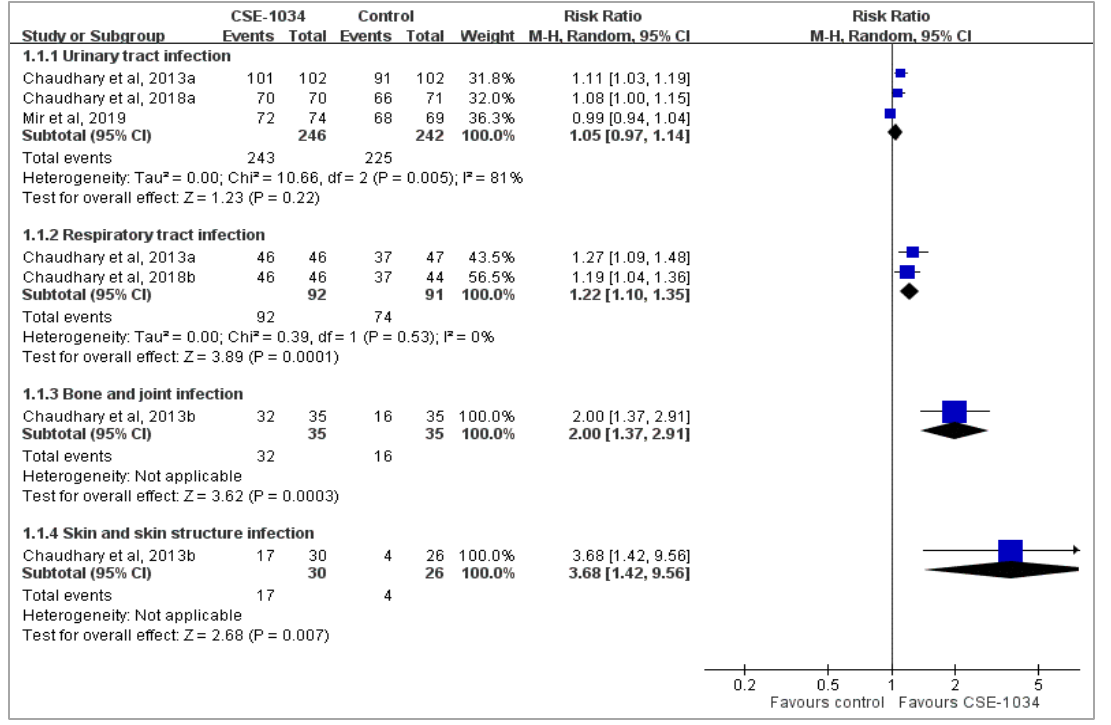
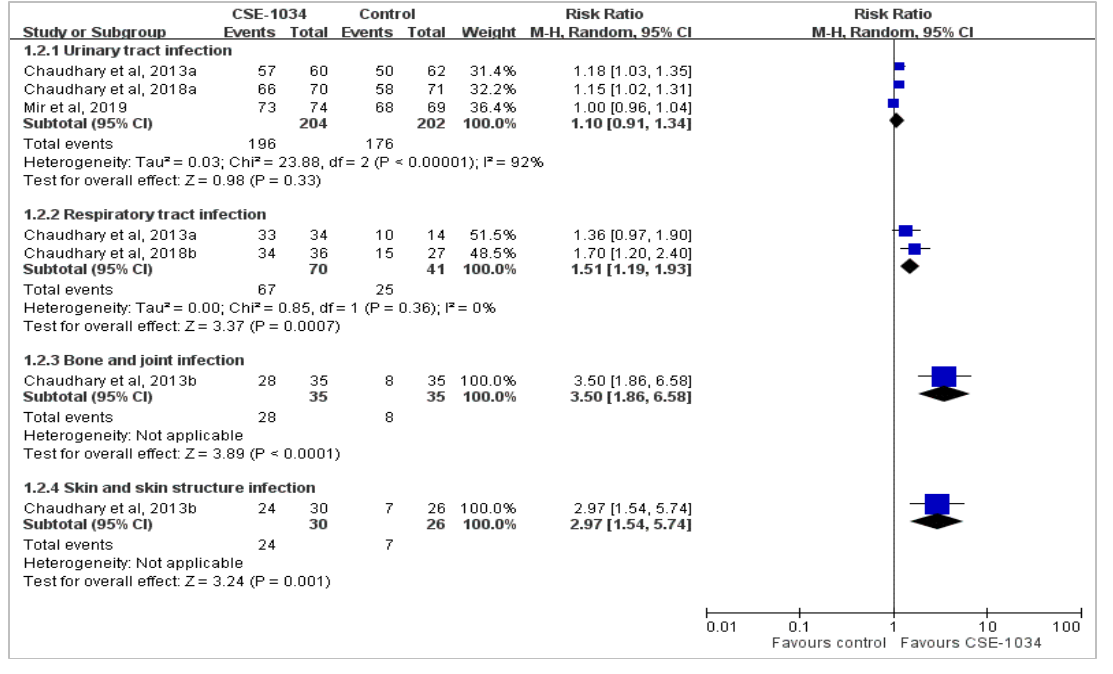
Overall, CSE-1034 had a higher microbiological eradication rate at EOT than the comparator (92.9% [315/339] vs. 71.1% [216/304], RR, 1.53; 95%CI,1.06-2.21;I(2)=97%; Figure-4). Additionally, the microbiological eradication rates of CSE- 1034 were similar to those of the comparator at LFU (RR, 2.98; 95% CI, 0.44-20.08; I(2)=74%) but higher than those of the comparator at TOC (RR,5.42; 95%CI, 1.88-15.56; I(2)=37%) in a pooled analysis of 3 studies reported the outcomes. In the subgroup of patients with lower respiratory tract infections, the microbiological eradication rate was higher for CSE-1034 than for the comparator (95.7% [67/70] vs. 61% [25/41], RR, 1.15; 95%CI, 1.19-1.93; I(2)=0%; Figure-4), and the similar trend was observed for patients with BJI and SSSIs. In contrast, no difference was observed in the subgroup analysis of patients with UTIs (96.1% [196/204] vs. 87.1% [176/202], RR, 110; 95%CI, 0.91-1.34; I(2)=92%; Figure-4). In the pooled analysis of four studies using ceftriaxone as comparator, CSE-1034 exhibited a higher eradication rate (91.3% [242/265] vs. 63.0% [148/235], RR, 1.58; 95%CI, 1.19-2.09; I(2)=86%). CSE-1034 showed a similar eradication rate to the comparator against Escherichia coli, Klebsiella pneumoniae, Acinetobacter baumanii, Enterobacter spp., Proteus spp., Pseudomonas aeruginosa.
Discussion
This meta-analysis of five RCTs (5–7, 9, 10) demonstrated that the clinical efficacy of CSE- 1034 is comparable or even superior to that of its comparators in treating patients with acute bacterial infection; the following evidence supports this. First, for treating acute bacterial infections, the overall pooled clinical cure rate of CSE-1034 at EOT was higher than that of the comparator; similar findings were obtained at LFU and TOC. Second, the pooled clinical failure rate of CSE-1034 was lower than that of its comparators. Third, in the subgroup analysis of different infection types, CSE-1034 exhibited a higher clinical response rate than the comparator in treating lower respiratory tract infections, BJI, and SSSI but a similar rate to the comparator in the treatment of UTIs. Finally, CSE-1034 showed a higher clinical cure rate than ceftriaxone. These findings are consistent with those of previous retrospective studies (2, 3, 11), in which the clinical response of CSE- 1034 in treating acute bacterial infection was favorable. A retrospective study(11) investigated the usefulness of CSE-1034 in 18 critically ill patients with septicemia and revealed that CSE-1034 achieved complete clinical cure and failure in 15 (83.3%) and 3 (16.7%) patients, respectively. In summary, the findings suggest that CSE-1034 can be a suitable therapeutic option in treating acute bacterial infections. In addition to clinical response, our meta-analysis revealed that CSE-1034 exhibited a favorable microbiological response. First, CSE-1034 exhibited a higher microbiological eradication rate than the comparator and ceftriaxone alone in treating acute bacterial infections. Second, CSE-1034 exhibited a higher microbiological eradication rate than the comparator in treating lower respiratory tract infections, BJI, and SSSI. Third, all other analyses revealed that for the treatment of UTIs and various pathogens, CSE-1034 had at least similar microbiological eradication rates to the comparator in the overall population. The findings of in vitro studies can explain the favorable microbiological responses of CSE- 1034 in treating acute bacterial infections (3, 4). The in vitro activity of CSE-1034 was also tested, and its susceptibility rates against E. coli, K. pneumoniae, Klebsiella oxytoca, P. aeruginosa, and A. baumannii (all of which are gram-negative bacteria) were 98% (410/419), 93% (145/156), 91% (49/54), 90% (178/198), and 89% (273/307), respectively. In addition, the susceptibility rates of CSE-1034 against Strepto-coccus pneumoniae, other streptococci, and Staphylococcus aureus (gram-positive bacteria) were more excellent than 95% (4). Another study reported that CSE-1034 was the most active antibacterial agent, with a susceptibility rate of 86% against clinical isolates; by contrast, meropenem had a susceptibility rate of only approximately 78% against clinical isolates, and piperacillin/tazobactam had a susceptibility rate of 25% (3). based on the findings of previous studies (3, 4) and our findings, we suggest that CSE-1034 can achieve a favorable microbiological response in clinical practice.
This study has several limitations. Only 5 RCTs in India were considered in this meta-analysis, and only four types of acute bacterial infections with limited case numbers (SSSI, BJI, UTIs, and lower respiratory tract infections)were included. The same group conducted all 5 RCTs. Further large-scale research is warranted to assess the usefulness of CSE-1034. Furthermore, this study did not assess the risk of adverse events related to CSE-1034; however, several studies have clarified this issue (3, 7). Gastrointestinal adverse events were the most common complication in the included studies, with most of such events being classified as mild in severity (5, 7). All of the included studies indicated CSE-1034 to be a safe agent. Cefoperazone/sulbactam (12–14) and other novel ß-lactam and ß-lactamase inhibitors, such as ceftazidime/ avibactam, ceftolozane / tazobactam, meropenem / vabor bactam, and imipenem/relebactam, have been developed into clinical use, especially for MDRO infections (15–18). However, head-to-head comparisons between CSE-1034 and these agents are lacking. Further study is required to clarify this issue.
Conclusion
CSE-1034 is comparable or even superior to comparators in terms of clinical and microbiological efficacy in the treatment of acute bacterial infections. Therefore, CSE-1034 is an appropriate option for antibiotic therapy in adult patients with acute bacterial infections.
Declarations
- Author contributions (CRediT)
- All authors contributed equally to all 14 CRediT roles (Conceptualization, Data curation, Formal analysis, Funding acquisition, Investigation, Methodology, Project administration, Resources, Software, Supervision, Validation, Visualization, Writing – original draft, Writing – review & editing).
- Funding
-
Funding information was not reported in the published version of this article.
- Conflicts of interest
- The authors declare no conflict of interest.
- Ethics approval
- The meta-analysis study is exempt from ethics approval as the study authors will be collecting and synthesizing data from previous clinical trials in which informed consent has already been obtained by the trial investigators.
- Data availability
- A data availability statement was not reported in the published version of this article.
References (18)
18 of 18 references are linked to their DOI.
- JL, Sahu M, Sanjith S, Bhalekar P, Keny D. Waging war against extended spectrum Beta lactamase and metallobetalactamase producing pathogens- novel adjuvant antimicrobial agent cse1034- an extended hope. J Clin Diagn Res. 2014;8(6):20-3 DOI Crossref PubMed Google Scholar
- Gupta R. Antibiotic adjuvant therapy for multi-drug resistant carbapenemases producing Klebsiella pneumoniae associated sepsis: A case study. J Clin Diagn Res. 2016;10(4):08-9 DOI Crossref PubMed Google Scholar
- Chakravorty S, Arun P. Antibiotic/adjuvant combinations (ceftriaxone + sulbactam + adjuvant disodium edetate) as an alternative empiric therapy for the treatment of nosocomial infections: Results of a retrospective study. Indian J Cancer. 2017;54(4):685-90 DOI Crossref PubMed Google Scholar
- Chaudhary M, Mir MA, Ayub SG. Safety and efficacy of a novel drug elores (ceftriaxone+sulbactam+disodium edetate) in the management of multi-drug resistant bacterial infections in tertiary care centers: a post-marketing surveillance study. Braz J Infect Dis. 2017;21(4):408-17 DOI Crossref PubMed Google Scholar
- Mir MDA, Chaudhary S, Payasi A, Sood R, Mavuduru RS, Shameem M. CSE (Ceftriaxone+ sulbactam+ disodium EDTA) versus meropenem for the treatment of complicated urinary tract Infections, including acute pyelonephritis: PLEA, a double-blind, randomized noninferiority trial. Open Forum Infect Dis. 2019;6(10):373 DOI Crossref PubMed Google Scholar
- Chaudhary M, Ayub SG, Mir MA. CSE -1034 versus ceftriaxone: Efficacy and safety analysis from a randomized, open-labeled phase III study in complicated urinary tract infections. J Glob Infect Dis. 2018;10(4):188-95 DOI Crossref PubMed Google Scholar
- Chaudhary M, Ayub SG, Mir MA. Comparative efficacy and safety analysis of CSE-1034: An open labeled phase III study in community acquired pneumonia. J Infect Public Health. 2018;11(5):691-7 DOI Crossref PubMed Google Scholar
- Higgins JP, Altman DG, Gotzsche PC, Juni P, Moher D, Oxman AD, et al. The Cochrane Collaboration's tool for assessing risk of bias in randomised trials. BMJ. 2011;343:5928 DOI Crossref PubMed Google Scholar
- Chaudhary M PA. A randomized, open-label, prospective, multicenter phase-III clinical trial of Elores in lower respiratory tract and urinary tract infections.J Pharm Res. 2013;6(4):40-414 DOI Crossref PubMed Google Scholar
- Chaudhary M, Payasi A. Clinical, microbial efficacy and tolerability of Elores, a novel antibiotic adjuvant entity in ESBL producing pathogens: Prospective randomized controlled clinical trial. J Pharm Res 2013;7(4):275-280 DOI Crossref PubMed Google Scholar
- Patil UN, Jambulingappa KL. A combination strategy of ceftriaxone, sulbactam and disodium edetate for the teatment of multi-drug resistant (MDR) septicaemia: A retrospective, observational study in Indian tertiary care hospital. J Clin Diagn Res. 2015;9(11):29-32 DOI Crossref PubMed Google Scholar
- Lai CC, Chen CC, Lu YC, Chuang YC, Tang HJ. In vitro activity of cefoperazone and cefoperazone -sulbactam against carbapenem-resistant Acinetobacter baumannii and Pseudomonas aeruginosa. Infect Drug Resist. 2019;12:25-9 DOI Crossref PubMed Google Scholar
- Lai CC, Chen CC, Lu YC, Lin TP, Chuang YC, Tang HJ. Appropriate composites of cefoperazone-sulbactam against multidrug-resistant organism. Infect Drug Resist. 2018;11: 1441-5 DOI Crossref PubMed Google Scholar
- Lan SH, Chang SP, Lai CC, Lu LC, Tang HJ. Efficacy and safety of cefoperazone-sulbactam in empiric therapy for febrile neutropenia: A systemic review and meta-analysis. Medicine (Baltimore). 2020;99(8):19321 DOI Crossref PubMed Google Scholar
- Cheng IL, Chen YH, Lai CC, Tang HJ. The use of ceftolozane-tazobactam in the treatment of complicated intra-abdominal infections and complicated urinary tract infections-A meta-analysis of randomized controlled trials. Int J Antimicrob Agents. 2020;55(2):105858 DOI Crossref PubMed Google Scholar
- Lin WT, Lai CC, Cheong CU. Novel beta-Lactam/beta-Lactamase combination versus meropenem for treating nosocomial pneumonia. Antibiotics (Basel). 2019;8(4):219 DOI Crossref PubMed Google Scholar
- Lu LC, Lai CC, Chang SP, Lan SH, Hung SH, Lin WT. Novel beta-Lactam/beta-Lactamase inhibitor combinations vs alternative antibiotics in the treatment of complicated urinary tract infections: A meta-analysis of randomized controlled trials. Medicine (Baltimore). 2020;99(19):19960 DOI Crossref PubMed Google Scholar
- Tan CK, Lai CC, Chao CM. Ceftazidime-avibactam versus meropenem for the treatment of complicated intra-abdominal infections. Antibiotics (Basel). 2019;8(4):255 CSE-1034 in Treatment of Acute Bacterial Infections Shao-Huan Lan et al. DOI Crossref PubMed Google Scholar
Respond to this article
Comments on a published article are welcome as a Letter to the Editor.
Get an e-mail when new articles in your fields are published
Questions to the authors
Questions are moderated: an editor approves each question, the authors answer, and an editor approves the answer before both appear here.
No answered questions yet.
Ask the authors a question
Discussion
Comments are moderated: they appear after the writer confirms the e-mail address and an editor approves them. Each comment carries a conflict-of-interest statement.
No comments yet.
Write a comment
Read the full text
Open the PDF here
Loading the PDF…
If the PDF does not show here, use the download button above.
How to cite this article
Lan SH, Chao CM, Chang SP, Lu LC, Hsu TL. Clinical and Microbiological Efficacy of CSE-1034 in Treatment of Acute Bacterial Infections: A Systematic Review and Meta-Analysis of Randomized Controlled Trials. Ulutas Med J. 2022;8(4):118-126. doi:10.5455/umj.20220622065911
Lan, S. H., Chao, C. M., Chang, S. P., Lu, L. C., & Hsu, T. L. (2022). Clinical and Microbiological Efficacy of CSE-1034 in Treatment of Acute Bacterial Infections: A Systematic Review and Meta-Analysis of Randomized Controlled Trials. The Ulutas Medical Journal, 8(4), 118–126. https://doi.org/10.5455/umj.20220622065911
Lan, S.H. et al. (2022) 'Clinical and Microbiological Efficacy of CSE-1034 in Treatment of Acute Bacterial Infections: A Systematic Review and Meta-Analysis of Randomized Controlled Trials', The Ulutas Medical Journal, 8(4), pp. 118–126. doi: 10.5455/umj.20220622065911.
@article{umj65602,
  title = {Clinical and Microbiological Efficacy of CSE-1034 in Treatment of Acute Bacterial Infections: A Systematic Review and Meta-Analysis of Randomized Controlled Trials},
  author = {Lan, Shao-Huan and Chao, Chien-Ming and Chang, Shen-Peng and Lu, Li-Chin and Hsu, Tzu-Liang},
  journal = {The Ulutas Medical Journal},
  year = {2022},
  volume = {8},
  number = {4},
  pages = {118--126},
  doi = {10.5455/umj.20220622065911},
  url = {https://www.ulutasmedicaljournal.com/?mno=65602},
  issn = {2149-388X}
}