The Ulutas Medical Journal · ISSN 2149-0430 (print), 2149-388X (online) · https://www.ulutasmedicaljournal.com/?mno=53006
Case Report · Open access
A Case of Scleredema Diabeticorum: Could Pentoxifylline Be a Therapeutic Option?
- Karabük University, Faculty of Medicine, Department of Dermatology ROR
- Karabük University, Faculty of Medicine, Department of Radiology ROR
- Karabük University, Faculty of Medicine, Department of Anatomy ROR
Abstract
- Background
- Scleredema diabeticorum is a dermatosis characterized by hardening of skin over the upper back. It is commonly seen in poor-controlled diabetic patients. Therapeutic options are limited. Psoralen and ultraviolet A therapy (PUVA), methotrexate, and topical steroids have been used with some success. Pentoxifylline is a xanthine derivative used mainly in peripheral vascular diseases. It also has antifibrotic effects due to its collagen synthesis inhibition action.
- Case Presentation
- In this paper, a trial of intralesional pentoxifylline treatment and magnetic resonance images of a male patient with scleredema diabeticorum are presented. Some subjective symptoms of the patient improved after this treatment, but, the thickness of the lesion did not change.
- Conclusion
- Pentoxifylline, probably via the oral route, could still be thought in such patients unresponsive to conventional approaches due to its antifibrotic activity and high safety profile.
Keywords
Full text
Introduction
Scleredema adultorum Buschke (SAB) is a rare skin disease characterized by skin hardening mainly on posterior neck and upper part of the trunk. There are three types of SAB. Type-1 is seen after a streptococcal infection; type-2 is associated with paraproteinemia. Type-3 is related to poorly controlled diabetes mellitus named diabetic scleredema and associated with diabetic retinopathy (1).
Treatment of skin changes caused by collagen degradation in the SAB is complicated except the type-1 in which scleroderma is reversed spontaneously within years (2). Skin hardening and tightening is progressive in type-2 and type-3 SAB: There are many modalities tried in treatment SAB such as phototherapy, cortico steroids, methotrexate with some success (3–5). Pentoxifylline is a phosphodiesterase four inhibitor molecule which has antifibrotic action through inhibition of collagen synthesis. Because of this action, pentoxifylline was used in some fibrosis-associated diseases with some success (6).
According to our best knowledge, there is no presentation about pentoxifylline effect on scleredema treatment in the literature. This paper presents a male patient with scleredema diabeticorum, who was treated intralesional pentoxifylline with magnetic resonance imaging findings.
Case Presentation
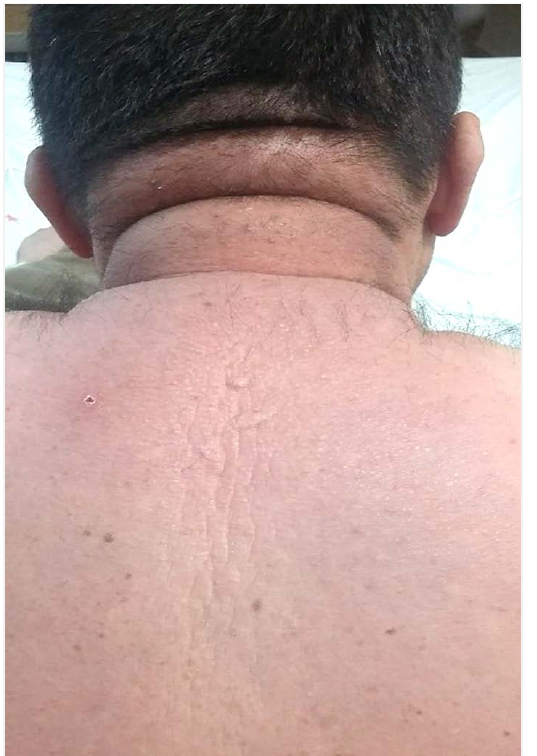
A 43-years-male patient presented to the dermatology outpatient clinic with hardening of the skin, pain, and motion limitation in the neck and severe itching over his upper back and around. In the dermatological examination, there was erythema, orange skin appearance, diffuse edema, and severe hardening with palpation over his interscapular area and posterior neck (Figure-1).
On history, he had diabetes mellitus and hypertension for 13 years and has been using insulin and metformin for his diabetes and a combination of perindopril and amlodipine for his high blood pressure. He has also been periodically followed due to diabetic retinopathy. His last laboratory result revealed 170 mg/dl glucose level, and blood pressure was 110/70 mmHg. ALT level was 42 U/L, AST was 61 U/L. Grade-3 hepatosteatosis and hepatomegaly were detected in abdominal ultrasonography.
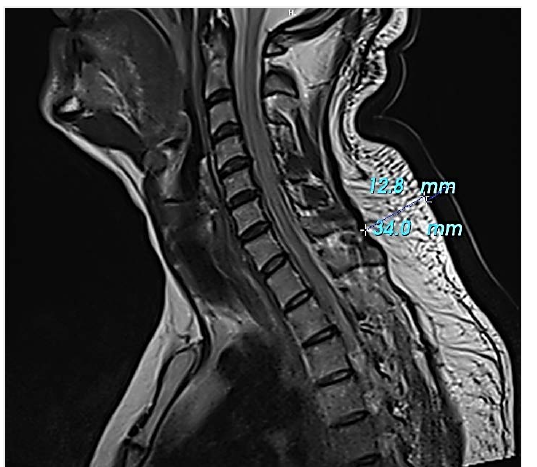
Skin biopsy taken from another center reported collagen thickening and high amount of intercellular material. Cutaneous sonography was tried, but hard tissue did not allow penetration of sound waves. Thus, magnetic resonance imaging (MRI) of the area was done. This gave a significant thickness in the skin (12.8 mm) and subcutaneous fat tissue (34 mm) (Figure-2). When compared to a healthy person, the thickness was about 4 times higher. Scleredema diabeticorum (type-3 scleredema) diagnosis was put based on clinical symptoms and skin biopsy findings.
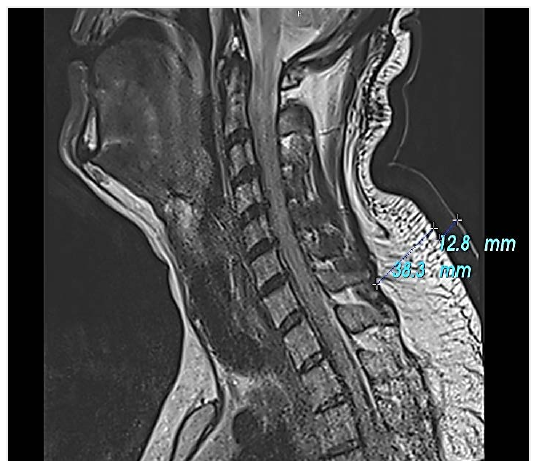
The patient had been on topical steroids and emollients for itching without an improvement. Oral cetirizine 10 mg a day was started for his itching resulting in a good response. Pentoxifylline was administered intralesionally 200 mg once a week as six sessions. With this therapy, the patient stated a gradual decrease in his pain and better sleep quality as he could lie more relaxed over his back. Following six weeks, MRI of the patient demonstrated slight thickening of subcutaneous fat tissue (38.3 mm) together with the same thickness (12.8 mm) of the skin in comparison to initial MRI (Figure-3). Pentoxifylline treatment discontinued despite the subjective improvement of the patient because of sensitive nature of the intervention.
Discussion
The treatment of scleredema diabeticorum is quite tricky and its success is limited. In addition to the use of peripheral vascular diseases, pentoxifylline also has a positive effect on fatty liver and high blood pressure (7, 8). In case there are no much alternatives in such presented patient who also has fatty liver and hypertension, pentoxifylline could be an excellent option to reverse the symptoms of scleredema because of its antifibrotic capability. The safety profile of pentoxifylline is excellent with a 1200 mg a day as a higher dosage. A weekly dose of 200 mg used in our patient could highly be accepted as safe. After 6 weeks of treatment, no adverse effect observed. Unfortunately, pentoxifylline did not show a clinical benefit to the dermatological sign of the patient despite a modest pain reduction and improvement in neck motions. Liver enzymes did not change during the observation period. In conclusion, we reported a demonstrative diabetic scleredema case with his MRI who is at least modestly responsive to subjective symptoms of SAB after pentoxifylline treatment. Pentoxifylline, probably via the oral route, could still be thought in such patients unresponsive to common approaches due to its antifibrotic activity and high safety profile.
Declarations
- Author contributions (CRediT)
- All authors contributed equally to all 14 CRediT roles (Conceptualization, Data curation, Formal analysis, Funding acquisition, Investigation, Methodology, Project administration, Resources, Software, Supervision, Validation, Visualization, Writing – original draft, Writing – review & editing).
- Funding
-
Funding information was not reported in the published version of this article.
- Conflicts of interest
- None of the authors has conflict of interest with the present article.
- Ethics approval
- Ethics approval details were not reported in the published version of this article.
- Data availability
- A data availability statement was not reported in the published version of this article.
References (8)
6 of 8 references are linked to their DOI.
- Menteş Miguel D, Schliemann S, Elsner P. Treatment of Scleroedema Adultorum Buschke: A systematic review. Acta Derm Venereol 2018;98:305-309 DOI Crossref PubMed Google Scholar
- Jung SE, Kim YC. Scleredema of Buschke following streptococcal infection. Ann Dermatol 2015;27(4):478-80 DOI Crossref PubMed Google Scholar
- Ng E, Rosenstein R, Terushkin V, Meehan S, Pomeranz MK. Idiopathic scleredema. Dermatol Online J 2016;22(12) PubMed Google Scholar
- Lemes LR, Vilela GM, Durães SM, Vilar EA. Scleredema of Buschke associated with difficult-to-control type 2 diabetes mellitus. Rev Assoc Med Bras 2016;62:199-201 DOI Crossref PubMed Google Scholar
- Kreuter A. Scleredema adultorum: Clinical presentation, diagnostic workup, differential diagnosis, treatment option. Hautarzt 2018;11:908-915 PubMed Google Scholar
- Sadaksharam J, Mahalingam S. Evaluation of Pentoxifylline in the management of oral submucous fibrosis - An ultrasonographic study. Contemp Clin Dent 2017;8:200-204 DOI Crossref PubMed Google Scholar
- Alam S, Nazmul Hasan S, Mustafa G, Alam M, Kamal M, Ahmad N. Effect of Pentoxifylline on histological activity and fibrosis of nonalcoholic steatohepatitis patients: A one year randomized control trial. J Transl Int Med 2017;5(3):155-163 DOI Crossref PubMed Google Scholar
- Plotnikov MB, Shamanaev AY, Aliev OI, Sidekhmenova AV, Anishchenko AM, Arkhipov AM. Pentoxifylline treatment enhances antihypertensive activity of captopril through hemorheological improvement in spontaneously hypertensive rats during development of arterial hypertension. J Am Soc Hypertens 2017;11:769-778 DOI Crossref PubMed Google Scholar
Read the full text
Open the PDF here
Loading the PDF…
If the PDF does not show here, use the download button above.
How to cite this article
Aktas H, Oner S, Oner Z. A Case of Scleredema Diabeticorum: Could Pentoxifylline Be a Therapeutic Option?. Ulutas Med J. 2019;5(3):225-228. doi:10.5455/umj.20190616024428
Aktas, H., Oner, S., & Oner, Z. (2019). A Case of Scleredema Diabeticorum: Could Pentoxifylline Be a Therapeutic Option?. The Ulutas Medical Journal, 5(3), 225–228. https://doi.org/10.5455/umj.20190616024428
Aktas, H., Oner, S. and Oner, Z. (2019) 'A Case of Scleredema Diabeticorum: Could Pentoxifylline Be a Therapeutic Option?', The Ulutas Medical Journal, 5(3), pp. 225–228. doi: 10.5455/umj.20190616024428.