The Ulutas Medical Journal · ISSN 2149-0430 (print), 2149-388X (online) · https://www.ulutasmedicaljournal.com/?mno=291032
Original Research · Open access
Psychiatric Residents Attitudes towards Psychotherapy Training and Associated Factors
Also available in: العربية · Türkçe · 中文
- Department of Psychiatry, King Khalid University Hospital, King Saud University Medical City, PO Box 242069, Riyadh 11322, Kingdom of Saudi Arabia. ROR
- Department of Psychiatry, King Khalid University Hospital, King Saud University Medical City, Kingdom of Saudi Arabia ROR
Abstract
- Background
- Studies detailing psychiatry residents' attitudes toward psychotherapy training are scant with nothing reported on Saudi psychiatric residents. We aimed to evaluate psychiatric residents' attitudes towards their training program specifically related to learning psychotherapy and to find out factors fashioning these attitudes.
- Methods
- A quantitative cross-sectional study was conducted on all psychiatric residents of year 1 to 4 enrolled in the joint residency program across three major cities in the Kingdom of Saudi Arabia. From 134 residents, data was collected after consent, anonymously & confidentially through a validated self-administered questionnaire, which included demographic data and a scale that has been used in two previous studies to examine attitudes on psychotherapy training.
- Results
- With a response rate of 60% (80 out of 134 psychiatry residents), an overwhelming majority (92%) of our cohort considered psychotherapy training resources to not be a burden. Nevertheless, three-quarters of our residents (73.75%) had concerns with the program not providing high-quality psychotherapy training, with more than half of our cohort (52.5%) disagreeing that the psychotherapy program helps them become a better psychotherapist. Although the majority of the residents acknowledged psychotherapy mentors' influence as positive, only 11% viewed the quality of supervision to be excellent. Across the years in training and various psychotherapy aspects, our residents perceived their competence in neutral to negative terms.
- Conclusion
- Our data depicts the need for raising standards & addressing the quality and quantity of training resources dedicated to psychotherapy in residency program across the kingdom.
Keywords
Full text
Introduction
Psychiatry residency training contributes highly to psychiatric residents’ knowledge, skills and decisions making. Thus, psychiatric educators must commit to the optimal delivery of new knowledge, as it is the essential basis for transforming the graduated medical students to independent practitioner giving a high-quality care in the future. And therefore, knowing what is faulting the program can aid in reducing the challenges (1, 2).
The psychiatry residency training program in saudi arabia is a four-year joint training program. The Saudi Commission for Health Specialties (SCFHS) established the program in 1997 and is supervised by it until now. The main objective of this program is to graduate competent, qualified, well-trained psychiatrists. Currently, there are 3 local training committees located in Riyadh, Dammam, and Jeddah (3). Psychotherapy training was not mandatory in the previous curriculum. A new curriculum was developed in 2015 that stated: “Psychotherapy training will be compulsory, with two patients and 1 hour of supervision weekly throughout the 4 years” (4).
In the United States for example, even though the American Association of Directors of Psychiatric Residency Training (AADPRT) has established a task force which works as a guide to program directors, psychotherapy educators and supervisors are still facing a challenge on how to evaluate residents’ competencies in psychotherapy. The Psychiatry Residency Review Committee (RRC) in their turn clarified the psychotherapy five branches that residents have to be competent at (brief therapy, cognitive behavior therapy, combined psycho-therapy and psychopharmacology, psychodynamic therapy, and supportive therapy). This also helped in advancing the psychiatric training program (5, 6).
Adequate mentorship gets the resident to have a higher self-perceived competence at practicing psychiatry independently after graduation. On the other hand, we can’t ignore the lack of tools to enable educators to precisely evaluate the residents’ cumulative competency, but they are in a position to assure that residents have the core knowledge and are able to perform different types of psychotherapy under an expert supervision or use a portfolio of recordings of psycho-therapy sessions (7–9). A course containing essential concepts of supervising psychodynamic psycho-therapy would make the educators well prepared for the supervision and assessments of residents (10).
For a long time, psychodynamic and other psychotherapies had insignificant space in the curricula. In addition, few of the faculty had the psychodynamic background to teach it. In spite that Residency training regulation demanded the residents to have clinical experience in it although it wasn’t defined by duration, content, or skill-set (11, 12). Subsequently leading to diminution of residents’ interest in practicing psychotherapy as they progress through training. Understanding residents’ attitude of the quality of psychotherapy training program is substantial to revise and improve the training program, which is essential in producing future psychiatrist with high self-perceived competency (13–15).
Despite concerns about the diminishing role of psychotherapy. Majority of psychiatric residents opined psychotherapy as an integral part of their psychiatric practice and a vital part of their identity as a psychiatrist where some of them were also considering psychotherapy in their future practice (16). In addition, most residents are satisfied with their mentors’ support of residents’ psychotherapy training. Their fellow residents were also encouraging one another on being a psychotherapist (14). Given that minimal local research focused on residents’ attitudes toward psychotherapy, and their perception of the number of resources, the quality of their supervision, or their self-perceived competence in various aspects of psychotherapy training, we set about quantifying the attitudes of our residents towards Psychotherapy hoping to aid in improving the residency training program, & subsequent acquisition of this valuable skill-set by our residents.
Materials and Method
Ours was a quantitative study conducted as a cross-sectional approach. It involved all psychiatric residents from residency year 1 to 4, through a psychiatry residency training program, which is a joint program between hospitals in three cities in the Kingdom of Saudi Arabia.
Data was collected using a well-structured paper pen self-administered questionnaire. It included five demographic questions, 32 Likert-scaled items (1=strongly disagree, 5=strongly agree), four yes/no items about personal psychotherapy experience, four questions asked about patient supervisory contact hours and an open-ended question asking residents to provide general comments about psycho-therapy training at their institution. The survey was used in two previous studies and we got the author consent (14, 17). The survey was revised multiple times by experts in psychotherapy training, educational research, and survey design.
The pilot was carried out by distributing the survey to some psychiatric residents, who just completed their psychiatric training. Afterward, only minor changes to some questions were made. A resident from each hospital was assigned to be responsible for the data collection from the psychiatric residents in the same hospital.
Statistical Analysis
Data was analyzed & computed using SPSS, version 21. Descriptive statistical data were presented by mean values, standard deviations, and percentages. ANOVA, post hoc analysis (Scheffé's method), and t-tests were used to compare subgroups. Additionally, Pearson’s correlation was used to assess the relationship between different variables. Only statistically significant differences at P-value< 0.05 was reported. Participants’ anonymity was assured and no incentives or reward were given to the participants. all participants’ informed consents were obtained. We got an IRB approval from King Saud University IRB before data collection.
Results
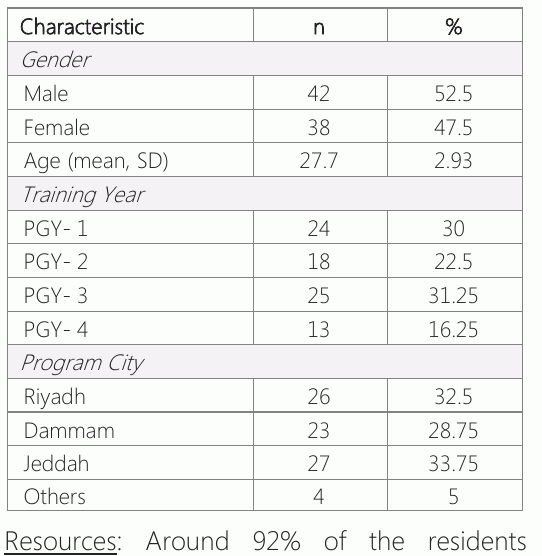
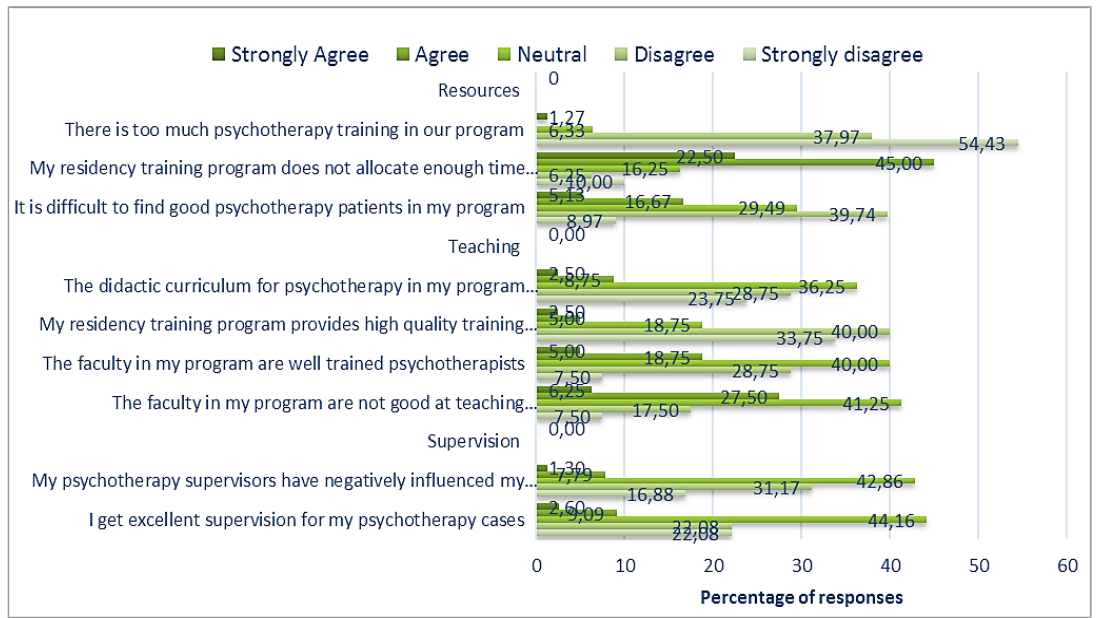
Total number recruited was 80 out of 134 psychiatry residents (60% response rate) in all different psychiatry training programs of Saudi Arabia, with almost equal gender distribution and with a mean age of 27 years (Table 1). disagreed with “There is too much psycho-therapy training in our program”. In addition, two third of them agreed with the statement that “My residency training program does not allocate enough time and resources for psychotherapy training”. Even though 49% disagreed that there is difficulty to find good psychotherapy patients in the program, 30% gave a neutral response to that, 21% agreed. Other items are shown in figure-1.
Teaching: More than half of our cohort (53%) disagreed that the psychotherapy program helps them become a better psychotherapist, where only 11% agreed. Furthermore, almost three quarters (74%) of our cohort disagreed that the training program provides high-quality training in psychotherapy, only 8% agreed. Supervision: Majority of the residents were either neutral, disagreed or strongly disagreed by 42%, 31%, 16% respectively, in terms of their supervisors negatively influencing their interest in psychotherapy. While only around 11% agreed that they get excellent supervision for their psychotherapy cases (figure-1).
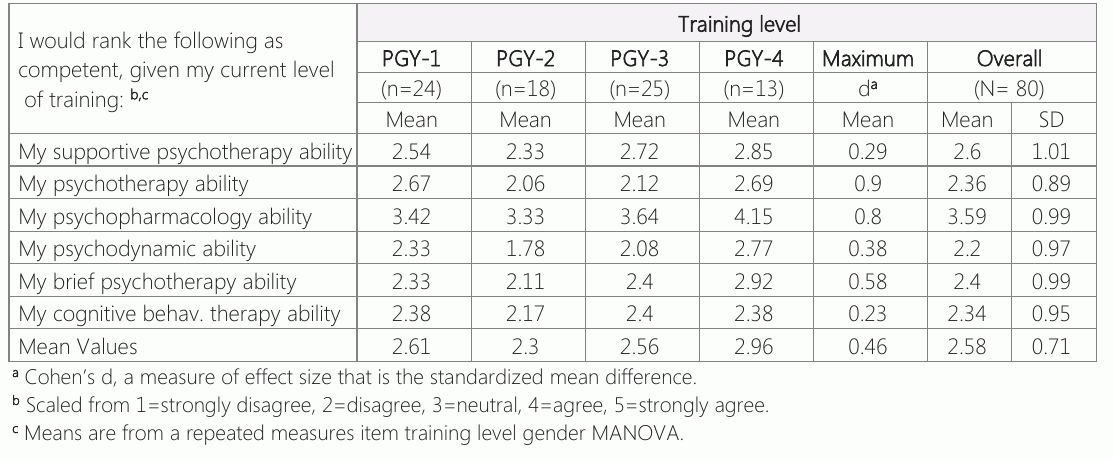
Self-Perceived Psychotherapy Competencies The residents were asked to rank their Self- Perceived Psychotherapy Competencies in different psychotherapy aspects at their level of training (1=strongly disagree, 3=neutral, 5=strongly agree). Replies were negative in which they were disagreed to neutral in terms of their competencies (Mean=2.58± 0.71). There was no difference between the different levels of the trainee. Even in the different psychotherapy aspects, competencies were almost the same as regards to supportive psychotherapy ability, psychotherapy ability, psychodynamic psychotherapy ability, brief psychotherapy ability, cognitive behavioral therapy ability. The only exception is psychopharmacology ability that was higher than the rest.
Discussion
Overall impression about psychotherapy training quality among residents is negative. Only 1% of the residents agreed that there is too much psychotherapy training in our program compared to 7% in the original American study. The majority of psychiatric residents (68%) have agreed on the insufficient time and resources their training program allocated, in contrast to the U.S study in which only minority (28%) opined that (14). At the same time, the majority denied having difficulty finding good psychotherapy patients. This tells a lot about having good resources from the patient side but not the training program side. This is also true regarding teaching. In which almost three quarters denied that the training program provides high-quality training in psychotherapy. In their views, this applies to the curriculum and the psychotherapy trainers. More than half the sample is not happy about the lectures and seminars and disagreed that their psychotherapy training didactic curriculum helps them become better psychotherapists. About 40% of the residents are not sure if the faculty is well-trained psychotherapists and they are not sure that the faculty is not good at teaching psychotherapy. This is maybe because the residents are not exposed enough to the psychotherapy training experience. This is mainly because psychotherapy training is not yet mandatory for completing the psychiatry board. the new curriculum started to be applied in 2016. By 2019, completing two psychotherapy cases will be mandatory for getting the board certificate (4). We believe that by that time; the psychotherapy training experience can be assessed better.
Also, supervision is not exceptional here. Only 12% agreed that they got excellent supervision for their psychotherapy cases. It was 64% in the US study. About 43% are neutral regarding “My psychotherapy supervisors have negatively influenced my interest in psychotherapy”, 9% agreed and 48% disagreed. This is negative compared to the American study, it was 15% neutral, 2% agreed and 83% disagreed. This is also the case for supervision in the psychiatry training program. In the previous study on almost the same sample, they were not happy a lot about supervision in the psychiatry training program generally not only in psychotherapy training (3).
Across different levels of psychiatry trainees, psychiatric residents perceived their psycho-therapy competencies in neutral to negative term. Furthermore, their competencies were almost the same in regard to the different psychotherapy types. They believe that psychopharmacology skills are better than psycho-therapy skills. The perceived competencies improved with time except in PGY2 (Post- Graduate-Year 2), where it was the lowest. This study has some limitations. Sampling and response biases are possible, although we managed to have 60% response rate, residents who are interested in psychotherapy could have participated more than non-interested residents in the study. Also, psychotherapy training was not assessed in the competency-based tool, we used a survey only.
Conclusion
Our data portrays a need for a programmatic upgrade across Psychiatry residency program specific to key Psychotherapy training aspects. Although,we hypothesized a generally negative attitude towards psychotherapy training in our cohort.
Nonetheless, our figures brought forth areas of focus in reassessing namely quality of supervision & subsequent self-perceptions among residents of their competence & skill-set. Further comprehensive studies are warranted to assess resident attitudes towards psychotherapy over time, including assessment ofperformance-based competence to decipher the relationship between the self-perception and the actual skill-set, as well as qualitative and quantifiable supervisor and resources evaluations.
Declarations
- Author contributions (CRediT)
- All authors contributed equally to all 14 CRediT roles (Conceptualization, Data curation, Formal analysis, Funding acquisition, Investigation, Methodology, Project administration, Resources, Software, Supervision, Validation, Visualization, Writing – original draft, Writing – review & editing).
- Funding
-
This research was funded by the SABIC Psychological Health Research and Applications Chair, Department of Psychiatry, College of Medicine, Deanship of Post- Graduate Teaching, King Saud University.
- Conflicts of interest
- The authors declare that they have no conflict of interest in the current study.
- Ethics approval
- We got an IRB approval from King Saud University IRB before data collection.
- Data availability
- A data availability statement was not reported in the published version of this article.
References (17)
12 of 17 references are linked to their DOI.
- Tasman A. The future of residency training in psychiatry. Bull Menninger Clin [Internet]. 1994;58(4):475–85. Available from: http://www.ncbi.nlm.nih.gov/pubmed/7812260 PubMed Google Scholar
- Accreditation Council for Graduate Medical Education. ACGME Program Requirements for Graduate Medical Education in Child and Adolescent Psychiatry. 2014;1–24. PubMed Google Scholar
- Alshomrani AT, AlHadi AN. The learning environment of the Saudi psychiatry board training program. Saudi Med J [Internet]. 2017 Jun;38(6):629 –35. Available from: http:// www.ncbi.nlm.nih.gov/pubmed/28578443 DOI Crossref PubMed Google Scholar
- SCFHS. Saudi Board Psychiatry Curriculum [Internet]. 2015 [cited 2017 Jan 18]. Available from: https://www. scfhs.org.sa/MESPS/TrainingProgs/TrainingProgsStatement/ Documents/Psychiatry new.pdf PubMed Google Scholar
- Khurshid KA, Bennett JI, Vicari S, Lee KL, Broquet KE. Residency programs and psychotherapy competencies: a survey of chief residents. Acad Psychiatry [Internet]. 2005;29(5):452– 8. Available from: http://www.ncbi.nlm.nih. gov/pubmed/16387969 DOI Crossref PubMed Google Scholar
- ACGME Program Requirements for Graduate Medical Education in Psychiatry [Internet]. 2017 [cited 2017 Sep 1]. Available from: https://www.acgme.org/Portals/0/PFAssets/ ProgramRequirements/400_psychiatry_2017-07-01.pdf PubMed Google Scholar
- Yager J, Bienenfeld D. How competent are we to assess psychotherapeutic competence in psychiatric residents? Acad Psychiatry [Internet]. 2003;27(3):174–81. Available from: http://www.ncbi.nlm.nih.gov/pubmed/12969841 DOI Crossref PubMed Google Scholar
- Manring J, Beitman B, Dewan MJ. Evaluating competence in brief psychotherapy. art Sci Br Psychother An Illus Guide (2nd ed) [Internet]. 2012;301–13. Available from: http://ovidsp. ovid.com/ovidweb.cgi?T=JS&PAGE=reference&D=psyc7& NEWS=N&AN=2012-10996-012 DOI Crossref PubMed Google Scholar
- Lis LD, Wood WC, Petkova E, Shatkin J. Mentoring in psychiatric residency programs: A survey of chief residents. Vol. 33, Academic Psychiatry. 2009. p. 307–12. DOI Crossref PubMed Google Scholar
- Riess H, Herman JB. Teaching the teachers: a model course for psychodynamic psychotherapy supervisors. Acad Psychiatry [Internet]. 2008;32(3):259– 64. Available from: http://www.ncbi.nlm.nih.gov/pubmed/18467486 DOI Crossref PubMed Google Scholar
- Mellman L a. How endangered is dynamic psychiatry in residency training? J Am Acad Psychoanal Dyn Psychiatry [Internet]. 2006;34(1):127–33. Available from: http://www. ncbi.nlm.nih.gov/pubmed/16548751 DOI Crossref PubMed Google Scholar
- Psychotherapy TC. The Cost-Effectiveness Psychotherapy. 1997. PubMed Google Scholar
- Kovach JG, Dubin WR, Combs CJ. Psychotherapy training: Residents’ perceptions and experiences. Acad Psychiatry. 2015;39(5):567– 74. DOI Crossref PubMed Google Scholar
- Calabrese C, Sciolla A, Zisook S, Bitner R, Tuttle J, Dunn LB. Psychiatric residents’ views of the quality of psychotherapy training and psychotherapy competencies: A multisite survey. Acad Psychiatry. 2010;34(1):13–20. DOI Crossref PubMed Google Scholar
- Zisook S, D JRMP, Sciolla A, D NLM, Calabrese C, D M, et al. Psychiatric Residents ’ Interest in Psychotherapy and Training Stage: A Multi-Site Survey. 2011;65(1):47–60. DOI Crossref PubMed Google Scholar
- Lanouette NM, Calabrese C, Sciolla AF, Bitner R, Mustafa G, Haak J, et al. Do psychiatry residents identify as psychotherapists? A multisite survey. Ann Clin Psychiatry [Internet]. 2011 Feb [cited 2016 Sep 17];23(1):30–9. Available from: http://www.ncbi.nlm.nih.gov/pubmed/21318194 DOI Crossref PubMed Google Scholar
- Lanouette NM, Calabrese C, Sciolla AF, Bitner R, Mustafa G, Haak J, et al. Do psychiatry residents identify as psychotherapists? A multisite survey. Ann Clin Psychiatry. 2011;23(1):30– 9. DOI Crossref PubMed Google Scholar
Respond to this article
Comments on a published article are welcome as a Letter to the Editor.
Get an e-mail when new articles in your fields are published
Questions to the authors
Questions are moderated: an editor approves each question, the authors answer, and an editor approves the answer before both appear here.
No answered questions yet.
Ask the authors a question
Discussion
Comments are moderated: they appear after the writer confirms the e-mail address and an editor approves them. Each comment carries a conflict-of-interest statement.
No comments yet.
Write a comment
Tell me when this article is cited
Leave your e-mail address and confirm it. These notices are not being sent yet; your confirmed address is kept for them and used for nothing else.
Read the full text
Open the PDF here
Loading the PDF…
If the PDF does not show here, use the download button above.
How to cite this article
AlOtaibi R, AlHadi AN, AlObaid L. Psychiatric Residents Attitudes towards Psychotherapy Training and Associated Factors. Ulutas Med J. 2018;4(3):124-130. doi:10.5455/umj.20180213085348
AlOtaibi, R., AlHadi, A. N., & AlObaid, L. (2018). Psychiatric Residents Attitudes towards Psychotherapy Training and Associated Factors. The Ulutas Medical Journal, 4(3), 124–130. https://doi.org/10.5455/umj.20180213085348
AlOtaibi, R., AlHadi, A.N. and AlObaid, L. (2018) 'Psychiatric Residents Attitudes towards Psychotherapy Training and Associated Factors', The Ulutas Medical Journal, 4(3), pp. 124–130. doi: 10.5455/umj.20180213085348.
@article{umj291032,
  title = {Psychiatric Residents Attitudes towards Psychotherapy Training and Associated Factors},
  author = {AlOtaibi, Reem and AlHadi, Ahmad N. and AlObaid, LuLu},
  journal = {The Ulutas Medical Journal},
  year = {2018},
  volume = {4},
  number = {3},
  pages = {124--130},
  doi = {10.5455/umj.20180213085348},
  url = {https://www.ulutasmedicaljournal.com/?mno=291032},
  issn = {2149-388X}
}