The Ulutas Medical Journal · ISSN 2149-0430 (print), 2149-388X (online) · https://www.ulutasmedicaljournal.com/?mno=227435
Original Research · Open access
Knowledge, Attitude and Behavior of Health College Students Related to Drug Abuse
- Adnan Menderes University Soke Health College ROR
Abstract
- Introduction
- This study was conducted to examine the knowledge, attitudes and behaviors of nursing students related to drug abuse.
- Method
- The sample of this study that is descriptive in nature formed by 238 students studying in the first class of Adnan Menderes University Health College Nursing Department. A questionnaire that questions the socio-demographic characteristics, knowledge, attitudes and behaviors about drug abuse and that consists of a total of 42 questions was used.
- Results
- In the study, 41,6% of the students were aware of the effects of drugs and 78.6% of them thought that drug abuse could be controlled if desired. According to 42% of the students, drug abuse by the young resulted from bad communication between parents and children. It was detected that 16.4% of the students currently smoked, 11.3% of them currently used alcohol, 2.5% of them had tried drug before. In the study, a statistically significant difference was found between the prevalence of smoking and drinking alcohol according to genders, smoking initiation age, family type and drug trial behaviors (p<0.05).
- Conclusion
- It is understood that although the students have positive attitudes about drug abuse, they do not have enough information and gender affects the use of addictive substances.
Keywords
Full text
Introduction
Alcohol and drug abuse is a serious public health problem increasing in Turkey and the world, as well as it is a sustained illness that may cause physical, mental and social problems in people (1). In the increase in the prevalence of drug abuse, psychological and social factors, and many other factors such as urbanization, industrialization and migration are effective (2–5). Drug use that has become widespread with the entertainment culture find themselves wider spaces especially in western societies (2).
In a study conducted in Hacettepe University Faculty of Medicine in 2004, it was found that 1.8% of the students had tried a kind of drug but they stopped to take it (one student took ecstasy, one student used glue, one student used thinner), and 6% of the students stated that the reports in media about drug abuse arouse the desire of trying it (2). In a study investigating the effect of drug use by Mom and Dad on young people, it has been detected that 33.3% of the students’ parents smoke cigarette, 16.1% of them drink alcohol, 1.07% of them use drugs and in parallel with this data, it has been detected that 25.8% of the students smoke, 13% of them drink alcohol and 6.5 of them take drugs (6). In a study conducted at a university, it has been detected that 73.2% of the students smoke cigarette, 56.6% of them drink alcohol and 9.6% of them take drug (4% of them use volatile substances such as glue, thinner, and Bali and 5.6% of them use other drugs such as marijuana, heroin, cocaine and pills) (7). In a study conducted on the university students in Şanlıurfa lifelong smoking, alcohol and drug use were found to be 64.4%, 30.4% and 2.3%, respectively (8).
Youth that is the transitional period from childhood to adulthood is one of the most important processes in the life of individual (7). This period is extremely important as a period in which the phenomenon of personality is defined and the first encounter with the material often occur (9). Adolescents are discussed as a risk group all over the world because of social, biological and psychological characteristics. Some reason such as the impact of fellowship, striving to prove himself, negative or negligent attitude of the family can take a lap the young people to the dangers of alcohol and drug abuse (2).
In starting to use addictive substance by a person, family has an important role (6). In order to develop a healthy personality, a person must be saturated in terms of some requirements such as to love, to be loved and being precious for the others just during the childhood and he must be given opportunity to develop this ability to meet requirements on his own in the future (9). Some reasons such as parental discord, the oppression of mother, father's strict authority, not to give love and interest to the child, being looked for love and compassion in their friends, being preferred of the outdoor environment by the child instead of his family, the loss of selfconfidence, lack of a positive approach from the family in the face of problems, may lead young people to improper and risky environment and drug abuse (2, 10).
Nurses affect the health of society as role models with their studies on protection and promotion of health and disease prevention. In leading a healthy life by an individual, lifestyles and behaviors are assumed to have the effect. Therefore, it is important to analyze the knowledge, attitude and behaviors of today’s nursing students who will give health service and who are the care professionals of tomorrow related to drug abuse.
Study Design
The research was conducted between the dates of November-December 2014. The universe of this descriptive study is 256 students studying in the first class of Nursing Department of Soke Health College in Adnan Menderes University; and sample is 238 students who fill in the data collection tools completely and who are volunteer in participating in the study. Post-hoc analysis conducted after the study for determining the power of the study, it was found that the sample "with a 3% effect size, which provides a 99% power at the 95% confidence interval". Data was collected by being filled of the questionnaire by the students in classroom environment outside school hours under observation. As data collection tool, a questionnaire prepared by the students in line with literature (2, 6, 7) and that is questioning students' sociodemographic characteristics, drug use beha-viors, knowledge and attitudes about drug abuse and consisting of a total of 42 questions were used.
Questionnaire: The questionnaire consists of two parts. In the first part, there are some questions questioning the students' sociodemographic variables (gender, family size, parents' educational level, parents' occupations, monthly income, the approach of the family to the young etc.); in the second part, there are some question questioning students 'smoking and alcohol use, usage frequency, drug trial status, the use frequency if they use, their attitudes towards drug abuse, their knowledge and the students’ suggestions to protect the young people from drug use.
The data were analyzed using statistical anaylze program as SPSS version 20. The variables were described using frequencies and percentages. The chi-square test was used to evaluate the relationship between qualitative datas (attitudes and sociodemographic characteristics, behaviors and sociodemographic characteristics) and logistical regression analysis was used to evaluate the relationship between sociodemo-graphic characteristics of students and behaviors related to drug abuse. The conditions, whose Type-1 error level was found below 5% (p<0.05), were considered significant.
Before the application, the aim of the study, questionnaire filling time, and some other explanations such that the participation in the study based on voluntariness, that they can end their participation at any point, that the information they gave will not be used outside the research and that writing their names in the questionnaire is not necessary were made and after their questions were answered if they had, their verbal and written consent was received about their participations. The study was planned regarding Helsinki principles and the legal permissions was also obtained from relevant institutions.
Results
When the sociodemographic characteristics of the students were evaluated, it was detected that 70.6% of them were female, 46.2% of them spent most of their time at the town center, 77.7% of them were in the type of nuclear family, mothers of 87% of them were housewives, fathers of 30.7% of them were retired, the mothers of 45% and fathers of 39.5% of them graduated from the primary school, 62.6% of them were staying in dormitory at that moment and 3.4% of them worked in a current job.
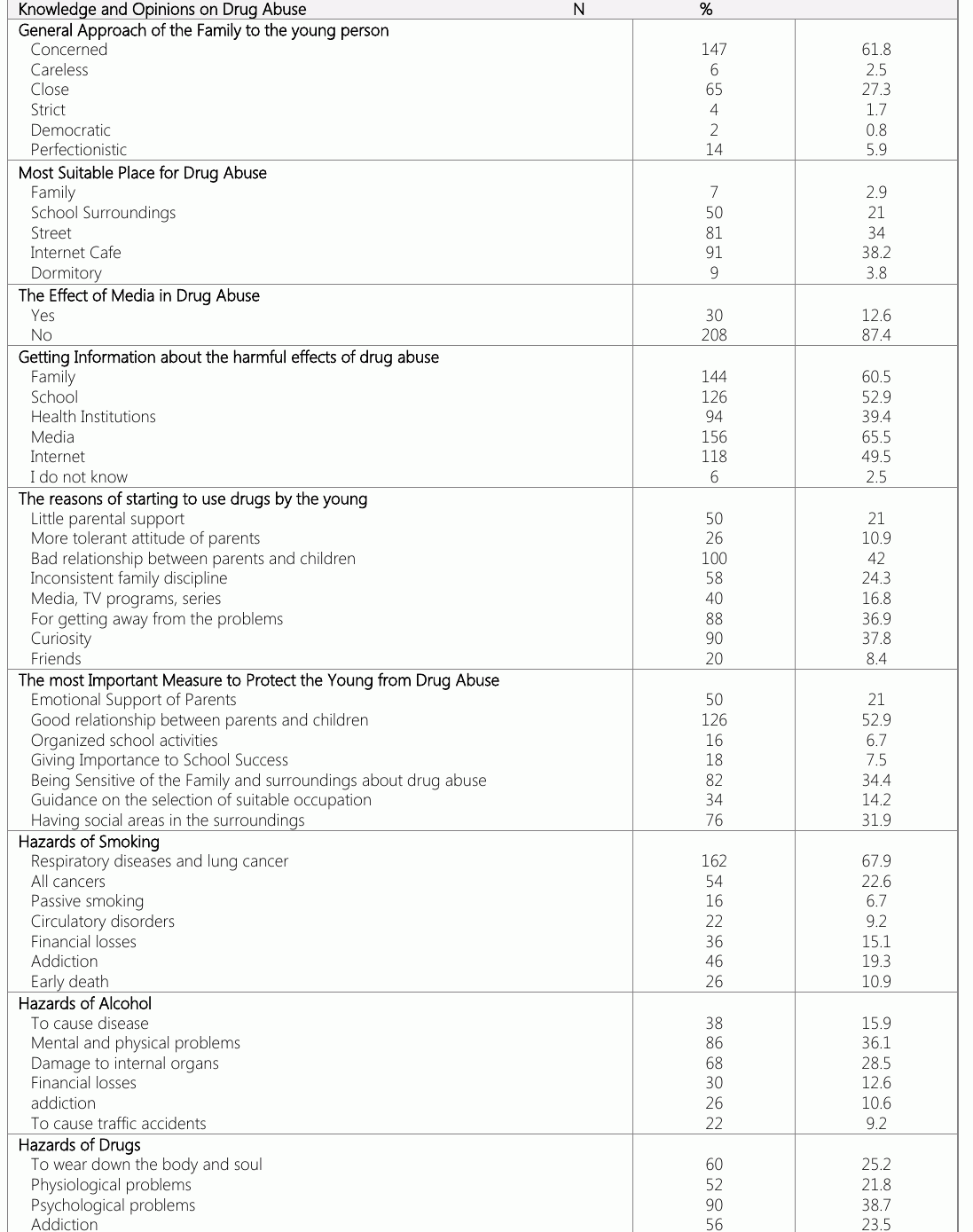
When the students’ knowledge and opinions related to drug use were examined, it was detected that the family of 61.8% of the students were concerned about them, 38.2% of them deemed internet cafe as the most suitable place for drug use, 87.4% of them stated that media had no effect on drug use, 65.5% of them received information from media related to the hazards of drug use, 42% of them thought that bad relationship between parents and children caused drug use, and 52.9% of them stated that good relationship between parents and children was an important measure.
When the same table was examined, it was detected that most of the students stated that smoking caused respiratory system diseases and lung cancer and alcohol caused mental and physical problems and drugs caused mental health problems (Table-1).
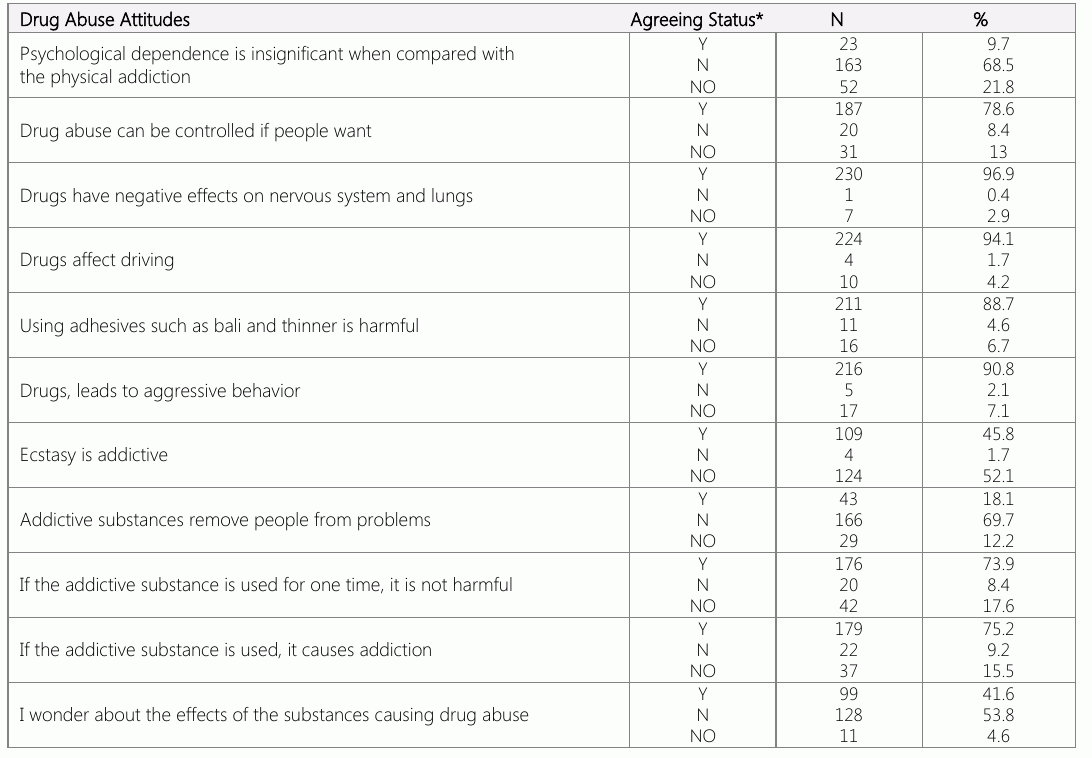
When the students’ attitudes toward drug use were examined, it was found that 68.5% of the students stated that the psychological addiction is as important as physical addiction, 78.6% of them stated that drug use could be controlled if desired, 96.9% of them stated that drugs had negative effects on the nervous system and the lungs, 94.1% of them stated that drug affected driving, 88.7% of them stated that the use of adhesives such as bali and thinner was harmful, 90.8% of them stated that drugs caused aggressive behavior, 45.8% of them stated that ecstasy caused addiction, 69.7% of them stated that the addictive substances did not get the people away from the problems, 73.9% of them stated that addictive substance would be harmful when they were used for several times, 75.2% of them stated that when addictive substance were used, it would cause addiction, 41.6% of them stated that they were curious about the effects of the addictive substances (Table-2).
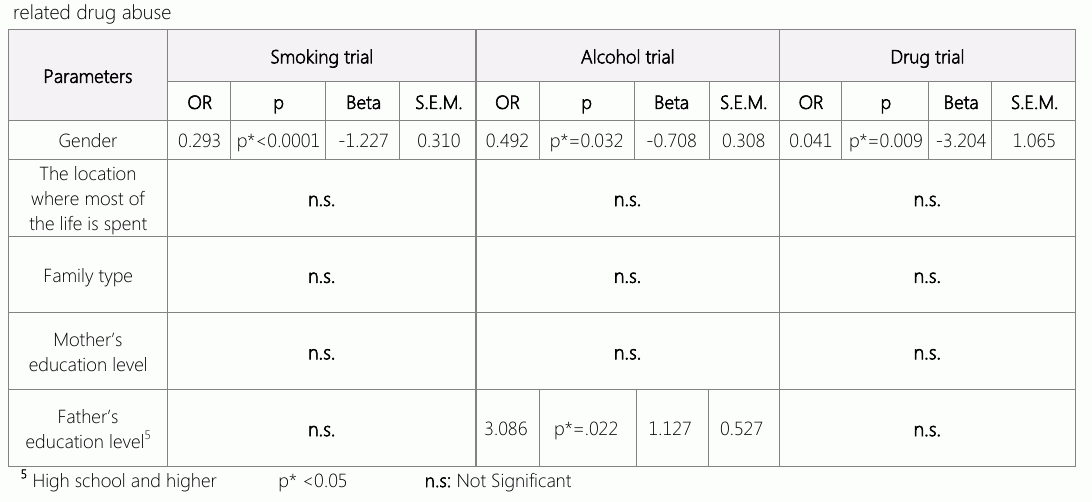
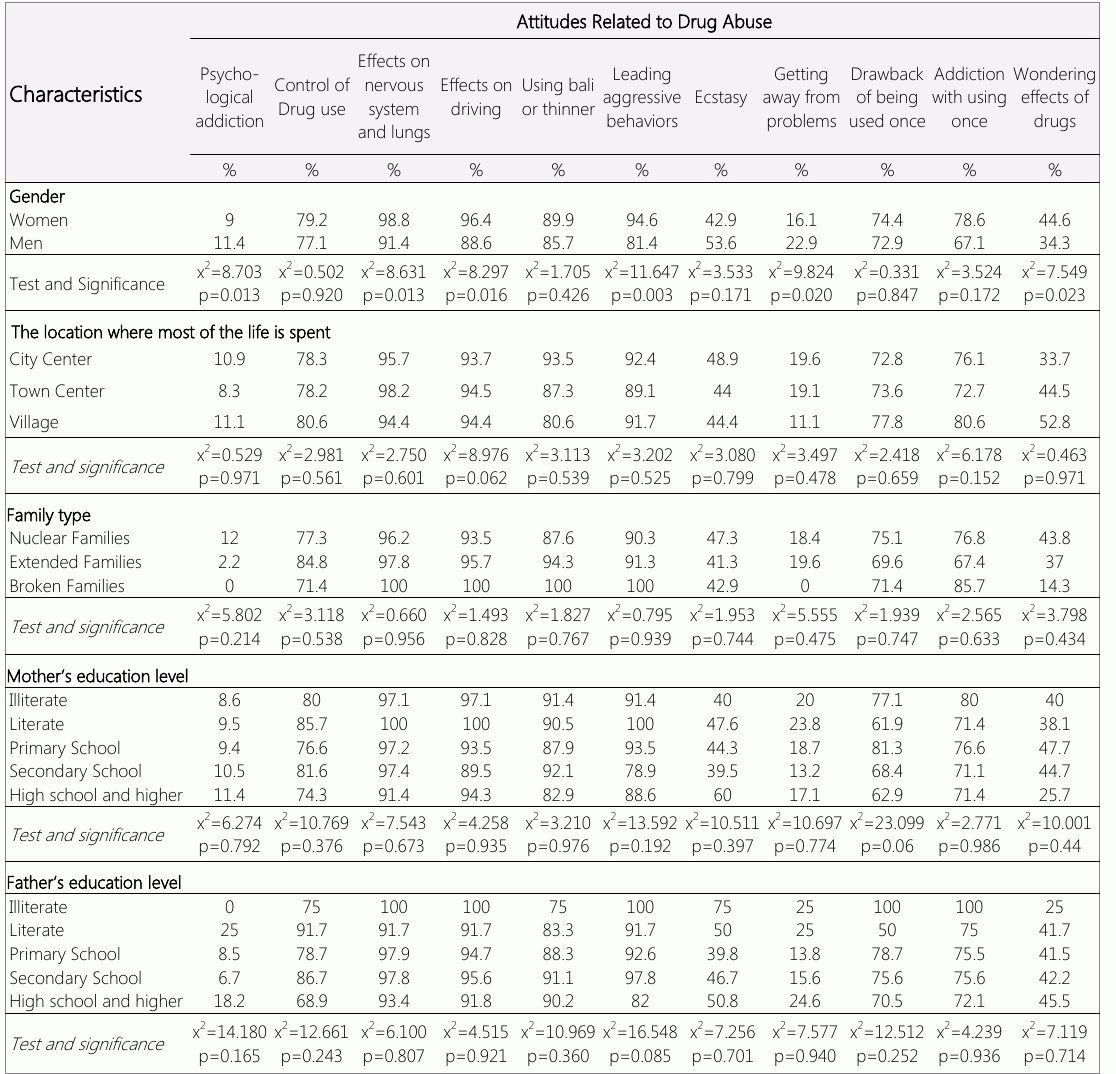
When the attitudes of the students toward drug abuse were compared according to their sociodemographic characteristics, it was found a statistically significant difference in the importance of psychological dependence by gender, the effect of drugs on nervous system drugs and the lungs (p=0.013), the effects of the use of vehicles (p=0.016), its leading to aggressive behavior (p=0.003), getting away from the problems and the curiosity of the students about the effects of the drugs (p=0.020, p<0.05); while no significant difference was founding other variables (p>0.05). These results indicate that gender influences attitudes toward drug use (Table-3). Logistical regression analysis was employed for independent predictors (smoking, alcohol and drug trials) to identify behaviors related to drug abuse. The variables of the model included gender, the location where most of the life is spent, family type, mother’s education level and father’s education level. According to the analysis result, student’s gender effects the smoking (OR: 0.29), alcohol (OR: 0.49) and drug trials (OR: 0.04). Besides, father’s education level (OR: 3.08), especially high school and higher is effective on alcohol trial (p<0.05, Table-4).
Discussion
In this study examining Health College students’ knowledge, attitude and behaviors about drug abuse, it has been found that the majority of the students received information about the hazards of drug use, and the young people stated that drug use resulted from the bad communication between parents and children and the most important measure to protect children from drug use was a good communication between parents and children. In the study, the majority of students stated that smoking caused respiratory diseases and lung cancer, alcohol caused mental and physical problems and drug caused mental health problems. In the study conducted by Gümüş et al, 35.48% of the students stated that alcohol caused cirrhosis, 12.9% of them that it lead to cardiovascular disease, 21.50% of them stated that alcohol was the main source of social problems (6).
In the study of Altıntaş et al. 72.3% of the students stated that they had heard drug abuse concept from written and mass media before, 52.2% of them received information related to drug abuse from school (2). In line with this data, it is seen that media has an effect on the students to know the concept of addiction. Therefore, media organizations and mass media publications should be more sensitive and careful on issues and refrain from wrong, encouraging and enticing news. In the study conducted by Korkmaz et al, 22% of students smoking started wondering, 18,2% started with friends encouragement, 4,0% started because of smoking parents (11). One of the reasons of the rising risk of drug use in adolescence is that the adolescent interferes with problem behavior due to the lack of maternal and paternal task (12). In the study conducted by Bahar, smoking rates was found higher in the students who evaluated the behaviors of their parents as uninterested and authority (13). In another study, in the families with a discrepancy of the parents, it was detected that the young people used alcohol as a reaction to their family and even one of the main reasons of drug use is the discrepancy of the parents (14). A healthy relationship between the family and children ensures individuals to develop healthier (15). Inconsistencies in attitudes of the parents towards young people, extreme rigidity or extreme comfort, failure to provide proper supervision, not monitored of the young person’s behavior by the parents are important risk factors for drug use (16, 17). Youth period is a process in which there is a search for identity and the behaviors of taking risks are seen mostly and during this period, the use of cigarette, alcohol and drugs are seen more frequently. In this period, a peaceful and trouble-free family atmosphere will ensure the young people to complete their spiritual development (17). Our study result that is similar to the literature stress the importance of growing up in a healthy family atmosphere for children and they also indicate the importance to consider the effect of family in both the prevention studies about addictive drug use and treatment studies.
When attitudes of the students toward substance use was examined, it was found that the majority of the students stated that psychological addiction is as important as physical addiction, drug use could be controlled, if desired, that the addictive substances did not get the people away from the problems, when addictive substances were used for several times they would be harmful, when addictive substances were used, they would cause addiction, and they wander about the effects of addictive substances. Similar to our research findings, in a study conducted with high school students by Gümüş et al, 64.5% of the students psychological addiction is as important as physical addiction, 58.1% of them stated that drug use could be controlled, if desired, 70.9% of them stated that when it is used cocaine, and 66.6% of them stated that when it is used ecstasy, they would cause addiction, and 36.5% of them wander about the effects of the addictive substances (6). In another study conducted on the 1st class of the Faculty of Medicine, it was found that more than half of the students did not agree with the statements 'addictive substances get the people away from the problems' and 'I'm not addicted if I use addictive substances'. Again in the same study, the ratio of the students who are wandering about the effects of addictive substances is 57.6% (2). In terms of these results, it can be said that the students are opposed to drug abuse. However, that some of the students wander about the effects of addictive substances and some of them think that when it is used addictive substances, they will not cause to addiction emphasize that it should be addressed on the subject more carefully and studiously and the educative activities about the subject must be increased. When the students’ behaviors related to drug use were examined, it was found that 16.4% of them were still smoking, 22.7% of them started to some between the ages of 15-18 and the fathers of 39.5% of them smoked cigarette. It was found that 11.3% of the students still used alcohol, the friends of 20.2% of them and the fathers of 9.2% of them used alcohol. Again in the study, it was detected that 2,5% of the students tried drugs, 1.7% of them had used and stopped using and some friends of 7.6% of them used drugs.
In a study conducted on the 1st class students, smoking ratio is 22.5% (18). In a study conducted by Şimşek et al on 1st class students in Harran University, it is seen that 25.4% of the students are still smoking (19). In Hassoy et al’ study, smoking prevalence among youths was 40,3% (male 57,1%, female 35,1%) (20). In a study conducted by Momtazi and Rawson on college students in Iran about drug abuse, it was detected that 12.8% of the students smoked cigarette; alcohol was the most addictive substance and the use rate was 9.9% (21). In a study examining drug abuse among faculty of medicine, it was detected that 10% of them smoked cigarette, 87.5% of them used alcohol, 2.8% of them used cocaine, 10% of used marijuana and 1.1% of them used some drugs such as opiat (22). In a study conducted by Arslan et al the number of students stating that they had used any substance during their lives was 3.15%, and was significantly higher among males (4.55%) compared to females (1.70%) (23). In another study, it was detected that 3.3% of the students smoked cigarette 1.7% of them used alcohol, 1.7% of them drank alcohol, 0.5 of them used cocaine, 0.3% of them used marijuana and 0.8% of them used drugs such as opiat (24). In another study also, it was found that the life-time use of cigarette was 69.5% and boys smoked more than girls, life-time use of any alcoholic beverages was 81.0%, and lifetime use of any illicit drug was 10.9% and the ratio was higher for boys (25). When compared to developed countries, the prevalence of alcohol and drug use that we obtained in our study was seen to be low (26, 27). In another study, it was detected that the age range in which drug abuse of both men and women in the lifetime was 18-29 (28). University years corresponding to these ages are the years in which many problems arise such as leaving from house and family and adaptation to a new environment. It is suggested that extreme anxiety and stress developed depending on these problems increase the use of tobacco, alcohol and drug by the university students (29). All these results that are similar to our findings show that it should be spent more effort on cigarettes and alcohol and the efforts on cigarette at a national level are still inadequate. Smoking, is a global health problem in our country and world health.
When the attitudes of the students related to drug use were examined according to descriptive features, a statistically significant difference was found between the importance of psychological addiction by gender, leading to aggressive behavior, getting away from the problems and the curiosity of the students about the effects of the drugs. These results indicate that gender influences attitudes toward the drug use. In his study of Altıntaş et al, it was found that gender effected the opinion that addictive substances got away people from the problems. In the same study, a significant correlation was found between the gender of the students and their opinion 'if I use addictive substances, I will not be addicted' statement (2). These results in the literature support our findings.
When the drug use behaviors of the students were compared according to their descriptive features, a statistically significant difference was found in smoking trial by gender, smoking frequency, the age to start smoking, alcohol and drug trial ages. Besides this, a statistically significant difference was found in drug trial age due to family type and the education level of mother, in smoking frequency, alcohol and drug trial behavior of father due to his education level. This result indicates that gender, family type, father’s and mother’s education level effect the behavior related to drug use. In parallel with the study results, in a study conducted by Ahmadi et al about the drug use frequency of nursing students, it was found that gender affected drug use, and the use ratio in male students was higher than the female students (24).
In a study conducted, it was detected that being role model of the parents (especially fathers) on drug use affected drug use by the young people (21). Besides this, another study indicates that family and close friends are effective on starting to use drugs in youth period (17, 30, 31). In another study, it was found that father’s and mother’s education level, ethnicity and living place affected stimulating and addictive drug use of university students (32). On the contrary to our life findings, in a study conducted by Pillon et al on the correlation between drug use and risky behaviors of university students, it was found that female students consumed more cigarette and alcohol than male students (33). It is known that drug use is seen less in women. These differences due to gender can be thought to have socio-cultural origin. In the cultures adopting Eastern culture, participation level of women in social and economic life is in low level. It is stressed that no matter how in developing countries consisting of our country, structure of the society is changing and the cultural structure is becoming westernized, conservative structure still keeps its effectiveness and therefore, social structure is opposed to be smoked cigarette by women and it is more tolerable to the cigarette and alcohol use of men (8).
Conclusion
It has been detected that although the attitudes of Health College students towards drug addiction are positive, their knowledge is not enough and gender affects addictive drug use. Addictive substances arise curiosity of all students due to some reasons such as media, friends and the negative relationship between family and young people. Although the population in our country and in the world is becoming older, in the countries having young population like our country, the future of young people is ended with such kind of substances. In line with this, university students must be seen risky group in terms of drug use and certain policies for preventing drug use must be developed in universities, education and guidance services must be given. In fighting with drug abuse, it should be raised awareness among families and it should be given importance to family training. It is suggested that the publications in media that are encouraging, intriguing and effective on drug use must be taken under more control. When the study was conducted in related institution, 1st, 2nd and 3rd grade students were trained. Because of 2nd and 3rd students educated about substance abuse at the undergraduate level, the study was carried out with only 1st class students.
Declarations
- Author contributions (CRediT)
- All authors contributed equally to all 14 CRediT roles (Conceptualization, Data curation, Formal analysis, Funding acquisition, Investigation, Methodology, Project administration, Resources, Software, Supervision, Validation, Visualization, Writing – original draft, Writing – review & editing).
- Funding
-
Funding information was not reported in the published version of this article.
- Conflicts of interest
- The authors declare that there is no conflict of interests to publish this article.
- Ethics approval
- The study was planned regarding Helsinki principles and the legal permissions was also obtained from relevant institutions.
- Data availability
- A data availability statement was not reported in the published version of this article.
References (33)
13 of 33 references are linked to their DOI.
- Güleç C, Köroğlu E. Psychiatry Main Book. Ankara, 1997. p.299-321. PubMed Google Scholar
- Altıntaş H, Temel F, Benli E, Çınar G, Gelirer Ö, Gün FA, et al. Knowledge, opinions and attitudes of first class students in faculty of medicine related to drug abuse. Bağımlılık Dergisi 2004;5(3):107-114. Health College Students Related to Drug Abuse Derya ADIBELLI, et al. PubMed Google Scholar
- World Health Organization, Management of Substance Dependence, Accessed July 01, 2015, from: http://www.who.int/ substance_abuse/publications/drug_role_mandate.pdf?ua=1 PubMed Google Scholar
- Ögel K, Çorapçıoğlu A, Tot Ş, Doğan O, Sır A, Bilici M, et al. Ecstasy use by young people in Turkey. Bağımlılık Dergisi 2003;4(2):67-71. PubMed Google Scholar
- Saatçioğlu Ö, Evren C, Çakmak D. The Evaluation of the cases inpatient with alcohol and drug abuse between the years of 1998-2002. Bağımlılık Dergisi 2003;4(3):109-117. DOI Crossref PubMed Google Scholar
- Gümüş İ, Kurt M, Günay Ermurat D, Feyatörbay E. The identification of knowledge, attitude and behavior levels of high school students related to drug abuse (The sample of Erzurum). Ekev Akademi Dergisi 2011;15(48):321-334. PubMed Google Scholar
- Turhan E, İnandı T, Özer C, Akoğlu S. Drug abuse, violence and some psychological features of university students. Türkiye Halk Sağlığı Dergisi 2011;9(1):33-44. PubMed Google Scholar
- Altındağ A, Yanık M, Yengil E, Karazeybek AH. Drug use by university students in Şanlıurfa. Bağımlılık Dergisi 2005;6:60-64. PubMed Google Scholar
- Şahin M. An Evaluation on Master’s Thesis Conducted in Turkey related to Drug abuse. Ankara University. Ankara, 2007. PubMed Google Scholar
- Ögel K. Educative Guidance of Drug and Addiction Education Package. İstanbul Özel Okullar Derneği. AMATEM. 1997.p. 13. PubMed Google Scholar
- Korkmaz M, Ersoy S, Özkahraman Ş, Taşçı Duran E, Çetinkaya Uslusoy E, Orak S, Orhan S. Süleyman Demirel Üniversitesi öğrencilerinin tütün mamulleri-alkol kullanım durumları ve sigaraya yaklaşımları. S.D.Ü. Tıp Fak. Derg 2013; 20(2):34-42 PubMed Google Scholar
- Steinberg L. Adolescence. İmge Kitabevi, İstanbul, 2007. p. 497. PubMed Google Scholar
- Bahar HH. Socio-economic factors that are effective in arising smoking habit in university students (Ph.D. thesis), Atatürk University, Social Sciences Institute. Erzurum, 2001. PubMed Google Scholar
- 14. Connors G, Maisto SA, Watson DW. Racial factors influencing college student’s ratings of alcohol’s usefulness. Drug Alcohol Depend 1998;21(3):247-252. DOI: 10.1016/0376-8716(88)90077-4 DOI Crossref PubMed Google Scholar
- Ekşi A. Child, Yung and Parents. Ankara. Bilgi Yayınevi, 1990. p. 101-126. PubMed Google Scholar
- Ögel K. Preventing the addiction-Guidance for Parents and Teachers. IQ Kültür Sanat Yayıncılık, İstanbul. 2001. p. 25-26. PubMed Google Scholar
- Kolay Akfert S, Çakıcı E, Çakıcı M. The Relationship between Smoking-Alcohol use and parental problems of University students. Anadolu Psikiyatri Dergisi 2009;10:40-47. PubMed Google Scholar
- Bertan M, Özcebe H, Haznedaroğlu D, Kırcalıoğlu N, Bülbül SH. The knowledge of adolescent period and the lifestyle of the first year students in universities. 29th UMEMPS Congress Union of Middle Eastern and Mediterranean Pediatric Societies 2005. p. 55-56. PubMed Google Scholar
- Şimşek Z, Koruk İ, Altındağ A. Risky Health Behaviors of the First Grade Students of Faculty of Medicine and Science and Letters in Harran University. Community Medicine Bulletin 2007;26(3): 19-24. PubMed Google Scholar
- Hassoy H, Ergin I, Davas A, Durusoy R, Karababa AO. Determining the factors effecting the cigarette, narghile and hand -rolled tobacco smoking among medical technology vocational training school students and evaluation of their opinions about starting and continuing with their habits of smoking. Solunum Dergisi 2011;13(2):91-99 DOI Crossref PubMed Google Scholar
- Momtazi S, Rawson R. Substance abuse among Iranian high school students. Curr Opin Psychiatry 2010;23(3):221-226. DOI: 10.1097/YCO.0b013e328338630d DOI Crossref PubMed Google Scholar
- Baldwin DJ Jr, Hughes PH, Conard SE, Storr CL, Sheehan DV. Substance use among senior medical students: A survey of 23 medical schools. JAMA 1991;265(16):2074-2078. DOI: 10.1001/jama. 1991.03460160052028 DOI Crossref PubMed Google Scholar
- Arslan HN, Terzi Ö, Dabak Ş, Pekşen Y. Subtance, cigarette and alcohol use among high school students in the Provincial center of Samsun, Turkey. Erciyes Med J 2012;34(2):79-84. DOI Crossref PubMed Google Scholar
- Ahmadi J, Maharlooy N, Alishahi M. Substance abuse: Prevalence in a sample of nursing students. J Clin Nurs 2003;13:60-64. DOI: 10.1046/j.1365-2702.2003.00841.x DOI Crossref PubMed Google Scholar
- Çakıcı E, Çakıcı M, Eş A, Ergün D. The prevalence and risk factors of substance use among university students in Turkish Republic of Northern Cyprus. Anatolian Journal of Psychiatry 2014;15:108-115. PubMed Google Scholar
- McCabe ES, West TB, Wechsler H. Trends and college level characteristics associated with the non- medical use of prescription drugs among US college students from 1993 to 2001. Addiction 2007;102:455-465. DOI Crossref PubMed Google Scholar
- Johnston LD, O’Malley PM, Bachman JG, Schulenberg JE. Monitoring The Future: National Survey Results On Drug Use, 1975-2007. Volume II College Students and Adults (ages 19-45). National Institute on Drug Abuse 2008. p. 236-238. PubMed Google Scholar
- Young SE, Corley RP, Stallings MC, Rhee SH, Crowley TJ, Hewitt JK. Substance use, abuse and dependence in adolescence: Preva-lence, symptom profiles and correlates. Drug Alcohol Depend 2002; 68:309–22. DOI: 10.1016/S0376-8716(02)00225-9 DOI Crossref PubMed Google Scholar
- Lanier CA, Nicholson T, Duncan D. Drug use and mental well - being among a sample of undergraduate and graduate college students. J Drug Educ. 2001;31(3):239-248. DOI: 10.2190/R7T3-T266-JN9E-UX3W DOI Crossref PubMed Google Scholar
- Tanrıkulu AÇ, Çarman KB, Palancı Y, Çetin D, Karaca M. Smoking Frequency and Risk Factors among the Various University Students in the City Center of Kars. Türk Toraks Dergisi 2009;10(3):101-106. PubMed Google Scholar
- Buller DB, Borland R, Woodal WG, Hall JR, Burris-Woodall P, Voeks JH. Understanding factors that influence smoking uptake. Tob Control 2003;12(Suppl 4):16-25. DOI:10.1136/TC.12.SUPPL_4.IV16 DOI Crossref PubMed Google Scholar
- McCabe ES, Knight JR, Teter CJ, Wechsler H. Non-medical use of prescription stimulants among US college students: prevalence and correlates form a national survey. Addiction 2004;99:96-106. DOI Crossref PubMed Google Scholar
- Pillon SC, O’Brien B, Chavez KAP. The relationship between drugs use and risk behaviors ın Brazilian University Students. Rev Latino-am Enfermagem.2005: Novembro-Dezembro,13:1169-76. DOI Crossref PubMed Google Scholar
Read the full text
Open the PDF here
Loading the PDF…
If the PDF does not show here, use the download button above.
How to cite this article
Adibelli D, Olgun S. Knowledge, Attitude and Behavior of Health College Students Related to Drug Abuse. Ulutas Med J. 2016;2(2):90-100. doi:10.5455/umj.20160523110809
Adibelli, D., & Olgun, S. (2016). Knowledge, Attitude and Behavior of Health College Students Related to Drug Abuse. The Ulutas Medical Journal, 2(2), 90–100. https://doi.org/10.5455/umj.20160523110809
Adibelli, D. and Olgun, S. (2016) 'Knowledge, Attitude and Behavior of Health College Students Related to Drug Abuse', The Ulutas Medical Journal, 2(2), pp. 90–100. doi: 10.5455/umj.20160523110809.