The Ulutas Medical Journal · ISSN 2149-0430 (print), 2149-388X (online) · https://www.ulutasmedicaljournal.com/?mno=288358
Original Research · Open access
Estimation of Plasma Glucose and Creatinine Level in Alloxan-induced Diabetic Wistar Rats treated with Metformin and Thiazolidinediones
Also available in: العربية · Türkçe · 中文
Abstract
- Introduction
- Diabetes increases the risk of developing neuropathy. In this study, we estimate the effect of Metformin, rosiglitazone, and pioglitazone on the body weight, blood glucose and creatinine level of alloxan-induced diabetic rats. Materials and Method: Alloxan (150 mg/kg) was used to induce hyperglycemia in fasted rats. Hyperglycaemia was treated with metformin, 150 mg/kg/d; pioglitazone, 3 mg/kg/d; and rosiglitazone, 10 mg/kg/d). The anti-diabetic drugs were administered orally for 28 days. The kidneys were removed when the animals were sacrificed plasma and kidney creatinine level was measured.
- Results
- There was the reduction in weight of diabetic rats and those administered with metformin while there was an increase in weight of rats administered with rosiglitazone and pioglitazone. There is also reduction in blood glucose level of all treated rats compared with the diabetes control. The effects of creatinine on muscle metabolism generation and serum are insignificant at P≤0.05.
- Conclusion
- This experiment suggests that short-term diabetes does not have an effect on plasma creatinine level and muscle metabolism of alloxan-induced diabetic rats.
Keywords
Full text
Introduction
Diabetes mellitus (DM) is a chronic, systemic, metabolic disease characterized by increase in plasma glucose level due to insulin deficiency and resistance. Diabetes mellitus is a common condition and it is classified into three main types; type-1 diabetes mellitus, type-2 diabetes mellitus and gestational diabetes mellitus. The prevalence of DM particularly type-2 DM has rapidly increase. Type-2 DM currently affects approximately 400 million people around the world (1). The long-term complication of DM includes diabetes nephropathy. Nephropathy is the leading cause of end-stage renal disease (ESRD) which requires dialysis or transplantation (2). The care for ESRD afflicted individual imposes financial burden on the afflicted individual and family members, this is because ESRD patients have co-morbid conditions especially the heart, eyes, and peripheral vascular disease. Diabetic nephropathy is clinically defined by persistence proteinuria greater than 500 mg/24 hours. The earliest functional abnormality in diabetic kidney is renal hypertrophy associated with a raised glomerular filtration rate. As the kidney becomes damaged by DM, vasodilation of afferent arteriole compares to efferent arteriole leads to increase of intraglomerular filtration which further damages the kidney. Increase intraglomerular pressure leads to increased shearing forces locally which are thought to contribute to mesangial cell hypertrophy and increased secretion of the extracellular mesangial matrix material. This eventually leads to glomerular sclerosis.
Diabetes mellitus can be managed in two ways. It can be managed pharmacologically and non-pharmacologically. The pharmacological management of diabetes mellitus is either by giving insulin or by using anti-diabetes drugs. There are many types of anti-diabetic drugs and they exert their useful effects by; increase insulin level in the body, increasing the body’s sensitivity to insulin and decreasing glucose absorption in the intestine. There are 4 major groups of oral anti-diabetic drugs. These are; Insulin secretagogues, Biguanides, Thiazolidinediones, and α-glucosidase inhibitor. The aim of this work is to test the effect of conventional drugs; Metformin (biguanides), rosiglitazone (thiazolidinediones) and pioglitazone (thiazolidinediones) on the body weight, blood glucose and creatinine level of alloxan-induced diabetic rats.
Material and Method
Animals
Twenty-five male Wistar rats with 8-10 weeks were breed in the animal house of Department of Anatomy, the University of Ilorin for this experiment. Their average weight was 177 g. The animals were kept in wire gauze cages under natural light and dark cycles at room temperature. They were feed with growers pellet obtained from Bendel feed, Ilorin and water ad libtum.
Induction of Diabetes Mellitus
The rats were induced to hyperglycemia using alloxan monohydrate (MO, USA). Alloxan was induced intraperitoneally at 150 mg/kg to overnight fasted rats. The rats were allowed access to food and water after injection. Hyperglycaemia developed about 7 days of post-alloxan injection. The rats with fasting blood glucose of 120 mg/dl were considered hyperglycaemic.
Experimental Design
The animals were randomly divided into five groups (n=5). Group 1: control (vehicle); they were not induced with alloxan; Group 2: Diabetics; they were induced with alloxan and were not treated; Group 3: diabetics + rosiglitazone; They were induced with alloxan and treated with rosiglitazone; Group 4: diabetics + pioglitazone; They were induced with alloxan and treated with pioglitazone; Group 5: diabetic and metformin; They were induced with alloxan and treated with metformin.All animals were treated for 28 days.
Measurement of Dosage
Each rat was administered rosiglitazone at 3mg/kg (3), pioglitazone at 5mg/kg (4) and metformin at 150 mg/kg (5) according to their respective groups.
Blood Glucose and Body Weight
Blood glucose was taken in overnight fasted rats using one touch glucometer (Roche diagnostic, Gemany) with its strips (Roche diagnostic, Asia). After the induction of diabetes, blood glucose was taken by day 7 and once a week during the period of administration of oral hypoglycemic drugs.
The body weights of the animals were taken prior to the induction of hyperglycaemic at day 7 of alloxan administration and then once per week for 4 weeks using weight balance.
Termination of Treatment and Tissue Homogenization
At the day 28 of treatment, the animals were sacrificed using diethyl anesthesia. Laparotomy was performed and blood was collected from the inferior vena cava for creatinine assay. Subsequently, the kidney was removed and fixed in 40% formalin solution.
Bioassay
The in vitro quantitative determination of serum creatinine was determined by using modified Jaffe’s method using a commercially available reagent (AGAPPE diagnostic kit, India) as previously described by Crocker et al. (6). The principle was for creatinine to react with picric acid to produce a colored compound, creatinine concentration.
Statistical Analysis
Statistical analyses were performed using SPSS 14.0 Windows Evaluation Version (SPSS Inc.,Chicago, USA) and Excel 2010 (Microsoft Co, USA). Results are expressed as mean (± S.E.M). Means were compared using Anova. P value ≤0.05 was considered significant.
Results
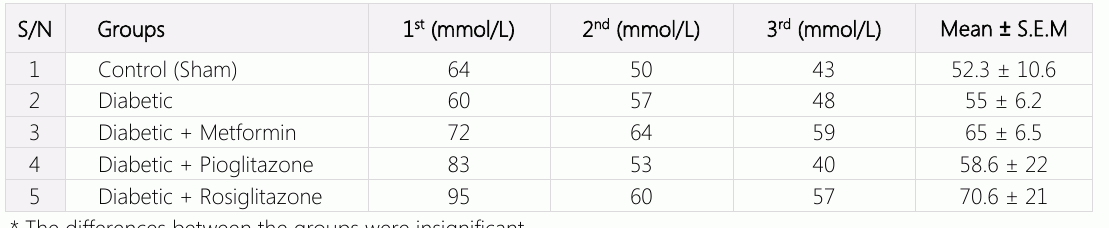
Table-1 shows the result of serum creatinine level of the animals to oral hypoglycemic drugs. At the termination of treatment, there was no statistically significant difference found in the serum creatinine level of all groups. The body weight responses of animals to oral hypoglycaemic drugs are shown in figure-1. The animals treated with metformin and the non-treated diabetic animals show a reduction in body weight while animals treated with glitazones show increase body weight as compared with the control group.
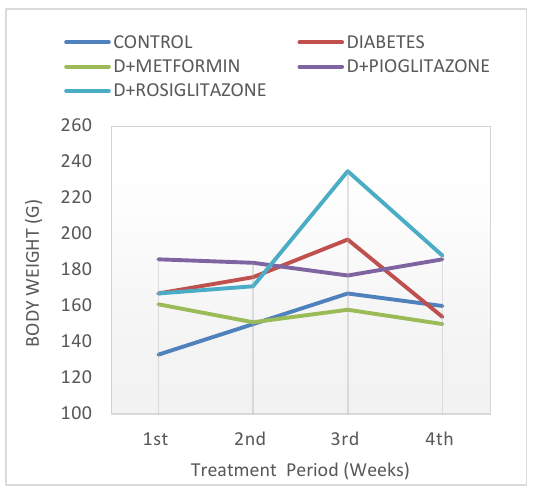
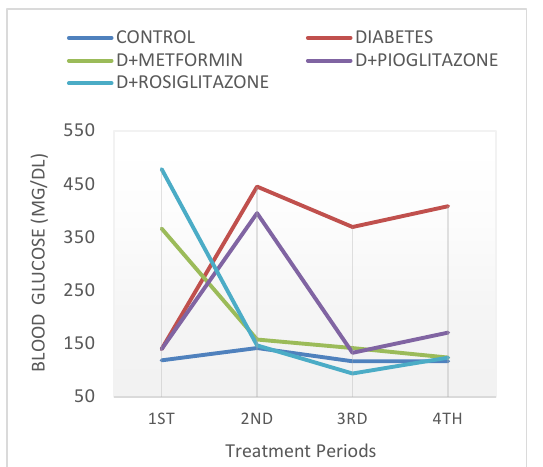
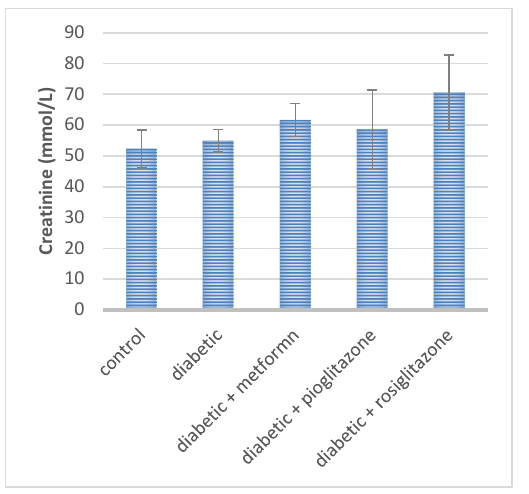
Figure-2 summarizes blood glucose changes in the blood glucose level of diabetic rats treated with oral hypoglycemic drugs (metformin, rosiglitazone, and pioglitazone) and the non-treated diabetic rats. The blood glucose level of the non-treated diabetic group was constantly higher than every other group throughout the period of the experiment while the blood glucose of the treated diabetic rats reduces with increase in study duration level. The results of creatinine assay in the kidneys of experimental animals are shown in figure-3. As shown in the graph, the differences in kidney muscle creatinine level of the control, non-treated diabetic and the oral hypoglycemic treated diabetic groups are insignificant.
Discussion
Hyperglycemia gives rise to many complications of diabetes which includes nephropathy. Therapeutic intervention of diabetes is aimed at reducing and avoiding constant hyperglycemia through the use of hypoglycemic agents and insulin. In this study, we induced diabetes with alloxan and treated the animals with oral hypoglycaemic drugs (Metformin, rosiglitazone and pioglitazone) for 28. At the end of the treatment, blood glucose level in diabetic rats treated with anti-diabetic drugs (metformin, rosiglitazone and pioglitazone) was reduced as compared to the untreated rats. The result of this study corresponds to previous report of Wei and Williams, 2012 on modeling disease progression and rosiglitazone intervention in diabetic Gotokakizaki rats (7) and Mohamed, 2010, on pioglitazone versus metformin in two rat models of glucose intolerance (8). There were no significant differences in the effect of three hypoglycaemic drugs used for treating diabetic rats in this study. Previous studies have examined the effects of Metformin, Pioglitazone and Rosiglitazone but none has investigated the differences among them.
In this study, alloxan induced diabetes causes loss in the body weight. The administration of glitazone (pioglitazone and rosiglitazone) restores the body weight and increases the body weight above the weight of the control group. The increase in body weight in animals treated with rosiglitazone corresponds to previous work (7) and may be as a result of reduced energy loss via urine (9).The reduction of body weight seen in non-treated diabetic rats was also seen in metformin treated rats which implies metformin had no inhibitory effect on the body weight of diabetic rats while the increase in body weight of glitazones treated rats shows that glitazone had inhibitory effect on body weight of diabetic rats. This result corresponds to previous work (10). The reduction in body weight of diabetic and metformin treated diabetic rats may be as a result of increase activity of glycogenolysis, lipolysis, gluconeogenesis which result in muscles wasting and loss of tissue protein which can lead to the reduction in body weight experience in alloxan-induced diabetic rats. Creatinine generated from muscle metabolism and serum was considered insignificant in all experimental groups. This may be as a result of the short period of time used for this experiment. Nephropathy is developed as a result of long time diabetes.
Conclusion
Data from this study shows that metformin, pioglitazone and rosiglitazone can reduce blood glucose in diabetic rats and rosiglitazone contribute to increase body weight. Since obesity is one of the key factors that contribute to development of Type-2 DM, rosiglitazone may not be the best option for the treatment of Type-2 DM.
Declarations
- Author contributions (CRediT)
- All authors contributed equally to all 14 CRediT roles (Conceptualization, Data curation, Formal analysis, Funding acquisition, Investigation, Methodology, Project administration, Resources, Software, Supervision, Validation, Visualization, Writing – original draft, Writing – review & editing).
- Funding
-
Funding information was not reported in the published version of this article.
- Conflicts of interest
- The authors have no conflict of interest.
- Ethics approval
- Ethics approval details were not reported in the published version of this article.
- Data availability
- A data availability statement was not reported in the published version of this article.
References (10)
5 of 10 references are linked to their DOI.
- Aguiree, Florencia, Brown, Alex, Cho, Nam Ho, Dahlquist, Gisela, Dodd, Sheree, Dunning, Trisha, Hirst, Michael, Hwang, Christopher, Magliano, Dianna, Patterson, Chris, Scott, Courtney, Shaw, Jonathon, Soltesz, Gyula, Usher-Smith, Juliet and Whiting, David, IDF Diabetes Atlas: sixth edition, 6th ed. 2013. Accessed December 22, 2017, from http://dro.deakin. edu.au/view/DU:30060687 PubMed Google Scholar
- Rodica P., Laurel R, Subramaniam P, Mathias K, Frank CB and Eva L.F. The Management of Diabetic Neuropathyin CKD and Dialysis patients. Am J Kidney Dis.2010; pp. 365-368. PubMed Google Scholar
- Yue TL, Bao W, Gu JL, Cui J, Tao L, et al. Rosiglitazone treatment in Zucker diabetic fatty rats is associated with ameliorated cardiac insulin resistance and protection from ischaemia/reperfusion-induced myocardial injury. Diabetes 2005; 55: 554-62. DOI Crossref PubMed Google Scholar
- Ko GJ, Kang YS, Han SY, et al. Pioglitazone attenuates diabetic nephropathy through anti -inflammatory mechanism in type 2 diabetic rats. Nephrol Dial Transplant 2008; 23 (9): 2750-60. DOI Crossref PubMed Google Scholar
- Majithiya JB, Balaraman R. Metformin reduces blood pressure and restores endothelial functions in aorta os streptozotocin-induced diabetic rats. Life Sci 2006; 78 (22): 2615-24 DOI Crossref PubMed Google Scholar
- Crocker H., Shephard M. D., and White, G. H. Evaluation of an enzymatic method for determining creatinine in plasma. Journal of clinical pathology 1988; 41(5): 576-581 DOI Crossref PubMed Google Scholar
- Wei and Willams. Modeling Disease Progression and Rosiglitazone Intervention in Type 2 Diabetic Goto-Kakizaki Rats. J Pharmacol Exp Ther. 2012; 341(3): 617–625. PubMed Google Scholar
- Mohamed Z., Noha A., Mansour H. and Lobna F. Pioglitazone Versus Metformin In Two Rat Models Of Glucose Intolerance And Diabetes. Pak. J. Pharm. Sci. 2010; 23(3): 305-312 PubMed Google Scholar
- Semenkovich CF. TZDs and diabetes: testing the waters. Nat Med 2005; 11:822–824 DOI Crossref PubMed Google Scholar
- Pouya Pournaghi, Rajab-Ali Sadrkhanlou, Shapour Hasanzadeh, and Azadeh Foroughi. An investigation on body weights, blood glucose levels and pituitary-gonadal axis hormones in diabetic and metformin-treated diabetic female rats. Vet Res Forum. Spring 2012; 3(2): 79–84. PubMed Google Scholar
Respond to this article
Comments on a published article are welcome as a Letter to the Editor.
Get an e-mail when new articles in your fields are published
Questions to the authors
Questions are moderated: an editor approves each question, the authors answer, and an editor approves the answer before both appear here.
No answered questions yet.
Ask the authors a question
Discussion
Comments are moderated: they appear after the writer confirms the e-mail address and an editor approves them. Each comment carries a conflict-of-interest statement.
No comments yet.
Write a comment
Tell me when this article is cited
Leave your e-mail address and confirm it. These notices are not being sent yet; your confirmed address is kept for them and used for nothing else.
Read the full text
Open the PDF here
Loading the PDF…
If the PDF does not show here, use the download button above.
How to cite this article
Oluwatomilayo O, Oluwole AB. Estimation of Plasma Glucose and Creatinine Level in Alloxan-induced Diabetic Wistar Rats treated with Metformin and Thiazolidinediones. Ulutas Med J. 2018;4(2):73-77. doi:10.5455/umj.20180116075446
Oluwatomilayo, O., & Oluwole, A. B. (2018). Estimation of Plasma Glucose and Creatinine Level in Alloxan-induced Diabetic Wistar Rats treated with Metformin and Thiazolidinediones. The Ulutas Medical Journal, 4(2), 73–77. https://doi.org/10.5455/umj.20180116075446
Oluwatomilayo, O. and Oluwole, A.B. (2018) 'Estimation of Plasma Glucose and Creatinine Level in Alloxan-induced Diabetic Wistar Rats treated with Metformin and Thiazolidinediones', The Ulutas Medical Journal, 4(2), pp. 73–77. doi: 10.5455/umj.20180116075446.
@article{umj288358,
  title = {Estimation of Plasma Glucose and Creatinine Level in Alloxan-induced Diabetic Wistar Rats treated with Metformin and Thiazolidinediones},
  author = {Oluwatomilayo, Ojo and Oluwole, Akinola Busayo},
  journal = {The Ulutas Medical Journal},
  year = {2018},
  volume = {4},
  number = {2},
  pages = {73--77},
  doi = {10.5455/umj.20180116075446},
  url = {https://www.ulutasmedicaljournal.com/?mno=288358},
  issn = {2149-388X}
}