The Ulutas Medical Journal · ISSN 2149-0430 (print), 2149-388X (online) · https://www.ulutasmedicaljournal.com/?mno=187367
Original Research · Open access
Estimation of glucose level and body weight in Alloxan Induced Diabetic Rat treated with Aqueous extract of Garcinia Kola Seed
Also available in: العربية · Türkçe · 中文
- Medical Laboratory Science Department, Ebonyi State University, Abakaliki, Ebonyi State, Nigeria ROR
- Physiology Department , Nnamdi Azikiwe University, Awka, Nnewi Campus Anambra State, Nigeria ROR
- Dept. of Community Medicine, Enugu State University of Science and Technology, Enugu, Nigeria ROR
- Nursing Science Deptment, Ebonyi State University, Abakaliki, Ebonyi Nigeria ROR
- Department of Physiotherapy, University of Nigeria Teaching Hospital, Enugu, Nigeria ROR
Abstract
- Aim
- Hypoglyceamic effect of Garcinia kola (GK) was evaluated in alloxan induced diabetic rats.
- Method
- Eighteen male wistar albino rats of weights between 158-172g were divided into three groups A- C. Group A was given distilled water (D/W) throughout the experiment; diabetes was induced in group B and C. Group B was given d/w but not GK while group C was treated with GK extract for 21 days. Fasting blood samples were collected at baseline, 24 hours, 7th, 14th and 21st day for blood glucose evaluation.
- Results
- Mean fasting blood glucose (FBG) level was significantly higher (P<0.001) after 24 hours diabetes induction with alloxan in groups B and C rats compared to the baseline. Group B showed geometric increase in FBG level and decrease in body weight from 24 hours after diabetes induction to the 21st day of study duration. Group C rats had significantly lower (P<0.001) mean FBG level than Group B rats. Significant difference in body weight was observed among the 3 groups throughout the study periods but for baseline.
- Conclusion
- Treatment of alloxan induced diabetic rats with GK extract lowers blood glucose level and restores weight loss.
Keywords
Full text
Introduction
Diabetes mellitus is a disease of the pancreas resulting in disorder of glucose metabolism. Symptoms of diabetes include hyperglycemia, frequent urination, increased thirst, and increased hunger. Hyperglycaemia in diabetic patients is associated with alterations in glucose and lipid metabolism and modification in liver enzyme levels (1, 2). Diabetes mellitus has been recognized as a major risk factor for Cardiovascular Diseases (CVD), such as atherosclerosis, heart attacks, stroke (3).
Garcinia kola (also known as bitter kola) is a species of flowering plant in the Clusiaceae or Guttiferae family. It is found in Benin, Cameroon, Democratic Republic of the Congo, Ivory Coast, Gabon, Ghana, Liberia, Nigeria, Senegal and Sierra Leone. Its natural habitat is subtropical or tropical moist lowland forests (4, 5). Garcinia kola (GK) contains sterols, terpenoids, flavenoids, glycosides, pseutannins, saponin, protein and starch. It prevails as a multi-purpose tree crop in the home gardens of southern Nigeria (6). Garcinia kola contains some active principles interfering with insulin metabolism causing reduction in glucose level (7). Kolaviron (KV), biflavonoid from garcinia kola has been shown to offer significant antidiabetic and tissues protective effects in diabetic rats (8). Pharmacological effects of Garcinia kola seed Powder (GK) on blood sugar, lipid profile and atherogenic index of diabetic rats have shown to lower blood glucose and improve lipid profile and atherogenic index of diabetic rats. This portrays GK as an antidiabetic, antilipidemic and anti-atherogenic agent with a tremendous potential to protect against coronary heart disease (9). Daily consumption of Garcinia kola has shown to induce hypoglycaemic effect and hepatic damage in Wistar albino rats (10). At the 9th Scientific Congress of Anatomical Society of West Africa, Garcinia kola seed was reported to have elevated blood glucose levels in normoglycaemic rats (11) while Adaramoye et al, (12) at the 7th Pan Arab Conference on Diabetes reported that Garcinia kola seed possess anti-diabetic property. In the midst of these contradicting views concerning the anti-diabetic potential of Garcinia kola, Azu et al, (13) investigated the effects of Garcinia kola seeds on normoglycemic, hyperglycaemic and alloxan-induced diabetic rats and found out that the extract of the seeds of Garcinia kola produced significant blood glucose-lowering effects in normoglycaemic, hyperglycaemic and in alloxan-induced diabetic rats. The extract was more effective in reducing the blood glucose concentrations of diabetic rats than in reducing the blood glucose concentrations of normoglycaemic rats. Sequel to this, Omage et al, (14) showed that oral administration of aqueous extract of Garcinia kola decreased the levels of blood glucose in normoglycaemic rats.
In adult rats, diabetes is accompanied with loss of body weight (15). Diabetes induction with Streptozotocin (STZ) caused a significant weight loss of rats while treatment with glibenclamide suppressed the decrease in the body weight (16). It has also been shown that STZ-induced diabetes causes a significant reduction in the body weight, ill looking and polydipsia in diabetic rats while the relative weights of kidney and liver were increased and the weight of pancreas was unaffected (17). Streptozotocin-Induced Diabetes causes significant loss of body weight in diabetic non-treated rat compared to the control and diabetic treated rat (18).
Despite a good number of standard drugs on the treatment of diabetes, these drugs are fast becoming less effective and some patients becoming resistant and/or non responsive to them. There is a growing public interest in dietary supplements and botanicals that has hypoglycemic property. There is a continuous search for herbal based anti diabetic agents. World Health Organization recommendations on diabetes mellitus, investigations of hypoglycemic agents of plant origin used in traditional medicine are important (19). This study therefore investigates the hypoglycemic effect of Garcinia kola extract and its ability to restore body weight loss in alloxan induced diabetic rats.
Study Design
Experimental animals
Eighteen male wistar albino rats of weights between 158-172g were bought from the animal house of the Faculty of Vertinary Medicine, University of Nigeria, Nsukka , Enugu State, Nigeria. All rats were allowed free access to water and feed through the period of experiments. The study was conducted in accordance with the recommendation from the declaration of Helsink, on guiding principles in care and use of animals.
Experimental plants
Preparation of Garcinia kola extract: Dry brown coated seed of Garcinia kola was bought from a a popular Ogbete Main Market, Enugu Nigeria. The seed was identifiedand authenticated by a taxonomist in the Department of Botany, University of Nigeria, Nsukka, Enugu State, Nigeria.The brown coat was peeled and the seed chopped into smaller pieces, allowed to completely dry in a room temperature. The chopped seed of Garcinia kola was ground to powdered form and extracted with methanol in a soxhlet apparatus. The extract was dried in a hot air oven (40-45oC) until semi-solid form. . Two (2) gram of the extract was dissolved in 100ml of distilled water to give 20mg and stored under 40c to minimize the activity of micro-organism.
Treatment of animals
The animals were randomly assigned into three groups of six (6) rats each. Group A designated as normal control; given only rat feed and drinking water ad libitum. Group B designated non-treated diabetic rats (NTDR); given rat feed and drinking water but no Garcinia kola extract. Group C designated as treated diabetic rats (TDR); placed on Garcinia kola extract and rat feed. The rat treatment and monitoring continued for 21 days. Baseline mean weights of each group were 171.66±12.58 g, 173.33±20.81 g and 158.50±7.85g respectively. Fasting blood samples were collected from all the rats for basal FBG before treatment of the individual group was commenced. Diabetes was induced in groups Band C with a single intraperitoneal administration of alloxan monohydrate (120 mg/kg BW) after an overnight fast of 12 hours to make them more susceptible to developing diabetes (Szkudelski, 1998). To confirm the presence of diabetes in the diabetic induced rat, fasting blood samples were collected from all the three groups after 24 hours to confirm diabetes induction. Garcinia kola extract (1.5 ml/100 g BW) was then administered to group C rats daily for 21 days orally. Groups A and B were administered with an equivalent 1.5 ml of distilled water for the 21 days of the experiment. All the rats were fed equally and continually with rat feed throughout the period of the experiment. Fasting rats were deprived of food for 12 hours only (overnight) but were allowed unrestricted access to water.
Blood collection and measurement
Fasting blood samples were collected from the tail vein unto sodium fluoride/potassium oxalate (NaF/KO) containers. Plasma was separated immediately and used for the analysis of fasting blood glucose (FBG) estimation. Glucose measurement was done with Randox kit utilizing the glucose oxidase method. All reagents are ready-to-use liquids and suitable for use on a wide range of chemistry analysers.
Statistical Analysis
Data was expressed as mean ± standard deviation. Comparative analyses between and amongst variables were done using independent sample t-test and analysis of variance (ANOVA). A post hoc comparison (Bonferonni) test was performed to further ascertain significant differences between means. Statistical significance was set at P <0.05. All statistics were done using SPSS for Windows (version 16).
Results
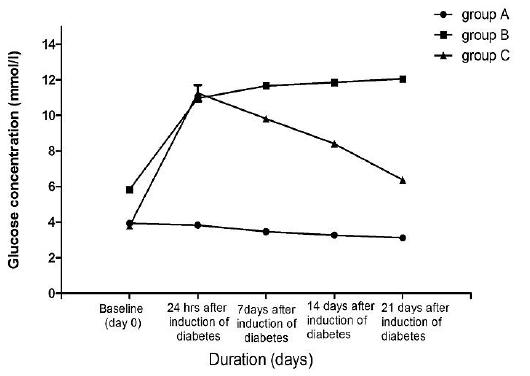
ANOVA indicated no significant differences were observed in glucose level (F =1.72; P>0.05) among the three groups at baseline. In contrast, significant differences were found in glucose level among the 3 groups on day 1 (F=634.59; P<0.0001); day 7 (F=2987.0; P<0.0001); day 14 (F = 7221.11; P<0.0001) and day 21 (F = 5535.90; P<0.0001) due to alloxan-induced diabetes in groups B and C (Figure-2). As expected, post-hoc comparative analysis further revealed that groups B and C had significantly higher (P<0.0001) glucose levels compared to group A on days 1, 7, 14 and 21 days of experiment respectively. Furthermore, significantly lower (P<0.001) mean glucose levels were observed in group C compared to group B on days 7, 14, and 21 but not on day 1. These data suggest that glycemic levels remained unchanged from baseline to end of experiment in control group A; increased from baseline till end of experiment in group B; increased after induction of diabetes but declined after commencement of treatment till end of experimental in group C (Figure-1).
Analysis of variance (ANOVA) indicated lack of significant differences in body weight among the 3 groups of rats at baseline (F = 0.91; P>0.05) and on day 1 (F = 3.04; P>0.05) respectively (Figure-2).
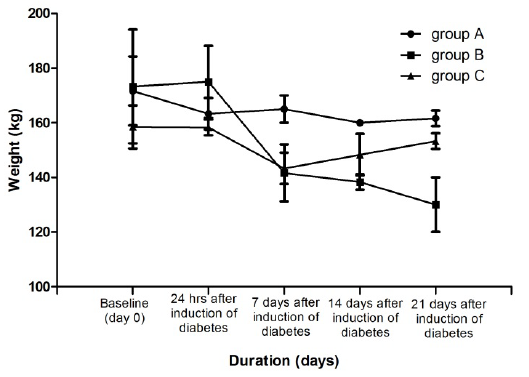
However, significant differences in weight were observed among the 3 groups on day 7 (F=9.15; P<0.05), day 14 (F=15.87; P<0.01) and day 21 (F=20.78; P<0.01) respectively. Post-hoc comparative analysis further indicated that the mean weight of group A was significantly higher (P<0.05 or P<0.01) compared to those of groups B and C respectively on days 7, 14 and 21. In addition, the mean body weight of group B was significantly lower (P<0.05) compared to group C on day 21. In contrast, no significant differences were observed in body weight between group B and group C on days 7 and 14 respectively.
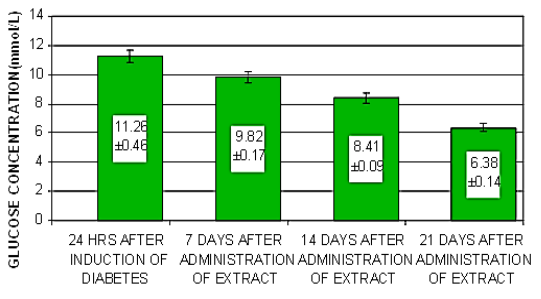
Figure-3 indicates that glycemic level declined with increasing period of administration of extract in group C diabetic rats treated with kola extract. ANOVA test indicates significant differences (F=192.56; P<0.0001) in the glucose level across the study periods. Data shows that glucose level 24 hrs after induction of diabetes was significantly higher (P<0.001) compared to the intervals of 7days, 14 days and 21 days after administration of extract. The same trend was observed when mean glucose level at 7 days interval was compared with those of 14 and 21 days respectively. In addition mean glucose level after 14 days of treatment with extract was significantly higher than that of 21 days.
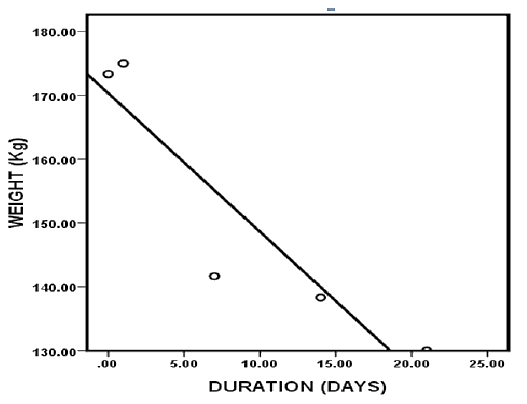
Linear regression analysis indicated significant negative association (R = -0.921; P<0.05) between mean weight and duration. This shows that mean weight of diabetic non-treated rats declined with increase in duration of study.
Discussion
Hyperglycemia gives rise to many complications of diabetes. Therapeutic intervention of diabetes is aimed at reducing and/or avoiding constant hyperglycemia using hypoglycemic agents and insulin. Blood glucose level in diabetic rats treated with Garcinia kola extract was observed to decrease significantly as the study duration increases while the untreated diabetic rats showed geometric increase in blood glucose level with increase in study duration. This shows that Garcinia kola extract possesses hypoglycemic property.
Our finding agrees with the study of Azu et al, (13) which showed that Garcinia kola extract significantly lowered blood glucose in alloxan induced diabetic rats. It also agrees with the study of Omage et al (14) in showing the hypoglyceamic effect of Garcinia kola though the rats were not diabetically induced. The work of Azu et al, (13) differentiated the level of hypoglyceamic effect of Garcinia kola among normoglycemic, hyperglycaemic and alloxan-induced diabetic rats and found out that the extract of the seeds of Garcinia kola produced significant blood glucose-lowering effects in normoglycaemic, hyperglycaemic and in alloxan-induced diabetic rats. The extract was more effective in reducing the blood glucose concentrations of diabetic rats than in reducing the blood glucose concentrations of normoglycaemic rats.
Alloxan causes diabetes in rat by damaging the insulin-secreting cells of the pancreas leading to hyperglycaemia (20, 21). Garcinia kola seed contains kolaviron which contains biflavonoids. These active compounds are believed to lower blood glucose level in diabetic rats through the following; promotes the transportation of glucose into cells, increases glycolysis by stimulating and activating the glycolytic enzymes, enhance glycogenesis by stimulating and activating glycogenic enzymes, promotes glucose utilization in extra hepatic tissues and/or increase the expression of insulin receptors in the liver plasma membranes. Our findings do not support the study of Thomas et al that Garcinia kola seed showed elevated blood glucose levels in normoglycaemic rats. The present finding is in agreement with the findings of Udenze et al, (9) which reported that Garcinia kola is an antidiabetic, antilipidemic and anti-atherogenic agent with a tremendous potential to protect against coronary heart disease.
Alloxan induced diabetes significantly decreases body weight of the diabetic untreated rat as the study duration increase compared with the diabetic treated and normal control rats. Alloxan induced diabetes causes a significant loss in body weight while treatment with Garcinia kola extract restores the body weight. Diabetes is accompanied with increased glycogenolysis, lipolysis, gluconeogenesis and these biochemical activities result in muscles wasting and loss of tissue protein. Garcinia kola is seen to prevent these changes and thus restore the body weight of the diabetic treated rats. This finding is similar to previous studies (15–18) involving the use of glibenclamide in the treatment of diabetes. Daye et al, (16) reported that glibenclamide suppressed the decrease in the body weight and while the suppression of weight loss in our study was achieved using Garcinia kola extract. This shows that Garcinia kola has the same function as glibenclamide used in the treatment of diabetes. Just like (17) observed that the diabetic non treated rats looked ill, polydipsia, the relative weights of kidney and liver were increased and the weight of pancreas was unaffected; our diabetic untreated rats showed similar sign of ill looking and polydipsia though their kidney, liver and pancreas were not weighed.
Garcinia kola extract has shown to be a potential agent for the treatment of diabetes mellitus and restoration of body weight loss in alloxan induced diabetic rats.
Declarations
- Author contributions (CRediT)
- All authors contributed equally to all 14 CRediT roles (Conceptualization, Data curation, Formal analysis, Funding acquisition, Investigation, Methodology, Project administration, Resources, Software, Supervision, Validation, Visualization, Writing – original draft, Writing – review & editing).
- Funding
-
Funding information was not reported in the published version of this article.
- Conflicts of interest
- A conflict of interest statement was not reported in the published version of this article.
- Ethics approval
- Ethics approval details were not reported in the published version of this article.
- Data availability
- A data availability statement was not reported in the published version of this article.
References (21)
12 of 21 references are linked to their DOI.
- WHO Diabetes Fact sheet N°312". October 2013. Retrieved 23 March 2015. PubMed Google Scholar
- Jenson T, Stender DT. Abnormalities in plasma concentration of lipoprotein and fibrinogen in type 1 diabetics with increased urinary albumin excretion. Diabetology 1998; 31:142-145. PubMed Google Scholar
- Mazumder PM, Farswan M, Parcha V. Effect of an isolated active compound (Cg-1) of Cassia glauca leaf on blood glucose, lipid profile and atherogenic index in diabetic rats. Indian J. Pharmacol 2009; 41:182-186. DOI Crossref PubMed Google Scholar
- Adesanya QA, Oluyemi KA et al. Micromorphometric and stereological effects of ethanolic extracts of Garcinia cambogia seeds on the testes and Epididymides of adult Wistar Rats. The Internet Journal of Alternative Medicines 2007; 5(1):22-34. DOI Crossref PubMed Google Scholar
- Okwu DE. Phytochemical, Vitamins and Mineral contents of two Nigerian medicianal plants. Int J Mol Med and Adv Sci 2005; 1(4):375-381. PubMed Google Scholar
- Nzegbule E, Mbakwe R. Effect of pre-sowing and incubation treatment on Germination of Garcinia Kola Heckel seed. Fruita 2001; 56:437-442. DOI Crossref PubMed Google Scholar
- Ofor CC, Oguwike FN, Onubueze DPM, Olisa MC. Effects of Bitter Cola (Garcinia Kola) On Haemostatic and Biochemical Indiced Male Diabetic Albino Wistar Rats. IOSR Journal of Dental and Medical Sciences (IOSR-JDMS) 2013; 11(3):53-57. DOI Crossref PubMed Google Scholar
- Adaramoye OA. Antidiabetic effect of kolaviron, a biflavonoid complex isolated from Garcinia kola seeds in Wistar rats. Afr Health Sci 2012; 12(4):498-506. DOI Crossref PubMed Google Scholar
- Udenze ECC, Braide VB, Okwesilieze CN, Akuodor GC. Pharmacological Effects of Garcinia kola Seed Powder on Blood Sugar, Lipid Profile and Atherogenic Index of Alloxan-induced Diabetes in Rats. Pharmacologia 2012;3(12):693-699. DOI Crossref PubMed Google Scholar
- Imo Chinedu et al. Acute administration of aqueous extract of Garcinia kola on daily blood glucose level and selected biochemical indices in longevity wistar albino rats. International Journal of Microbiology and Mycology 2013;1(2):7-12. PubMed Google Scholar
- Thomas BO, Ibeabuchi NM et al. Effects of Garcinia kola on glucose metabolism in rats. 9th Scientific Congress of anatomical Society of West Afric 2000, Ibadan, Nigeria. PubMed Google Scholar
- Adaramoye OA, Adeyemi EO, Emerole GO (2003) Evaluation of hypoglycemic and anti-hyperglycemic activities of flavonoids from Garcinia kola seeds in rats. 7th Pan Arab conference on Diabetes, Cairo, Egypt. PubMed Google Scholar
- Azu OO, Osinubi AA, Noronha CC, Okanlawon AO. Hypoglycaemic Activities of Extract of Garcinia Kola Seeds in Normal, Hyperglycaemic and Alloxan-Induced Diabetic Rats. West Africa Journal of Anatomy 2005;8:141-149. PubMed Google Scholar
- Omage Kingsley, Idokpesi O Georginah, Josiah J Sunday et al. Evaluation of hypoglycemic and antioxidant properties of aqueous extract of Garcinia kola seeds in wister rats. Research Journal of Biological Sciences 2010;5(10):647-647. DOI Crossref PubMed Google Scholar
- Akbarzadeh A, Norouzian D, Mehrabi MR, Jamshidi SH, Farhangi A, Allah Verdi A, Mofidian SMA, Lame Rad B. Induction of diabetes by streptozotocin in rats. Indian Journal of Clinical Biochemistry 2007;22(2):60-64. DOI Crossref PubMed Google Scholar
- Daye Cheng, Bin Liang, Yunhui Li. Antihyperglycemic Effect of Ginkgo biloba Extract in Streptozotocin-Induced Diabetes in Rats. BioMed Research International Volume 2013; Article ID 162724, 7 pages. DOI Crossref PubMed Google Scholar
- Muhammad Zafar, Syed Naeem-ul-Hassan Naqv. Effects of STZ-Induced Diabetes on the Relative Weights of Kidney, Liver and Pancreas in Albino Rats: A Comparative Study. Int. J. Morphol 2010;28(1):135-142. DOI Crossref PubMed Google Scholar
- Okon UA, Owo DU, Udokang NE, Udobang JA, Ekpenyong CE. Oral Administration of Aqueous Leaf Extract of Ocimum Gratissimum Ameliorates Polyphagia, Polydipsia and Weight Loss in Streptozotocin-Induced Diabetic Rats. American Journal of Medicine and Medical Sciences 2012;2(3): 45-49. PubMed Google Scholar
- WHO. Expert Committee on Diabetes Mellitus, Technical Report Series World Health Organization 1980, Geneva. PubMed Google Scholar
- Ewenighi CO, Dimkpa U, Adejumo B I, Onyeanusi JC, Onoh L U M, Ezeugwu U, Onoh G O, Uzor S, Orji E, Anojulu A. Estimation of lipid profile and glucose level in alloxan-induced diabetic rats treated with Cymbopogon citratus (lemongrass). J Exp Integr Med 2013;3(3):249-253. DOI Crossref PubMed Google Scholar
- Lenzen S. The mechanisms of alloxan and streptozotocin induced diabetes. Diabetologica 2008;51:216-226. DOI Crossref PubMed Google Scholar
Respond to this article
Comments on a published article are welcome as a Letter to the Editor.
Get an e-mail when new articles in your fields are published
Questions to the authors
Questions are moderated: an editor approves each question, the authors answer, and an editor approves the answer before both appear here.
No answered questions yet.
Ask the authors a question
Discussion
Comments are moderated: they appear after the writer confirms the e-mail address and an editor approves them. Each comment carries a conflict-of-interest statement.
No comments yet.
Write a comment
Read the full text
Open the PDF here
Loading the PDF…
If the PDF does not show here, use the download button above.
How to cite this article
Ewenighi C, Dimkpa U, Onyeanusi J, Onoh L, Onoh G, Ezeugwu U. Estimation of glucose level and body weight in Alloxan Induced Diabetic Rat treated with Aqueous extract of Garcinia Kola Seed. Ulutas Med J. 2015;1(2):26-30. doi:10.5455/umj.20150507042420
Ewenighi, C., Dimkpa, U., Onyeanusi, J., Onoh, L., Onoh, G., & Ezeugwu, U. (2015). Estimation of glucose level and body weight in Alloxan Induced Diabetic Rat treated with Aqueous extract of Garcinia Kola Seed. The Ulutas Medical Journal, 1(2), 26–30. https://doi.org/10.5455/umj.20150507042420
Ewenighi, C. et al. (2015) 'Estimation of glucose level and body weight in Alloxan Induced Diabetic Rat treated with Aqueous extract of Garcinia Kola Seed', The Ulutas Medical Journal, 1(2), pp. 26–30. doi: 10.5455/umj.20150507042420.
@article{umj187367,
  title = {Estimation of glucose level and body weight in Alloxan Induced Diabetic Rat treated with Aqueous extract of Garcinia Kola Seed},
  author = {Ewenighi, Chinwe and Dimkpa, Uchechukwu and Onyeanusi, Joel and Onoh, Linus and Onoh, Gladys and Ezeugwu, Uchechukwu},
  journal = {The Ulutas Medical Journal},
  year = {2015},
  volume = {1},
  number = {2},
  pages = {26--30},
  doi = {10.5455/umj.20150507042420},
  url = {https://www.ulutasmedicaljournal.com/?mno=187367},
  issn = {2149-388X}
}