The Ulutas Medical Journal · ISSN 2149-0430 (print), 2149-388X (online) · https://www.ulutasmedicaljournal.com/?mno=254958
Original Article · Open access
Assessment of Micronutrients, Cortisol, and Blood Pressure in Pregnant Women Attending a Healthcare Facility
Also available in: العربية · Türkçe · 中文
- Department of Medical Laboratory Science Chukwuemeka Odumegwu Ojukwu University Igbariam Campus, Anambra State, Nigeria. ROR
- Department of Obstetrics and Gynecology, Federal Teaching Hospital, Owerri Imo State, Nigeria. ROR
- Department of Medical Microbiology Chukwuemeka Odumegwu Ojukwu University Awka Campus, Anambra State, Nigeria. ROR
- Department of Chemical Pathology Chukwuemeka Odumegwu Ojukwu University Awka Campus, Anambra State, Nigeria. ROR
Abstract
- Background
- The study aims to assess serum iron, zinc, and selenium concentrations, cortisol levels, and blood pressure measurements in pregnant and non-pregnant women, and to examine variations in these parameters among pregnant women by maternal age, trimester of gestation, and adherence to routine antenatal medication.
- Materials and Methods
- In this cross-sectional study conducted at Iyi-Enu Mission Hospital, 102 pregnant and 80 age-matched non-pregnant women (18–43 years) were studied. Fasting serum iron, zinc, and selenium levels were measured by atomic absorption spectrophotometry, cortisol levels were measured by competitive ELISA, and blood pressure was measured using a sphygmomanometer. Pregnant participants were further stratified by age group (18–26, 22–35, 36–43 years), trimester (first, second, third), and adherence to routine antenatal medications (always vs. not always).
- Results
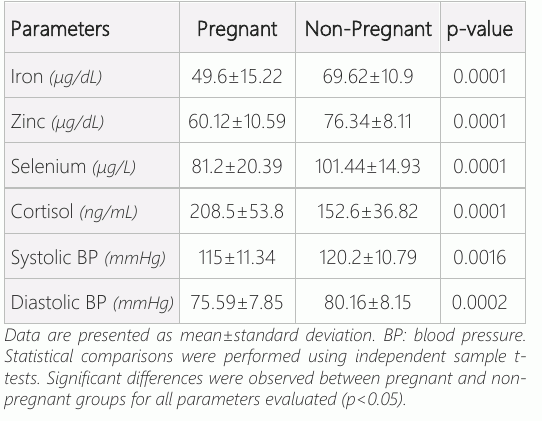
- Compared to controls, pregnant women exhibited lower levels of serum iron (49.7±15.2 vs. 69.6±10.9 μg/dL), zinc (60.1±10.6 vs. 76.3±8.1 μg/dL), and selenium (81.2±20.4 vs. 101.4±14.9 μg/L), higher cortisol (208.5±53.8 vs. 152.6±36.8 ng/mL) and elevated systolic and diastolic blood pressures (p<0.05). Within the pregnant group, no differences were observed by age or trimester (p>0.05). Medication adherence did not affect micronutrient or blood pressure levels; however, women who were always adherent had higher cortisol levels than those who were not adherent (p=0.047).
- Conclusions
- Pregnancy induces substantial changes in micronutrient levels, cortisol, and blood pressure in this population, whereas maternal age, gestational stage, and adherence to routine medication have minimal influence. These findings highlight the importance of targeted nutritional and clinical monitoring during antenatal care.
Keywords
Full text
Introduction
Micronutrient deficiencies represent a critical global public health challenge, particularly among pregnant women in low- and middle-income countries. Iron deficiency anemia affects approximately 37% of pregnant worldwide reflecting substantial gaps in hemoglobin synthesis and oxygen transport capacity (1). In some regions, multiple micronutrient deficiency and anemia prevalence among expectant mothers exceed 50%, with concurrent deficits in zinc and selenium observed across trimesters (2), exacerbating risks for adverse outcomes. These deficits have been consistently linked to maternal morbidity, including anemia and hemorrhage, and to negative fetal endpoints such as preterm birth, low birth weight, and impaired neurodevelopment (3).
Iron mineral is indispensable for fetal neurodevelopment: it underpins neurotransmitter synthesis, myelination, cellular differentiation in the developing brain and early-life iron underloading has been shown to produce long-term neurobehavioral deficits (4). Zinc functions in cell proliferation, DNA replication and immune competence. Maternal zinc deficiency is associated with fetal growth restriction, congenital anomalies, and a small but significant increase in preterm birth risk (5). Selenium, as a cofactor for glutathione per-oxidases and other selenoproteins, is vital for antioxidant defense in both mother and fetus; low maternal selenium may depict oxidative stress as can be found in preeclampsia (6). Cortisol, the primary glucocorticoid secreted by the maternal adrenal cortex, increases throughout pregnancy due to elevated corticosteroid-binding globulin levels and heightened hypothalamic pituitary axis (HPA) activity. Hypertensive disorders remain a leading cause of maternal and perinatal mortality. Hypertensive disorders of pregnancy constitute a leading cause of maternal and perinatal mortality worldwide (7).
In Nigeria, few studies have concurrently evaluated the full spectrum of micronutrient status, cortisol levels, and blood pressure in pregnant women. Understanding the interplay between micronutrient status, maternal cortisol, and blood pressure is essential for tailoring interventions to optimize both maternal and fetal health outcomes in this region. Therefore, this study aims to assess and compare serum iron, zinc, and selenium concentrations, cortisol levels, and blood pressure measurements in pregnant and non-pregnant women, and to examine variations in these parameters among pregnant women by maternal age group, trimester of gestation, and adherence to routine antenatal medication.
Materials and methods
Study Design and Setting
A hospital-based cross-sectional study was conducted at Iyi-Enu Mission Hospital, Ogidi, Anambra State, Nigeria, between January and July 2023. Pregnant women attending the antenatal clinic and age-matched non-pregnant controls were recruited for the study.
Subjects
This comprised 102 pregnant and 80 non-pregnant women, aged 18–43 years, who were recruited by simple random sampling from the sampling frame of all consenting attendees during the study period. Consenting females with no chronic illnesses (e.g., diabetes, hypertension, etc.) were included in the study, while those on antihypertensive therapy, micronutrient supplements, or glucocorticoids were excluded from the study.
Sample Collection
Fasting venous blood (5 mL) was drawn from the antecubital vein into plain tubes, allowed to clot at room temperature for 30 minutes, and centrifuged at 3000g for 5 minutes. Sera obtained were used for biochemical analyses.
Biochemical Assays
Serum iron, zinc, and selenium concentrations were measured using atomic absorption spectrophotometry following standardized protocols according to the method of American Public Health Association (8). Cortisol was measured by enzyme-linked immunosorbent assay (ELISA) kit (Abcam, ab108665) according to the manufacturer’s instructions Blood Pressure Measurement Systolic and diastolic blood pressures were obtained in the seated position after a 5-minute rest by sphygmomanometer and stethoscope. The cuff was positioned at heart level, with readings taken twice at 1-minute intervals and averaged for analysis, following international recommendations for manual blood pressure measurement (9).
Participants Stratification
Pregnant participants were stratified into 3 groups; based on age (18–26 years, 22–35 years, and 36–43 years), gestational stage; (first (≤13 weeks), second (14–27 weeks), and third (≥28 weeks) trimesters), and self-reported adherence to routine antenatal medications (“always adherent” and “not always adherent”).
Ethical Considerations
Ethical approval was obtained from the Research Ethics Committee of the School of Medical Laboratory Technicians, Iyi-Enu Mission Hospital, Ogidi, Anambra State, and all participants provided written informed consent prior to enrollment. All procedures were according to 1975 Helsinki Declaration.
Statistical Analysis
Data were analyzed by Statistical Package for Social Sciences (Chicago, IL, USA) v25. Variables were presented as mean±SD. Independent-samples t-tests were used to compare two independent variables, one-way analysis of variance (ANOVA) was used to compare means across variables, and a post-hoc test was employed for pairwise comparisons. A p-value of <0.05 was considered significant.
Results
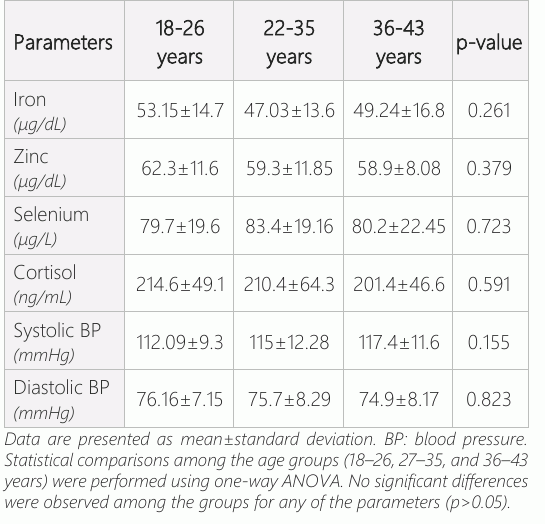
In Table 1, the pregnant group demonstrated significantly lower levels of iron, zinc, and selenium compared to the non-pregnant group (p=0.0001). Additionally, cortisol levels were higher in the pregnant group compared to the non-pregnant group (p=0.0001). Additionally, the systolic and diastolic blood pressure values were lower in the pregnant women compared to their non-pregnant counterparts (p=0.0002). In Table 2, no significant differences (p>0.05) were observed in micronutrients, cortisol, and blood pressure across the age brackets (18–26 years, 22–35 years, and 36–43 years).
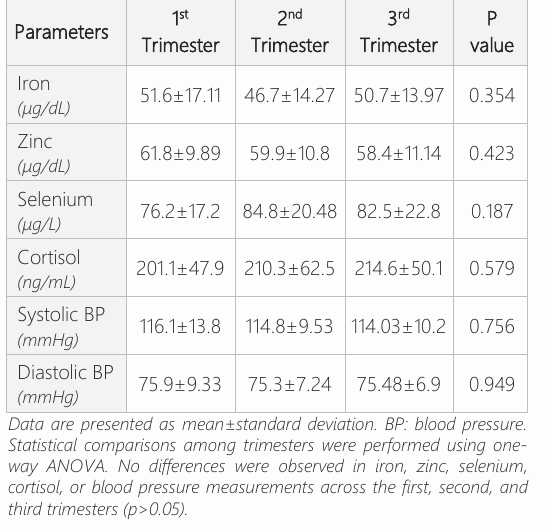
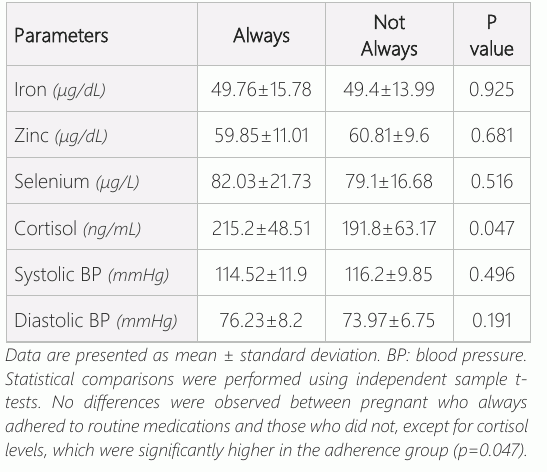
The comparison across pregnancy trimesters also yielded no significant differences (p>0.05), as shown in Table-3. Among the pregnant women, cortisol was higher in those who reported always adhering to their routine medications compared to those who did not always take their routine drugs (p=0.0474). However, other parameters, including iron, zinc, selenium levels, and blood pressure, showed no differences based on medication adherence (p>0.05).
Discussion
The study examined the levels of selenium, zinc, iron, cortisol and blood pressure in pregnant women attending a healthcare facility in Anambra State. From the findings, selenium, zinc, and iron levels were lower in pregnant women compared to non-pregnant women, emphasizing the role of dietary intake and supplementation in mitigating deficiencies. Selenium and zinc are critical for antioxidant defense and immune function, which are vital during pregnancy. The observed lower levels may be attributed to the physiological demands of these micronutrients during pregnancy, characterized by increased requirements for micronutrients to support fetal development, maternal tissue growth, and placental function. Alongside selenium, sufficient zinc intake plays a critical role in supporting successful embryo-genesis and lowering the likelihood of preterm birth (10). These results align with those of Iqbal et al. (3) and Ilechukwu et al. (6), who also reported lower selenium and zinc in pregnant women. Joseph et al., similarly, observed lower zinc levels but higher selenium levels in women at the late stage of pregnancy (11), while Karita et al. did not observe any differences in the plasma selenium levels of pregnant and non-pregnant Japanese women (12).
During pregnancy, the increased iron requires often exceed what can be obtained from dietary alone, making expectant mothers more susceptible to iron deficiency anaemia. Iron deficiency is common due to expanded blood volume and increased iron utilization for erythropoiesis and fetal needs. This explains the lower iron levels observed in pregnant women in the present study, which corroborates the study done by Aloy-Amadi et al. on pregnant women in Nnewi, Anambra State (13). Lower levels of hemoglobin, an iron-rich protein found in red blood cells have also been reported in pregnant women (14). However, Ezeugwunne et al. in their study did not observe any differences in the mean hemoglobin of pregnant women compared to the non-pregnant in Nnewi, Anambra State (15). The differences in the reported results may be due to nutritional status, environmental factors or population characteristics. Findings underscore importance of adequate micronutrient intake during pregnancy to prevent complications such as oxidative stress, anemia, and impaired fetal growth.
The higher cortisol levels in pregnant women can be attributed to the physiological stress of pregnancy and the activation of the HPA axis. Cortisol plays a vital role in fetal development, particularly in lung maturation and, regulation of metabolism. However, excessive cortisol may have adverse effects, including increased risk of gestational diabetes and hypertension. The finding is consistent with that of Vrijkotte et al., who also observed higher cortisol levels in pregnant women from 5 to 20 weeks of gestation (16).
The lower systolic and diastolic blood pressure observed in pregnant women compared to non-pregnant women may reflect the hemo-dynamic changes during pregnancy. Zhang et al. observed a decrease in blood pressure during early pregnancy, followed by a gradual increase in the mid and late stages of pregnancy (17). The decrease is usually associated with vasodilation and decreased peripheral vascular resistance (18). These changes are considered adaptive mechanisms to meet the circulatory demands of pregnancy. However, deviations from the normal pattern can have significant implications for maternal and fetal health. Ezeugwunne et al., however, observed higher systolic and diastolic pressures in pregnant women compared to the control group (15). There was a remarkable consistency in micronutrients, cortisol, and blood pressure levels among pregnant women across different maternal ages, trimesters, and medication adherence categories, with a notable exception in cortisol level, which was significantly higher in pregnant women who took their routine drugs regularly. This consistency can be attributed to body homeostatic mechanisms, which regulate these parameters to meet the physiological demands of pregnancy. Regardless of age, the gradual physiological changes throughout pregnancy likely allowed for balanced adaptations, minimizing variations across trimesters. For women who occasionally skipped medications, compensatory nutrient-rich diets or baseline nutrient sufficiency could have mitigated any significant deficits. Similarly, the observed stability in pressure may reflect the effectiveness of cardiovascular adaptations during pregnancy, which maintain equilibrium despite differences in these variables. On the contrary, Ezeugwunne et al. found higher systolic and diastolic blood pressure values in 6-9 months compared to 3-5 months (15). Aloy-Amadi et al. reported that serum iron decreased with increased gestational age and decreased progressively in each trimester (13). The difference in cortisol based on medication adherence highlights the importance of consistent prenatal care. Pregnant women who adhered to their medication regimen exhibited higher cortisol levels, which may reflect better physiological adaptation to pregnancy. Non-adherence could contribute to suboptimal health outcomes, including stress-related complications. The higher cortisol in pregnant women who consistently take their routine medications compared to those who do not could reflect better physiological adaptation to pregnancy. Regular medication adherence, including prenatal supplements, may optimize nutritional status and support the HPA axis, enhancing cortisol production essential for fetal development. Moreover, consistent medication use might synchronize hormonal responses, contributing to elevated cortisol as part of the body's natural stress regulatory mechanisms. Therefore, healthy and moderate levels of glucocorticoids were related to an adequate development of cognitive and emotional brain networks during certain sensitive periods (19), since these levels are not considered harmful for the infant.
Conclusion
The findings of the present study underscore the need for targeted interventions to address micronutrient deficiency and optimize maternal health. The prenatal supplementation, dietary counseling, and regular monitoring of micronutrients should be integral components of antenatal care. Future research should explore long-term effects of micronutrient deficiencies on maternal and child health, as well as the efficacy of the supplementation programs in diverse populations.
Declarations
- Author contributions (CRediT)
- All authors contributed equally to all 14 CRediT roles (Conceptualization, Data curation, Formal analysis, Funding acquisition, Investigation, Methodology, Project administration, Resources, Software, Supervision, Validation, Visualization, Writing – original draft, Writing – review & editing).
- Funding
-
Funding information was not reported in the published version of this article.
- Conflicts of interest
- The authors reported no conflicts of interest.
- Ethics approval
- Ethical approval was obtained from the Research Ethics Committee of the School of Medical Laboratory Technicians, Iyi‐ Enu Mission Hospital, Ogidi, Anambra State, and all participants provided written informed consent prior to enrollment. All procedures were according to 1975 Helsinki Declaration.
- Data availability
- A data availability statement was not reported in the published version of this article.
References (19)
13 of 19 references are linked to their DOI.
- World Health Organization. Anaemia. Geneva: WHO; 2025 [updated February 10, 2025; Accessed April 26, 2025]. Available from: https://www.who.int/news-room/fact-sheets/ detail/anaemia. PubMed Google Scholar
- Gopal M, Sunitha K, Arockiasamy J, Sibqathulla MJ, Yuvaraj J, Kalyanaraman S. Micronutrient deficiency in pregnancy: time to think beyond iron and folic acid supplementation. Indian J Community Med 2022;47(3):425-8. DOI Crossref PubMed Google Scholar
- Iqbal S, Ali I, Rust P, Kundi M, Ekmekcioglu C. Selenium, zinc, and manganese status in pregnant women and its relation to maternal and child complications. Nutrients 2020;12(3):725. DOI Crossref PubMed Google Scholar
- Georgieff MK. The importance of iron deficiency in pregnancy on fetal, neonatal and infant neurodevelopmental outcomes. Int J Gynaecol Obstet 2023;162 Suppl 2:83-8. DOI Crossref PubMed Google Scholar
- Chaffee BW, King JC. Effect of zinc supplementation on pregnancy and infant outcomes: a systematic review. Paediatr Perinat Epidemio. 2012;26 Suppl 1:118-37. DOI Crossref PubMed Google Scholar
- Ilechukwu OU, Onuegbu JA, Olisekodiaka JM, Obi-Ezeani CN. Evaluation of plasma selenium, zinc, and PubMed Google Scholar
- Karrar SA, Martingano DJ, Hong PL. Preecla mpsia [Internet]. Treasure Island: StatPearls Publishing; April 26, 2025]. Available from: https://ncbi.nlm.nih.gov/books/NBK570611 PubMed Google Scholar
- American Public Health Association. Direct Air-Acetylene Flame Method: Standard Methods for the Examination of Metals in Blood. 20th ed. Washington (DC): American Public Health Association; 1995. PubMed Google Scholar
- Pickering TG, Hall JE, Appel LJ, et al. Recommendations for blood pressure measurement in humans: an AHA scientific statement from the Council on High Blood Pressure Research Professional and Public Education Subcommittee. J Clin Hypertens 2005;7(2):102-9. DOI Crossref PubMed Google Scholar
- Terrin G, Canani RB, Di Chiara M, Pietravalle A, Aleandri V, Conte F, et al. Zinc in early life: a key element in the fetus and preterm neonate. Nutrients 2015;7:10427 -46. DOI Crossref PubMed Google Scholar
- Joseph GU, Oyediran OT, Oladiti RA, Iyanda AA. Investigation of serum trace element levels of Nigerian women at a late stage of pregnancy. J Integr Health Sci 2023;11(2):99-103. DOI Crossref PubMed Google Scholar
- Karita K, Takano T, Satoh K, Suzuki T. Variations in plasma selenium levels as a result of the menstrual cycle and pregnancy in healthy Japanese women. Biol Trace Elem Res 2004;99(1-3):83-91. DOI Crossref PubMed Google Scholar
- Aloy-Amadi O, Akujobi AU, Nnodim J, Ndudim-Dike J, Edward A, Anokwute M. Serum ferritin and iron/TIBC of pregnant women attending Nnamdi Azikiwe University Teaching Hospital, Nnewi, Anambra State, Nigeria: a longitudinal study. Clin Res Obstet Gynecol 2020;3(2):1-6. PubMed Google Scholar
- Michael OA, Theresa OA, Tyodoo MM. Haematological indices of Nigerian pregnant women. J Blood Lymph 2017;7(1):1000159. DOI Crossref PubMed Google Scholar
- Ezeugwunne IP, Ogbodo EC, Aghara OA, Odumodu IO, Analike RO, Onuora IJ, et al. Assessment of the levels of fasting blood sugar, hemoglobin, proteinuria, and blood pressure in pregnant women in Nnewi, Anambra State, South East Nigeria. Saudi J Biomed Res 2018;3(6):169-74. PubMed Google Scholar
- Vrijkotte TGM, de Rooij SR, Roseboom TJ, Twickler THB. Maternal serum cortisol levels during pregnancy differ by fetal sex. Psychoneuroendocrinology 2023;149: 105999. DOI Crossref PubMed Google Scholar
- Zhang K, Wei X, Zhao H. Study on the regularity of blood pressure changes in pregnant women and its influencing factors. BMC Pregnancy Childbirth 2025;25:268. DOI Crossref PubMed Google Scholar
- Sanghavi M, Rutherford JD. Cardiovascular physiology of pregnancy. Circulation 2014;130(12):1003-8. DOI Crossref PubMed Google Scholar
- Davis EP, Head K, Buss C, Sandman CA. Prenatal maternal cortisol concentrations predict neuro development in middle childhood. Psychoneuro endocrinology 2017;75:56-63. DOI Crossref PubMed Google Scholar
Respond to this article
Comments on a published article are welcome as a Letter to the Editor.
Get an e-mail when new articles in your fields are published
Questions to the authors
Questions are moderated: an editor approves each question, the authors answer, and an editor approves the answer before both appear here.
No answered questions yet.
Ask the authors a question
Discussion
Comments are moderated: they appear after the writer confirms the e-mail address and an editor approves them. Each comment carries a conflict-of-interest statement.
No comments yet.
Write a comment
Tell me when this article is cited
Leave your e-mail address and confirm it. These notices are not being sent yet; your confirmed address is kept for them and used for nothing else.
Read the full text
Open the PDF here
Loading the PDF…
If the PDF does not show here, use the download button above.
How to cite this article
Obi-ezeani CN, Onuora IJ, Onyegbule OA, Nnoruka EO, Afulukwe SC, Onuike AL, et al. Assessment of Micronutrients, Cortisol, and Blood Pressure in Pregnant Women Attending a Healthcare Facility. Ulutas Med J. 2025;11(2):34-40. doi:10.5455/umj.20250428092346
Obi-ezeani, C. N., Onuora, I. J., Onyegbule, O. A., Nnoruka, E. O., Afulukwe, S. C., Onuike, A. L., & Umeaba, G. N. (2025). Assessment of Micronutrients, Cortisol, and Blood Pressure in Pregnant Women Attending a Healthcare Facility. The Ulutas Medical Journal, 11(2), 34–40. https://doi.org/10.5455/umj.20250428092346
Obi-ezeani, C.N. et al. (2025) 'Assessment of Micronutrients, Cortisol, and Blood Pressure in Pregnant Women Attending a Healthcare Facility', The Ulutas Medical Journal, 11(2), pp. 34–40. doi: 10.5455/umj.20250428092346.
@article{umj254958,
  title = {Assessment of Micronutrients, Cortisol, and Blood Pressure in Pregnant Women Attending a Healthcare Facility},
  author = {Obi-ezeani, Chikaodili Nwando and Onuora, Ifeoma Joy and Onyegbule, Onyema Athanasius and Nnoruka, Eugenia Obiageli and Afulukwe, Stella Chinyere and Onuike, Amuche Lilian and Umeaba, Georgina Nwabugo},
  journal = {The Ulutas Medical Journal},
  year = {2025},
  volume = {11},
  number = {2},
  pages = {34--40},
  doi = {10.5455/umj.20250428092346},
  url = {https://www.ulutasmedicaljournal.com/?mno=254958},
  issn = {2149-388X}
}