The Ulutas Medical Journal · ISSN 2149-0430 (print), 2149-388X (online) · https://www.ulutasmedicaljournal.com/?mno=218974
Original Research · Open access
Lymph Node Yield in Laparoscopic Total Mesorectal Excision: Our Clinical Experience
Also available in: العربية · Türkçe · 中文
Abstract
- Introduction
- Over the years, with advances in minimally invasive surgery, laparoscopic TME has been more widely performed for the surgical treatment of rectal cancer. In addition to the well known advantages of laparoscopic surgery, there is also evidence that it is not oncologically inferior to open approach in the management of colorectal cancers. In the present study, we discuss our results for lymph node yield in laparoscopic total mesorectal excision for the malignant diseases of the rectum and the sigmoid colon.
- Method
- We retrospectively collected the data from laparoscopic operations for malignant diseases of the rectum and the sigmoid colon. All laparoscopic anterior resection, low anterior resection and abdominoperineal resection procedures performed between 2009 and 2015 in the Istanbul Training and Research Hospital General Surgery Clinic were included. The results were analyzed and compared with the literature.
- Results
- A total of 75 laparoscopic procedures for sigmoid colon and rectum cancers were performed in our clinic. The average lymph node yield was 17.5 (±8.4) and average metastatic lymph node was 2.4 (±3.4). There was a positive correlation between lymph node yield and tumor size.
- Conclusion
- In conclusion, laparoscopic TME is a valid option for the treatment of colorectal cancers. In addition to the universal benefits of minimally invasive surgery, laparoscopic approach allows extensive lymph node dissection, addressing oncological concerns surrounding the technique.
Keywords
Full text
Introduction
Rectal cancer is a significant cause of morbidity and mortality worldwide. Although the disease requires a multidisciplinary approach, the standard surgical treatment remains total mesorectal excision (TME) for over 30 years. Resection of the rectum with clear margins and the intact mesorectum, together with extensive lymph node dissection has been shown to reduce recurrence (1). Over the years, with advances in minimally invasive surgery, laparoscopic TME has been more widely performed for the surgical treatment of rectal cancer. Laparoscopic approach offers the advantage of allowing comprehensive and easy dissection of the mesocolon and mesorectum under direct vision. There is also evidence from numerous prospective randomized studies demonstrating the feasibility, safety and advantages of laparoscopic colorectal surgery. In addition to the well known advantages of laparoscopic surgery, such as shorter hospital stay, lower morbidity and better cosmetic results, there is also evidence that it is not oncologically inferior to open approach in the management of colorectal cancers (2).
In the present study, we discuss our results for lymph node yield in laparoscopic total mesorectal excision for the malignant diseases of the rectum and the sigmoid colon.
Study Design
In our study, we retrospectively collected the data from laparoscopic operations for malignant diseases of the rectum and the sigmoid colon. All laparoscopic anterior resection, low anterior resection and abdominoperineal resection procedures performed between 2009 and 2015 in the Istanbul Training and Research Hospital General Surgery Clinic were included. Demographic data, surgical procedure, tumor stage and lymph node clearance were recorded. The results were analyzed and compared with the literature.
Laparoscopic colorectal surgery was performed using the standard four or five port technique. Preoperative informed consent for the operation was obtained from the patients. If at any point during the operation it was deemed necessary, conversion to open approach was made. Only cases completed using the laparoscopic technique was included in the analysis.
Results
Between January 2009 and January 2015, a total of 75 laparoscopic procedures for sigmoid colon and rectum cancers were performed in our clinic. The mean age was 62.9 (±10.8). Twenty nine patients (38.7%) were female and 46 (61.3%) were male. 63 (84%) of patients had received neoadjuvant therapy.
The surgical procedure was determined according to the location of the tumor: for sigmoid and rectosigmoid tumors, anterior resection was performed (n:39, 52%), for proximal and middle rectal carcinomas, low anterior resection (n:27, %36) and for tumors invading the distal rectum and the anal verge, abdominoperineal resection and Miles procedure (n:9, %12) was performed. The surgery, laparoscopic TME has been more widely performed. As extensive lymph node dissection is a key aspect in the success of average lymph node yield was 17.5 (±8.4) and mean metastatic lymph node was 2.4 (±3.4). The results are summarized in Table-1.
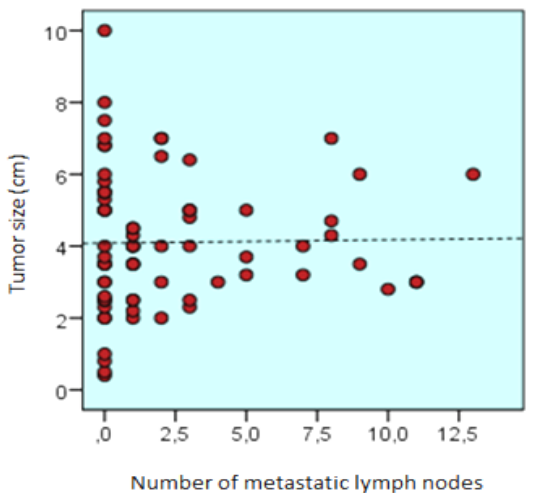
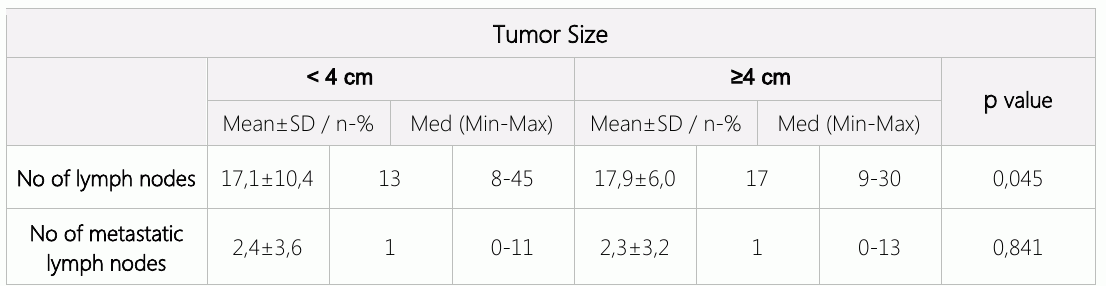
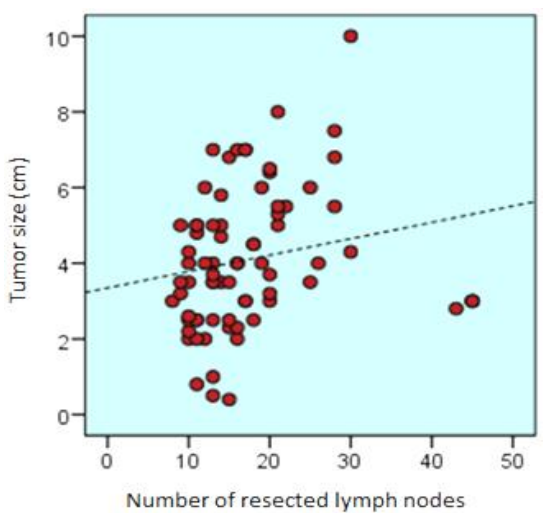
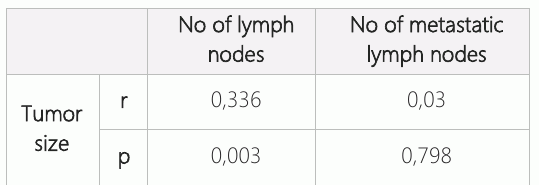
Number of harvested lymph nodes was significantly higher in cases with tumor size ≥4 cm , and there was a positive correlation between lymph node yield and tumor size. On the other hand, no such relationship that reached statistical significance was demonstrated for number of metastatic lymph nodes and tumor size. The lymph node yield and number of metastatic lymph nodes according to tumor size are shown in Table-2 and Spearan Correlation in Table-3. Figure-1 and 2 contain the graphical analyses.
Discussion
TME has been standard surgical treatment for rectal cancer for over 30 years. Over the years, with advances in minimally invasive colorectal surgery, one of the major concerns surrounding laparoscopic colorectal surgery is about whether sufficient lymphatic dissection is possible with this approach. Thus, numerous studies were conducted which compare laparoscopic and open techniques regarding lymph node yield, completeness of mesorectal excision morbidity and survival.
Among randomized trials comparing laparoscopic and open approaches to rectal surgery, Leung et al. reported a mean lymph node yield of 11.1 from 203 laparoscopic operations (3). Braga et al. in a smaller series of 83 patients reported 12.7 nodes (4). Ng et al, in their study with low rectal cancers undergoing abdominoperineal resection published in 2008, compared laparoscopic and open approaches with an average of 12.4 lymph nodes per laparoscopic operation (5). In a more recent study from the same institution, this time including mid level as well as low level rectal cancers, the average number of lymph nodes removed was 17.7 (6).
There are also many non-randomized studies comparing laparoscopic and open rectal surgery. Anthuber et al. have reported 15.3 lymph nodes in 2003 (7). Bretagnol et al have harvested in average 10 nodes per laparoscopic operation (8) and Morino et al 12.4 (9). Average yield in the study of Law et al was found to be 10 lymph nodes (10). Two series of similar size by Lelong et al and Staudacher et al comparing laparoscopic and total mesorectal excision, both published in 2007 report the number of laparoscopically resected lymph nodes as 11 and 14.3, respectively (11, 12). The study of Dural et al from Turkey reports the highest number of resected lymph nodes at 20.7 (13). The results of our analysis from our own clinic are similar with others in the literature. Taking the number of resected lymph nodes as a sign of successful surgery, with 17.5 lymph nodes per operation, we have performed favorably. Our results thus support the point that laparoscopic approach does indeed allow meticulous lymphatic dissection with the added benefit of low surgical morbidity.
Our study has several drawbacks. One of these was that there is no distinction between patients receiving neoadjuvant oncological therapy and those who do not. Neoadjuvant therapy can significantly reduce the number of lymph nodes in the specimen, thus affecting the results. Another drawback was the retrospective descriptive nature of the study only analyzing cases who underwent laparoscopic colorectal surgery instead of comparing laparoscopy and open technique. As discussed previously, the lymph node yield differs very much between different institutions, so comparing the results from different studies would inevitably overlook the effects of surgical experience and the pathological examination process. The finding that the number of total resected lymph nodes was higher in larger tumors despite the number of metastatic nodes not displaying statistical difference was interesting. The sample size might be inadequate for demonstrating any such statistical significance. In conclusion, laparoscopic TME is a valid option for the treatment of colorectal cancers. In addition to the universal benefits of minimally invasive surgery, laparoscopic approach allows extensive lymph node dissection, addressing oncological concerns surrounding the technique.
Declarations
- Author contributions (CRediT)
- All authors contributed equally to all 14 CRediT roles (Conceptualization, Data curation, Formal analysis, Funding acquisition, Investigation, Methodology, Project administration, Resources, Software, Supervision, Validation, Visualization, Writing – original draft, Writing – review & editing).
- Funding
-
Funding information was not reported in the published version of this article.
- Conflicts of interest
- The authors declare no conflicts of interest.
- Ethics approval
- Preoperative informed consent for the operation was obtained from the patients.
- Data availability
- A data availability statement was not reported in the published version of this article.
References (13)
13 of 13 references are linked to their DOI.
- Boutros M, Hippalgaonkar N, Silva E, Allende D, Wexner SD, Berho M. Laparoscopic Resection of Rectal Cancer Results in Higher Lymph Node Yield and Better Short-term Outcomes Than Open Surgery: A Large Single-Center Comparative Study. Dis Colon Rectum 2013;56:679-88 DOI Crossref PubMed Google Scholar
- Pechlivanides G, Gouvas N, Tsiaoussis J. Lymph Node Clearance after Total Mesorectal Excision for Rectal Cancer: Laparoscopic versus Open Approach. Dig Dis 2007;25:94-9. DOI Crossref PubMed Google Scholar
- Leung KL, Kwok SP, Lam SC. Laparoscopic resection of rectosigmoid carcinoma: Prospective randomised trial. Lancet 2004; 363:1187-92. DOI Crossref PubMed Google Scholar
- Braga M, Frasson M, Vignali A, Zuliani W, Capretti G, Di Carlo V. Laparoscopic resection in rectal cancer patients:outcome and cost-benefit analysis. Dis Colon Rectum 2007;50:464-71. DOI Crossref PubMed Google Scholar
- Ng SS, Leung KL, Lee JF, Yiu RY, Li JC, Teoh AY, Leung WW. Laparoscopic-assisted versus open abdominoperineal resection for low rectal cancer: a prospective randomized trial. Ann Surg Oncol 2008;15:2418-25. DOI Crossref PubMed Google Scholar
- Ng SS, Lee JF, Yiu RY. Laparoscopic –assisted versus open total mesorectal excision with anal sphincter preservation for mid and low rectal cancer: a prospective, randomised trial. Surg Endosc 2014;28:297-306. DOI Crossref PubMed Google Scholar
- Anthuber M, Fuerst A, Elser F, Berger R, Jauch KW. Outcome of laparoscopic surgery for rectal cancer in 101 patients. Dis Colon Rectum 2003;46:1047-53. DOI Crossref PubMed Google Scholar
- Bretagnol F, Lelong B, Laurent C. The oncological safety of laparoscopic total mesorectal excision with sphincter preservation for rectal carcinoma. Surg Endosc 2005;19:892-6. DOI Crossref PubMed Google Scholar
- Morino M, Allaix ME, Giraudo G, Corno F, Garrone C. Laparoscopic versus open surgery for extraperitoneal rectal cancer: a prospective comparative study. Ann Surg 2005;242:897-901. Lymph Node Yield in Total Mesorectal Excision Aziz Arı, et al. DOI Crossref PubMed Google Scholar
- Law WL, Lee YM, Choi HK, Seto CL, Ho JW. Laparoscopic and open anterior resection for upper and mid rectal cancer: an evaluation of outcomes. Dis Colon Rectum 2006;49:1108-15. DOI Crossref PubMed Google Scholar
- Lelong B, Bege T, Esterni B. Short-term outcome after laparoscopic or open restorative mesorectal excision for rectal cancer: a comparative cohort study. Dis Colon Rectum 2007;50:176-83. DOI Crossref PubMed Google Scholar
- Staudacher C, Vignali A, Saverio DP, Elena O, Andrea T. Laparoscopic vs. open total mesorectal excision in unselected patients with rectal cancer: impact on early outcome. Dis Colon Rectum 2007;50:1324-31. DOI Crossref PubMed Google Scholar
- Dural AC1, Keskin M, Balik E, Akici M, Kunduz E, Yamaner S, Asoglu O, Gulluoglu M, Bugra D. The role of the laparoscopy on circumferential resection margin positivity in patients with rectal cancer: long-term outcomes at a single high-volume institution. Surg Laparosc Endosc Percutan Tech 2015 Apr;25(2):129-37. DOI Crossref PubMed Google Scholar
Respond to this article
Comments on a published article are welcome as a Letter to the Editor.
Get an e-mail when new articles in your fields are published
Questions to the authors
Questions are moderated: an editor approves each question, the authors answer, and an editor approves the answer before both appear here.
No answered questions yet.
Ask the authors a question
Discussion
Comments are moderated: they appear after the writer confirms the e-mail address and an editor approves them. Each comment carries a conflict-of-interest statement.
No comments yet.
Write a comment
Read the full text
Open the PDF here
Loading the PDF…
If the PDF does not show here, use the download button above.
How to cite this article
Ari A, Buyukasik K, Segmen O, Akkus O, Tatar C. Lymph Node Yield in Laparoscopic Total Mesorectal Excision: Our Clinical Experience. Ulutas Med J. 2016;2(1):36-40. doi:10.5455/umj.20160226125754
Ari, A., Buyukasik, K., Segmen, O., Akkus, O., & Tatar, C. (2016). Lymph Node Yield in Laparoscopic Total Mesorectal Excision: Our Clinical Experience. The Ulutas Medical Journal, 2(1), 36–40. https://doi.org/10.5455/umj.20160226125754
Ari, A. et al. (2016) 'Lymph Node Yield in Laparoscopic Total Mesorectal Excision: Our Clinical Experience', The Ulutas Medical Journal, 2(1), pp. 36–40. doi: 10.5455/umj.20160226125754.
@article{umj218974,
  title = {Lymph Node Yield in Laparoscopic Total Mesorectal Excision: Our Clinical Experience},
  author = {Ari, Aziz and Buyukasik, Kenan and Segmen, Ozgur and Akkus, Onder and Tatar, Cihad},
  journal = {The Ulutas Medical Journal},
  year = {2016},
  volume = {2},
  number = {1},
  pages = {36--40},
  doi = {10.5455/umj.20160226125754},
  url = {https://www.ulutasmedicaljournal.com/?mno=218974},
  issn = {2149-388X}
}