The Ulutas Medical Journal · ISSN 2149-0430 (print), 2149-388X (online) · https://www.ulutasmedicaljournal.com/?mno=215692
Original Research · Open access
Changing of Hemoglobin A1c Affects Mean Platelet Volume in Type-2 Diabetes Mellitus
- Department of Internal Medicine, School of Medicine, The University of Balikesir, Turkey ROR
Abstract
- Background
- Mean platelet volume (MPV) level is known to increase in diabetes mellitus (DM).
- Objective
- In this study, the first aim is to examine whether there is a correlation between MPV and hemoglobin A1c (HbA1c) and fasting plasma glucose (FPG). The second aim is to investigate whether a correlation exists between MPV and HbA1c and FPG changes after treatment Method: In the study, we examined baseline and final HbA1c, MPV and FPGA values of 343 patients. Including the study group (SG) consisted of 169 patients with diabetes whose HbA1c levels decreased %1 and the control group involving 174 patients whose HbA1c levels did not change.
- Results
- Similar to CG, HbA1c level of SG decreased to 7.58, and MPV level reduced to 8.68. There existed a positive correlation between MPV and HbA1c levels (r≤154; p<0.005). Additionally, positive correlation was found between MPV and HbA1c changes (r≤216; p≤0.005), and MPV and FPG changes (r≤245; p≤0.001) in SG. Moreover, there was a positive correlation between MPV and HbA1c changes (r≤306; p<0.005), and MPV and FPG changes (r≤306; p<0.005) in patients underwent insulin treatment.
- Conclusion
- The change in HbA1c level is similar to MPV level change. The effect of insulin therapy on MPV is significant.
Keywords
Full text
Introduction
Diabetes is a disease of metabolism clinically expressed by chronic hyperglycemia and blood lipid and protein disorders that have been extensively reported as linked to several complications causing morbidity and mortality (1). Long-term complications of diabetes include retinopathy with potential loss of vision; nephropathy leading to renal failure; peripheral neuropathy with risk of foot ulcers, amputations, and Charcot joints. In addition, it causes autonomic neuropathy cardiovascular symptoms and sexual dysfunction. Patients with diabetes have an increased incidence of atherosclerotic cardiovascular, peripheral arterial and cerebrovascular disease (2). People with type-2 diabetes mellitus (DM) have a two to four times higher risk of coronary heart disease (CHD) morbidity and mortality, a four-to eight-fold higher risk of congestive heart failure, a two- to six-fold higher risk of stroke, and a poorer prognosis of cardiovascular events than people without diabetes (3, 4). It is reported that cardiovascular mortality risk is correlated with blood glucose concentration in cases with type 2 DM (5, 6). Based on the data resulting from large epidemiologic studies, diabetes has been classified as CHD and cerebrovascular risk equivalent (7, 8).
Platelets play an important role in the integrity of normal hemostasis. Larger platelets with higher mean platelet volume (MPV) are hemostatically more reactive and produce higher amounts of the prothrombotic factor thromboxane A2, increasing the propensity to thrombosis (9, 10). Altered platelet morphology and function have been reported in patients with DM, and MPV was found to be significantly higher in diabetic patients (11, 12). Increased platelet activity due to abnormal insulin action is emphasized in the development of vascular complications of DM (13). Hemoglob in A1c (HbA1c), which indicates glucose tolerance and glucose regulation in diabetes, is a marker formed by slow and non-enzymatic glycosylation of hemoglobin. Additionally, it shows glycemia control in people with diabetes and is closely associated with the risk of developing DM complications (14).
Epidemiologic studies in type-2 diabetes have shown that higher glucose levels, as determined by HbA1c, are associated with increased risk of diabetic retinopathy, nephropathy, and neuropathy (15). Guidelines suggest a target ≤HbA1c 6.5% (American Association of Clinical Endocrinologists) or <7.0% (American Diabetes Association) for patients with short diabetes duration, long life expectancy and at low hypoglycemia risk (16, 17). In the study conducted by Action to Control Cardiovascular Risk in Diabetes (ACCORD), tight glycemia control has been found to reduce micro-vascular complications but to increase mortality particularly in elderly diabetics. For that reason, it has been concluded that glycemia control should be a little more flexible (HbA1c 7-7.5%) especially in older individuals (18). In United Kingdom Prospective Diabetes Study (UKPDS), the risks of microvascular complications and glycemia, such that for every percentage point decrease in HbA1c (e.g., 9 to 8%), there was a 35% reduction in the risk of complications (19). The studies investigating MPV levels in diabetic patients have been cross-sectional. It is known that MPV levels are high in DM and there is a correlation between hemoglobin A1c and MPV. In this study, our aim is to investigate whether MPV are affected by the change in HbA1c l levels in the event that HbA1c levels change in a certain period of time.
Study Design
The Studied Subjects
The present study was conducted through the retrospective examination of medical records of patients diagnosed with DM and observed in internal medicine clinic in Balıkesir University School of Medicine between January 2014 and December 2015. At clinic follow-up, detailed history of the patients diagnosed with DM and observed regularly was investigated, routine physical examinations were performed, other diseases were examined, and all medications that they used were recorded. Physical examination included systolic blood pressure and diastolic blood pressure measurement with subjects sitting after a 10 minute rest using sphygmomanometer. At the routine checkups of DM diagnosed patients carried out every 3 months, blood samples from antecubital vein in sitting position were taken so as to determine complete blood count, urinalysis, 12-hour fasting glucose, total cholesterol, LDL cholesterol, HDL cholesterol, triglycerides, urea, creatinine, alanine aminotransferase, and aspartate aminotransferase levels. The results of blood samples taken from patients were evaluated on the same day and treatment were restated in case of need. By analyzing the medical records of patients diagnosed with DM, the ones that were suitable for the study criteria were included in the study. At the latest 3 months follow-up, the patients who had a difference in HbA1c values more than 1% formed the study group (SG), while the patients having %0.1 differences or no difference created control group (CG). On the other hand, the diabetic patients diagnosed with diabetic retinopathy at annual eye clinic controls and detected to have urine protein/creatinine value above 0.2 and the patients diagnosed with diabetic neuropathy during their routine controls were excluded in the study. The individuals who used acetyl salicylic acid (ASA) during the study were included, whereas the patients who started to use ASA or stopped using ASA during the study were excluded.
Exclusion criteria were:
• Essential hypertension (systolic blood pressure ≥140 mmHg and/or diastolic blood pressure ≥90 mmHg in-clinic and daytime ambulatory), • Hepatic and other systemic diseases, • Use of ticlopidine, warfarin, heparin, statin, • Acute or chronic infection, • Male patients with hemoglobin below 13 mg/dL and female patients below 12 mg/dL, • Abnormal platelet counts (<150 and >400 x 103/μL) • Others: Recent major surgery, smoking, alcohol consumption, pregnancy and cancer.
Biochemical and Hematologic Evaluation
Blood samples taken for the complete blood count were placed EDTA tubes and studied through Beckman Coulter LH 780 Hematology Analyzer (Beckman Coulter, Inc., CA, USA) within an hour. Glucose, lipid profile measurements and urine specimen were conducted using the Beckman Coulter AU680 Analyzer (Beckman Coulter, Inc. CA, USA). HbA1c was studied with high-performance liquid chromatography (HPLC) method. HbA1c measurements were conducted using the Menarini/ARKRAY ADAMS A1c HA-8160 device (MenariniDiagnostics, Firenze, Italy).
Statistical Analysis
Data were expressed as mean – standard deviation. Statistical analyses were carried out using the SPSS software version 20.0 (SPSS Inc, Chicago, IL, USA). Data were tested for normal distribution using the Kolmogorov–Smirnov test. MPV, FPG and HbA1c changes in both groups after 3 months were compared by paired Student's t test. The chi-square test was used to compare the categorical parameters. Pearson’s correlation coefficients were calculated to evaluate the relationships between HbA1c, MPV and several clinical variables (age, sex, total cholesterol, HDL cholesterol, LDL cholesterol and triglycerides). Differences in baseline patient characteristics measurements among both group patients were analyzed by one-way analysis of variance (ANOVA). If ANOVA indicated a significant difference, the Tukey multiple comparison procedure was used to determine which groups were different. A P-value of <0.05 was considered statistically significant.
Results
The study consisted of 343 individual, 169 of whom having HbA1c difference above 1% in the three-month follow-up were included in SG and 174 of whom having % 0.1 HbA1c difference or no HbA1c difference were in CG. There was no statistical difference between the two groups with regard to age, sex, total cholesterol, LDL cholesterol, HDL cholesterol, triglyceride and platelet count. The mean demographic and metabolic characteristics of study and control groups (at baseline and after 3 months) are given in Table 1. 118 (% 69.8) of the patients in SG and 124 (%71.2) of the patients in CG were using ASA.
At the baseline, there was a significant difference between control and study groups with MPV (p<0.005),FPG and HbA1c (p<0.001). At the end of the three months, as the mean HbA1c level of SG decreased %2.09, the level of MPV, FPG, and HbA1c were compared for both groups, no difference was observed. The mean HbA1c level of CG decreased from 7.74±0.09 to 7.65±0.09 after three months, and the mean MPV level decreased from 8.86±0.06 to 8.75±0.06. Additionally, mean HbA1c level of SG decreased 9.68±0.12 to 7.58±0.09 in three month’s period, and the mean MPV level decreased from 9.16±0.07 to 8.68±0.06. At the beginning of the study, there was a significant difference between HbA1c, FPG and MPV values of both groups (p<0.005), whereas no statistical difference was found after three months during which the treatment was performed. The mean Hba1c change of study group was % 2.09±0.08, while the mean MPV change was 0.47±0.03.
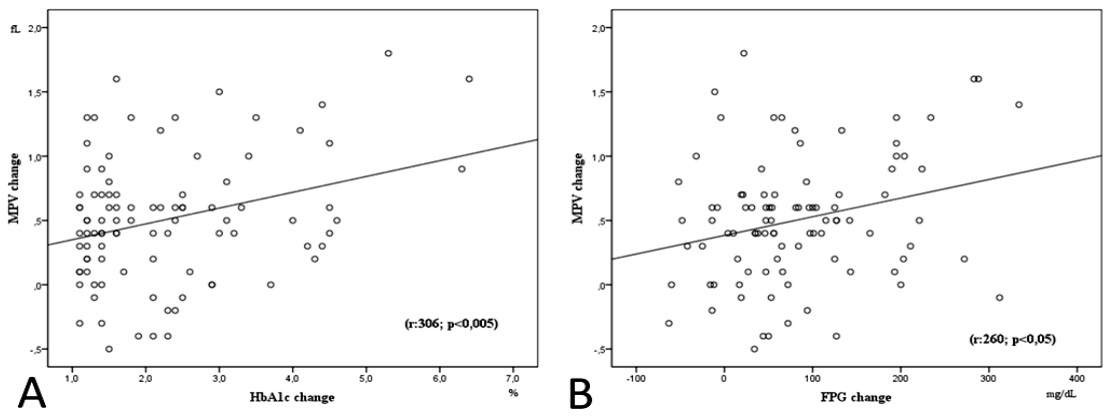
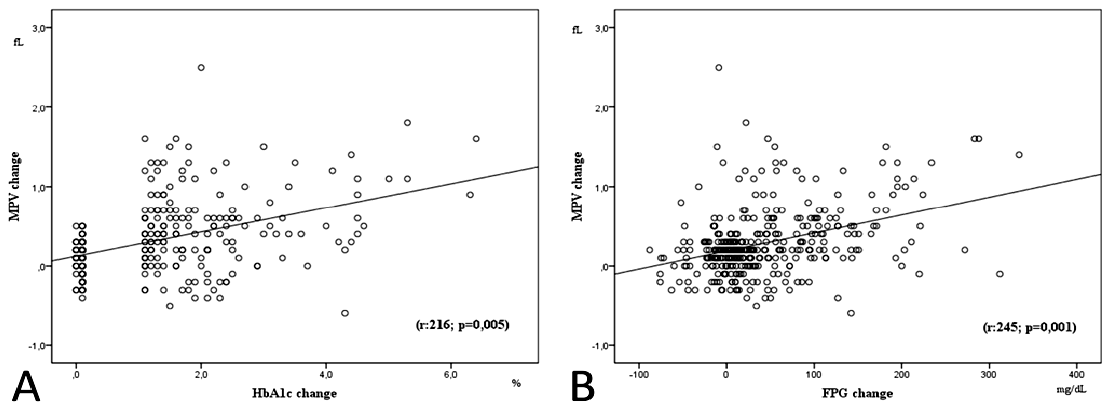
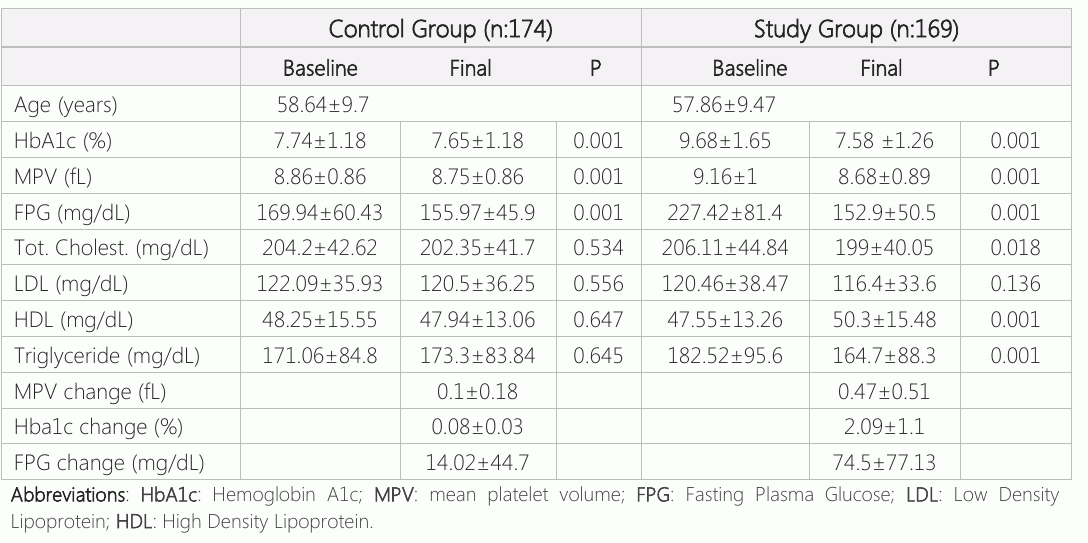
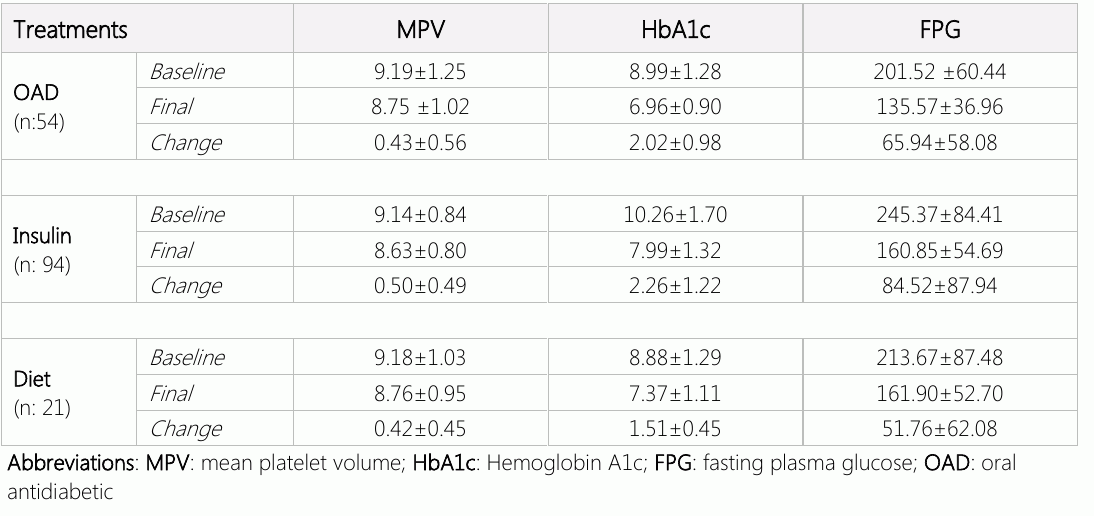

The SG consisted of 169 individuals having HbA1c change above %1 in 3 months period. 94 of those patients got insulin therapy, 54 were performed OAD change and/or new OAD addition, and 21 were increased dietary compliance with dietary modification, which reduced HbA1c level. The mean baseline and final Hba1c and MPV values of the patients in the SG which got treatment change are shown in Table-2. Whether there was a difference between types of treatment change and HbA1c levels in three months period was tested using one-way analysis of variance. A difference was found between three types of treatment change (F:4.39, p:0.014). Posthoc Tukey HSD test was used for this analysis. It was found that difference was between insulin addition and the dietary change (p<0.05) (Table-3). According to Pearson correlation analysis, positive correlation existed between MPV and HbA1c levels (r:154; p<0.005), and MPV and FPG levels (r:217; p<0.001) of the patients included in the study. Additionally, there was a positive correlation between MPV and HbA1c changes (r:216; p:0.005), and MPV and FPG changes (r:245; p:0.001) for individuals in the study (Figure 1A, B). When the therapy applied to patients in SG and MPV change were examined, positive correlation existed in patient applied insulin as a therapy. In addition, positive correlation was found between MPV and HbA1c changes (r:306; p<0.005), and MPV and FPG changes (r:260; p<0.05) in SG patients given insulin as treatment (Figure 2A, B). On the other hand, no correlation was found between MPV change, and HbA1c and FPG changes in SG patients whose OAD was changed and/or added new drugs, whose diet was modified.
Discussion
Compared to healthy people, MPV is known to be higher in patients with diabetes. The first study investigating MPV effect in patients with diabetes was conducted by Winocour et al. The study demonstrated that MPV was higher in patients with DM. (20). Çoban et al. identified later that MPV was higher in patients with prediabetes as well as DM (21, 22).
Ulutaş et al. found that positive correlation existed between MPV level and HbA1c and FBG level (23). At the end of this study which investigated the patients having above and below % 7 HbA1c level, it was found that MPV would be a beneficial prognostic marker of cardiovascular complications in patients with type 2 DM. Demirtunç et al. noted that MPV increased as the blood glucose level increased and there was a positive correlation between MPV and blood glucose level. In addition, they found that MPV levels increased as HbA1c level increased and positive correlation existed between MPV and HbA1c level (24). In this study, the patients who had microvascular complications of diabetes and suffered from cardiovascular diseases were included and the number of patients was limited. Additionally, no correlation existed between the decrease in the mean fasting blood glucose and HbA1c level at the end of the study as HbA1c was not investigated by HPLC method. In the studies conducted so far, the relationship between MPV and HbA1c has been demonstrated only in cross sectional studies except Demirtunç et al. (9, 25). This is the first study examining prospectively the relationship between MPV and HbA1c levels in patients not having microvascular complications of diabetes.
MPV elevation is known as an important factor for disturbed homeostatic system and prothrombotic state in DM (13). Platelet dysfunction has begun at the early stages of diabetes even before occurrence of vascular pathology. Increased platelet activity has an important role in the development of vascular complications in type 2 DM (26). MPV can reflect platelet activity, and high MPV is associated with thrombogenic activation and an increased risk of CVD (27). Hendra et al. showed that MPV was higher in patients with DM who had a history of acute myocardial infarction (AMI) when compared with the patients with DM who did not have a history of AMI (28). MPV can be used as a favorable test in the monitoring of type 2 DM in terms of atherosclerosis development. Skyler et al. suggest that glucose control plays a greater role before macrovascular disease is well developed and a minimal role when it is advanced, and that significant benefit is only seen in subsets of patients with shorter type 2 DM duration, lower baseline HbA1c, and/or absence of known CVD (29).
One of the most important findings of our study was that the decrease in MPV level was similar to the decrease in HbA1c level. When the initial HbA1c level of patient in SG that was 9.68 at first decreased to 7.58, MPV level decreased from 9.16 to 8.68 which was similar to CG level. These results demonstrated that individuals diagnosed with DM and having similar HbA1c level also had similar values of MPV. The mean HbA1c levels of patients in SG decreased % 2.09 and MPV levels decreased 0.47 fL. The changes in HbA1c and MPV levels were similar (Figure 1). In UKPDS, it was reported that glycemia and microvascular complications of diabetes decrease %35, and cardiovascular complications decrease %25 if HbA1c levels decline in %1 (19). Han et al. stated that MPV levels are closely associated with cardiovascular diseases and stroke development (30).
In the event that HbA1c level of the patients with diabetes reduces, there will be a decrease in cardiovascular diseases and the other diseases caused by vascular pathologies. In the present study, modification of dietary habits, the transition to intensive insulin therapy, and OAD change and/or OAD addition were effective in the reduction of HbA1c levels of patients in the study group. Of all the treatment options, intensive insulin therapy was the most efficient in reducing HbA1c and MPV levels. Additionally, unlike other treatments, the change in HbA1c and MPV levels were correlated in intensive insulin therapy. In the literature, there are two studies investigating MPV level and the treatment of DM. In the study which examined MPV level and the treatment of DM, it was found that HbA1c and MPV levels reduced with metformin, whereas no correlation was found between HbA1c and MPV (31). When MPV levels of the patients underwent insulin and OAD therapy were compared, MPV level of patients who got insulin therapy was significantly lower. However, in that study, MPV level of patients who got insulin therapy was found to be lower than healthy people(32).
As intensive insulin treatment is effective in the regulation of diabetes, studies which claim insulin therapy should be started in the early stages of diabetes have been conducted. Kramer et al. suggest that short-term intensive insulin therapy improves β-cell function and insulin resistance in patients with early type 2 DM (33). Diabetes is regulated effectively thanks to intensive insulin treatment. By decreasing MPV levels, vascular complications that may occur can be avoided.
The present study had several limitations. First, present study consisted of findings obtained retrospective data even if our work was a prospective study. Second, MPV measure from the blood samples taken from individuals were performed immediately (less than 60 minute). If sodium citrate had been added to the blood taken from individuals, the platelet swelling induced by EDTA could have been avoided. However, MPV measured using EDTA and Na+ citrate as anticoagulants are highly correlated, and reported differences are consistently <10%. Third, our findings are based only on the Turkish population; different results might be seen in other ethnic groups.
As a result, there is a correlation between MPV and HbA1c levels in diabetic patients. Changes in HbA1c levels are similar to the change in the MPV levels. By controlling diabetes, MPV levels decrease. The effects of insulin therapy to be administered in controlling diabetes are quite evident. Additionally, it might be expected that the insulin therapy is quite effective in the control of vascular events associated with DM.
Declarations
- Author contributions (CRediT)
- All authors contributed equally to all 14 CRediT roles (Conceptualization, Data curation, Formal analysis, Funding acquisition, Investigation, Methodology, Project administration, Resources, Software, Supervision, Validation, Visualization, Writing – original draft, Writing – review & editing).
- Funding
-
There is no funding for the current study.
- Conflicts of interest
- The authors declare that there is no conflict of interests to publish this article.
- Ethics approval
- Ethics approval details were not reported in the published version of this article.
- Data availability
- A data availability statement was not reported in the published version of this article.
References (33)
30 of 33 references are linked to their DOI.
- Demirtas L, Degirmenci H, Akbas EM, Ozcicek A, Timuroglu A, Gurel A, et al. Association of hematological indicies with diabetes, impaired glucose regulation and microvascular complications of diabetes. International journal of clinical and experimental medicine. 2015;8(7):11420-7. PubMed Google Scholar
- American Diabetes A. Diagnosis and classification of diabetes mellitus. Diabetes care. 2007;30 Suppl 1:S42-7. DOI Crossref PubMed Google Scholar
- Gerich JE. Type 2 diabetes mellitus is associated with multiple cardiometabolic risk factors. Clinical cornerstone. 2007;8(3):53-68. DOI Crossref PubMed Google Scholar
- Fox CS, Coady S, Sorlie PD, D'Agostino RB, Sr., Pencina MJ, Vasan RS, et al. Increasing cardiovascular disease burden due to diabetes mellitus: the Framingham Heart Study. Circulation. 2007;115(12):1544-50. DOI Crossref PubMed Google Scholar
- Danaei G, Lawes CM, Vander Hoorn S, Murray CJ, Ezzati M. Global and regional mortality from ischaemic heart disease and stroke attributable to higher-than-optimum blood glucose concentration: comparative risk assessment. Lancet. 2006;368(9548):1651-9. DOI Crossref PubMed Google Scholar
- Amin AA AW, Farrag AA. Impact of glycemic status on left ventricular systolic function in patients with acute coronary syndrome. Ulutas Med J. 2015;3(1):58-63. DOI Crossref PubMed Google Scholar
- Buse JB, Ginsberg HN, Bakris GL, Clark NG, Costa F, Eckel R, et al. Primary prevention of cardiovascular diseases in people with diabetes mellitus: a scientific statement from the American Heart Association and the American Diabetes Association. Diabetes care. 2007;30(1):162-72. DOI Crossref PubMed Google Scholar
- Jeerakathil T, Johnson JA, Simpson SH, Majumdar SR. Short-term risk for stroke is doubled in persons with newly treated type 2 diabetes compared with persons without diabetes: a population-based cohort study. Stroke; a journal of cerebral circulation. 2007;38(6):1739-43. DOI Crossref PubMed Google Scholar
- Shimodaira M, Niwa T, Nakajima K, Kobayashi M, Hanyu N, Nakayama T. Correlation between mean platelet volume and blood glucose levels after oral glucose loading in normoglycemic and prediabetic Japanese subjects. Journal of diabetes investigation. 2014;5(1):66-71. DOI Crossref PubMed Google Scholar
- Colwell JA, Nesto RW. The platelet in diabetes: focus on prevention of ischemic events. Diabetes care. 2003;26(7):2181-8. DOI Crossref PubMed Google Scholar
- Papanas N, Symeonidis G, Maltezos E, Mavridis G, Karavageli E, Vosnakidis T, et al. Mean platelet volume in patients with type 2 diabetes mellitus. Platelets. 2004;15(8):475-8. DOI Crossref PubMed Google Scholar
- Jindal S, Gupta S, Gupta R, Kakkar A, Singh HV, Gupta K, et al. Platelet indices in diabetes mellitus: indicators of diabetic microvascular complications. Hematology. 2011;16(2):86-9. Hemoglobin A1c Affects Mean Platelet Volume Huseyin Kurt, et al. DOI Crossref PubMed Google Scholar
- Vinik AI, Erbas T, Park TS, Nolan R, Pittenger GL. Platelet dysfunction in type 2 diabetes. Diabetes care. 2001;24(8):1476-85. DOI Crossref PubMed Google Scholar
- Herman WH, Fajans SS. Hemoglobin A1c for the diagnosis of diabetes: practical considerations. Polskie Archiwum Medycyny Wewnetrznej. 2010;120(1-2):37-40. DOI Crossref PubMed Google Scholar
- Ismail-Beigi F, Craven T, Banerji MA, Basile J, Calles J, Cohen RM, et al. Effect of intensive treatment of hyperglycaemia on microvascular outcomes in type 2 diabetes: an analysis of the ACCORD randomised trial. Lancet. 2010;376(9739):419-30. DOI Crossref PubMed Google Scholar
- American Diabetes A. Standards of medical care in diabetes--2014. Diabetes care. 2014;37 Suppl 1:S14-80. DOI Crossref PubMed Google Scholar
- Authors/Task Force M, Ryden L, Grant PJ, Anker SD, Berne C, Cosentino F, et al. ESC Guidelines on diabetes, pre-diabetes, and cardiovascular diseases developed in collaboration with the EASD: the Task Force on diabetes, pre-diabetes, and cardiovascular diseases of the European Society of Cardiology (ESC) and developed in collaboration with the European Association for the Study of Diabetes (EASD). European heart journal. 2013;34(39):3035-87. DOI Crossref PubMed Google Scholar
- Anderson RT, Narayan KM, Feeney P, Goff D, Jr., Ali MK, Simmons DL, et al. Effect of intensive glycemic lowering on health-related quality of life in type 2 diabetes: ACCORD trial. Diabetes care. 2011;34(4):807-12. DOI Crossref PubMed Google Scholar
- Genuth S, Eastman R, Kahn R, Klein R, Lachin J, Lebovitz H, et al. Implications of the United kingdom prospective diabetes study. Diabetes care. 2003;26 Suppl 1:S28-32. DOI Crossref PubMed Google Scholar
- Winocour PD. Platelets, vascular disease, and diabetes mellitus. Canadian journal of physiology and pharmacology. 1994;72(3):295-303. DOI Crossref PubMed Google Scholar
- Coban E, Kucuktag S, Basyigit S. Platelet activation in subjects with impaired glucose tolerance. Platelets. 2007;18(8):591-4. DOI Crossref PubMed Google Scholar
- Coban E, Bostan F, Ozdogan M. The mean platelet volume in subjects with impaired fasting glucose. Platelets. 2006;17(1):67-9. DOI Crossref PubMed Google Scholar
- Ulutas KT, Dokuyucu R, Sefil F, Yengil E, Sumbul AT, Rizaoglu H, et al. Evaluation of mean platelet volume in patients with type 2 diabetes mellitus and blood glucose regulation: a marker for atherosclerosis? International journal of clinical and experimental medicine. 2014;7(4):955-61. PubMed Google Scholar
- Demirtunc R, Duman D, Basar M, Bilgi M, Teomete M, Garip T. The relationship between glycemic control and platelet activity in type 2 diabetes mellitus. Journal of diabetes and its complications. 2009;23(2):89-94. DOI Crossref PubMed Google Scholar
- Lippi G, Salvagno GL, Nouvenne A, Meschi T, Borghi L, Targher G. The mean platelet volume is significantly associated with higher glycated hemoglobin in a large population of unselected outpatients. Primary care diabetes. 2015;9(3):226-30. DOI Crossref PubMed Google Scholar
- Kodiatte TA, Manikyam UK, Rao SB, Jagadish TM, Reddy M, Lingaiah HK, et al. Mean platelet volume in Type 2 diabetes mellitus. Journal of laboratory physicians. 2012;4(1):5-9. DOI Crossref PubMed Google Scholar
- Shimodaira M, Niwa T, Nakajima K, Kobayashi M, Hanyu N, Nakayama T. Correlation between mean platelet volume and fasting plasma glucose levels in prediabetic and normoglycemic individuals. Cardiovascular diabetology. 2013;12:14. DOI Crossref PubMed Google Scholar
- Hendra TJ, Oswald GA, Yudkin JS. Increased mean platelet volume after acute myocardial infarction relates to diabetes and to cardiac failure. Diabetes research and clinical practice. 1988;5(1):63-9. DOI Crossref PubMed Google Scholar
- Skyler JS, Bergenstal R, Bonow RO, Buse J, Deedwania P, Gale EA, et al. Intensive glycemic control and the prevention of cardiovascular events: implications of the ACCORD, ADVANCE, and VA diabetes trials: a position statement of the American Diabetes Association and a scientific statement of the American College of Cardiology Foundation and the American Heart Association. Circulation. 2009;119(2):351-7. DOI Crossref PubMed Google Scholar
- Han JY, Choi DH, Choi SW, Kim BB, Ki YJ, Chung JW, et al. Stroke or coronary artery disease prediction from mean platelet volume in patients with type 2 diabetes mellitus. Platelets. 2013;24(5):401-6. DOI Crossref PubMed Google Scholar
- Dolasik I, Sener SY, Celebi K, Aydin ZM, Korkmaz U, Canturk Z. The effect of metformin on mean platelet volume in diabetic patients. Platelets. 2013;24(2):118-21. PubMed Google Scholar
- Vernekar PV, Vaidya KA. Comparison of mean platelet volume in type 2 diabetics on insulin therapy and on oral hypoglycaemic agents. Journal of clinical and diagnostic research: JCDR. 2013;7(12):2839-40. DOI Crossref PubMed Google Scholar
- Kramer CK, Zinman B, Retnakaran R. Short-term intensive insulin therapy in type 2 diabetes mellitus: a systematic review and meta-analysis. The lancet Diabetes & endocrinology. 2013;1(1):28-34. DOI Crossref PubMed Google Scholar
Respond to this article
Comments on a published article are welcome as a Letter to the Editor.
Get an e-mail when new articles in your fields are published
Questions to the authors
Questions are moderated: an editor approves each question, the authors answer, and an editor approves the answer before both appear here.
No answered questions yet.
Ask the authors a question
Discussion
Comments are moderated: they appear after the writer confirms the e-mail address and an editor approves them. Each comment carries a conflict-of-interest statement.
No comments yet.
Write a comment
Read the full text
Open the PDF here
Loading the PDF…
If the PDF does not show here, use the download button above.
How to cite this article
Kurt H, Demirkiran D. Changing of Hemoglobin A1c Affects Mean Platelet Volume in Type-2 Diabetes Mellitus. Ulutas Med J. 2016;2(1):27-35. doi:10.5455/umj.20160211122820
Kurt, H., & Demirkiran, D. (2016). Changing of Hemoglobin A1c Affects Mean Platelet Volume in Type-2 Diabetes Mellitus. The Ulutas Medical Journal, 2(1), 27–35. https://doi.org/10.5455/umj.20160211122820
Kurt, H. and Demirkiran, D. (2016) 'Changing of Hemoglobin A1c Affects Mean Platelet Volume in Type-2 Diabetes Mellitus', The Ulutas Medical Journal, 2(1), pp. 27–35. doi: 10.5455/umj.20160211122820.