The Ulutas Medical Journal · ISSN 2149-0430 (print), 2149-388X (online) · https://www.ulutasmedicaljournal.com/?mno=216967
Original Research · Open access
Efficacy of Local Lactobacillus Casei Var Rhamnosus Döderlein Monotherapy for Bacterial Vaginosis
Also available in: العربية · Türkçe · 中文
- Department of General and Oncogynecology, Military Medical Academy, Sofia, Bulgaria ROR
- Department of Microbiology and Virology, University Hospital Queen Joanna ISUL, Sofia, Bulgaria ROR
Abstract
- Introduction
- The objective of this study was to establish the efficacy of local probiotic monotherapy for the treatment of bacterial vaginosis.
- Method
- A total of 141 women with bacterial vaginosis, randomized into two groups, were examined. In the first group, 85 women were treated with local probiotic medicine (QD for 10 days) containing Lactobacillus casei var rhamnosus Döderlein (Lcr35®). In the second group, 56 patients received the same local probiotic treatment as those in the first group, in addition to treatment with an oral administration of metronidazol (500 mg tablet BID for 7 days). The efficacy of the monotherapeutic scheme was evaluated by comparing the number of clinical complaints and the results of clinical examinations and microbiological tests in the two groups.
- Results
- One month after the probiotic monotherapy in the first group, the clinical efficacy was 47.1% and the microbiological efficacy was 41.1%. The combined treatment in the second group was more efficacious (clinical efficacy: 89.3%; microbiological efficacy: 76.7%).
- Conclusions
- Thus, our results indicate that local probiotic monotherapy is less effective than combined metronidazole/probiotic scheme for the treatment of bacterial vaginosis.
Keywords
Full text
Introduction
The use of probiotics to restore and maintain normal vaginal flora represents a promising alternative or addition to conventional therapy for the treatment of bacterial vaginosis (BV) (1–3). Probiotics can be used independently or in addition to the primary therapy for BV and clinical trials have been conducted for both monotherapy and combined therapy (1–3). These studies administered specific strains of lactobacilli orally or locally and tracked their ability to colonize the vagina of patients with symptomatic and asymptomatic BV. The ability of the strains to reduce the colonization and symptoms of pathogens was also assessed. The results of these studies indicate that the use of probiotics in treatment of BV is a promising alternative to conventional therapy (1–3).
The aim of our study was to establish the clinical and microbiological efficacy of local probiotic Lactobacillus casei var rhamnosus Döderlein monotherapy of BV and its effect on the vaginal flora.
Study Design
We conducted an open, single-site survey in the gynecological outpatient clinic of the Military Medical Academy in Sofia, Bulgaria, from 2013 to December 2015. The patients were provided with information regarding the purposes of the investigation and the conditions of inclusion; all of the patients gave informed consent for their participation. The study included a total of 192 women aged 17– 50 years with clinically and/or microbiologically established BV. However, only 141 women came forward for the control review, which was conducted 35–40 days after the study began. Therefore, only the data collected from these 141 women were analyzed in the survey.
established Neisseria Patients with gonorrhoeae, Chlamydia trachomatis, HSV, HPV, HIV, or other vaginal infections were excluded from the study. Also excluded were pregnant women; those taking corticosteroids, antibiotics, imidazoles, or probiotics; those who used vaginal preparations in the last month; immunocompromised patients; those with autoimmune diseases, endocrine diseases, or diabetes; and those with cancer.
BV Diagnosis
For all study participants, medical history was recorded and gynecological examination and microbiological tests were performed. Examination of the vagina was performed to evaluate vaginal secretion according to following specifications: quantity, consistency, color, and odor. The amount of vaginal discharge (flow) was given a score of 0, (+), (++), or (+++). During examination of the vagina from the back vaginal vault, a sample of the vaginal secretion was taken with a dry sterile swab for microbiological testing. The following clinical criteria, introduced into gynecology practice by Amsel et al. (1983), were used for the diagnosis of BV:
• Homogeneous vaginal discharge (color and amount may vary) • Amine (fishy) odor when potassium hydroxide solution is added to vaginal secretions (commonly called "whiff test") • Presence of clue cells (greater than 20%) on microscopy • Vaginal pH greater than 4.5 (4).
The establishment of three of these four criteria was considered sufficient for diagnosis (4). To determine vaginal pH, indicator strips (Merck) in the pH range 4–7 were used, as a pathological result is indicated at a pH above 4.5. The whiff test of vaginal secretion was reported as positive when an unpleasant odor was detected. For the preparation of the wet mount, the vaginal secretion was affixed to a slide and a saline solution (0.9% NaCl) was added. The wet mount was then observed with a light microscope in order to determine the proportion of clue cells in the sample. Not all patients included in the study showed pronounced clinical symptoms. For many, asymptomatic BV was diagnosed via microscopic examination of a gram-stained preparation of the vaginal secretion. Gram-stained preparations were evaluated micros-copically (1000×) using oil immersion for following morphotypes: large, gram-positive rods (Lactobacillus morphotype); petty gram-variable rods (G. vaginalis morphotype); small gram-negative rods(Bacteroides morphotype); curved gram-variable rods (Mobiluncus morphotype); and gram-positive cocci. We used Nugent’s criteria for the evaluation of microscopic gram-stained preparations (5). This method separates smears with normal flora dominated by lactobacilli and those with mixed flora characteristic of BV (5). This method has been modified to include intermediate categories of mixed microbial flora with a significant amount of lactobacilli, and smears of vaginal flora are currently grouped into the following grades (5, 6):
• Grade 0, epithelial cells with no bacteria • Grade I, normal vaginal flora (Lactobacillus morphotypes alone) • Grade II, reduced numbers of Lactobacillus morphotypes with a mixed bacterial flora • Grade III, mixed bacterial flora only, few or absent Lactobacillus morphotypes • Grade IV, gram-positive cocci only • Grades 0, I, and IV are found in women without BV. Grade II is intermediate and is not found in women with BV as defined by Amsel ´s criteria. Grade III is consistent with BV as diagnosed by Amsel´s criteria (6).
Randomization
Patients with BV were randomized into two groups in 1:1 correlation. The first clinical group contained 96 patients (85 patients [88.5%] with control review participation) who were given a mono-therapeutic treatment scheme (described in the next section). The second group contained 96 patients (56 patients [58.3%] with control review participation) who were given a combined therapeutic scheme.
Therapeutic Schemes
Patients in the first group (monotherapeutic scheme) were treated with a local application (QD for 10 days) of probiotic vaginal ovules containing live Lactobacillus casei var. rhamnosus Döderlein (Lcr35® Gynophilus; Laboratoires Lyocentre, France). Patients in the second group (combined therapeutic scheme) were treated with seven daily oral doses of metronidazol (divided into two 500-mg doses taken 12 hours apart). After seven days of metronidazole therapy, the second group was also administered the local probiotic Lactobacillus casei var. rhamnosus Döderlein (Lcr35®) (QD for 10 days). Sexual abstinence during the treatment and until the control examination was recommended to the patients. Sex partners were treated with oral tinidazol (1g daily) for two days.
Tracing was performed with a control review 35–40 days after the therapy, which involved a gynecological examination and microbiological examination with direct microscopy of wet and gram-stained mounts of vaginal samples. The efficacy of the monotherapeutic scheme was evaluated by comparing the number of clinical complaints and the results of clinical examinations and microbiological tests in the two groups.
Statistical Analysis
Clinical and microbiological data obtained during the review were analyzed using the χ(2)test. Statistical significance was defined at P < 0.05. For each monitored parameter, we calculated the proportion (in percent) of patients with improvement in each treatment scheme individually.
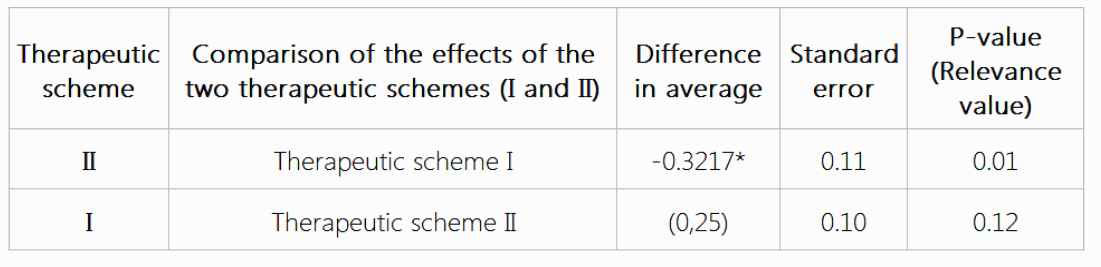
We analyzed the changes in number of patients with positive/negative results of laboratory and microbiological examinations that occurred as a result of the treatment. Two-factor dispersion analyses with repeated observations were used (two-way ANOVA with repeated measures) with subsequent (post hoc) comparisons of the effect of therapy by Tukey’s HSD method.
Results
In total, 192 women participated in the therapeutic portion of this study. However only 141 women (73.4%) participated in a control review examination that was conducted subsequent to the therapy; thus, we included only the results from these 141 patients in our analysis. The remaining 51 women (26.6%) were considered to have dropped out of the study.
Clinical Efficacy
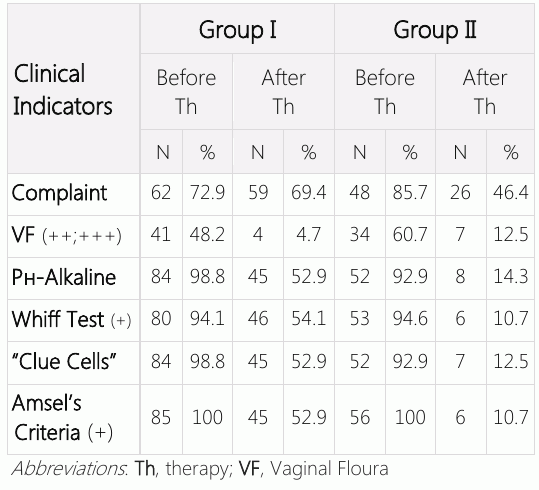
Table-1 displays the number and proportion of patients with the main clinical indicators of BV before and after therapy. The data clearly indicate that the proportion of patients with these clinical signs decreased after therapy in both groups; however, in general, larger decreases were observed in the second group.
Microbiological Efficacy
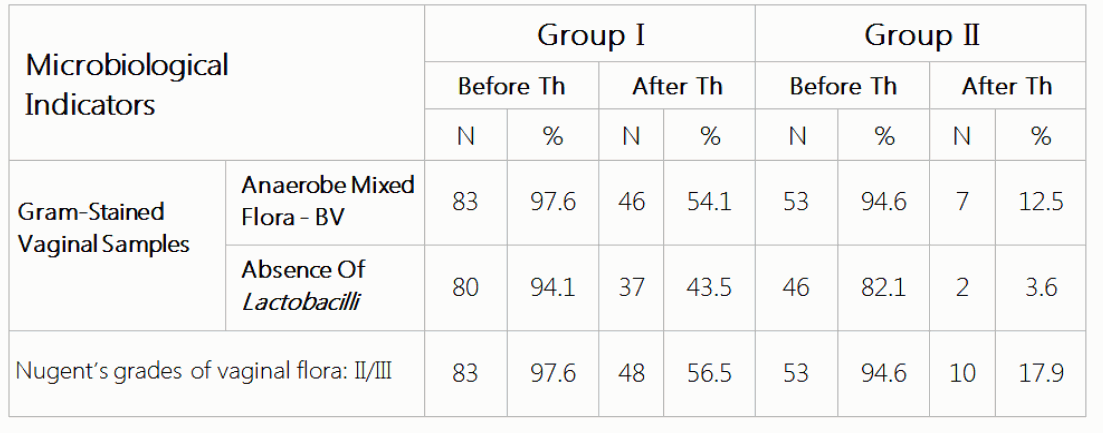
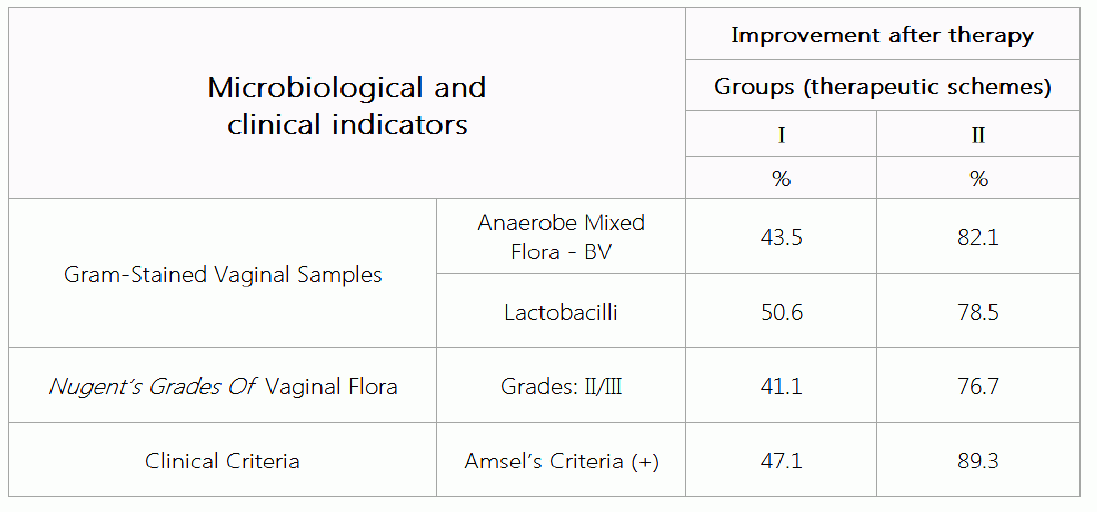
Table-2 shows the frequency of basic microbiological indicators of BV before and after therapy in the two groups. The results show that the reduction in the number of patients with the microbiological indicators was larger in the second group than in the first group following therapy. Statistical analyses of the study data are shown in Table 3. The relative improvement in the proportion of patients with the clinical and microbiological indicators of BV is shown in Table 4. These data indicate that compared to the monotherapy given to the first group, the combination therapy given to the second group resulted in a greater improvement in the clinical and microbiological indicators of BV assessed in this study.
Discussion
Many studies have administered specific strains of lactobacilli orally or locally and tracked their ability to colonize the vagina of patients with symptomatic and asymptomatic BV and to reduce colonization of pathogens and the associated symptoms. Hallen et al. (1992) observed that the administration of lactobacilli for 7–10 days in a group of patients with dysbacteriosis with dominant anaerobic strains was more effective than a placebo (7). The restoration of normal vaginal microflora occurred in 57% of patients (16 out of 28) treated with lactobacilli and in 0% (none out of 29) who received the placebo (7). Rossi et al. (2010) explored the long-term effects of treatment with a local probiotic in 40 women with BV, and observed an 80% clinical efficacy of probiotic therapy (8). Hemalatha et al. (2012) used probiotic monotherapy in the treatment of 67 women with BV, and found that the clinical efficacy (Amsel’s criteria) was 47% (3). A prospective study by Chimura et al. (1995), which tracked 11 women with BV, confirmed the effect of local application of lactobacilli (1). The authors established a statistically significant reduction of vaginal inflammation and pH and the disappearance of all 14 gram-negative strains of micro-organisms isolated in the first 3 days after the treatment (1).
In microbiological terms, BV was cured completely in 54.5% of patients (6 out of 11), and was partially cured in 27.3% of patients (3 out of 11) (1). Mastromarino et al (2009) conducted a placebo-controlled study of the effectiveness of vaginal probiotics in the treatment of 39 women with BV (9). Two weeks after the treatment, the clinical and microbiological efficacy was 61% in women using probiotics and 19% in the placebo group (9). In a Bulgarian placebo-controlled study by Sigridov et al. (2007), the local application of lactobacilli for 1 month in 20 patients with BV led to a cure in 90% of cases, while in the placebo group 67% were cured (10). Follow-up of the patients after 3 months showed that 90% of patients were cured in the group treated with lactobacilli and 50% of patients were cured in the group treated with a placebo (10).
In contrast, several other randomized clinical trials found no significant difference between the therapeutic outcomes of BV patients treated locally with specific strains of lactobacilli and those treated with vaginal lincozamides/nitroimidazoles (2, 11). Fredricsson et al. (1989) treated 14 women with BV with a local administration of L.acidophilus and achieved a therapeutic effect in only 1 of them, whereas vaginal metronidazole showed 92.9% efficacy (2). In addition, the authors did not detect an increasing number of lactic acid bacteria in the vagina of women treated with L. acidophilus (2). Erikson et al. (2005) used vaginal clindamycin for the treatment of 187 women with BV and continued with a local administration of L.gasseri, L.casei, L. rhamnosus, L. fermentum, or placebo within one menstrual cycle (11). The therapeutic results after the second menstrual cycle defined by the Amsel criteria or by the Nugent-Ison-Hay score of microscopic preparation of vaginal contents showed no statistically significant difference between patients treated with lactobacilli and those treated with placebo (11).
The results of the current study showed a 47.1% clinical efficacy (determined by Amsel's clinical criteria) of the probiotic monotherapy with no serious side effects. The microbiological efficacy (determined by Gram staining of vaginal samples and Nugent's criteria) was 41.1%. These efficacy values are lower than those established in the clinical studies discussed above.
The efficacy of the monotherapy was also lower than that of the combined metronidazole/probiotic therapy in our study, which showed a clinical efficacy of 89.3% and a microbiological efficacy of 76.7%. Thus, the results obtained in this study indicate that local probiotic monotherapy has a lower efficacy than a combined therapeutic metronidazole/probiotic scheme for the treatment of BV.
Declarations
- Author contributions (CRediT)
- All authors contributed equally to all 14 CRediT roles (Conceptualization, Data curation, Formal analysis, Funding acquisition, Investigation, Methodology, Project administration, Resources, Software, Supervision, Validation, Visualization, Writing – original draft, Writing – review & editing).
- Funding
-
There is no funding for the current study.
- Conflicts of interest
- The authors declare that there is no conflict of interests to publish this article.
- Ethics approval
- Ethics approval details were not reported in the published version of this article.
- Data availability
- A data availability statement was not reported in the published version of this article.
References (11)
8 of 11 references are linked to their DOI.
- Chimura T, Funayama T, Murayama K, Numazaki M. Ecological treatment of bacterial vaginosis. Jpn J Antibiot 1995; 48: 432-436. PubMed Google Scholar
- Fredricsson B, Englund K, Weintraub L, Olund A, Nord CE. Bacterial vaginosis is not a simple ecological disorder. Gynecol Obstet Invest 1989; 28:156-160. DOI Crossref PubMed Google Scholar
- Hemalatha R, Mastromarino P, Ramalaxmi BA, Balakrishna NV, Sesikeran B. Effectiveness of vaginal tablets containing lactobacilli versus pH tablets on vaginal health and inflammatory cytokines: a randomized, double-blind study. Eur J Clin Microbiol Infect Dis 2012; 31(11):3097-105. DOI Crossref PubMed Google Scholar
- Amsel R, Totten PA, Spiegel CA, Chen KCS, Eschenbach D, Holmes KK. Non-specific vaginitis: diagnostic and microbial and epidemiological associations. Am J Med 1983;74:14-22. DOI Crossref PubMed Google Scholar
- Nugent RP, Krohn MA, Hillier S. Reliability of diagnosing bacterial vaginosis is improved by standardized method of Gram stain interpretation. J Clin Microbiol 1991;29:297-301. Probiotic Monotherapy of Bacterial Vaginosis Stefan Kovachev, et al. DOI Crossref PubMed Google Scholar
- Ison CA, Hay PE. Validation of a simplified grading of Gram stained vaginal smears for use in genitourinary medicine clinics. Sex Transm Infect 2002; 78: 413-415. DOI Crossref PubMed Google Scholar
- Hallen A, Jarstrand C, Pahlson C. Treatment of bacterial vaginosis with lactobacilli. Sex Transm Dis 1992;19:146-148. PubMed Google Scholar
- Rossi A, Rossi T, Bertini M, Caccia G. The use of Lactobacillus rhamnosus in the therapy of bacterial vaginosis. Evaluation of clinical efficacy in a population of 40 women treated for 24 months. Arch Gynecol Obstet 2010; 281(6):1065-9. DOI Crossref PubMed Google Scholar
- Mastromarino P, Macchia S, Meggiorini L, Trinchieri V, Mosca L, Perluidgi M, Midulla C. Effectiveness of Lactobacillus-containing vaginal tablets in the treatment of symptomatic bacterial vaginosis. Clin Microbiol Infect 2009; 15(1): 67-74. DOI Crossref PubMed Google Scholar
- Sigridov I, Ivanov S, Batashki I. Preliminary results of Lactofem trial-first impressions. Akush Ginekol (Sofiia) 2007; 46 Suppl 2: 29-32. PubMed Google Scholar
- Eriksson K, Carlsson B, Forsum U, Larsson PG. A double-blind treatment study of bacterial vaginosis with normal vaginal lactobacilli after an open treatment with vaginal clindamycin ovules. Acta Derm Venereol 2005; 85: 42-46. DOI Crossref PubMed Google Scholar
Respond to this article
Comments on a published article are welcome as a Letter to the Editor.
Get an e-mail when new articles in your fields are published
Questions to the authors
Questions are moderated: an editor approves each question, the authors answer, and an editor approves the answer before both appear here.
No answered questions yet.
Ask the authors a question
Discussion
Comments are moderated: they appear after the writer confirms the e-mail address and an editor approves them. Each comment carries a conflict-of-interest statement.
No comments yet.
Write a comment
Read the full text
Open the PDF here
Loading the PDF…
If the PDF does not show here, use the download button above.
How to cite this article
Kovachev S, Vatcheva-Dobrevska R. Efficacy of Local Lactobacillus Casei Var Rhamnosus Döderlein Monotherapy for Bacterial Vaginosis. Ulutas Med J. 2016;2(1):20-26. doi:10.5455/umj.20160210060327
Kovachev, S., & Vatcheva-Dobrevska, R. (2016). Efficacy of Local Lactobacillus Casei Var Rhamnosus Döderlein Monotherapy for Bacterial Vaginosis. The Ulutas Medical Journal, 2(1), 20–26. https://doi.org/10.5455/umj.20160210060327
Kovachev, S. and Vatcheva-Dobrevska, R. (2016) 'Efficacy of Local Lactobacillus Casei Var Rhamnosus Döderlein Monotherapy for Bacterial Vaginosis', The Ulutas Medical Journal, 2(1), pp. 20–26. doi: 10.5455/umj.20160210060327.
@article{umj216967,
  title = {Efficacy of Local Lactobacillus Casei Var Rhamnosus Döderlein Monotherapy for Bacterial Vaginosis},
  author = {Kovachev, Stefan and Vatcheva-Dobrevska, Rossitza},
  journal = {The Ulutas Medical Journal},
  year = {2016},
  volume = {2},
  number = {1},
  pages = {20--26},
  doi = {10.5455/umj.20160210060327},
  url = {https://www.ulutasmedicaljournal.com/?mno=216967},
  issn = {2149-388X}
}