The Ulutas Medical Journal · ISSN 2149-0430 (print), 2149-388X (online) · https://www.ulutasmedicaljournal.com/?mno=183141
Original Article · Open access
Comparative Evaluation of Anthropometric Parameters in Detecting Low Birth Weight Infants
Also available in: العربية · Türkçe · 中文
- Department of Neonatology, Chittagong Medical College, Bangladesh ROR
- Department of Maternal & Child Health, NIPSOM, Mohakhali, Dhaka
- Dept. of Pediatric Gastroenterology & Nutrition, Shahbag, Dhaka ROR
- Dept. of Obst & Gynecology, BGC Trust Medical College, Candonaish, Bangladesh ROR
Abstract
- Background
- Birth weight is an important indicator of neonatal health. Incidence of low birth weight infants in developing country like Bangladesh is high. Deliveries as 75% are conducted in rural community mainly by Traditional Birth Attendants or by relatives. Facility of birth weight recording is not existent. To overcome the problem of weight recording, it was justified to find out other simple measurements that could be used as substitute of weighing babies. Aim of the study was to examine the validity of anthropometric measurements as a screening method of low birth weight babies. Material & Methods: A cross sectional analytical study was conducted on 560 newborns over a period of 18 months in 2000-2001 in Dhaka city. Mid-arm circumference, length, head circumference, chest circumference, abdominal girth and calf circumference were considered.
- Results
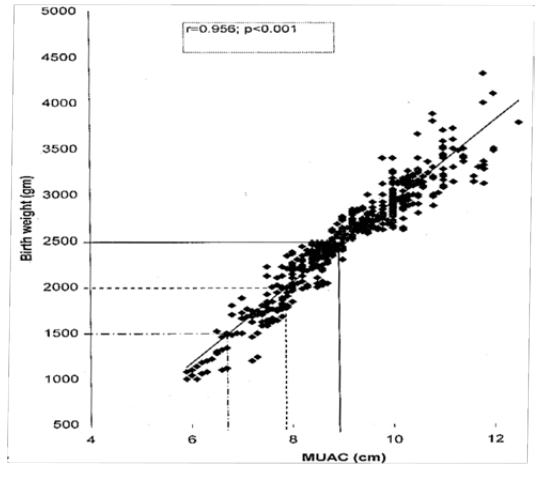
- A significant correlation was observed for birth weight with all other anthropometrical parameters (P<0.001). However, there was a higher correlation (r=0.946) between birth weight and mid-arm circumference. The study showed that in identifying newborns of <2500 gm a mid-arm circumference of <9 cm had the best sensitivity (96.2%) and specificity (97.3%). A value of <8 cm and <6.8 cm for mid-arm circumference showed highest validity for picking up newborns weighing <2000 gm and <1500 gm respectively. Cut-off values for all other parameters to screen neonates categorically were observed. Regression analysis of birth weight on all other parameters was seen.
- Conclusion
- The work concluded that anthropometric parameters might be a valid alternative method in screening low birth weight infants.
Keywords
Full text
Introduction
The incidence of low birth weight is different in place to place. In Western Europe and North America fewer than 10% of all infants weigh less than 2500 gm at birth. They constitute more than 50% of all death during the first week of life and those who survive have a greater than average chance of physical or mental handicap despite the high standard of pediatric care (1). Situation in developing countries is much more unfavorable. In Bangladesh prevalence of low-birth weight is much higher, ranging from 32% to 47% (2–4). Here, majority (>80%) of the people live in rural areas where illiteracy and poverty are widely prevalent and health service facility even for neonate is unsatisfactory. In this country, 75% deliveries are conducted in rural community mainly by birth attunements or by relatives (5).
Birth weight is an important indicator of survival and future health of the child. It is the most important determinant with which the baby adjusts itself to its surroundings. Birth weight is the most important factor that determines the ability of the infant to cope with its new environment and to develop normally (6).Low birth weight is associated with high neonatal morbidity and mortality (7). Recording of birth weight is universal in developed countries whereas it is almost nonexistent specially in rural community of developing country like Bangladesh. Important reasons for not to weigh the babies in rural areas are lack of ignorance of weighing the baby, confinement of mother and baby after delivery restrict the outsider to weigh the baby, taboos of not to weigh the baby. Weighing scale is expensive and not easy to keep in the delivery kit or to carry from door to door by the birth attendants. Lack of feasibility of having a weighing scale within the delivery kits in rural areas is also important factor of not to weigh the baby (8). Measurement of birth weight is important for monitoring growth of the child.
The 34th World Health Assembly in 1981 recommended it to be one of the 12 global indicators for monitoring of health of the community (9). Unfortunately, although low birth weight is an up most problem in this country, facility of weight recording is non-existing till today in rural Bangladesh. The only rough measure available is ‘eye estimation’, which is very subjective and open for controversy. It is time honored demand that an alternative means has to be developed to pick-up low birth weight infants. It is assumed that some measurements of newborns e.g. mid-arm circumference, calf circumference, head circumference, chest circumference, abdominal girth and length on newborns can be measured easily. If any of these parameters is proved to have good correlation with birth weight, it may be used to infer weight of baby. Moreover, hopefully barriers on taking birth weight will not existent during taking such anthropometric parameters. This study was conducted to find out which of these parameters correlate more closely to birth-weight and to see the cut-off values of parameters those should be used to identify and categorize low birth weight babies in community.
Material & Methods
Five hundred and sixty live born infants from three different hospitals of Dhaka city from 1st July 2000 to 25th December 2001 constituted study population. Informed informed consent was taken from mothers or legal guardians before data collection. Babies with major congenital malformation, caput succedaneum, gross cephal hematoma, seriously ill and twin were excluded. Babies of mothers having serious obstetrical or medical problem or diabetes were excluded from the study. A simple proforma was used as research instrument. A sensitive modified weighing scale, an infantometer and a measuring tape were used as research equipments. Head circumference (HC) was measured at the level of supraorbital ridges in front and maximum occipital prominence behind. Chest circumference (ChC) was measured at the level of xiphisternum and below the inferior angle of scapula.

Abdominal girth (AG) at the level of umbilicus, calf circumference (CC) at the most prominent point in semi flexed position of the left leg and mid-arm circumference (MAC) was taken at midway between the tip of acromion process of scapula and olicranon process of ulna of left arm. Weight was recorded up to a minimum value of 20 gm and all other anthropometrical variables up to 0.1cm. All measurements were recorded by one of the researchers within 24 hours of delivery. Data was collected by face to face interview of mothers, from case sheets and by measuring newborn babies. Standard stastics were used for determination of critical limit, sensitivity, specificity, linear regression and correlation coefficient of different anthropometrical measurements in relation to birth weight. A p value of 0.05 was taken as level of significance.

Results
The mean gestational age was 37.9 weeks and the mean postnatal age of babies was 12.2 hours. The mean anthropometrical values and correlation coefficient between anthropometrical variables of neonates are given in Table-I and Table-II,respectively. Significant correlation (p<0.001) of birth weight was observed with all other parameters. However, highest correlation(r=0.946) was observed between birth weight and mid-arm circumference. A high significant correlation (r=0.879, p<0.001) was seen between birth weight and head circumference on newborn infant, as well (Table 1).
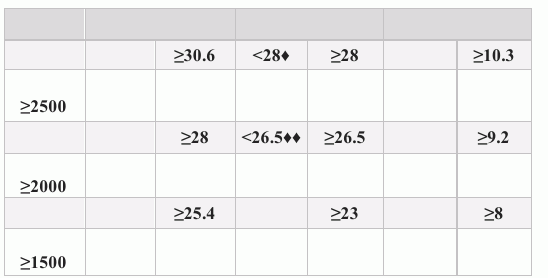
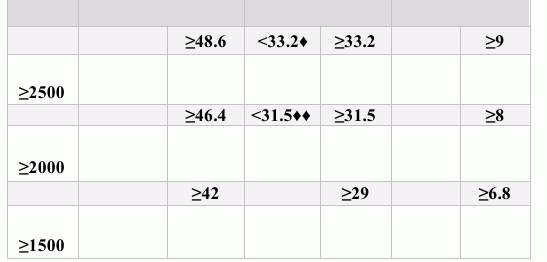
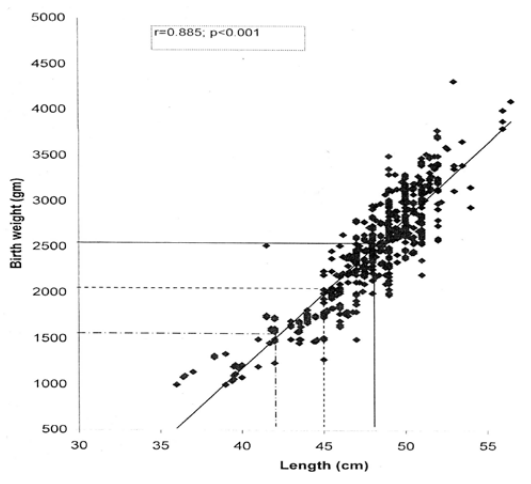
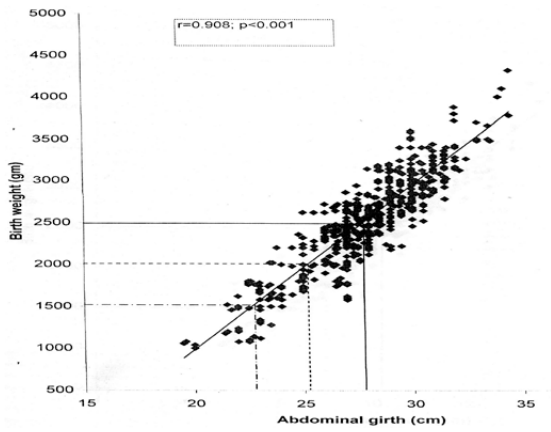
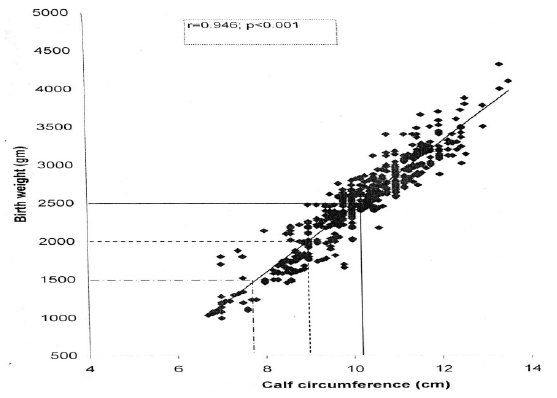
For screening low birth weight (< 2500 gm) from its counterpart, a cut-off value for mid-arm circumference of <9 cm was observed. The critical limit of 9 cm had quite good sensitivity and specificity (table-III). Cut-off values for mid-arm circumference (MAC) to screen babies of <2000 gm and <1500 gm was also seen. The critical values of MAC for these types of neonates were 8 cm and 6.8 cm respectively with high sensitivity and specificity (table-III, Fig-1). The regression analysis of birth weight on mid-arm circumference was: birth weight = -1448.97±437.37 X mid-arm circumference (Fig-1). Cut-off points of other anthropometric parameters for all three categories babies were also observed. In all case, results showed quite good sensitivity and specificity (Table-III, IV & Figure-2 to 6). The highest validity in screening different categories of infants was observed on mid-arm circumference (Table-2).
Discussion
Weight, height (length), head circumference, mid-arm circumference, skin fold thickness, calf circumference etc. are used to assess the growth and body stature. Birth weight is an index of nutritional status of community. Birth weight determines the ability of infants to adjust itself to its new environment (10). Significant correlation was observed between birth weight and other anthropometrical parameters in the present study. Birth weight and mid-arm circumference showed the highest correlation (r=0.946). Head circumference, chest circumference, abdominal girth and calf circumference showed highly significant (p<0.001) but slightly lower values. These findings were consistent with findings of Vaquera et al (10) who observed arm circumference had the highest correlation (r=0.92) with birth weight followed by chest circumference (r=0.86), head circumference (r=0.79) and length (0.78). The present findings were similar to findings of some other works (11–14) but were not consistent to study conducted by researchers (15, 16). Different workers observed different cut-off values (17–22). Many researchers pointed out the cut-off values of anthropometric parameters in different parts of the globe. Validity of cut-off points was high in all cases. Few workers worked on critical limit for screening babies weighing less than 2000 gm.
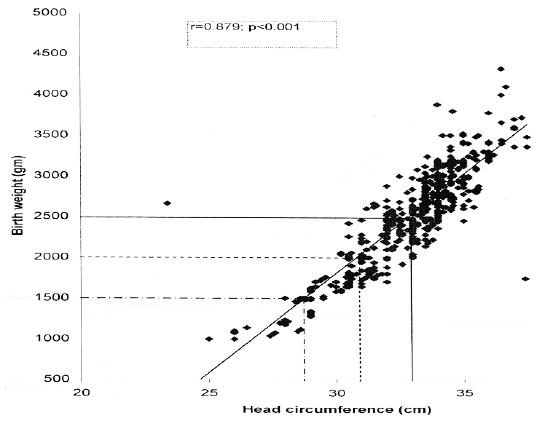
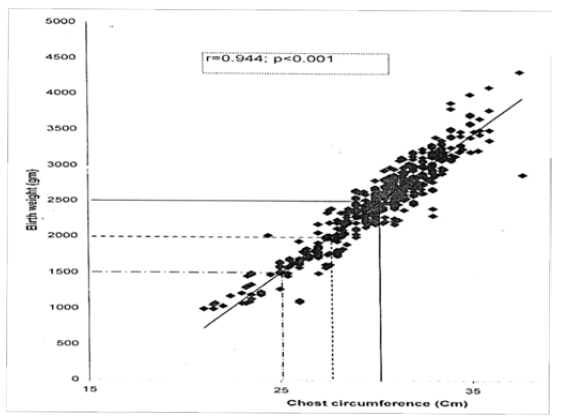
In this study, the critical limit of 8 cm showed the highest validity to screen babies weighing <2000 gm. Probably only one researcher18 known so far, screened out very low-birth weight (VLBW e.g. <1500 gm) neonate with critical limit of <6.1 cm for mid-arm circumference. In this work, the observed cut-off value for MAC to screen VLBW was 6.8 cm with highest validity followed by other anthropometric parameters. High morbidity and mortality in VLBW babies in the past might be the reason of giving less attention to screen out this category of newborn infant. But due to advancement of neonatal care, morbidity and mortality came down in this group of neonate. The present study showed cut-off value of 48.6 cm for length which can objectively screen out LBW babies in contrast to cut-off value of 47.7 cm (21) and 44.6 cm (19) by other workers. Critical limits of 46.4 cm and 42 cm for length to screen out 2000 gm and 1500 gm babies were lacking in previous two works. A value of 32.2 cm for head circumference was found to screen LBW infant with high sensitivity in the present work. Though Vaquera MVD et al and Gupta V et al (17, 23) found cut-off values at 32 cm and 32.2 cm for head circumference to screen LBW baby from its counterpart, other workers (19) found the value at higher level (33.9) than present work. In contrast to the earlier studies the present work showed critical limits of 31.5 cm and 29 cm to screen 2000 gm and 1500gm babies. The critical point to screen LBW babies in case of chest circumference in present work (30.6 cm) was similar to other two works (17, 22) .Cut-off values for other variables to screen babies categorically, were either similar or close to the present values. The observed marginal differences between these values were probably due to presence of confounding factors like geographical, ethnical and postnatal age variation between study groups. Another important aspect of the present work is the simple regression equation for each parameter. Birth weight can be calculated almost exactly from this simple equation. The present study shows that simple anthropometrical measurements can be used as an alternative to the weight recording for identifying newborns with low-birth weight or very low-birth weight. Though MAC showed the highest validity in screening neonates categorically, cut-off values of all other parameters were valid statistically. It would be logical to assume that these variables would be useful in predicting neonatal outcome. It also would be rational to develop simple waterproof, flexible tape with appropriate cut-off points marking in separate colors into three zones, if developed, may serve the purpose reliably. Medical professionals including birth attendants can easily be provided with simple tape or a similar different colored device as a component of the delivery kit which may be conveniently introduced into the existing health care delivery system as a quick-reliable-practical and cost effective alternative to weighing newborn infants.
Declarations
- Author contributions (CRediT)
- All authors contributed equally to all 14 CRediT roles (Conceptualization, Data curation, Formal analysis, Funding acquisition, Investigation, Methodology, Project administration, Resources, Software, Supervision, Validation, Visualization, Writing – original draft, Writing – review & editing).
- Funding
-
Funding information was not reported in the published version of this article.
- Conflicts of interest
- There is no conflict of interest or not any sources of support.
- Ethics approval
- Informed informed consent was taken from mothers or legal guardians before data collection.
- Data availability
- A data availability statement was not reported in the published version of this article.
References (23)
3 of 23 references are linked to their DOI.
- Barid SD. The epidemiology of prematurity. J Pediatr 1965; 65:909-923. PubMed Google Scholar
- Das JC, Khanam ST. Correlation of anthropometric measurements of mothers and their newborns. Bangladesh Med. Res. Counc. Bull 1997; 23(1):10-15. PubMed Google Scholar
- Ali MM, Kawser CA, Talukder MQK. Very low birth weight infants; clinical course in the hospital. Bangladesh J Child Health1989; 13(2/3):90-95. PubMed Google Scholar
- Arifeen SE et al. Infant growth pattern in the slums of Dhaka in relation to birth weight, intrauterine growth retardation and prematurity. Am J Clin Nutr 2000;72(4):1010-1017. DOI Crossref PubMed Google Scholar
- Hossain ST.1999 statistical year book of Bangladesh 12th ed. Dhaka, B.B.S Ministry of Planning, Government of the Peoples’ Republic of Bangladesh, 2001; 38:24,144-146. PubMed Google Scholar
- World Health Organization. Expert committees on maternal and child health. Public health aspect of low birth weight, third report. WHO, Geneva, 1961. PubMed Google Scholar
- Pratindhi AK, Shrotri AN, Shah U and Bodhani ND. Domiciliary care of low birth weight neonate. Indian J Pediatr 1986; 53:87-92. PubMed Google Scholar
- Kumar V and Datta N. Birth weight as an indicator of health. Indian J Pediatr 1984;21:113-118. PubMed Google Scholar
- Development of indicators for monitoring progress towards ‘Health for all by year 2000’: Health for all series No.4.WHO, Geneva, 1981. PubMed Google Scholar
- Vaquera MVD, Townsend JW, Arroyo JJ, Lechtig A. The relationship between arm circumference at birth and early mortality. J. Trop Pediatr 1983; 29:167-174. PubMed Google Scholar
- Bhatia B.D and Tyagi N.K. Birth weight: Relationship with other fetal anthropometrical parameters. Indian Pediatr 1984; 21:833-838. PubMed Google Scholar
- Prasad S.R.S, Mohan M, Kumar A and Kapani V. Intrauterine growth curves for mid-arm and thigh circumferences. Indian Pediatr 1989; 26:343-347. PubMed Google Scholar
- Mohan M, Chellani H.K, Prasad S.R.S. and Kapani V. Intrauterine growth predictor. Indian Pediatr 1991; 28:1299-1304. PubMed Google Scholar
- Khanam ST and Shahidullah M. A study of correlation of thigh and mid- arm circumference of newborns and birth weight. Bangladesh Med J 1990; 19:45-50. PubMed Google Scholar
- Bhargava SK, Ramji S, Kumar A, Mohan M, Marwah J. and Sachdev HPS. Mid-arm and chest circumferences at birth as predictors of low-birth weight and neonatal mortality in the community. Br Med J 1985; 291:1617-1619. Jagadish, et al. Anthropometry in low birth weight DOI Crossref PubMed Google Scholar
- Ramji S, Marwah J, Satyanarayana L, Kapani V, Mohan M and Bhargava S.K. Neonatal thigh circumference as an alternative indicator of low birth weight. Indian J Med Res 1986; 83:653-654. PubMed Google Scholar
- Gupta V, Hatwal S.K, Mathur S, Tripathi VN, Sharma S. N, Saxena S.C et al. Calf circumference as a predictor of low birth weight babies. Indian Pediatr 1996; 33:119-121. PubMed Google Scholar
- Sharma J.N, Sharma B.S, Gupta M.L, Saxena S and Sharma. Mid arm circumference at birth as a predictor of low birth weight babies and early neonatal mortality. Indian Pediatr 1986; 23:915-919. PubMed Google Scholar
- Samal G.C and Swain A.K. Calf circumference as an alternative to birth weight for identification of low birth weight babies. Indian Pediatr 2001; 38:275-277. PubMed Google Scholar
- Kulkarni M.L Rehman M. Neonatal assessment beyond birth weight. Indian Pediatr 1991; 28:929-931. PubMed Google Scholar
- Neela J, Raman L, Balakrisna N and Rao K.V. Usefulness of calf circumference as a measure for screening low birth weight infants. Indian Pediatr1991; 28:881-884. PubMed Google Scholar
- Raman L, Neela J and Balakrishna N. Comparative evaluation of calf, thigh and arm circumferences in detecting low birth weight infants-Part II. Indian Pediatr 1992;29:481-484. PubMed Google Scholar
- Michelsson K, Lindahl E, Parre M, Helenius M. Nine year follow up of infants weighing 1500g or less at births. Acta Paediatr Scand 1984; 73:835-841. DOI Crossref PubMed Google Scholar
Respond to this article
Comments on a published article are welcome as a Letter to the Editor.
Get an e-mail when new articles in your fields are published
Questions to the authors
Questions are moderated: an editor approves each question, the authors answer, and an editor approves the answer before both appear here.
No answered questions yet.
Ask the authors a question
Discussion
Comments are moderated: they appear after the writer confirms the e-mail address and an editor approves them. Each comment carries a conflict-of-interest statement.
No comments yet.
Write a comment
Tell me when this article is cited
Leave your e-mail address and confirm it. These notices are not being sent yet; your confirmed address is kept for them and used for nothing else.
Read the full text
Open the PDF here
Loading the PDF…
If the PDF does not show here, use the download button above.
How to cite this article
Das JC, Khanam ST, Afroze A, Paul N. Comparative Evaluation of Anthropometric Parameters in Detecting Low Birth Weight Infants. Ulutas Med J. 2015;1(1):10-15. doi:10.5455/umj.2015.1.3
Das, J. C., Khanam, S. T., Afroze, A., & Paul, N. (2015). Comparative Evaluation of Anthropometric Parameters in Detecting Low Birth Weight Infants. The Ulutas Medical Journal, 1(1), 10–15. https://doi.org/10.5455/umj.2015.1.3
Das, J.C. et al. (2015) 'Comparative Evaluation of Anthropometric Parameters in Detecting Low Birth Weight Infants', The Ulutas Medical Journal, 1(1), pp. 10–15. doi: 10.5455/umj.2015.1.3.
@article{umj183141,
  title = {Comparative Evaluation of Anthropometric Parameters in Detecting Low Birth Weight Infants},
  author = {Das, Jagadish C and Khanam, Sadiqa Tahera and Afroze, Ainun and Paul, Nibedita},
  journal = {The Ulutas Medical Journal},
  year = {2015},
  volume = {1},
  number = {1},
  pages = {10--15},
  doi = {10.5455/umj.2015.1.3},
  url = {https://www.ulutasmedicaljournal.com/?mno=183141},
  issn = {2149-388X}
}