The Ulutas Medical Journal · ISSN 2149-0430 (print), 2149-388X (online) · https://www.ulutasmedicaljournal.com/?mno=119071
Original Article · Open access
Diagnosis and Management of ERCP Complications: The Results of 15000 Cases from Two Centers
Also available in: العربية · Türkçe · 中文
- S.B.Ü. Sanliurfa Mehmet Akif Inan Education and Research Hospital, General Surgery, Şanlıurfa Turkey ROR
- Afyon Kocatepe University Faculty of Medicine General Surgery Clinic, Afyon Turkey ROR
Abstract
- Introduction
- Endoscopic retrograde cholangiopancreatography (ERCP) is a method of diagnosing and treating pancreaticobiliary diseases. ERCP differs from other endoscopic procedures with a greater risk of developing complications. The study aims to share experiences in diagnosing and managing complications in 15000 ERCP cases performed by two general surgeons in two separate general surgery ERCP units in 13 years and to determine appropriate diagnosis and treatment approaches in patients with complications.
- Materials and Methods
- This study retrospectively evaluated the data of 15000 patients who underwent ERCP with various diagnoses between June 2009 and June 2022 in General Surgery Clinics in two different centers. Age, sex, ERCP indications, comorbidity, and clinical findings of the patients were recorded.
- Results
- All patients who underwent ERCP were divided into two groups according to the incidence of complications. The patients who developed complications had higher ages, hospitalization days, and intensive care unit admission rates. Comorbidity increased the rate of complication development: amylasemia and acute pancreatitis were the most developed complications, respectively. Women developed more post-ERCP pancreatitis (PEP). Pre-incision, the number of ERCPs applied was not found to affect PEP development. Choledochal stone was the most important indication for ERCP in patients who developed PEP.
- Conclusion
- ERCP is an invasive procedure, and complications such as acute pancreatitis, hemorrhage, perforation, cholangitis, and cholecystitis develop after this procedure. Determining these complications and related risk factors will be beneficial in terms of patient satisfaction and health expenditures.
Keywords
Full text
Introduction
Endoscopic retrograde cholangiopancreatography (ERCP) is an interventional endoscopic method used to treat biliary tract and pancreatic diseases. By developing technology, it is used more for therapeutic purposes. Therefore, the rate of complication increases after ERCP procedure (1). The most common and severe complications are pancreatitis, bleeding, perforation, and cholangitis (2). Although ERCP is an outpatient treatment method, it has a severe complication rate ranging from 4-16% (3). Only 1-2% of these complications are severe, and mortality rates below 1% have been reported (4). Some precautions should be taken for the success of this invasive procedure. To control the correct indication, the patient should be carefully examined, an experienced endoscopist should perform the procedure, and the follow-up after ERCP should be continued meticulously. The experience and expertise of the endoscopist and patient-related factors are essential in the emergence of complications related to ERCP (5). To increase the reliability of the ERCP procedure, risk factors of ERCP complications should be determined very carefully (3).
The study aims to analyze ERCP case performed by two surgeons (in a large series) in two centers and to determine appropriate diagnostic and treatment approaches for complications developing during and after the procedure.
Materials and Methods
Study Design
The study shows that the data of 15000 patients who underwent ERCP with various diagnoses between June 2009-2022 at Şanlıurfa Mehmet Akif İnan Training and Research Hospital and Afyonkarahisar Health Sciences University General Surgery were retrospectively evaluated.
Ethical Statement
Ethics committee approval of the study was obtained from Harran University Clinical Research Ethics Committee (HRÜ/22.14.13). Patient demographic data, such as age, sex, laboratory, and endoscopic data, were obtained from the hospital data processing database. ERCP indication, ERCP number, and ERCP procedures were recorded in the reports. The development of post-ERCP pancreatitis (PEP), perforation, bleeding, and infectious complication and early diagnosis and treatment of complications were determined from the patient files. Complications were defined and classified according to the American Society for Gastrointestinal Endoscopy (ASGE) criteria (6).
Statistical Analysis
Data were evaluated using the IBM SPSS Statistics 20 package software (IBM, New York, USA). Data were given as the number of units (n), percent (%), and mean±standard deviation. Statistical analyzes were performed using the unpaired t-test and chi-square test depending on the appropriate variable. P-value<0.05 was considered significant.
Results
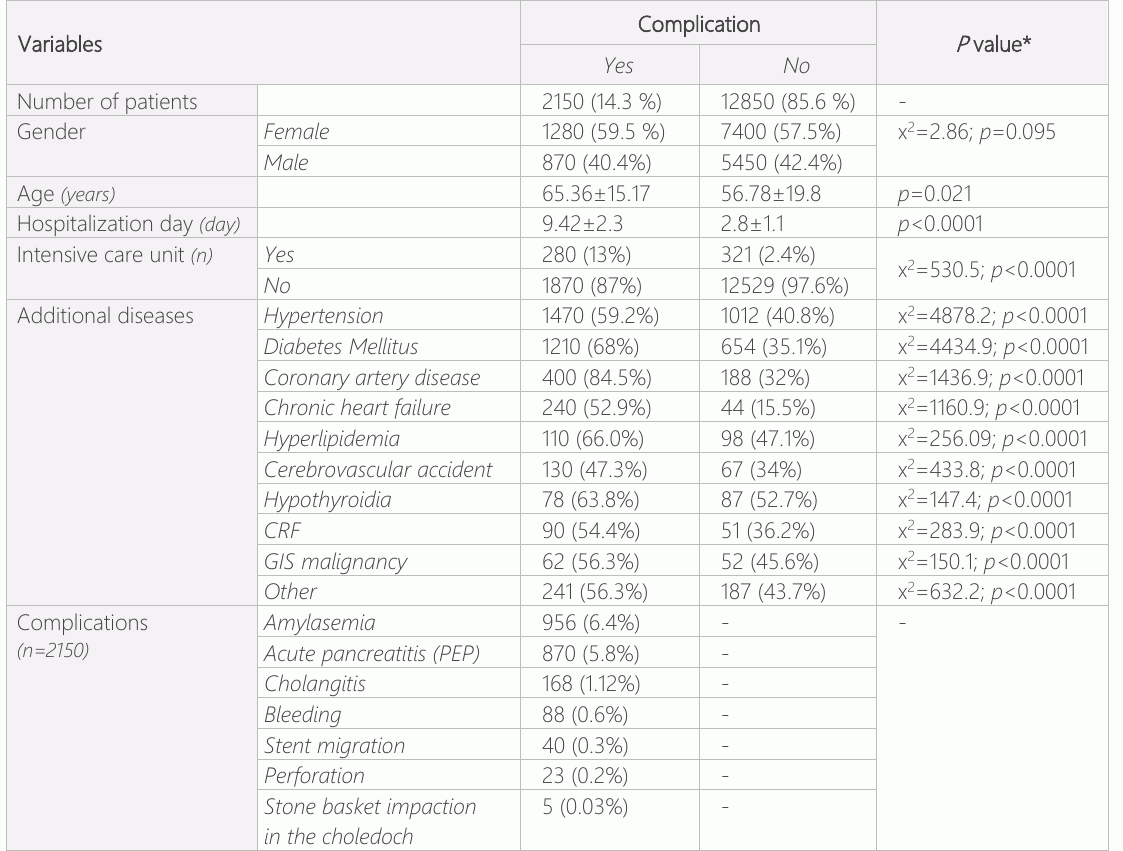
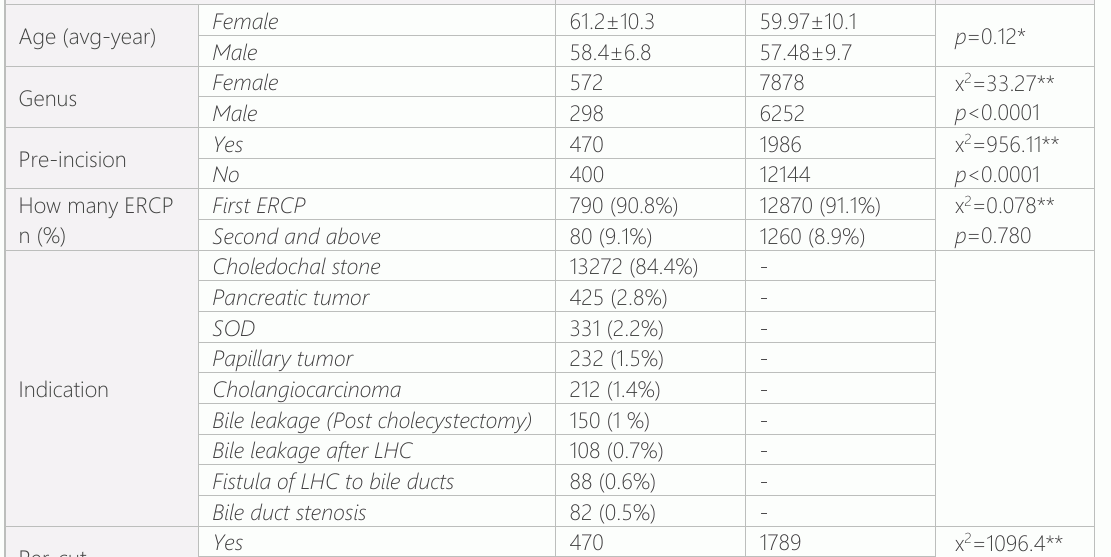
In this study, 15000 patients who underwent ERCP were divided into two groups according to the incidence of complications. When the patients with complications were compared in terms of the gender of the patients without complications, there was no difference between them (p=0.095). The age of the patients who developed complications was higher (p=0.021). The day was higher in patients with complications (p<0.0001). Patients who developed complications had a higher rate of admission to the intensive care unit (x(2)=530.5; p<0.0001).Comorbidity [Hypertension, diabetes mellitus, coronary artery disease, chronic heart failure, hyperlipidemia, cerebrovascular accident, hypothyroidia, chronic renal failure (CRF), gastrointestinal system (GIS) malignancy, and other] increased the complication rate (table 1). The most common complications in these patients were amylasemia (n=956; 6.4%) and acute pancreatitis (n=870; 5.8%). Other complications are given in Table-1. Periampullary diverticulum (PAD) was present in 1354 (9.0%) in this study. Of these cases, 772 were female, and 582 were male. Complications were seen in 196 (14.4%) of 1354 patients with PAD. Cholangitis was seen in 168 (1.12%) patients after ERCP. 46 patients died of sepsis due to cholangitis after ERCP. Patients who developed post-ERCP pancreatitis (PEP) as a complication were anaylzed separately. Patients with and without PEP were compared with each other. The results are given in Table 2.
Discussion
This study found that 15000 patients who underwent ERCP had an additional disease, increasing the development of complications. Amylasemia and PEP were the most common complications in 15000 ERCP cases. The most important indication for ERCP for patients who developed PEP was choledochal stone.
In this study, it was found that the age of the patients who developed complications was higher compared to that of those who did not develop complications. This finding supports previously reported studies (7–9). Since elderly patients have more comorbidities and use antithrombotic agents than younger patients, the rates of systemic complications and death are higher in elderly patients (7, 8). In elderly patients with acute cholangitis, symptoms are vaguer; comorbidities and delay in diagnosis are more common (9). Elderly patients are diagnosed in more severe stages than younger patients (9). Fritz et al. (10) evaluated the reliability of the ERCP procedure in patients older than and below 80 years, and no difference was found between the groups regarding procedural success and complication rates. In another study, the ERCP procedure was compared in patients over 90 and 70-90 years old, and early complication rates were similar in the groups after ERCP (11). In our study, the mean age in the patient group with complications was 65.36±15.17 years, and the mean age in the uncomplicated patient group was 56.78±19.8 years.
The literature has reported successful selective cannulation of the common bile duct in ERCP between 80-97% (12). The success of biliary cannulation depends on several factors, including the patient's anatomy, the use of specialized catheters, and skill and experience (12, 13). However, cannulation is impossible in approximately 20% of cases with the usual techniques (14). Per-cut is an alternative to cannulation under challenging situations, although its success is not guaranteed (14). Repeating ERCP within three days after a failed per-cut is acceptable (14). In this study, successful cannulation was achieved in 15000 patients. Nine hundred ninety-seven patients included in the ERCP procedure but could not be cannulated were excluded from the study. The successful cannulation rate is 93.7%. While selective cannulation was performed in 12344 patients, pre-cut cannulation was performed in 2656 patients.
The risk of infection is exceptionally high during ERCP (15). The most common intervention that causes bacteremia, especially in cases of biliary obstruction, is the ERCP procedure (15). The most common infection-related complication of ERCP is ascending cholangitis. In general, it was reported as 1.4%; however, it is associated with high mortality rate of 7.9% (15). Therefore, prophylactic antibiotics were administered to our patients before the ERCP procedure. This study observed cholangitis in 168 (1.12%) patients after ERCP, which is consistent with the literature. 46 of these patients died of sepsis due to cholangitis after ERCP. Bleeding after diagnostic ERCP is rare; sphincterotomy is the leading cause of bleeding (2). In this way, the bleeding rate has been reported as 0.3-2% in the literature (2, 5). In our study, 88 (0.5%) patients developed bleeding during the procedure. Two of them underwent surgery to control the bleeding. Transduodenal sphincterotomy and transpapillary T-tube placement were performed. No bleeding was observed in the late period. Transfusion was required in 4 patients after the procedure. If the platelet count of patients with risky comorbidities is below 50000/mm3, the number should be kept between 50000 and 80000 by giving platelet suspension with appropriate timing (16). This study studied pre-procedural hemogram and INR values of all our patients. After a hematology consultation, platelet suspension was administered to patients with low platelet counts. Necessary consultations were made for patients whose INR values were not within normal limits. Patients with average INR values were included in the procedure. In our practice, patients were included in the ERCP procedure by keeping the INR value below 1.5. Fresh frozen plasma was transfused and processed in 62 patients with high INR (1.5-4.3). Anticoagulant drugs were discontinued 5 days before the procedure. It was started again 3 days after the procedure. Although many studies suggest discontinuing acetylsalicylic acid (especially if papilloectomy/resection is to be performed), there are also studies claiming that this is not necessary for recent years (17). In our practice, we stopped aspirin 5 days before the procedure and administered low molecular-weight heparin under the skin.
The incidence of duodenal perforation after ERCP ranges from 0.09 to 1.67%, with mortality up to 8% (18). In a study conducted by Wu et al. (19) on 30 cases of perforation that occurred in 6620 ERCP procedures, 7 patients had guidewire perforation in the bile duct, 11 perforations were peri-ampullary, 3 duodenal, 1 esophageal, and 1 patient had a perforation of the afferent extremity of the Billroth II anastomosis. Conservative treatment is emphasized in perforations that develop as a complication of ERCP, unlike standard gastrointestinal perforations, and surgery should be applied to patients after careful selection. In this study, 23 (0.2%) patients developed duodenal perforation during the procedure, and 7 required open surgery. Although there was no intraoperative mortality, two patients died of sepsis that persisted after surgery.
The periampullary diverticulum (PAD) reported in the literature is between 6-20% (20). The increase in pancreatic cannulation during the procedure may be essential factor contributing to the development of pancreatitis due to anatomical position changes in the common bile duct and pancreatic duct due to the change in papilla position due to diverticula. Cannulation failure due to the change in the position of the papilla is also considered another morbidity caused by PAD, but the data on this subject are conflicting. Tyagi et al. (21) showed that the size of the diverticulum and the location of the papilla did not affect cannulation success. Choledoch cannulation in patients with PAD is more complicated and requires extraordinary skill. In addition, this diverticulum increases the risk of stone formation in the common bile duct after ERCP. In this study, 1354 (9%) of our patients had PAH. Of these cases, 772 were female, and 582 were male. Our cannulation time was longer in patients with periampullary diverticulum. Although conflicting results in terms of bleeding in studies with patients with PAH, it was shown that there was no difference in terms of pancreatitis and perforation compared to those without PAD (22). In this study, the complication rate in patients without diverticulum was not different from the complication rate in the PAD patient group. Our overall complication rate in 1354 patients with PAD was 14.4%, with 196 patients. The most common complication of ERCP is pancreatitis (23, 24). The frequency of PEP has been reported as 1-40% (24). Predicting possible complications and their course is essential to reduce risk and mortality (24). Various risk factors have been defined for developing complications, especially PEP (24). The relationship between PEP and female gender, young age, previous PEP history, presence of recurrent pancreatitis attacks, oddi sphincter dysfunction, percutaneous biliary intervention, and difficult cannulation has been proven in various studies (25, 26). In this study, PEP developed in 870 (5.8%) patients after the procedure. In our study, pre-cut cannulation was performed in 470 (54%) of 870 patients who developed PEP. An anterior pre-cut should be performed early to prevent PEP in high-risk patients. Prospective studies with more cases are needed to demonstrate that the anterior incision is protected from PEP with a needlepoint sphycterotome.
The most important limitation of this study is that patients who underwent gastric and duodenal surgery were excluded. ERCP application to patients undergoing gastric and duodenal surgery is a particular procedure. It is appropriate to carry out studies that include this group.
Conclusion
With the introduction of various imaging methods into clinical practice, ERCP has rapidly lost its diagnostic function. Today, the most critical indication for ERCP is the treatment of biliary tract and pancreatic diseases. Despite the possibility of serious complications, we believe the performance of ERCP inappropriate indications and early diagnosis of complications is essential in preventing morbidity and mortality. We also believe that the indications and complications of the ERCP procedure should be managed by a team more than any other endoscopic procedure. Consultation of indications and possible complications by a general surgeon, gastroenterologist, and radiology specialist is crucial for patient and physician safety
Declarations
- Author contributions (CRediT)
- All authors contributed equally to all 14 CRediT roles (Conceptualization, Data curation, Formal analysis, Funding acquisition, Investigation, Methodology, Project administration, Resources, Software, Supervision, Validation, Visualization, Writing – original draft, Writing – review & editing).
- Funding
-
Funding information was not reported in the published version of this article.
- Conflicts of interest
- The authors declare no conflict of interest.
- Ethics approval
- Ethics committee approval of the study was obtained from Harran University Clinical Research Ethics Committee (HRÜ/22.14.13).
- Data availability
- A data availability statement was not reported in the published version of this article.
References (26)
23 of 26 references are linked to their DOI.
- Shih HY, Hsu WH, Kuo CH. Postendoscopic retrograde cholangiopancreatography pancreatitis. Kaohsiung J Med Sci. 2019;35(4):195-201 DOI Crossref PubMed Google Scholar
- Freeman ML, Nelson DB, Sherman S, Haber GB, Herman ME, Dorsher PJ, et al. Complications of endoscopic biliary sphincterotomy. N Engl J Med. 1996;335(13):909-18 DOI Crossref PubMed Google Scholar
- Freeman ML. Complications of endoscopic retrograde cholangiopancreatography: avoidance and management. Gastrointest Endosc Clin N Am. 2012;22(3):567-86 DOI Crossref PubMed Google Scholar
- Adike A, Al-Qaisi M, Baffy NJ, Kosiorek H, Pannala R, Aqel B, et al. International Normalized Ratio Does Not Predict Gastrointestinal Bleeding After Endoscopic Retrograde Cholangiopancreatography in Patients With Cirrhosis. Gastroenterology Res. 2017;10(3):177-81 DOI Crossref PubMed Google Scholar
- Cotton PB, Garrow DA, Gallagher J, Romagnuolo J. Risk factors for complications after ERCP: a multivariate analysis of 11,497 procedures over 12 years. Gastrointest Endosc. 2009; 70(1):80-8 DOI Crossref PubMed Google Scholar
- Tintara S, Shah I, Yakah W, Ahmed A, Sorrento CS, Kandasamy C, et al. Evaluating the accuracy of American Society for Gastrointestinal Endoscopy guidelines in patients with acute gallstone pancreatitis with choledocholithiasis. World J Gastroenterol. 2022;28(16):1692-704 DOI Crossref PubMed Google Scholar
- Han SJ, Lee TH, Kang BI, Choi HJ, Lee YN, Cha SW, et al. Efficacy and Safety of Therapeutic Endoscopic Retrograde Cholangiopancreatography in the Elderly Over 80 Years. Dig Dis Sci. 2016;61(7):2094-101 DOI Crossref PubMed Google Scholar
- Pakoz Z, Gunay S, et al. ERCP başarısı ve komplikasyonlarının yaşa göre değerlendirilmesi. 2019;27(3):89-92 DOI Crossref PubMed Google Scholar
- Park CS, Jeong HS, Kim KB, Han JH, Chae HB, Youn SJ, et al. Urgent ERCP for acute cholangitis reduces mortality and hospital stay in elderly and very elderly patients. Hepatobiliary Pancreat Dis Int. 2016;15(6):619-25 DOI Crossref PubMed Google Scholar
- Fritz E, Kirchgatterer A, Hubner D, Aschl G, Hinterreiter M, Stadler B, et al. ERCP is safe and effective in patients 80 years of age and older compared with younger patients. Gastro intest Endosc. 2006;64(6):899-905 DOI Crossref PubMed Google Scholar
- Katsinelos P, Paroutoglou G, Kountouras J, Zavos C, Beltsis A, Tzovaras G. Efficacy and safety of therapeutic ERCP in patients 90 years of age and older. Gastrointest Endosc. 2006;63(3): 417-23 DOI Crossref PubMed Google Scholar
- Testoni PA, Mariani A, Aabakken L, Arvanitakis M, Bories E, Costamagna G, et al. Papillary cannulation and sphincterotomy techniques at ERCP: European Society of Gastrointestinal Endoscopy (ESGE) Clinical Guideline. Endoscopy. 2016;48(7):657-83 DOI Crossref PubMed Google Scholar
- Freeman ML, Guda NM. ERCP cannulation: a review of reported techniques. Gastrointest Endosc. 2005;61(1):112-25 DOI Crossref PubMed Google Scholar
- Penaloza Ramirez A, Rodriguez Tello D, Murillo Arias A, Barreto Perez J, Aponte Ordonez P. Endoscopic retrograde cholangiopancreatography results three days after a failed pre-cut. Rev Esp Enferm Dig. 2021;113(7):486-9 DOI Crossref PubMed Google Scholar
- Talukdar R. Complications of ERCP. Best Pract Res Clin Gastroenterol. 2016;30(5):793-805 PubMed Google Scholar
- Cohen S, Bacon BR, Berlin JA, Fleischer D, Hecht GA, Loehrer PJ, Sr., et al. National Institutes of Health State-of-the-Science Conference Statement: ERCP for diagnosis and therapy, January 14-16, 2002. Gastrointest Endosc. 2002;56(6):803-9 DOI Crossref PubMed Google Scholar
- Lee MG, Kim J, Lee SH, Lee BS, Lee SJ, Lee YS, et al. Effect of sustained use of platelet aggregation inhibitors on post-endoscopic sphincterotomy bleeding. Dig Endosc. 2014;26(6): 737-44 DOI Crossref PubMed Google Scholar
- Cirocchi R, Kelly MD, Griffiths EA, Tabola R, Sartelli M, Carlini L, et al. A systematic review of the management and outcome of ERCP related duodenal perforations using a standardized classification system. Surgeon. 2017;15(6):379-87 DOI Crossref PubMed Google Scholar
- Wu HM, Dixon E, May GR, Sutherland FR. Management of perforation after endoscopic retrograde cholangiopancreato graphy (ERCP): a population-based review. HPB (Oxford). 2006;8(5):393-9 DOI Crossref PubMed Google Scholar
- Yamaner S, Bilsel Y, Bulut T, Bugra D, Buyukuncu Y, Akyuz A, et al. Endoscopic diagnosis and management of complications 57 77 ERCP Complications UĞURLU & YILMAZ following surgery for gallstones. Surg Endosc. 2002;16(12): 1685-90 DOI Crossref PubMed Google Scholar
- Tyagi P, Sharma P, Sharma BC, Puri AS. Periampullary diverticula and technical success of endoscopic retrograde cholangiopancreatography. Surg Endosc. 2009;23(6):1342-5 DOI Crossref PubMed Google Scholar
- Mu P, Yue P, Li F, Lin Y, Liu Y, Meng W, et al. Does periampullary diverticulum affect ERCP cannulation and post-procedure complications? an up-to-date meta-analysis. Turk J Gastroenterol. 2020;31(3):193-204 DOI Crossref PubMed Google Scholar
- Iorgulescu A, Sandu I, Turcu F, Iordache N. Post-ERCP acute pancreatitis and its risk factors. J Med Life. 2013;6(1):109-13. PubMed Google Scholar
- Tryliskyy Y, Bryce GJ. Post-ERCP pancreatitis: Pathophysiology, early identification and risk stratification. Adv Clin Exp Med. 2018;27(1):149-54 DOI Crossref PubMed Google Scholar
- Committee ASoP, Anderson MA, Fisher L, Jain R, Evans JA, Appalaneni V, et al. Complications of ERCP. Gastrointest Endosc. 2012;75(3):467-73 PubMed Google Scholar
- Dumonceau JM, Andriulli A, Elmunzer BJ, Mariani A, Meister T, Deviere J, et al. Prophylaxis of post-ERCP pancreatitis: European Society of Gastrointestinal Endoscopy (ESGE) Guideline. Endoscopy. 2014;46(9):799-815 DOI Crossref PubMed Google Scholar
Respond to this article
Comments on a published article are welcome as a Letter to the Editor.
Get an e-mail when new articles in your fields are published
Questions to the authors
Questions are moderated: an editor approves each question, the authors answer, and an editor approves the answer before both appear here.
No answered questions yet.
Ask the authors a question
Discussion
Comments are moderated: they appear after the writer confirms the e-mail address and an editor approves them. Each comment carries a conflict-of-interest statement.
No comments yet.
Write a comment
Tell me when this article is cited
Leave your e-mail address and confirm it. These notices are not being sent yet; your confirmed address is kept for them and used for nothing else.
Read the full text
Open the PDF here
Loading the PDF…
If the PDF does not show here, use the download button above.
How to cite this article
Ugurlu ET, Yilmaz S. Diagnosis and Management of ERCP Complications: The Results of 15000 Cases from Two Centers. Ulutas Med J. 2023;9(1):51-57. doi:10.5455/umj.20221219050725
Ugurlu, E. T., & Yilmaz, S. (2023). Diagnosis and Management of ERCP Complications: The Results of 15000 Cases from Two Centers. The Ulutas Medical Journal, 9(1), 51–57. https://doi.org/10.5455/umj.20221219050725
Ugurlu, E.T. and Yilmaz, S. (2023) 'Diagnosis and Management of ERCP Complications: The Results of 15000 Cases from Two Centers', The Ulutas Medical Journal, 9(1), pp. 51–57. doi: 10.5455/umj.20221219050725.
@article{umj119071,
  title = {Diagnosis and Management of ERCP Complications: The Results of 15000 Cases from Two Centers},
  author = {Ugurlu, Esat Taylan and Yilmaz, Sezgin},
  journal = {The Ulutas Medical Journal},
  year = {2023},
  volume = {9},
  number = {1},
  pages = {51--57},
  doi = {10.5455/umj.20221219050725},
  url = {https://www.ulutasmedicaljournal.com/?mno=119071},
  issn = {2149-388X}
}