The Ulutas Medical Journal · ISSN 2149-0430 (print), 2149-388X (online) · https://www.ulutasmedicaljournal.com/?mno=63126
Original Article · Open access
Is Vitamin D Deficiency the Invisible Part of the Iceberg in Preschool Children?
- Department of Pediatrics, Medicine Hospital, Atlas University ROR
- Department of Pediatrics, Medicine Hospital, ROR
- Department of Pediatrics, Kartal Dr. Lütfi Kırdar Training and Research Hospital, University of Health Sciences ROR
- Department of Pediatric Endocrinology, Trakya University Medical Faculty ROR
Abstract
- Introduction
- Vitamin D deficiency continues to be a serious public health problem in all age groups in Turkey. The aim of this prospective study was to evaluate the vitamin D status in preschool children after the initiation of support programs and to determine risk factors for vitamin D deficiency.
- Materials and Methods
- The study included 135 preschool children, >24 months to <84 months of age, who presented to the pediatric clinic between January and September 2018. The demographics, risk factors, diet, and daily vitamin D intake were recorded. Serum levels of 25(OH)D, calcium, phosphorus, and alkaline phosphatase were measured. Serum 25(OH)D levels were evaluated in relation to several risk factors including age, gender, body mass index, number of siblings, socioeconomic status, education level of the family, vitamin D intake during pregnancy and infancy, daily sunlight exposure, and season of presentation.
- Results
- The mean 25(OH)D level was 19.6±8.5 ng/mL. According to the vitamin D levels, more than half of the children had vitamin D deficiency (n=31, 23%) or insufficiency (n=42, 31.1%). Significantly lower 25(OH)D levels were found in children with low socioeconomic status (p=0.01), a low maternal education level (p=0.02), low regular vitamin D intake during infancy (p=0.04), less daily sunlight exposure (p=0.03), and in those who presented in winter (p=0.01). Laboratory parameters did not differ significantly across the vitamin D deficient, insufficient, and sufficient groups.
- Conclusion
- Despite the current preventive strategies and supplementation programs, vitamin D deficiency continues to be an important problem not only for risk groups but also for preschool children.
Keywords
Full text
Introduction
Vitamin D (Vit-D), a prohormone, is important for calcium-phosphorus balance and bone mineralization and is produced by the kidneys (1–3). Vit-D deficiency is not only associated with rickets and osteomalacia but may also predispose individuals to many diseases such as cardiovascular diseases, rheumatic diseases, neuropsychiatric dysfunction, and immune system disorders (4–7).
In both adults and children, vit-D deficiency is a public health problem in Turkey. Therefore, vit-D supplementation programs have been initiated for newborns and infants since 2005 and pregnant women since 2011. It has also been shown that the support program for infants reduces the incidence of rickets, especially under 3 years of age (8, 9). However, recent research also shows that vit-D deficiency and insufficiency are still major problems (9). Most of the studies evaluating vit-D status following supplementation programs generally involve the risk groups; thus, data are limited in the case of vit-D preschool children. Given its predisposing role to many metabolic and systemic diseases, preventive strategies against vit-D deficiency can be promoted in this pediatric population.
This study aims to determine the vit-D status in preschool children and to determine the important risk factors for vit-D deficiency in this population.
Materials and Methods
This study was carried out prospectively in the Pediatrics Department of the Medical Hospital following the principles of the Declaration of Helsinki.
Ethical Statement
All applications were approved by Biruni University Medical Ethics Committee (2018/15- 18). The informed consent was also obtained from the parents for the children.
135 preschool children aged 24-84 months, who presented to the pediatric outpatient clinic between January and September 2018, were included in the study. All parents completed a questionnaire at enrollment to collect medical history and socio-economic demographics. Exclusion criteria for children included age <2 or >7 years, the attendance of chronic disease, congenital disease or malformation, use of any medication that may assume the 25(OH)D level, and refusal of parental consent. A detailed data collection was made involving, gender, age, body mass index (BMI), height, weight number of siblings, socioeconomic position, parental education level, daily exposure to the sun, vitamin D intake during the first year of life, maternal vitamin D intake through pregnancy, diet and the season in which the child visited the clinic. Daily exposure to sunlight for more than 30 minutes was evaluated as adequate sun exposure. Mothers and their children were divided into groups according to their vit-D intake during infancy and pregnancy; none, irregular intake, and regular intake.
Dietary intakes of calcium (Ca) and vit-D were also recorded, with adequate consumption considered to involve two fish meals and three eggs per week and daily intake of milk and dairy products. BMI was calculated by dividing the weight in kilograms by the square height in meters (10). To determine 25(OH)D, alkaline phosphatase (ALP), phosphorus (P), Ca levels of the children, blood samples were collected and analyzed on the same day. Serum ALP, P, and Ca levels were analyzed by photometry on the Cobas Integra 400-Plus automatic analyzer (Roche Diagnostics, Germany). 25(OH)D levels were analyzed by enzyme-linked fluorescence assay on a Mini Vidas automated system (Biomerieux, France). There are also different classifications for evaluating vitamin D status in the literature. In our study, serum 25(OH)D levels were classified according to the 'Global Consensus Recommendations on the Prevention and Management of Nutritional Rickets' (deficiency: <12 ng/mL, insufficiency: 12-20 ng/mL, sufficient: >20 ng/mL) (11).
Statistical Analysis
Data were analyzed using the SPSS Statistics 20 program. G * Power Version 3.1 was used for the sufficient sample size. The minimum value for the total sample size was 134 and the effect size was 0.35, the power was 0.8 and the type 1 error was 0.05. Descriptive data were expressed as a percentage, minimum, maximum, mean, median, and standard deviation. Student t-test and one-way analysis of variance (ANOVA) were used for normally distributed data, and Kruskal-Wallis test was used for non-parametric data to test the differences between means. The Chi-square test was used to determine the significant differences between categorical variables. A p-value of less than 0.05 was considered to be significant for type 1 error.
Results
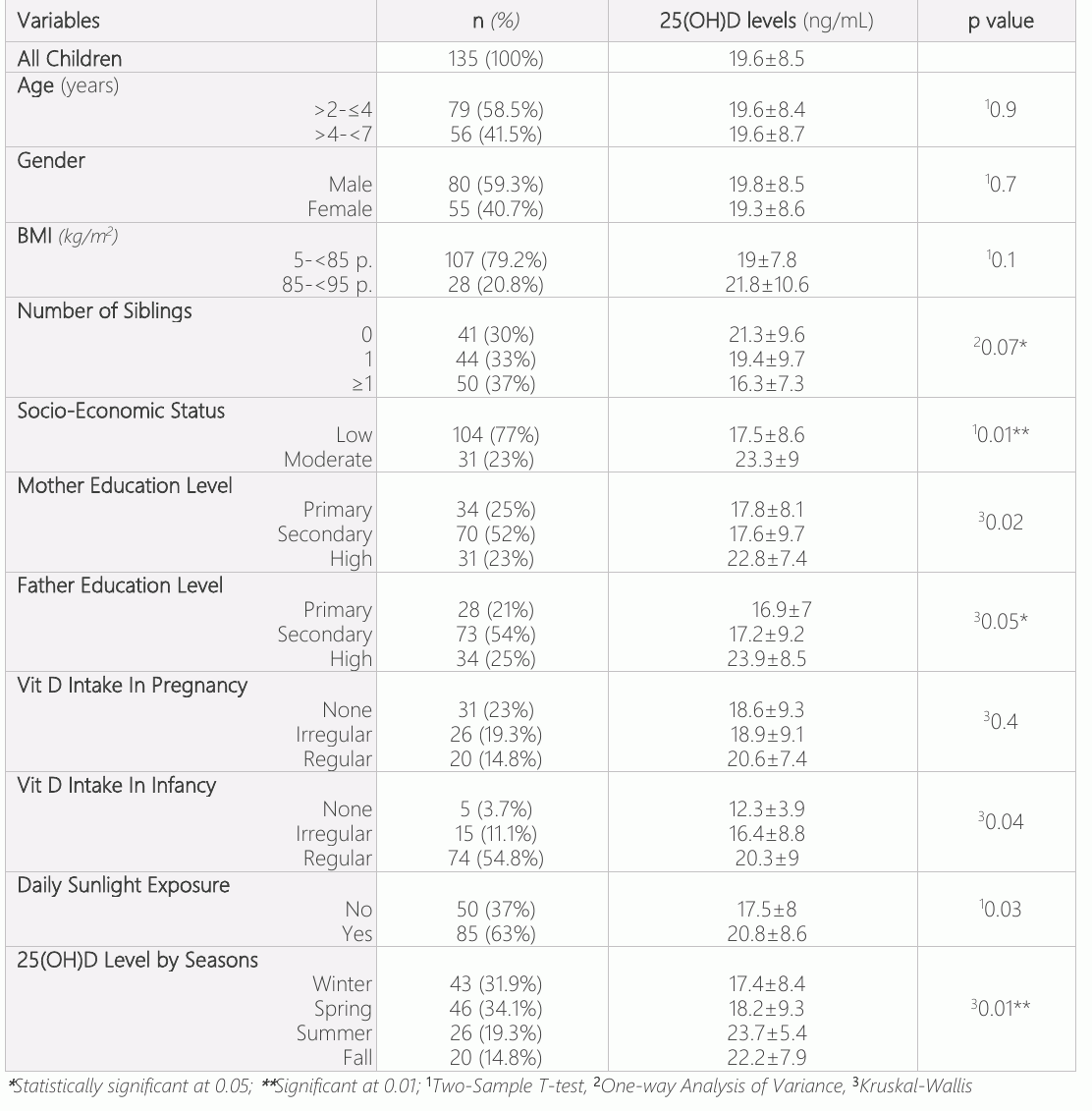
Of 135 children, 55 (40.7%) were females and 80 (59.3%) were males. The mean age was 45.6±13.7 months. The mean 25(OH)D level was 19.6±8.5 (range 5.7-42.9) ng/mL and the mean Ca, P, ALP levels were 9.5±0.5 mg/dL, 4.5±0.7 mg/dL, and 179.5±41 U/L, respectively. Some of the mothers could not give an accurate account as to whether they had received vit-D during pregnancy (58; 43%) or for their babies (41; 30%).
Serum 25(OH)D levels showed no noteworthy differences among children by age, gender, BMI, number of siblings, father education level, and vit-D intake during pregnancy (Table 1). A higher socioeconomic status (p=0.01), a higher maternal education level (p=0.02), regular vit-D intake during infancy (p=0.04), the presence of daily sunlight exposure (p=0.03), and summer visits (p=0.01) had significant effects on higher serum 25(OH)D levels (Table 1). Serum 25(OH)D levels were meaningfully lower in children who presented in winter and spring seasons than in those who presented in fall and summer seasons (p=0.01).
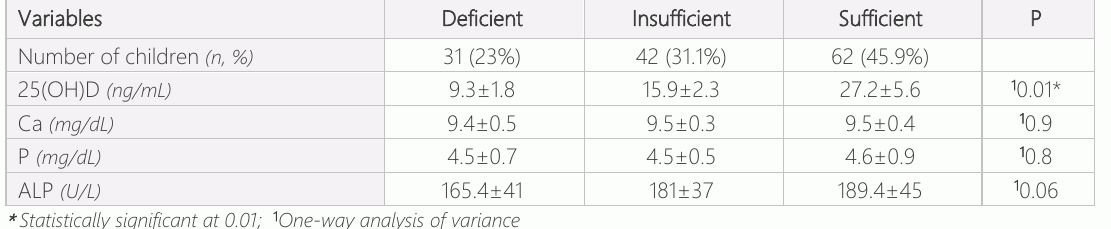
Children were divided into groups according to their 25 (OH) D levels as deficient, inadequate, and sufficient(11) (Table 2). More than half of the children fell into deficient (n=31, 23%) or insufficient (n=42, 31.1%) categories. As expected, the mean 25(OH)D level in the deficient group (9.3±1.8ng/mL) was significantly lower than those of the insufficient (15.9±2.3 ng/mL) and sufficient groups (27.2±5.6 ng/mL) (p=0.01). Ca, P, ALP levels were similar across the three groups.
Serum 25(OH)D levels of children were also evaluated concerning the consumption of nutrients rich in Ca and vit-D. Children with higher consumption of nutrients rich in Ca and vit-D had higher serum 25(OH)D levels than those with an inadequate ingesting of nutrients wealthy in Ca and vit-D, but with no significant difference (for Ca intake, 19.3±9 vs. 17.1±9.2 ng/mL, p=0.16; for vit-D intake, 19.1±8.4 vs. 18.3±9.4 ng/mL, p=0.48).
Discussion
This prospective study provides more evidence to the literature that vit-D deficiency is an ongoing major health problem in the preschool age group. The incidences of deficiency (23%) and insufficiency (31.1%) were high among preschool children, with serum 25(OH)D levels being significantly affected by socio-economic status, mother education level, vit-D intake during the first year of life, sunlight exposure, seasons and vit-D status.
The reported prevalence of vit-D deficiency in children shows a wide range from 1 to as high as 80%, depending on geographical distribution and countries. Two studies in the U.S.A reported the prevalence of serum vit-D levels at <20 ng/ml were 18% and 12.1% (12, 13). In a meta-analysis of the European pediatric population, the prevalence ranged from 1-40% (14). In two studies conducted in China and India, the prevalence was reported as 38.8% and 40-80%, respectively (15, 16).
Vit-D deficiency is still an important public health problem in Turkish children, despite support programs for babies and pregnant women. In 2005, Hatun et al. found the incidence of vit-D deficiency to be 21.7% among adolescent girls (17). In another study, Ölmez et al. drew attention to undulating prevalence patterns of insufficiency among adolescent girls, being 59.4% during the end of winter and 15.6% during the end of summer (18). In 2010, Arıca et al. reported that 37.5% of children aged 0-36 months had serum 25(OH)D levels of ≤10 ng/mL (19). In 2011, Andıran et al. reported the prevalence of vit-D deficiency as 25% among children and adolescents 0 to 16 years of age (20). In 2015, Doğan et al. reported a vit-D deficiency in 35% of children aged 1 month to 17 years, with a higher incidence of 41% among children aged 4 to 7 years (21). In 2016, Demiral et al. found that 51.5% of pediatric patients presenting to the endocrinology clinic had serum 25(OH)D levels of <12 ng/mL (22). Despite the use of varying cut-off values, these studies show that the rates of vit-D deficiency remain high among the pediatric population. In our study, the mean serum 25(OH)D level was within the range of deficiency (19.6±8.5 ng/mL) and the incidence of vit-D deficiency was 23%. Previous studies primarily focused on the vit-D status of risky groups such as infants and adolescents. In this study, we evaluated only preschool children (2-7 years of age) owing to limited data for this age group. Our results demonstrated a high incidence of vit-D deficiency and insufficiency in preschool children.
The primary source of vit-D is sun exposure because it is primarily produced in the skin through exposure to ultraviolet radiation. Therefore, the factors causing limited sun exposure have been implicated as the risk for a deficiency, including increased skin coloring, use of sunscreens, a covered dress style, winter season, living at higher latitudes, and increased daily time spent indoors (1, 3). As for seasonal variations, Karagüzel et al. reported the incidence of insufficiency as 93% throughout spring and as 71% throughout autumn among school children 11 to 18 years of age (23). Using serum samples obtained at the end of winter, Ölmez and Erol et al. reported vit-D insufficiency in 59.8% of female adolescents and 80% of children and adolescents, respectively (18, 24). In our study, 25(OH)D was significantly lower in winter serum samples than in fall and summer samples. An advanced level of daily sunlight exposure was also associated with significantly higher 25(OH)D levels.
Concerning other risk factors, children with a higher socioeconomic status and a higher mother education level had higher 25(OH)D levels and vice versa. A study from Belgium reported a significantly lower incidence of vitamin D deficiency among pregnant women with a higher education level (25). In a study, El Koumi et al. showed that low socioeconomic status was related to maternal vitamin D deficiency, which in turn had a significant adverse effect on neonatal vit-D status (26). Several studies from Turkey also found adverse effects of low socioeconomic status and a low educational level on the vit-D status of mothers and their newborns (18, 24, 27). Impaired vit-D status of children related to the low socio-economic status and low educational levels may be attributed to the fact that these risk factors directly influence individual lifestyles, among which are nutritional habits, clothing, and insufficient time-spending outdoors. Concerning nutritional habit, we also evaluated serum 25(OH)D levels of children in terms of consumption of nutrients wealthy in Ca and vit- D, which, albeit not significant, showed higher 25(OH)D levels in children having adequate consumption. This finding supports the major role of sunlight in vit-D status as well as the relatively small role of dietary intake.
There are some limitations to our study. Especially, this study was conducted in a localization where the majority of the population consists of families with low-medium socio-economic status. Second, PTH levels could not be measured. Therefore, many further studies are needed to fully elucidate the results associated with vit-D status in preschool children.
Conclusion
There is growing evidence from recent studies that the problem of vit-D deficiency in children is far to abate. The data in the present study advise that vit-D deficiency is a significant problem not only in risky age groups but also in the preschool period. Therefore, considering relevant and amendable risk factors, preventive strategies such as preschool support programs or expanded support program continuing in babies may be considered to ensure the health of future generations.
Declarations
- Author contributions (CRediT)
- All authors contributed equally to all 14 CRediT roles (Conceptualization, Data curation, Formal analysis, Funding acquisition, Investigation, Methodology, Project administration, Resources, Software, Supervision, Validation, Visualization, Writing – original draft, Writing – review & editing).
- Funding
-
Funding information was not reported in the published version of this article.
- Conflicts of interest
- The authors do not report a conflict of interest for the present study.
- Ethics approval
- All applications were approved by Biruni University Medical Ethics Committee (2018/15- 18). The informed consent was also obtained from the parents for the children.
- Data availability
- A data availability statement was not reported in the published version of this article.
References (27)
22 of 27 references are linked to their DOI.
- Holick MF, Chen TC. Vitamin D deficiency: a worldwide problem with health consequences. Am J Clin Nutr 2008;87: 1080-6 DOI Crossref PubMed Google Scholar
- Palacios C, Gonzales L. Is vitamin D deficiency a major global public health problem? J Steroid Biochem Mol Biol 2014;144: 138-45 DOI Crossref PubMed Google Scholar
- Misra M, Pacaud D, Petryk A, Collett-Solberg PF, Kappy M. Vitamin D deficiency in children and its management: Review of current knowledge and recommendations. Pediatrics 2008; 122:398-417 DOI Crossref PubMed Google Scholar
- Liang Ke, Mason RS, Kariuki M, Mpofu E, E Brock K. Vitamin D status and hypertension: a review. Integrated Blood Pressure Control 2015;8:13-35 DOI Crossref PubMed Google Scholar
- Schlög M, Holick MF. Vitamin D and neurocognitive function. Clinical Interventions in Aging 2014; 9:559-68 DOI Crossref PubMed Google Scholar
- Aranow C. Vitamin D and the Immune System. J Investig Med 2011;59:881-6 DOI Crossref PubMed Google Scholar
- Kulie T, Groff A, Redmer J, Hounshell J, Schrager S. Vitamin D: An Evidence-Based Review. J Am Board Fam Med 2009; 22:698-706 DOI Crossref PubMed Google Scholar
- Hatun S, Ozkan B, Bereket A. Vitamin D deficiency and prevention: Turkish experience. Acta Paediatr 2011; 100:1195-9 DOI Crossref PubMed Google Scholar
- Ozdemir AA, Ercan Gündemir Y, Küçük M, Yıldıran Sarıcı D, Elgörmüş Y, Cag Y, et al. Vitamin D Deficiency in Pregnant Women and Their Infants. J Clin Res Pediatr Endocrinol 2018;10:44-50 DOI Crossref PubMed Google Scholar
- Bundak R, Furman A, Gunoz H, Darendeliler F, Bas F, Neyzi O. Body mass index references for Turkish children. Acta Paediatr 2006;95:194-8 DOI Crossref PubMed Google Scholar
- Munns CF, Shaw N, Kiely M, Specker BL, Thacher TD, Ozono K, et al. Global Consensus Recommendations on Prevention and Management of Nutritional Rickets. J Clin Endocrinol Metab 2016; 101:394-415 DOI Crossref PubMed Google Scholar
- Mansbach JM, Ginde AA, Camargo Jr CA. Serum 25 - Hydroxyvitamin D Levels Among US Children Aged 1to 11 Years: Do Children Need More Vitamin D? Pediatrics 2009;124:1404-10 DOI Crossref PubMed Google Scholar
- Gordon CM, Feldman HA, Sinclair L, Williams AL, Kleinman PK, Perez-Rossello J, et al. Prevalence of Vitamin D Deficiency Among Healthy Infants and Toddlers. Arch Pediatr Adolesc Med 2008; 162:505-12 DOI Crossref PubMed Google Scholar
- Saggese G, Vierucci F, Prodam F, Cardinale F, Cetin I, Chiappini E, et al. Vitamin D in pediatric age: consensus of the Italian Pediatric Society and the Italian Society of Preventive and Social Pediatrics, jointly with the Italian Federation of Pediatricians. Ital J Pediatr 2018;44:51 DOI Crossref PubMed Google Scholar
- Zhao X, Xiao J, Liao X, Cai L, Xu F, Chen D, et al. Vitamin D Status among Young Children Aged 1-3 Years: A Cross-Sectional Study in Wuxi, China. PLoS One 2015; 10 (10): e0141595 DOI Crossref PubMed Google Scholar
- Surve S, Chauhan S, Amdekar Y, Joshi B. Vitamin D deficiency in Children: An update on its Prevalence, Therapeutics and Knowledge gaps. Indian J Nutri 2017;4:167 PubMed Google Scholar
- Hatun S, Islam O, Cizmecioglu F, Kara B, Babaoğlu K, Berk F, et al. Subclinical vitamin D deficiency is increased in adolescent girls who wear concealing clothing. J Nutr 2005;135:218-22 DOI Crossref PubMed Google Scholar
- Olmez D, Bober E, Buyukgebiz A, Cimrin D. The frequency of vitamin D insufficiency in healthy female adolescents. Acta Paediatr 2006;95:1266-9 Vitamin D Deficiency Ozdemir et al. DOI Crossref PubMed Google Scholar
- Arıca V, Arıca S, Gücük S, Edirne T. Level of serum 25-OHD in healthy children aged 0-36 months in Van. Turk Arch Ped 2010; 45:286-90 PubMed Google Scholar
- Andıran N, Çelik N, Akça H, Doğan G. Vitamin D deficiency in children and adolescents. J Clin Res Pediatr Endocrinol 2012; 4(1):25-9 DOI Crossref PubMed Google Scholar
- Doğan N, Aydoğdu Çolak A, Güden N, Üstüner F. Vitamin D deficiency in children in Aegean region in Turkey. Cumhuriyet Medical Journal 2015;37(1):17-22 DOI Crossref PubMed Google Scholar
- Demiral Başar M, Sırmagül SB. Endokrin Polikliniğine Başvuran Çocuklarda D Vitamini Düzeyleri. J Curr Pediatr 2016;14:60-6 PubMed Google Scholar
- Karagüzel G, Dilber B, Çan G, Ökten A, Değer O, Holick MF. Seasonal vitamin D status of healthy schoolchildren and predictors of low vitamin D status. J Pediatr Gastroenterol Nutr 2014;58:654-60 DOI Crossref PubMed Google Scholar
- Erol M, Yiğit Ö, Küçük SH, Bostan Gayret Ö. Vitamin D Deficiency in Children and Adolescents in Bağcılar, İstanbul. J Clin Res Pediatr Endocrinol 2015;7:134-9 DOI Crossref PubMed Google Scholar
- Vandevijvere S, Amsalkhir S, Van Oyen H, Moreno-Reyes R. High prevalence of vitamin D deficiency in pregnant women: a national cross- sectional survey. PLoS One 2012; 7(8): e43868 DOI Crossref PubMed Google Scholar
- El Koumi MA, Ali YF, Abd El Rahman RN. Impact of maternal vitamin D status during pregnancy on the prevalence of neonatal vitamin D deficiency. Turk J Pediatr 2013;55:371 -7 PubMed Google Scholar
- Andiran N, Yordam N, Ozön A. Risk factors for vitamin D deficiency in breast-fed newborns and their mothers. Nutrition 2002;18:47-50 PubMed Google Scholar
Read the full text
Open the PDF here
Loading the PDF…
If the PDF does not show here, use the download button above.
How to cite this article
Ozdemir AA, Varol A, Cag Y, Dilek E. Is Vitamin D Deficiency the Invisible Part of the Iceberg in Preschool Children?. Ulutas Med J. 2021;7(2):124-130. doi:10.5455/umj.20210311011458
Ozdemir, A. A., Varol, A., Cag, Y., & Dilek, E. (2021). Is Vitamin D Deficiency the Invisible Part of the Iceberg in Preschool Children?. The Ulutas Medical Journal, 7(2), 124–130. https://doi.org/10.5455/umj.20210311011458
Ozdemir, A.A. et al. (2021) 'Is Vitamin D Deficiency the Invisible Part of the Iceberg in Preschool Children?', The Ulutas Medical Journal, 7(2), pp. 124–130. doi: 10.5455/umj.20210311011458.