The Ulutas Medical Journal · ISSN 2149-0430 (print), 2149-388X (online) · https://www.ulutasmedicaljournal.com/?mno=48183
Original Article · Open access
Stent Use in Emergency Treatment of Malignant Colonic Obstruction
Also available in: العربية · Türkçe · 中文
- General Surgery Clinic, Health Ministry, Gebze Fatih State Hospital, Kocaeli, Turkey ROR
- Gaziosmanpaşa Taksim Eğitim ve Araştırma Hastanesi, Istanbul, Turkey ROR
Abstract
- Background
- In previous studies, the outcome of stent use in malignant colonic obstruction patients widely varies. We aim to present the outcome of our patients who have undergone colonic stenting in malignant colonic obstruction as a bridge or conservative therapy in line with the literature. Materials and Method: We have retrospectively reviewed patient records in surgical endoscopy clinic of our hospital. The subjects were patients who had a diagnosis of colon malignancy between 2012-2018 and had undergone a self-expandable stent. Stenting was done as a bridge to surgery in resectable colorectal tumors or for palliation in colonic obstructions due to inoperable colorectal malign disease. Clinical success was defined as resolution of obstructive symptoms and immediate decompression of the bowels proven by the passage of stool and gas in 24 hr.
- Results
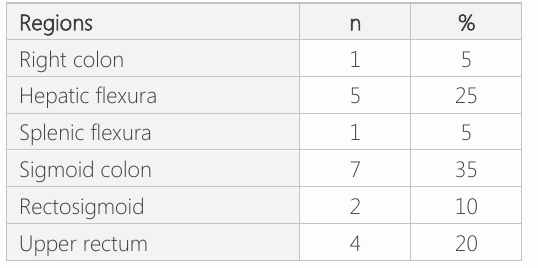
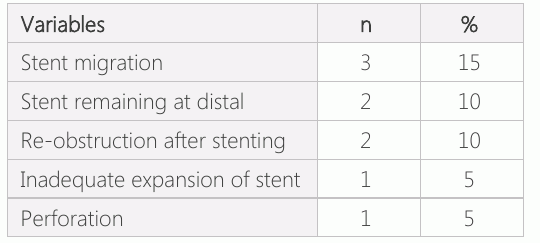
- Twenty patients were included in the study. 14 (70%) patients were male, and 6 (30%) female, mean age was 61.4±22.6 years. Right colon 1 (5%), hepatic flexure 5 (25%), splenic flexure 1 (5%), sigmoid colon 7(35%), recto-sigmoid 2 (10%), upper rectum 4 (20%) stenting was performed in terms of location. In 11 of the patients (55%), the tumor was considered resectable. After the emergency condition of the patients was improved by stenting, they were ready for elective curative surgery. In nine (45%) patients, the tumor was unresectable. In these patients, stenting was ensued by oncologic follow-up. Stent migration after the procedure 3 (15%), stent remaining at distal during the procedure 2 (10%), re-obstruction after the procedure due to tumor invasion 2 (10%), inadequate expansion of the stent 1(5%) and perforation 1 (5%) were observed in patients.
- Conclusion
- Stenting as a bridge or conservative therapy in malignant colonic obstruction by skilled surgeon increases success rates of one-stage operation significantly and increases the quality of life by decreasing the rates of a permanent stoma and wound infections.
Keywords
Full text
Introduction
Colorectal cancer is a common malignancy with a high rate of mortality (1). Emergency colon resection has higher rates of mortality, morbidity, and stoma compared with elective colon resection (2). Emergency surgical patients are usually those who are older and with bowel distension (3). Thus, converting an urgency to an elective procedure may be desirable. It has suggested that self-expandable metal stents may facilitate bowel decompression and serve as “bridge to the surgery” in patients with the resectable disease (4). Insertion of self-expandable metal stents is shown to be useful both as a definitive procedure in a palliative setting and as a bridge to surgery in the treatment of acute colonic obstruction (4–6). Endoscopic colon stenting as a bridge to elective surgery has significant advantages in terms of short- and long-term outcomes (4, 7). However, in some studies, the rate of general complications and mortality were reported to be similar to “bridge” stenting and emergency surgery (8). Results with wide variations have been reported in studies assessing stenting in malignant colon obstruction.
This study aims to present the outcome of our patients who have undergone colonic stenting in malignant colonic obstruction as a bridge or conservative therapy in line with the literature.
Materials and Method
After the approval of ethics committee (Kartal Koşuyolu Yüksek Ihtisas Training and Research Hospital), we have retrospectively reviewed patient records in surgical endoscopy clinic of Gebze State Hospital.The subjects were patients who had a diagnosis of colon malignancy between 2012-2018 and had undergone self-expandable stent (SEMS) operation. Stenting was done as a bridge to surgery in resectable colorectal tumors or for palliation in colonic obstructions due to inoperable colorectal malign disease.
The procedures were done by experienced endoscopists under mild sedation or general anesthesia. Type of anesthesia was decided upon concomitant diseases and general condition of the patients and localization of the obstruction (in distal obstructions sedation was less needed). Length of the stent was selected according to the length of the tumor at CT (tumor length +4 cm, 2 cm will remain at proximal and 2 cm at distal). Tumor tissue was approached by colonoscope for SEMS insertion and by 0.035-inch tapered tip flexible guidewire was inserted to the proximal of the tumor. After confirming the passage of guidewire comfortably, SEMS was advanced through the accessory canal of the guidewire. If the stent sent through the guidewire pushes endoscope back and away from the tumor, the guidewire was withdrawn and then sent once more.
Moreover, after confirming the insertion of the stent comfortably, the stent was expanded. After observing the stent was expanded the procedure was terminated. 48-72 hours after SEMS procedure colon segments at the proximal of the tumor were inspected by passing through the SEMS.
Clinical success was defined as resolution of obstructive symptoms and immediate decompression of the bowels proven by the passage of stool and gas in 24 hr. After the procedure, successful stent placement and bowel decompression were confirmed by abdominal X-ray. Complications were classified as early (within 30 days) and late complications. Perforation, re-obstruction, and migration were complications associated with stenting and were treated by re-stenting or surgery.
Results
Twenty patients who have referred to our emergency department for colonic obstruction and undergone stenting were included in the study. 14 (70%) patients were male, and 6 (30%) female, mean age was 61.4±22.6 years. Right colon 1, hepatic flexure 5, splenic flexure 1, sigmoid colon 7, recto-sigmoid 2, upper rectum four stentings were performed in terms of location (Table-1). In one patient, malignant obstruction was suspected, and the stent was inserted into the rectosigmoid junction. However, three biopsies failed to confirm malignancy. Anterior resection and biopsy were done due to a strong suspicion of malignancy, but Crohn disease was diagnosed in the specimen sent to the pathology examination. These patients were excluded from the study. In 20 patients, stenting was used due to malignant disease. In 11 of the 20 patients with a colon cancer diagnosis, the tumor was considered resectable. After the emergency condition of the patients was improved by stenting, they were ready for elective curative surgery. In nine patients, the tumor was unresectable. In these patients, stenting was ensued by oncologic follow-up. Complications: 1-stent migration after the procedure in 3 patients. Usually in Day 5-8. Re-stenting was done. 2- stent remaining at distal in 2 patients. Re-stenting was done. 3- Re-obstruction due to tumor growth in 2 patients. These patients were non-resectable, and obstruction was decompressed by re-stenting. In one patient, stent expansion was inadequate. Re-stenting was done in Day 6. Perforation was observed in one patient (Table-2).
Obstruction has developed after specific periods because of tumor growth in this non-resectable patients. Re-stenting was done after each occasion. Perforation has occurred during the procedure. Emergency surgery was performed. Colostomy was created. Hepatic failure has developed due to multiple liver metastases and the patients have died at post-op Day 15.
Discussion
Bowel obstruction is a clinical and surgical emergency. The primary reason for the interest of surgeons in using SEMS is their desire to convert an urgent operation into an elective one. Thus, pre-op morbidity potential may be reduced, bowel functions may be regained, and stoma requirement may be eliminated (9). Colon stenting aims to resolve obstruction and to decompress the bowel. For a successful decompression, the stent should be placed with a correct technique, and the stent should decompress the lumen but remain in situ. (10, 11). Adequate decompression rates changes between 70% and 86% (12, 13). In our series, the rate was within this range.
Perforation may cause severe mortality and morbidity. It may potentially lead to fecal contamination, peritonitis, and death, and in malignant strictures, the disease may be disseminated. It was reported as 4% in the literature (14, 15). Perforation has occurred in one patient in our series. In these patients with extra-colonic involvement, perforation has occurred during the fourth stenting because of tumor growth. When assessed by the number of total stents, the rate is lower than the literature. In some patients, proximal of the tumor was not reached by the guidewire comfortably. Thus we preferred emergency surgery in these patients and did not insist for stenting, so this may be the reason for the low rate of complications in our study.
Sebastian et al., and Chun et al. have reported stent migration 10-12%, re-obstruction 7-10%, total mortality 1% in their studies (16, 17). In procedure 3(15%), stent remaining at distal during the procedure 2(10%), re-obstruction after procedure due to tumor invasion 2(10%), inadequate expansion of the stent 1(5%) and perforation 1(5%) were observed. Our results are in line with the literature.
In the 2014 guideline of the European Society of Gastrointestinal Endoscopy (ESGE) SEMS as a bridge to elective surgery in symptomatic malignant left colon obstruction is not recommended as standard treatment with a clear statement(18). Authors of the guideline have stated that some benefits of SEMS as a bridge to surgery has been supported in a recent meta-analysis of randomized, controlled studies(19). However, observance of higher oncologic risk associated with perforation has prompted the authors to advise prudent use of stenting (20).
In their study, Arezzo et al., have compared the morbidity associated with stenting as the bridge in malignant colon obstructions and emergency surgery. In 39 months of average follow up, they have reported that oncologic outcomes were not different, and stoma rate was significantly lower in stent patients (9). When the fact that 30% of temporary stomas could not’ be closed is taken into account, it is clear that the quality of life of these patients will decrease (9). They have concluded that stenting by skilled specialists as bridge treatment may be an appropriate approach in terms of quality of life, although there is no difference in oncologic outcomes (9).
In their study, Boyle et al., have reported that the compression was more successful in colorectal cancer patients compared to patients with the diverticular disease or external compression (21). Although the reason is not apparent, it may be multifactorial. Potentially, irregular mucosa observed in colorectal cancer may ease the attachment of the stent and prevent migration; on the other hand, smooth fibrotic diverticular strictures and external compressions may limit the expansion of the stent and may impede attachment of the stent. Moreover, in this study, it has been shown that the failure rate may be higher in longer strictures, and diverticular strictures are 2.5 cm longer on average compared to colon strictures (21). In our study, stenting was done only in colorectal tumor patients. There were no patients with external compression or diverticular stricture.
In conclusion, stenting as bridge in malignant colonic obstruction or as conservative therapy in non-resectable tumors by skilled surgeon increases success rates of one-stage operation significantly and increases the quality of life by decreasing the rates of a permanent stoma and wound infections.
Declarations
- Author contributions (CRediT)
- All authors contributed equally to all 14 CRediT roles (Conceptualization, Data curation, Formal analysis, Funding acquisition, Investigation, Methodology, Project administration, Resources, Software, Supervision, Validation, Visualization, Writing – original draft, Writing – review & editing).
- Funding
-
Funding information was not reported in the published version of this article.
- Conflicts of interest
- None of the authors has a conflict of interest with the present article.
- Ethics approval
- Materials and Method After the approval of ethics committee (Kartal Koşuyolu Yüksek Ihtisas Training and Research Hospital), we have retrospectively reviewed patient records in surgical endoscopy clinic of Gebze State Hospital.
- Data availability
- A data availability statement was not reported in the published version of this article.
References (21)
21 of 21 references are linked to their DOI.
- Landis, S.H., et al., Cancer statistics, 1998. CA: a cancer journal for clinicians, 1998. 48(1):6-29 DOI Crossref PubMed Google Scholar
- Ribeiro, I.B., et al., Acute abdominal obstruction: Colon stent or emergency surgery? An evidence-based review. World journal of gastrointestinal endoscopy, 2019. 11(3):193 DOI Crossref PubMed Google Scholar
- Mauro, M.A., R.E. Koehler, and T.H. Baron, Advances in gastrointestinal intervention: treatment of gastroduodenal and colorectal obstructions with metallic stents. Radiology, 2000. 215(3):659-669 DOI Crossref PubMed Google Scholar
- Fung BM, Sweetser S, Wong Kee Song LM, Tabibian JH. Foreign object ingestion and esophageal food impaction: An update and review on endoscopic management. World J Gastrointest Endosc. 2019;11(3):174–192 DOI Crossref PubMed Google Scholar
- Bhardwaj, R. and M. Parker, Palliative therapy of colorectal carcinoma: stent or surgery? Colorectal Disease, 2003. 5(5): 518-521 DOI Crossref PubMed Google Scholar
- Tan, C., B. Dasari, and K. Gardiner, Systematic review and meta‐analysis of randomized clinical trials of self‐expanding metallic stents as a bridge to surgery versus emergency surgery for malignant left‐sided large bowel obstruction. British Journal of S urgery, 2012. 99(4): 469-476 DOI Crossref PubMed Google Scholar
- Gianotti, L., et al., A prospective evaluation of short-term and long-term results from colonic stenting for palliation or as a bridge to elective operation versus immediate surgery for large-bowel obstruction. Surgical endoscopy, 2013. 27(3): 832-842 DOI Crossref PubMed Google Scholar
- Ho, K.-S., et al., Endoscopic stenting and elective surgery versus emergency surgery for left-sided malignant colonic obstruction: a prospective randomized trial. International journal of colorectal disease, 2012. 27(3):355-362 DOI Crossref PubMed Google Scholar
- Arezzo, A., et al., Colonic stenting as a bridge to surgery versus emergency surgery for malignant colonic obstruction: results of a multicentre randomised controlled trial (ESCO trial). Surgical endoscopy, 2017. 31(8):3297-3305 DOI Crossref PubMed Google Scholar
- White, S.I., et al., Management of malignant left‐sided large bowel obstruction: a comparison between colonic stents and surgery. ANZ journal of surgery, 2011. 81(4):257-260 DOI Crossref PubMed Google Scholar
- Blake, P., et al., Large bowel obstruction due to colorectal carcinoma can be safely treated by colonic stent insertion– case series from a UK district general hospital. Colorectal Disease, 2012. 14(12):1489-1492 DOI Crossref PubMed Google Scholar
- Geraghty, J., et al., Management of large bowel obstruction with self‐expanding metal stents. A multicentre retrospective study of factors determining outcome. Colorectal Disease, 2014. 16(6):476-483 DOI Crossref PubMed Google Scholar
- Yoon, J.Y., et al., Clinical outcomes and risk factors for technical and clinical failures of self-expandable metal stent insertion for malignant colorectal obstruction. Gastro intestinal endoscopy, 2011. 74(4):858-868 DOI Crossref PubMed Google Scholar
- Lee, J.G., et al., Angular positioning of stent increases bowel perforation after self-expandable metal stent placement for malignant colorectal obstruction. Clinical endoscopy, 2013. 46(4):384 DOI Crossref PubMed Google Scholar
- Lujan, H.J., et al., Self-expanding metallic stents for palliation and as a bridge to minimally invasive surgery in colorectal obstruction. Journal of the Society of Laparoendoscopic Surgeons, 2013. 17(2):204 DOI Crossref PubMed Google Scholar
- Sebastian, S., et al., Pooled analysis of the efficacy and safety of self-expanding metal stenting in malignant colorectal obstruction. The American journal of gastroenterology, 2004. 99(10):2051 DOI Crossref PubMed Google Scholar
- Ng, K.C., et al., Self-expanding metallic stent as a bridge to surgery versus emergency resection for obstructing left-sided colorectal cancer: a case-matched study. Journal of Gastrointestinal Surgery, 2006. 10(6):798-803 DOI Crossref PubMed Google Scholar
- Van Hooft, J.E., et al., Self-expandable metal stents for obstructing colonic and extracolonic cancer: European Society of Gastrointestinal Endoscopy Clinical Guideline. Gastrointestinal Endoscopy, 2014. 80(5):747-761 DOI Crossref PubMed Google Scholar
- De Ceglie, A., et al., A meta-analysis of endoscopic stenting as bridge to surgery versus emergency surgery for left-sided colorectal cancer obstruction. Critical reviews in oncology/ hematology, 2013. 88(2):387-403 DOI Crossref PubMed Google Scholar
- Van den Berg, M., et al., Bridge‐to‐surgery stent placement versus emergency surgery for acute malignant colonic obstruction. British Journal of Surgery, 2014. 101(7):867-873 DOI Crossref PubMed Google Scholar
- Boyle, D.J., et al., Predictive factors for successful colonic stenting in acute large-bowel obstruction: a 15-year cohort analysis. Diseases of Colon & Rectum, 2015. 58(3):358-362 DOI Crossref PubMed Google Scholar
Respond to this article
Comments on a published article are welcome as a Letter to the Editor.
Get an e-mail when new articles in your fields are published
Questions to the authors
Questions are moderated: an editor approves each question, the authors answer, and an editor approves the answer before both appear here.
No answered questions yet.
Ask the authors a question
Discussion
Comments are moderated: they appear after the writer confirms the e-mail address and an editor approves them. Each comment carries a conflict-of-interest statement.
No comments yet.
Write a comment
Tell me when this article is cited
Leave your e-mail address and confirm it. These notices are not being sent yet; your confirmed address is kept for them and used for nothing else.
Read the full text
Open the PDF here
Loading the PDF…
If the PDF does not show here, use the download button above.
How to cite this article
Celik Y, Erbil OA. Stent Use in Emergency Treatment of Malignant Colonic Obstruction. Ulutas Med J. 2019;5(3):189-193. doi:10.5455/umj.20190510021841
Celik, Y., & Erbil, O. A. (2019). Stent Use in Emergency Treatment of Malignant Colonic Obstruction. The Ulutas Medical Journal, 5(3), 189–193. https://doi.org/10.5455/umj.20190510021841
Celik, Y. and Erbil, O.A. (2019) 'Stent Use in Emergency Treatment of Malignant Colonic Obstruction', The Ulutas Medical Journal, 5(3), pp. 189–193. doi: 10.5455/umj.20190510021841.
@article{umj48183,
  title = {Stent Use in Emergency Treatment of Malignant Colonic Obstruction},
  author = {Celik, Yahya and Erbil, Ozan Andac},
  journal = {The Ulutas Medical Journal},
  year = {2019},
  volume = {5},
  number = {3},
  pages = {189--193},
  doi = {10.5455/umj.20190510021841},
  url = {https://www.ulutasmedicaljournal.com/?mno=48183},
  issn = {2149-388X}
}