The Ulutas Medical Journal · ISSN 2149-0430 (print), 2149-388X (online) · https://www.ulutasmedicaljournal.com/?mno=38410
Meta-Analysis · Open access
Clinical Efficacy of Doripenem in Treating Hospital-Acquired Pneumonia and Ventilator-Associated Pneumonia: A Systematic Review and Meta-Analysis
- Department of Radiology, Chi Mei Medical Center, Liouying, Tainan, Taiwan ROR
- Department of Intensive Care Medicine, Chi Mei Medical Center, Liouying, Tainan, Taiwan ROR
- Department of Nursing, Kaohsiung Municipal United Hospital, Taiwan ROR
Abstract
This meta-analysis investigated whether the clinical efficacy of doripenem is comparable to that of alternative antibiotics for treating hospital-acquired pneumonia (HAP) and ventilator-associated pneumonia (VAP). The PubMed, Web of Science, Cochrane Library, Ovid MEDLINE, and EBSCO databases were searched for literature published before October 20, 2021. Clinical studies comparing the efficacy of doripenem with that of other antibiotics in HAP/VAP treatment were included. Primary outcomes included all-cause mortality at 28 to 30 days, whereas the secondary outcome was the clinical cure rate. In total, 5 clinical studies were included in this meta-analysis. All-cause mortality did not differ significantly between doripenem and the comparators. For VAP alone, no statistical differences were observed between doripenem and the comparators. For Pseudomonas aeruginosa-related pneumonia, mortality did not differ between doripenem and the comparators. The clinical cure rates were 60.7% and 57.3% for doripenem and the comparators, respectively; a similar trend was observed in the subgroup analysis for VAP. For HAP/VAP due to P. aeruginosa, the clinical cure rates for doripenem and the comparators did not differ. Doripenem was comparable to other antibiotics in the treatment of HAP and VAP.
Keywords
Full text
Introduction
Respiratory tract infections are some of the most common types of nosocomial infections (1–3). Of these, the most severe are hospital-acquired pneumonia (HAP; where pneumonia appears after 48 hours of hospital admission) and ventilator-associated pneumonia (VAP; where pneumonia develops after 48 hours of mechanical ventilation) (4, 5). HAP and VAP are associated with high morbidity, mortality, and hospital costs (6–8). Early and appropriate antibiotic treatments are key to improving the clinical outcomes of patients with HAP/VAP (5, 9, 10). However, therapeutic options for HAP/VAP treatment are limited because multidrug-resistant organisms (MDROs) are becoming increasingly common (4, 5, 9–13). Doripenem, a carbapenem, has broad-spectrum activity. However, studies evaluating the clinical efficacy of doripenem in HAP/VAP treatment have reported inconsistent results (14–18). Two randomized controlled trials (RCTs) (14, 16) found doripenem to be clinically efficacious and therapeutically noninferior to imipenem and piperacillin-tazobactam. By contrast, in another RCT on patients with microbiologically confirmed late-onset VAP, a fixed 7-day course of doripenem led to non-significantly higher clinical failure and mortality rates than did a fixed 10-day course of imipenem (15). Consequently, doripenem was not approved for treatment of HAP/VAP by the US Food and Drug Administration (19, 20). However, doripenem has been approved in Europe and other countries for the treatment of patients with HAP/VAP; it is also commonly used for treating HAP/VAP in Asia (21, 22). Here, we evaluated the efficacy of doripenem in HAP/VAP treatment through a meta-analysis and investigated the clinical outcomes of patients with HAP/VAP receiving doripenem and other comparators.
Materials and Methods
Data Sources and Search Strategy
We followed the Preferred Reporting Items for Systematic Reviews and Meta-Analyses (PRISMA) guidelines when searching for articles, selecting studies, evaluating article quality, and analyzing data (23). We searched PubMed, Web of Science, EBSCO, Cochrane Library, and Ovid MEDLINE for eligible articles published before October 20, 2021. The search terms used were “doripenem,” “doribaxa,” “finabax,” and “pneumonia.” No publication year or language limitations were applied during the literature search. Only clinical studies comparing the efficacies of doripenem and other alternative antibiotics in the treatment of adult patients with HAP/VAP were included in the study. Next, 3 investigators reviewed the full texts of the candidate articles to finalize the experimental and control groups for meta-analysis. They reviewed study methods, sites, durations, populations, treatment regimens, and clinical outcomes reported in the articles. Initially, 2 investigators (Lan and Chang) independently examined the publications to avoid bias, and the third investigator (Lu) was consulted for resolving any disagreements. The reported study designs, durations, sites, populations, antibiotic regimens, and outcomes for doripenem and comparators were recorded, along with studies’ years of publication. The protocol was registered in PROSPERO as CRD42021284915.
Outcomes
The primary outcome was all-cause mortality at 28 to 30 days, and the secondary outcome was the clinical cure rate, which was defined as improvement or lack of progression of baseline radiographic findings resolution of signs and symptoms of pneumonia at follow-up.
Quality Assessment and Data Analysis
The Cochrane Risk-of-Bias tool was used to assess the quality and associated risk of bias of the included RCTs (24). The Newcastle– Ottawa scale was used to assess the quality of retrospective observational trials (25). A random-effects model in Review Manager (version 5.3) was used for statistical analyses. Pooled odds ratios (ORs) and 95% CIs were calculated for outcome analyses.
Results
Study Selection
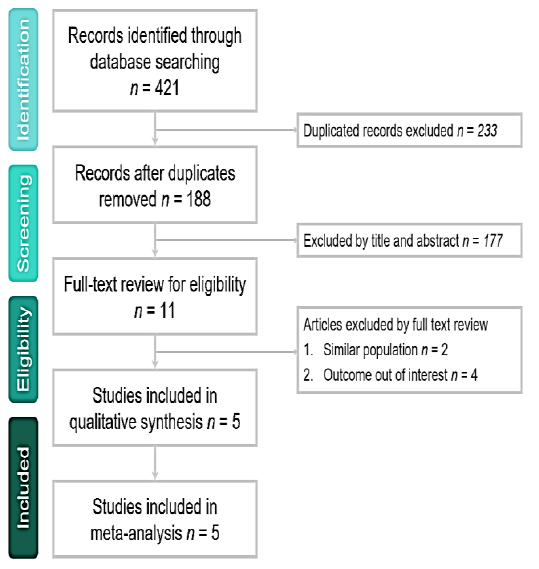
The online database search yielded 421 articles, including 97 from PubMed, 142 from Web of Science, 28 from EBSCO, 37 from the Cochrane Library, and 116 from Ovid MEDLINE (Appendix 1). After screening title and abstracts, we excluded 177 irrelevant articles. Next, after screening the full texts, we excluded 6 irrelevant studies. Finally, five clinical studies14-18 were enrolled for meta-analysis (Figure 1).
Study Characteristics
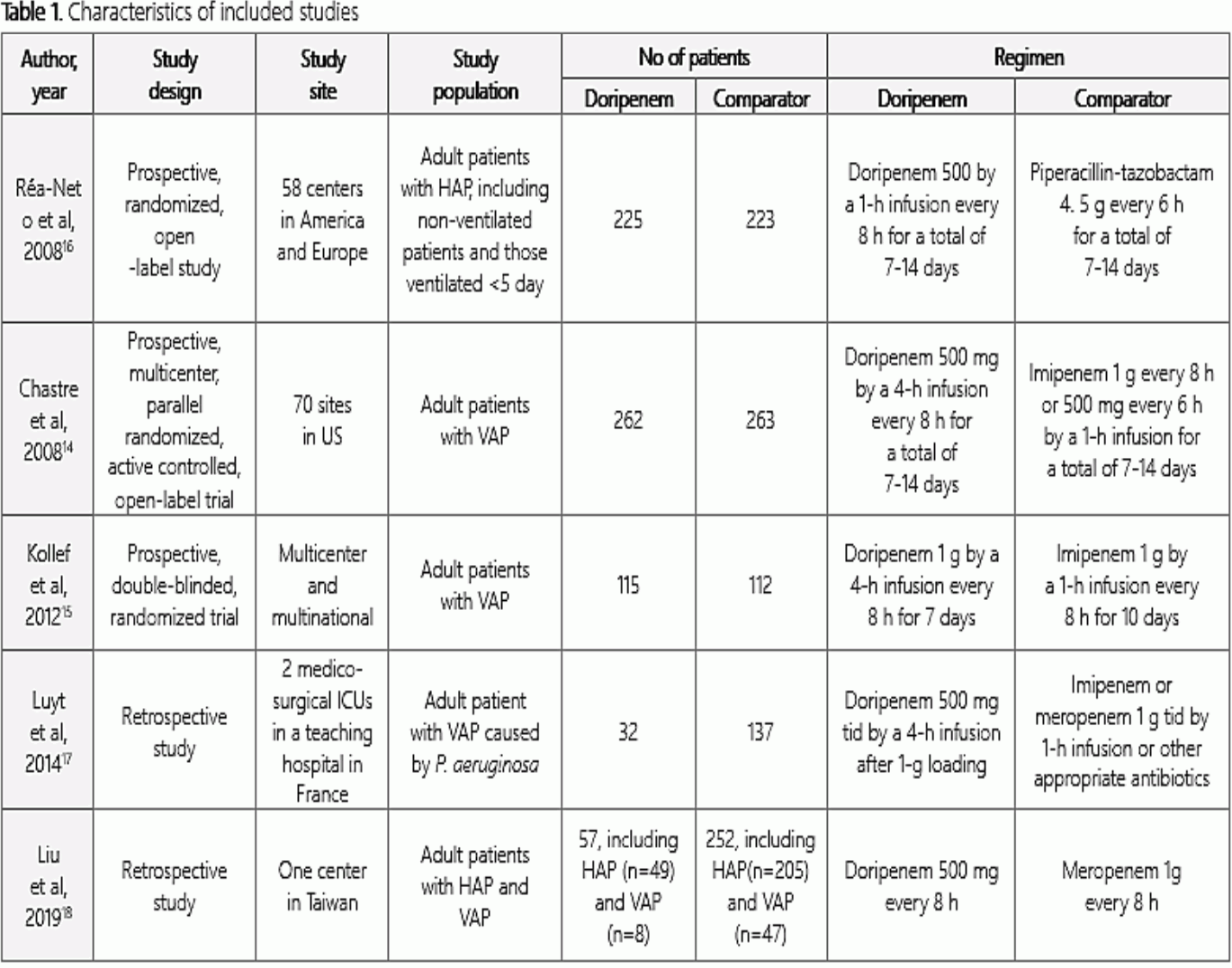
In general, 3 RCTs14-16 and 2 retrospective studies were included in the meta-analysis (17, 18). The RCTs were multicentered, whereas 2 retrospective studies were single-centered conducted in France and Taiwan each (Table 1). One study (15) used a 1-g (high) dose of doripenem, whereas the other 4 studies (14–18) used 500-mg dose every 8 hours. Moreover, in the RCT using 1 g of doripenem, doripenem was given daily for 7 days, whereas the comparator imipenem administered at 1 g every 8 hours for 10 days (15). In other 2 RCTs, both doripenem and the comparators were used for a total of 7 to 14 days. In the 2 retrospective studies, antibiotic treatment was left to the physician’s discretion. The median antibiotic treatment durations used in the study of Liu et al were 10 (5–17) and 11 (7–15) days for doripenem and meropenem, respectively (18). Three RCTs (14–16) demonstrated had high risk of selection, performance, and detection bias and one retrospective study had deficiency of timing and adequacy of follow-up (17).
All-Cause Mortality
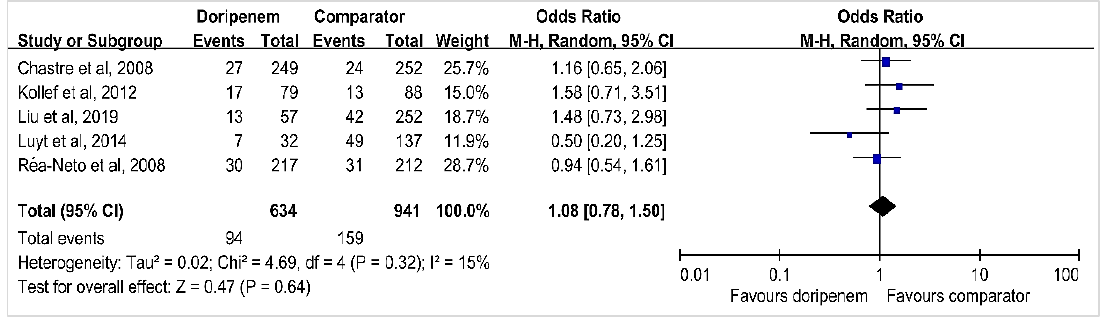
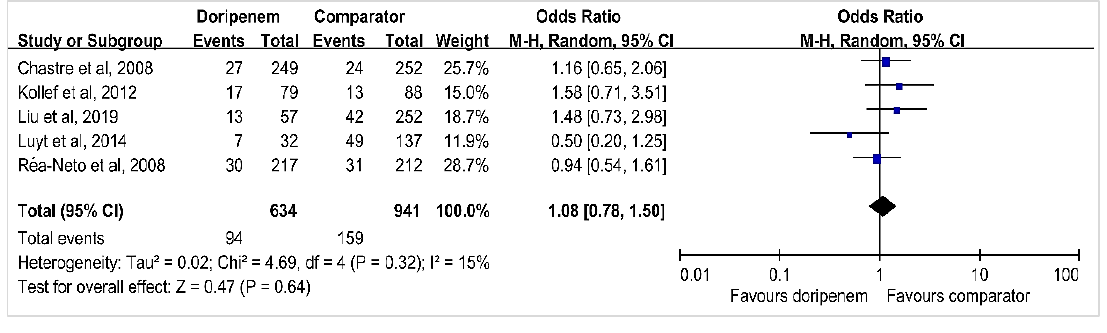
In the pooled analysis of all 5 studies, all-cause mortality did not differ between doripenem and the comparators (14.8% and 16.9%,respectively; OR 1.08, 95%CI 0.78-1.5, I2=0%, Figure 2). A similar trend was seen in the pooled analysis of the 3 RCTs (13.6% and 12.3%, respectively; OR 1.12, 95%CI 0.79-1.6, I2=0%) and 2 retrospective studies (22.5% and 23.1%, respectively; OR 0.9, 95%CI 0.31-2.58, I2=71%). In patients with VAP alone, no differences were noted between doripenem and the comparators in the pooled analysis of 4 studies (14–18) (13.8% and 17.9%, respectively; OR 0.98, 95%CI 0.56-1.71, I2=33%). Only 2 studies (15, 17) recorded mortality of patients with P.aeruginosa, the and subgroup analysis demonstrated that mortality did not differ between doripenem and the comparators (26.5% and 33.3%, respectively; OR 0.81, 95%CI 0.37-1.73; I2=76%).
Doripenem Versus Other Carbapenems
In the subgroup analysis of the 4 studies (14, 15, 17, 18) that used carbapenem as the comparator, the all-cause mortality of the doripenem and carbapenem groups did not differ (18.4% and 15.4%, respectively; OR 1.3, 95%CI 0.58-1.81, I2=44%). In the subgroup analysis of the 3 studies (14, 15, 18) comparing doripenem and imipenem, no differences were observed (14.2% and 14.0%, respectively; OR 0.92,95%CI 0.42-2.01, I2=65%). In the subgroup analysis of the 2 studies (17, 18) that compared doripenem and meropenem, no differences were observed (22.5% and 16.7%, respectively; OR 1.45, 95%CI 0.83-2.52, I2=0%).
Clinical Cure Rate
In the pooled analysis of the four studies (14–17) that reported clinical responses, the clinical cure rates were 60.7% and 57.3% for doripenem and the comparators, respectively (OR 1.06, 95%CI 0.80-1.39, I2=0%; Figure 3). A similar trend was observed in the subgroup analyses for VAP (56.6% and 54.4%; OR 1.01, 95%CI 0.73-1.39, I2=15%). Moreover, the clinical cure rate for doripenem and the comparators in the treatment of HAP/VAP did not differ for Enterobacteriaceae bacteria (62.2% and 62.1%, respectively; OR 1.00, 95% CI 0.68-1.47, I2 = 0%) or P. aeruginosa (69.1% and 58.1%, respectively; OR 1.35, 95%CI 0.2-9.03, I2=75%) or for the presence (65.5% and 64.5%, respectively; OR 1.05, 95%CI 0.36-3.05, I2=0%) or absence (73% and 69%, respectively; OR 1.22, 95%CI 0.85- 1.73, I2=0%) of bacteremia.
Discussion
This meta-analysis included 5 clinical studies to compare the efficacy of doripenem and other alternative antibiotics in adults with HAP/VAP. We found that doripenem was noninferior to the comparators in HAP/VAP treatment. First, with respect to all-cause mortality among patients with HAP/VAP including patients with VAP alone, doripenem was comparable to the comparators. Second, this similarity remained unchanged in the subgroup analyses of the 3 RCTs and 2 retrospective studies included. Doripenem was comparable to carbapenems, imipenem, and meropenem in terms of all-cause mortality. Finally, the clinical cure rate for doripenem was comparable to the comparators in the treatment of patients with HAP/VAP as well as in the subgroup analyses according to different pathogens and the presence of bacteremia. Overall, our findings were consistent with those of previous meta-analyses 26 of RCTs alone and provided additional evidence supporting appropriate use of doripenem for HAP/VAP treatment (21, 22). Because P. aeruginosa was the most common pathogen causing HAP/VAP, this study also investigated the usefulness of doripenem against P. aeruginosa-related HAP/VAP. We found that all-cause mortality, clinical cure rate, and microbiological eradication rate (OR 2.72, 95%CI 0.93-7.94, I2=0%) did not differ between doripenem and the comparators. This is in contrast to Kollef et al, (15) which indicated that the clinical cure and all-cause mortality rate were lower in patients with P.aeruginosa-related VAP treated with doripenem group than in those treated with imipenem (clinical cure rate: 41.2% vs 60%, 95%CI −57.2 to 19.5; mortality: 35.3% vs 0%; 95%CI 12.6–58); however, doripenem treatment duration was only 7 days, which was shorter than the 10-day duration of imipenem treatment. This suggests that a 7-day doripenem treatment course may not be adequate for P. aeruginosa-related VAP. In addition to that study, (15) the duration of antibiotic treatment in the other included studies (14, 16, 18) in this meta-analysis was 7 days or longer. Moreover, doripenem exhibited a greater in vitro activity against P. aeruginosa than did the comparators (piperacillin-tazobactam and imipenem) in the included studies (14, 16, 17) and previous surveillance studies (27–32). Therefore, our findings suggest that doripenem is comparable to others and could be a therapeutic option for treating P. aeruginosa-related HAP/VAP.
This meta-analysis had several limitations. First, the number of included studies and enrolled patients was limited, and only 3 RCTs were included. Second, the effect of high doses, infusion duration, and treatment duration of doripenem on the outcome was not evaluated. Third, microbiological eradication was not assessed except for P.aeruginosa due to unavailable data. Finally, safety issues were not assessed; however, studies have investigated safety profile of doripenem and demonstrated that intravenous doripenem was well tolerated with a safety profile comparable to that of the comparators (26, 27, 33).
Conclusion
The efficacy of doripenem in the treatment of HAP and VAP, including P. aeruginosa-related VAP, is comparable to that of other antibiotics.
Declarations
- Author contributions (CRediT)
- All authors contributed equally to all 14 CRediT roles (Conceptualization, Data curation, Formal analysis, Funding acquisition, Investigation, Methodology, Project administration, Resources, Software, Supervision, Validation, Visualization, Writing – original draft, Writing – review & editing).
- Funding
-
Funding information was not reported in the published version of this article.
- Conflicts of interest
- All authors declare no conflict of interest.
- Ethics approval
- Ethics committee approval was not required for this article, as it is based on previously published literature and does not involve human participants, patient data or animals.
- Data availability
- A data availability statement was not reported in the published version of this article.
References (33)
31 of 33 references are linked to their DOI.
- Vincent JL, Rello J, Marshall J, Silva E, Anzueto A, Martin CD, et al. International study of the prevalence and outcomes of infection in intensive care units. JAMA 2009;302:2323-9 DOI Crossref PubMed Google Scholar
- Magill SS, Edwards JR, Bamberg W, Beldavs ZG, Dumyati G, Kainer MA. Multistate point-prevalence survey of health care-associated infections. N Engl J Med 2014; 370:1198-208 Doripenem for HAP and VAP Wu et al. DOI Crossref PubMed Google Scholar
- Baker D, Quinn B. Hospital acquired pneumonia prevention Initiative-2: incidence of non-ventilator hospital-acquired pneumonia in the United States. Am J Infect Control 2018; 46:2-7 DOI Crossref PubMed Google Scholar
- Zaragoza R, Vidal-Cortés P, Aguilar G, Borges M, Diaz E, Ferrer R, et al. Update of the treatment of nosocomial pneumonia in the ICU. Crit Care 2020; 24:383 DOI Crossref PubMed Google Scholar
- Torres A, Niederman MS, Chastre J, Ewig S, Fernandez-Vandellos P, Hanberger H, et al. International ERS/ ESICM/ESCMID/ALAT guidelines for the management of hospital-acquired pneumonia and ventilator-associated pneumonia: Guideline for the management of hospital-acquired pneumonia (HAP)/ventilator -associated pneumonia (VAP) of the European Respiratory Society (ERS), European Society of Intensive Care Medicine (ESICM), European Society of Clinical Microbiology and Infectious Diseases (ESCMID) and Asociación Latinoamericana del Tórax (ALAT). Eur Respir J 2017; 50:1700582 DOI Crossref PubMed Google Scholar
- Giuliano KK, Baker D, Quinn B. The epidemiology of nonventilator hospital-acquired pneumonia in the United States. Am J Infect Control 2018; 46:322-7 DOI Crossref PubMed Google Scholar
- Ibn Saied W, Mourvillier B, Cohen Y, Ruckly S, Reignier J, Marcotte G, et al. A Comparison of the mortality risk associated with ventilator-acquired bacterial pneumonia and nonventilator ICU-acquired bacterial pneumonia. Crit Care Med 2019; 47:345-52 DOI Crossref PubMed Google Scholar
- Micek ST, Chew B, Hampton N, Kollef MH. A Case-control study assessing the impact of nonventilated hospital-acquired pneumonia on patient outcomes. Chest 2016; 150:1008-14 DOI Crossref PubMed Google Scholar
- Chou CC, Shen CF, Chen SJ, Chen HM, Wang YC, Chang WS, et al. Recommendations and guidelines for the treatment of pneumonia in Taiwan. J Microbiol Immunol Infect 2019; 52:172-99 DOI Crossref PubMed Google Scholar
- Wu H, Harder C, Culley C. The 2016 Clinical practice guidelines for management of hospital-acquired and ventilator-associated pneumonia. Can J Hosp Pharm 2017; 70:251-2 DOI Crossref PubMed Google Scholar
- Tsai WC, Syue LS, Ko WC, Lo CL, Lee NY. Antimicrobial treatment of monomicrobial phenotypic carbapenem-resistant Klebsiella pneumoniae bacteremia: Two are better than one. J Microbiol Immunol Infect 2021 Oct 1;S1684-1182(21)00188-2 DOI Crossref PubMed Google Scholar
- Jean SS, Lee YL, Liu PY, Lu MC, Ko WC, Hsueh PR. Multicenter surveillance of antimicrobial susceptibilities and resistance mechanisms among Enterobacterales species and non-fermenting Gram-negative bacteria from different infection sources in Taiwan from 2016 to 2018. J Microbiol Immunol Infect 2021 Sep 3;S1684-1182 (21)00182-1 DOI Crossref PubMed Google Scholar
- Jean SS, Lee WS, Ko WC, Hsueh PR. In vitro susceptibility of ceftaroline against clinically important Gram-positive cocci, Haemophilus species and Klebsiella pneumoniae in Taiwan: Results from the Antimicrobial Testing Leadership and Surveillance (ATLAS) in 2012-2018. J Microbiol Immunol Infect 2021; 54:627-31 DOI Crossref PubMed Google Scholar
- Chastre J, Wunderink R, Prokocimer P, Lee M, Kaniga K, Friedland I. Efficacy and safety of intravenous infusion of doripenem versus imipenem in ventilator-associated pneumonia: a multicenter, randomized study. Crit Care Med 2008; 36:1089-96 DOI Crossref PubMed Google Scholar
- Kollef MH, Chastre J, Clavel M, Restrepo MI, Michiels B, Kaniga K, et al. A randomized trial of 7-day doripenem versus 10-day imipenem-cilastatin for ventilator-associated pneumonia. Crit Care 2012; 16:R218 DOI Crossref PubMed Google Scholar
- Réa-Neto A, Niederman M, Lobo SM, Schroeder E, Lee M, Kaniga K, et al. Efficacy and safety of doripenem versus piperacillin/tazobactam in nosocomial pneumonia: a randomized, open-label, multicenter study. Curr Med Res Opin 2008; 24:2113-26 DOI Crossref PubMed Google Scholar
- Luyt CE, Aubry A, Lu Q, Micaelo M, Bréchot N, Brossier F, et al. Imipenem, meropenem, or doripenem to treat patients with Pseudomonas aeruginosa ventilator-associated pneumonia. Antimicrob Agents Chemother. 2014;58:1372-80 DOI Crossref PubMed Google Scholar
- Liu WD, Shih MC, Chuang YC, Wang JT, Sheng WH. Comparative efficacy of doripenem versus meropenem for hospital-acquired and ventilator-associated pneumonia. J Microbiol Immunol Infect 2019; 52:788-95 DOI Crossref PubMed Google Scholar
- Tang HJ, Lai CC. Doripenem for treating nosocomial pneumonia and ventilator-associated pneumonia. Lancet Infect Dis 2020; 20:20 DOI Crossref PubMed Google Scholar
- U.S. Food and Drug Administration. https://www.fda.gov/ drugs/drug-safety-and-availability/fda-drug-safety-commu nication-fda-approves-label-changes-antibacterial-doribax-doripenem-describing. Accessed on October 26, 2021 PubMed Google Scholar
- Chao CM, Chen CC, Huang HL, Chuang YC, Lai CC, Tang HJ. Clinical experience of patients receiving doripenem-containing regimens for the treatment of healthcare-associated infections. PLoS One 2016;11: e0167522 DOI Crossref PubMed Google Scholar
- Mustafa M, Chan WM, Lee C, Harijanto E, Loo CM, Van Kinh N, et al. A PROspective study on the Usage patterns of Doripenem in the Asia-Pacific region (PROUD). Int J Antimicrob Agents 2014; 43:353-60 DOI Crossref PubMed Google Scholar
- Liberati A, Altman DG, Tetzlaff J, Mulrow C, Gøtzsche PC, Ioannidis JP, et al. The PRISMA statement for reporting systematic reviews and meta-analyses of studies that evaluate health care interventions: explanation and elaboration. Ann Intern Med 2009; 151:W65-94 DOI Crossref PubMed Google Scholar
- Higgins JP, Altman DG, Gøtzsche PC, Jüni P, Moher D, Oxman AD, et al. The Cochrane Collaboration's tool for assessing risk of bias in randomised trials. BMJ 2011; 343:d5928 DOI Crossref PubMed Google Scholar
- Stang A. Critical evaluation of the Newcastle-Ottawa scale for the assessment of the quality of non-randomized studies in meta-analyses. Eur J Epidemiol 2010; 25:603-5 DOI Crossref PubMed Google Scholar
- Lai CC, Cheng IL, Chen YH, Tang HJ. The efficacy and safety of doripenem in the treatment of acute bacterial infections-Doripenem for HAP and VAP Wu et al. A systemic review and meta-analysis of randomized controlled trials. J Clin Med 2019; 8:958 DOI Crossref PubMed Google Scholar
- Gales AC, Azevedo HD, Cereda RF, Girardello R, Xavier DE. Antimicrobial activity of doripenem against Gram-negative pathogens: results from INVITA-A-DORI Brazilian study. Braz J Infect Dis 2011; 15:513-20 DOI Crossref PubMed Google Scholar
- Betriu C, Gómez M, López-Fabal F, Culebras E, Rodríguez-Avial I, Picazo JJ. Activity of doripenem against extended-spectrum betalactamase-producing Enterobacteriaceae and Pseudomonas aeruginosa isolates. Eur J Clin Microbiol Infect Dis 2010; 29:1179-81 DOI Crossref PubMed Google Scholar
- Castanheira M, Jones RN, Livermore DM. Antimicrobial activities of doripenem and other carbapenems against Pseudomonas aeruginosa, other nonfermentative bacilli, and Aeromonas spp. Diagn Microbiol Infect Dis 2009; 63:426-33 DOI Crossref PubMed Google Scholar
- Christiansen KJ, Ip M, Ker HB, Mendoza M, Hsu L, Kiratisin P, et al. In vitro activity of doripenem and other carbapenems against contemporary Gram-negative pathogens isolated from hospitalised patients in the Asia-Pacific region: results of the COMPACT Asia-Pacific Study. Int J Antimicrob Agents 2010; 36:501-6 DOI Crossref PubMed Google Scholar
- Fera MT, Zummo S, A DES. In vitro activity studies of doripenem and two other carbapenems tested against Pseudomonas aeruginosa and other non-fermentative bacilli. J Chemother 2011; 23:335-40 PubMed Google Scholar
- Fujimura T, Anan N, Sugimori G, Watanabe T, Jinushi Y, Yoshida I, et al. Susceptibility of Pseudomonas aeruginosa clinical isolates in Japan to doripenem and other antipseudomonal agents. Int J Antimicrob Agents 2009; 34:523-8 DOI Crossref PubMed Google Scholar
- Redman R, File TM, Jr. Safety of intravenous infusion of doripenem. Clin Infect Dis 2009;49 Suppl 1: S28-35 DOI Crossref PubMed Google Scholar
Read the full text
Open the PDF here
Loading the PDF…
If the PDF does not show here, use the download button above.
How to cite this article
Wu KY, Chao CM, Lee GM. Clinical Efficacy of Doripenem in Treating Hospital-Acquired Pneumonia and Ventilator-Associated Pneumonia: A Systematic Review and Meta-Analysis. Ulutas Med J. 2022;8(3):110-117. doi:10.5455/umj.20220513031721
Wu, K. Y., Chao, C. M., & Lee, G. M. (2022). Clinical Efficacy of Doripenem in Treating Hospital-Acquired Pneumonia and Ventilator-Associated Pneumonia: A Systematic Review and Meta-Analysis. The Ulutas Medical Journal, 8(3), 110–117. https://doi.org/10.5455/umj.20220513031721
Wu, K.Y., Chao, C.M. and Lee, G.M. (2022) 'Clinical Efficacy of Doripenem in Treating Hospital-Acquired Pneumonia and Ventilator-Associated Pneumonia: A Systematic Review and Meta-Analysis', The Ulutas Medical Journal, 8(3), pp. 110–117. doi: 10.5455/umj.20220513031721.