The Ulutas Medical Journal · ISSN 2149-0430 (印刷版), 2149-388X (在线版) · https://www.ulutasmedicaljournal.com/?mno=38410
荟萃分析 · 开放获取
多里佩内姆在治疗医院 -- -- 获得性肺炎和通风 -- -- 结合性肺炎方面的临床功效:系统审查和Meta分析
标题、摘要和全文为机器翻译。 英文原文
- Department of Radiology, Chi Mei Medical Center, Liouying, Tainan, Taiwan ROR
- Department of Intensive Care Medicine, Chi Mei Medical Center, Liouying, Tainan, Taiwan ROR
- Department of Nursing, Kaohsiung Municipal United Hospital, Taiwan ROR
- 开放获取
- CC BY-NC 4.0
- ORCID
- 资助
- 伦理批准
- 数据可用性
摘要
这一元分析调查了多里佩内姆的临床疗效是否与治疗医院后天肺炎(HAP)和通风机相关肺炎(VAP)的替代抗生素相似. PubMed,Web of Science,Cochrane Library,Ovid MEDLINE,以及EBSCO数据库在2021年10月20日之前的文献被搜索. 包括了临床研究,将多里佩内姆的疗效与其他抗生素在HAP/VAP治疗中的疗效进行比较. 初级结果包括28至30天的全因死亡率,而次级结果则是临床治愈率。 共有5项临床研究被纳入本元分析. 所有原因造成的死亡率在多里佩内姆和比较国之间没有很大差别。 仅就《万象行动计划》而言,多里佩内姆与比较国之间没有统计差异。 对于与Pseudomonas aeruginosa有关的肺炎,多里佩内姆和参照物的死亡率没有差别。 多里佩内姆和参照国的临床治愈率分别为60.7%和57.3%;在对VAP的分组分析中也观察到类似趋势。 对于由于P. aeruginosa引起的HAP/VAP,多里佩内姆和参照物的临床治愈率没有差别。 多里佩内姆在治疗HAP和VAP时与其他抗生素相当.
关键词
全文
全文为机器翻译;以英文原文为准。 英文原文
导言
呼吸道感染是最常见的鼻腔感染类型。 (1–3)其中最严重的是医院获得的肺炎(HAP;在住院48小时后出现肺炎)和呼吸器相关肺炎(VAP;在机械通风48小时后出现肺炎). (4, 5)高发病率、死亡率和住院费用与高发病率、高死亡率和高死亡率有关 (6–8)早期和适当的抗生素治疗是改善HAP/VAP患者临床结果的关键 (5, 9, 10)然而,治疗HAP/VAP的治疗选择有限,因为耐多种药物的生物越来越普遍。 (4, 5, 9–13)多里佩内姆(Doripenem),一种车型,具有广义的活动. 然而,评价多里佩内姆在HAP/VAP治疗中的临床疗效的研究表明,结果不一致。 (14–18). 两次随机对照试验 (14, 16) 发现doripenem在临床上是有效的,在治疗上对imipenem和iperacillin-tazobactam是非贫的。 相比之下,在另一例针对微生物确诊晚期VAP的患者的RCT中,固定的7天多里佩内姆治疗方法导致临床衰竭和死亡率不明显高于固定的10天多里佩内姆治疗方法。 (15)因此,美国食品和药物管理局没有批准Doripenem治疗HAP/VAP。 (19, 20)然而,多里佩内姆已被欧洲和其他国家批准用于治疗HAP/VAP的患者;它也通常用于治疗亚洲的HAP/VAP. (21, 22) 在这方面,我们通过元分析评估了多里佩内姆在HAP/VAP治疗中的疗效,并调查了接受多里佩内姆的HAP/VAP患者和其他比较者的临床结果。
材料和方法
数据源和搜索策略
我们在查找文章、选择研究、评价文章质量和分析数据时遵循了《系统审查和元分析优先报告项目》准则。 (23). 我们搜索了PubMed,Web of Science,EBSCO,Cochrane图书馆,Ovid MEDLINE等在2021年10月20日之前发布的合格文章. 搜索术语是“doripenem”、“doribaxa”、“finabax”和“肺炎”。 在文献搜索过程中没有应用出版年份或语言限制. 研究中只包括了将多里佩内姆和其他替代抗生素在使用HAP/VAP治疗成年患者方面的功效进行比较的临床研究. 接下来,3名调查员审查了候选文章的全文,以最后确定进行元分析的实验和控制小组。 他们审查了文章中报告的研究方法、地点、持续时间、人口、治疗方法以及临床结果。 最初,2名调查员(Lan和Chang)独立审查出版物以避免偏见,第三名调查员(Lu)被咨询以解决任何分歧. 报告的研究设计、持续时间、地点、人口、抗生素疗法、多里佩内姆和参照物的成果以及研究出版的年份都有记录。 该协议在PROSPERO注册为CRD42021284915.
结果
主要结果为28至30天的全因死亡率,次要结果为临床治愈率,其定义为跟踪时基线射线测定结果对肺炎征兆和症状的分辨率改善或缺乏进展.
质量评估和数据分析
Cochrane Bias风险工具用于评估包括RCT在内的偏见的质量和相关风险 (24)纽卡斯尔-渥太华尺度用于评估追溯性观察试验的质量 (25)在统计分析中使用了审查管理器中的随机效应模型(第5.3版)。 为结果分析计算了集合概率率和95%的计算结果。
结果
学习选择
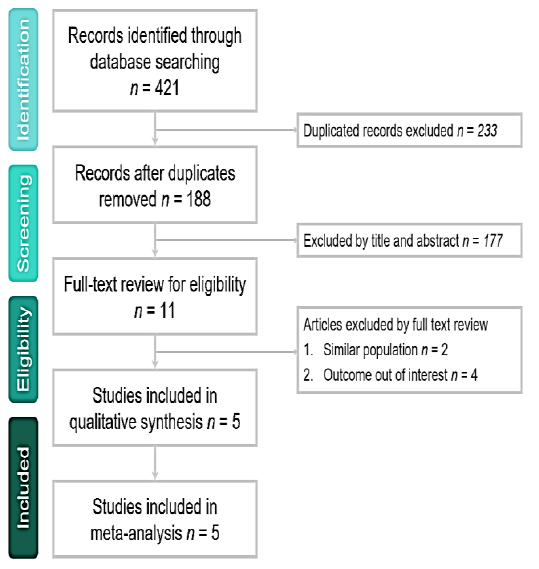
在线数据库搜索获得了421篇文章,其中97篇来自PubMed,142篇来自科学网,28篇来自EBSCO,37篇来自Cochrane图书馆,116篇来自Ovid MEDLINE(附录1). 在筛选标题和摘要之后,我们排除了177条无关的文章。 接下来,在筛选了全文之后,我们排除了6项无关的研究。 最后,有5个临床研究14-18被录取进行元分析(图1)。
研究特点
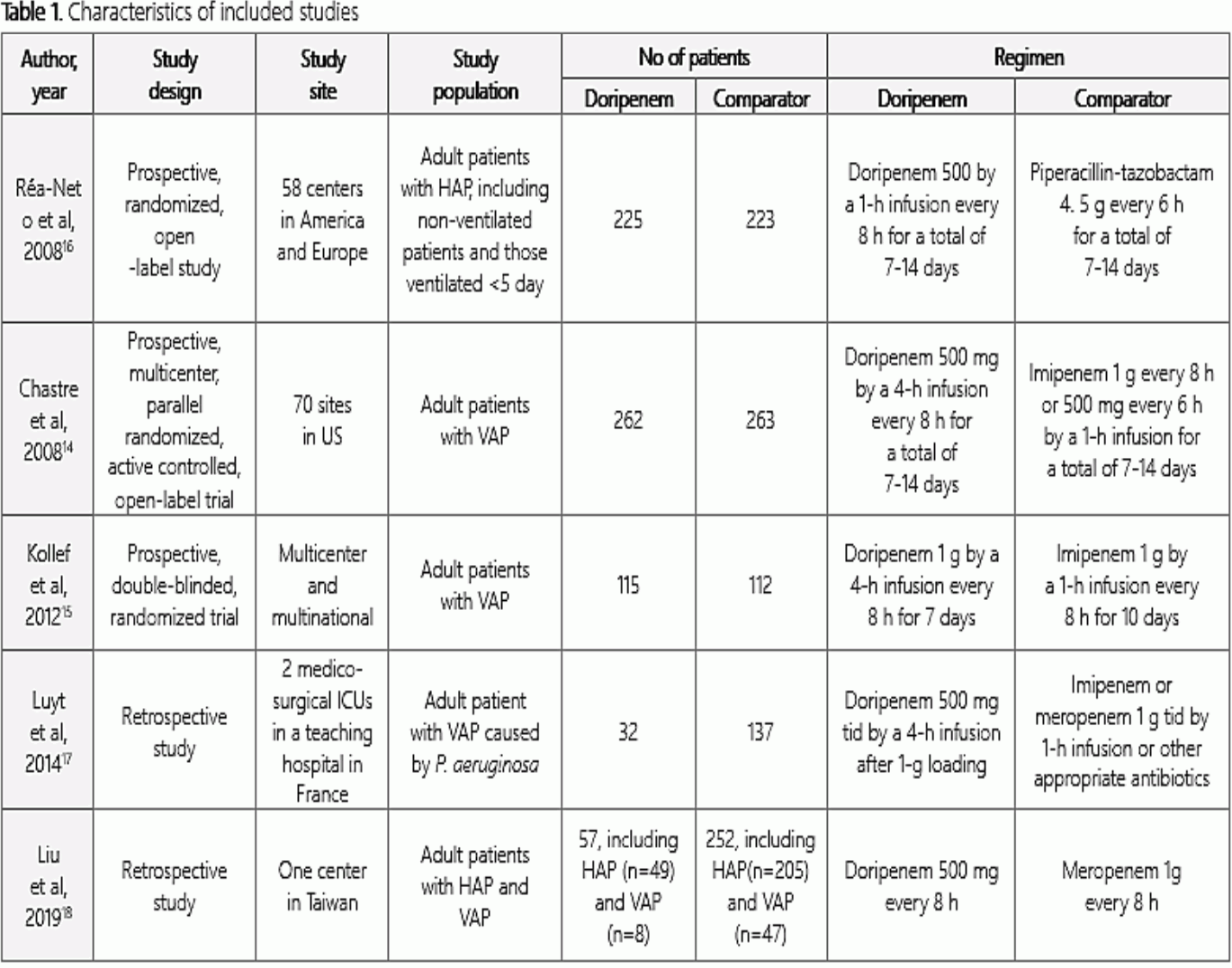
总的来说,3份RCTs14-16和2份回顾性研究报告被纳入元分析 (17, 18)5. 区域协商中心是多中心研究,而在法国和台湾分别进行了2项以单中心研究(表1)。 一个研究 (15) 使用1克(高)剂量多里佩内姆,而其他4项研究 (14–18) 每8小时使用500毫克剂量。 此外,在使用1克多里佩内姆的RCT中,多里佩内姆每天得到7天,而参照物伊米佩内姆每8小时1克管理10天 (15)在其他2个RCT中,多里佩内姆和比较方总共使用了7至14天。 在两次回顾性研究中,抗生素治疗由医生自行决定。 刘等人的研究中使用的抗生素治疗时间中位数为10。 (5–17) 第11条 (7–15) 多里佩内姆和多里佩内姆的天数 (18)三个RCT (14–16) 一项回顾性研究缺乏时间和后续行动的充分性 (17)。 。 。
全因死亡率
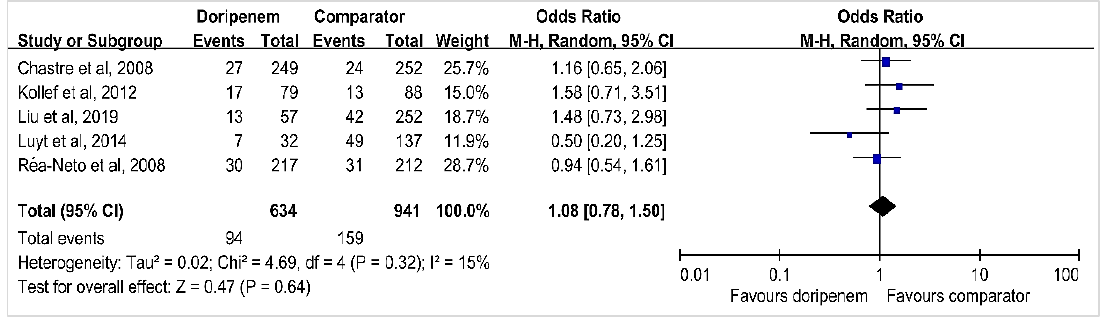
在对所有5项研究的集合分析中,多里佩内姆与参照国之间因各种原因造成的死亡率没有差别(分别为14.8%和16.9%);或1.08,95%CI 0.78-1.5,I2=0%,图2)。 3个RCT的集合分析(分别为13.6%和12.3%)、OR1.12%、95%CI 0.79-1.6、I2=0%和2个追溯性研究(分别为22.5%和23.1%)、OR0.9%、95%CI 0.31-2.58、I2=71%,也出现了类似趋势。 仅在VAP患者中,在对4项研究进行集合分析时,Doripenem与比较者之间没有区别。 (14–18) (分别为13.8%和17.9%;或0.98,95%CI 0.56-1.71,I2=33%)。 只有2项研究 (15, 17) 记录的P.aeruginosa患者的死亡率,以及分组分析表明,多里佩内姆和参照物的死亡率没有差别(分别为26.5%和33.3%);OR 0.81,95%CI 0.37-1.73;I2=76%)。
多里佩内姆·弗苏斯 其他卡巴佩内姆
4项研究的分组分析 (14, 15, 17, 18) 以卡巴佩内姆为参照物,多里佩内姆和卡巴佩内姆组的全因死亡率没有差别(分别为18.4%和15.4%); 3项研究的分组分析 (14, 15, 18) 相比多里佩内姆和伊米佩内姆,没有观察到差异(分别为14.2%和14.0%;OR 0.92,95%CI 0.42-2.01,I2=65%)。 两项研究的分组分析 (17, 18) (c) OR1.45%,95%CI 0.83-2.52%,I2=0%)。
临床剂量率
在四项研究的集合分析中 (14–17) 多里佩内姆和参照物的临床治愈率分别为60.7%和57.3%(OR1.06,95%CI 0.80-1.39,I2=0%;图3)。 在VAP的分组分析中也观察到类似趋势(56.6%和54.4%;OR 1.01,95%CI 0.73-1.39,I2=15%)。 此外,多里佩内姆和参照物在治疗HAP/VAP时的临床治愈率对肠杆菌(分别为62.2%和62.1%)或缺血(分别为73%和69%;或1.00、95%CI 0.68-1.47、I2 =0%)或P. aruginosa(分别为69.1%和58.1%;或1.35%、95%CI 0.2-9.03、I2 =75%)或存在(分别为65.5%和64.5%;或1.05、95%CI 0.36-3.05、I2=0%)或缺血(分别为73%和69%;或1.22%、95%CI 0.85-1.73、I2=0%)。
讨论情况
这一元分析包括5项临床研究,以将成人多肽和其他替代抗生素的疗效与HAP/VAP进行比较。 我们发现,在HAP/VAP治疗中,Doripenem对比较者来说是没有优势的。 第一,关于所有原因造成的HAP/VAP患者的死亡率,包括仅VAP患者的死亡率,Doripenem与比较者相当。 第二,在对3份RCT和包括2份回顾性研究报告进行的分组分析中,这种相似性保持不变。 多里佩内姆与卡巴佩内姆、伊米佩内姆和多里佩内姆的死亡率相当。 最后,多里佩内姆的临床治愈率与比较者在治疗HAP/VAP病人方面,以及根据不同的病原体和细菌性贫血的存在进行的分组分析中,具有可比性。 总体而言,我们的调查结果仅与先前26例氯三联苯的元分析结果一致,并提供了其他证据,证明适当使用多里佩内姆进行HAP/VAP治疗 (21, 22)由于P. aeruginosa是造成HAP/VAP的最常见病原体,本研究还调查了Doripenem对P. aeruginosa有关的HAP/VAP的有用性。 我们发现,所有原因造成的死亡率、临床治愈率和微生物根除率(或2.72,95%CI 0.93-7.94,I2=0%)在多里佩内姆和参照物之间没有差别。 这与Kollef等人相反, (15) 这表明临床治疗和所有原因的死亡率在多里佩内姆与P.aeruginosa有关的VAP治疗的病人中比在伊米佩内姆治疗的病人中低(临床治疗率:41.2%对60%,95%CI-57.2至19.5;死亡率:35.3%对0%;95%CI 12.6至58);然而,多里佩内姆治疗的持续时间只有7天,比伊米佩内姆治疗的10天持续时间短。 这表明,为期7天的多里佩内姆治疗课程可能不适合与P. aeruginosa有关的VAP。 除此研究外, (15) 其他研究中抗生素治疗的期限 (14, 16, 18) 在这个元分析中是7天或更长时间。 此外,Doripenem对P. aeruginosa的体外活动比所包括的研究中的比较者(pperacillin-tazobactam和imipenem)表现得更大。 (14, 16, 17) 和以往的监测研究 (27–32)因此,我们的调查结果表明,doripenem与其他药物相似,可作为治疗与P. aeruginosa有关的HAP/VAP的治疗选择。
这一元分析有若干局限性。 首先,所包括的学习和注册病人数量有限,只包括3名RCT。 第二,没有评估高剂量、输液持续时间和治疗时间对结果的影响。 第三,由于没有数据,除P.aeruginosa外,未对根除微生物进行评估。 最后,没有评估安全问题;不过,研究调查了多里佩内姆的安全情况,并表明静脉注射多里佩内姆完全被容忍,其安全情况与比较国相似。 (26, 27, 33)。 。 。
结论
doripenem在治疗HAP和VAP(包括P. aeruginosa相关VAP)中的疗效与其他抗生素的疗效相当.
声明
- 作者贡献(CRediT)
- 所有作者对全部 14 项 CRediT 角色贡献均等(Conceptualization, Data curation, Formal analysis, Funding acquisition, Investigation, Methodology, Project administration, Resources, Software, Supervision, Validation, Visualization, Writing – original draft, Writing – review & editing)。
- 资助
-
Funding information was not reported in the published version of this article.
- 利益冲突
- All authors declare no conflict of interest.
- 伦理批准
- Ethics committee approval was not required for this article, as it is based on previously published literature and does not involve human participants, patient data or animals.
- 数据可用性
- A data availability statement was not reported in the published version of this article.
参考文献 (33)
33 条参考文献中有 31 条已链接 DOI。
- Vincent JL, Rello J, Marshall J, Silva E, Anzueto A, Martin CD, et al. International study of the prevalence and outcomes of infection in intensive care units. JAMA 2009;302:2323-9 DOI Crossref PubMed Google Scholar
- Magill SS, Edwards JR, Bamberg W, Beldavs ZG, Dumyati G, Kainer MA. Multistate point-prevalence survey of health care-associated infections. N Engl J Med 2014; 370:1198-208 Doripenem for HAP and VAP Wu et al. DOI Crossref PubMed Google Scholar
- Baker D, Quinn B. Hospital acquired pneumonia prevention Initiative-2: incidence of non-ventilator hospital-acquired pneumonia in the United States. Am J Infect Control 2018; 46:2-7 DOI Crossref PubMed Google Scholar
- Zaragoza R, Vidal-Cortés P, Aguilar G, Borges M, Diaz E, Ferrer R, et al. Update of the treatment of nosocomial pneumonia in the ICU. Crit Care 2020; 24:383 DOI Crossref PubMed Google Scholar
- Torres A, Niederman MS, Chastre J, Ewig S, Fernandez-Vandellos P, Hanberger H, et al. International ERS/ ESICM/ESCMID/ALAT guidelines for the management of hospital-acquired pneumonia and ventilator-associated pneumonia: Guideline for the management of hospital-acquired pneumonia (HAP)/ventilator -associated pneumonia (VAP) of the European Respiratory Society (ERS), European Society of Intensive Care Medicine (ESICM), European Society of Clinical Microbiology and Infectious Diseases (ESCMID) and Asociación Latinoamericana del Tórax (ALAT). Eur Respir J 2017; 50:1700582 DOI Crossref PubMed Google Scholar
- Giuliano KK, Baker D, Quinn B. The epidemiology of nonventilator hospital-acquired pneumonia in the United States. Am J Infect Control 2018; 46:322-7 DOI Crossref PubMed Google Scholar
- Ibn Saied W, Mourvillier B, Cohen Y, Ruckly S, Reignier J, Marcotte G, et al. A Comparison of the mortality risk associated with ventilator-acquired bacterial pneumonia and nonventilator ICU-acquired bacterial pneumonia. Crit Care Med 2019; 47:345-52 DOI Crossref PubMed Google Scholar
- Micek ST, Chew B, Hampton N, Kollef MH. A Case-control study assessing the impact of nonventilated hospital-acquired pneumonia on patient outcomes. Chest 2016; 150:1008-14 DOI Crossref PubMed Google Scholar
- Chou CC, Shen CF, Chen SJ, Chen HM, Wang YC, Chang WS, et al. Recommendations and guidelines for the treatment of pneumonia in Taiwan. J Microbiol Immunol Infect 2019; 52:172-99 DOI Crossref PubMed Google Scholar
- Wu H, Harder C, Culley C. The 2016 Clinical practice guidelines for management of hospital-acquired and ventilator-associated pneumonia. Can J Hosp Pharm 2017; 70:251-2 DOI Crossref PubMed Google Scholar
- Tsai WC, Syue LS, Ko WC, Lo CL, Lee NY. Antimicrobial treatment of monomicrobial phenotypic carbapenem-resistant Klebsiella pneumoniae bacteremia: Two are better than one. J Microbiol Immunol Infect 2021 Oct 1;S1684-1182(21)00188-2 DOI Crossref PubMed Google Scholar
- Jean SS, Lee YL, Liu PY, Lu MC, Ko WC, Hsueh PR. Multicenter surveillance of antimicrobial susceptibilities and resistance mechanisms among Enterobacterales species and non-fermenting Gram-negative bacteria from different infection sources in Taiwan from 2016 to 2018. J Microbiol Immunol Infect 2021 Sep 3;S1684-1182 (21)00182-1 DOI Crossref PubMed Google Scholar
- Jean SS, Lee WS, Ko WC, Hsueh PR. In vitro susceptibility of ceftaroline against clinically important Gram-positive cocci, Haemophilus species and Klebsiella pneumoniae in Taiwan: Results from the Antimicrobial Testing Leadership and Surveillance (ATLAS) in 2012-2018. J Microbiol Immunol Infect 2021; 54:627-31 DOI Crossref PubMed Google Scholar
- Chastre J, Wunderink R, Prokocimer P, Lee M, Kaniga K, Friedland I. Efficacy and safety of intravenous infusion of doripenem versus imipenem in ventilator-associated pneumonia: a multicenter, randomized study. Crit Care Med 2008; 36:1089-96 DOI Crossref PubMed Google Scholar
- Kollef MH, Chastre J, Clavel M, Restrepo MI, Michiels B, Kaniga K, et al. A randomized trial of 7-day doripenem versus 10-day imipenem-cilastatin for ventilator-associated pneumonia. Crit Care 2012; 16:R218 DOI Crossref PubMed Google Scholar
- Réa-Neto A, Niederman M, Lobo SM, Schroeder E, Lee M, Kaniga K, et al. Efficacy and safety of doripenem versus piperacillin/tazobactam in nosocomial pneumonia: a randomized, open-label, multicenter study. Curr Med Res Opin 2008; 24:2113-26 DOI Crossref PubMed Google Scholar
- Luyt CE, Aubry A, Lu Q, Micaelo M, Bréchot N, Brossier F, et al. Imipenem, meropenem, or doripenem to treat patients with Pseudomonas aeruginosa ventilator-associated pneumonia. Antimicrob Agents Chemother. 2014;58:1372-80 DOI Crossref PubMed Google Scholar
- Liu WD, Shih MC, Chuang YC, Wang JT, Sheng WH. Comparative efficacy of doripenem versus meropenem for hospital-acquired and ventilator-associated pneumonia. J Microbiol Immunol Infect 2019; 52:788-95 DOI Crossref PubMed Google Scholar
- Tang HJ, Lai CC. Doripenem for treating nosocomial pneumonia and ventilator-associated pneumonia. Lancet Infect Dis 2020; 20:20 DOI Crossref PubMed Google Scholar
- U.S. Food and Drug Administration. https://www.fda.gov/ drugs/drug-safety-and-availability/fda-drug-safety-commu nication-fda-approves-label-changes-antibacterial-doribax-doripenem-describing. Accessed on October 26, 2021 PubMed Google Scholar
- Chao CM, Chen CC, Huang HL, Chuang YC, Lai CC, Tang HJ. Clinical experience of patients receiving doripenem-containing regimens for the treatment of healthcare-associated infections. PLoS One 2016;11: e0167522 DOI Crossref PubMed Google Scholar
- Mustafa M, Chan WM, Lee C, Harijanto E, Loo CM, Van Kinh N, et al. A PROspective study on the Usage patterns of Doripenem in the Asia-Pacific region (PROUD). Int J Antimicrob Agents 2014; 43:353-60 DOI Crossref PubMed Google Scholar
- Liberati A, Altman DG, Tetzlaff J, Mulrow C, Gøtzsche PC, Ioannidis JP, et al. The PRISMA statement for reporting systematic reviews and meta-analyses of studies that evaluate health care interventions: explanation and elaboration. Ann Intern Med 2009; 151:W65-94 DOI Crossref PubMed Google Scholar
- Higgins JP, Altman DG, Gøtzsche PC, Jüni P, Moher D, Oxman AD, et al. The Cochrane Collaboration's tool for assessing risk of bias in randomised trials. BMJ 2011; 343:d5928 DOI Crossref PubMed Google Scholar
- Stang A. Critical evaluation of the Newcastle-Ottawa scale for the assessment of the quality of non-randomized studies in meta-analyses. Eur J Epidemiol 2010; 25:603-5 DOI Crossref PubMed Google Scholar
- Lai CC, Cheng IL, Chen YH, Tang HJ. The efficacy and safety of doripenem in the treatment of acute bacterial infections-Doripenem for HAP and VAP Wu et al. A systemic review and meta-analysis of randomized controlled trials. J Clin Med 2019; 8:958 DOI Crossref PubMed Google Scholar
- Gales AC, Azevedo HD, Cereda RF, Girardello R, Xavier DE. Antimicrobial activity of doripenem against Gram-negative pathogens: results from INVITA-A-DORI Brazilian study. Braz J Infect Dis 2011; 15:513-20 DOI Crossref PubMed Google Scholar
- Betriu C, Gómez M, López-Fabal F, Culebras E, Rodríguez-Avial I, Picazo JJ. Activity of doripenem against extended-spectrum betalactamase-producing Enterobacteriaceae and Pseudomonas aeruginosa isolates. Eur J Clin Microbiol Infect Dis 2010; 29:1179-81 DOI Crossref PubMed Google Scholar
- Castanheira M, Jones RN, Livermore DM. Antimicrobial activities of doripenem and other carbapenems against Pseudomonas aeruginosa, other nonfermentative bacilli, and Aeromonas spp. Diagn Microbiol Infect Dis 2009; 63:426-33 DOI Crossref PubMed Google Scholar
- Christiansen KJ, Ip M, Ker HB, Mendoza M, Hsu L, Kiratisin P, et al. In vitro activity of doripenem and other carbapenems against contemporary Gram-negative pathogens isolated from hospitalised patients in the Asia-Pacific region: results of the COMPACT Asia-Pacific Study. Int J Antimicrob Agents 2010; 36:501-6 DOI Crossref PubMed Google Scholar
- Fera MT, Zummo S, A DES. In vitro activity studies of doripenem and two other carbapenems tested against Pseudomonas aeruginosa and other non-fermentative bacilli. J Chemother 2011; 23:335-40 PubMed Google Scholar
- Fujimura T, Anan N, Sugimori G, Watanabe T, Jinushi Y, Yoshida I, et al. Susceptibility of Pseudomonas aeruginosa clinical isolates in Japan to doripenem and other antipseudomonal agents. Int J Antimicrob Agents 2009; 34:523-8 DOI Crossref PubMed Google Scholar
- Redman R, File TM, Jr. Safety of intravenous infusion of doripenem. Clin Infect Dis 2009;49 Suppl 1: S28-35 DOI Crossref PubMed Google Scholar
阅读全文
在此打开 PDF
正在加载 PDF…
若 PDF 未在此显示,请使用上方的下载按钮。
如何引用本文
Wu KY, Chao CM, Lee GM. Clinical Efficacy of Doripenem in Treating Hospital-Acquired Pneumonia and Ventilator-Associated Pneumonia: A Systematic Review and Meta-Analysis. Ulutas Med J. 2022;8(3):110-117. doi:10.5455/umj.20220513031721
Wu, K. Y., Chao, C. M., & Lee, G. M. (2022). Clinical Efficacy of Doripenem in Treating Hospital-Acquired Pneumonia and Ventilator-Associated Pneumonia: A Systematic Review and Meta-Analysis. The Ulutas Medical Journal, 8(3), 110–117. https://doi.org/10.5455/umj.20220513031721
Wu, K.Y., Chao, C.M. and Lee, G.M. (2022) 'Clinical Efficacy of Doripenem in Treating Hospital-Acquired Pneumonia and Ventilator-Associated Pneumonia: A Systematic Review and Meta-Analysis', The Ulutas Medical Journal, 8(3), pp. 110–117. doi: 10.5455/umj.20220513031721.