The Ulutas Medical Journal · ISSN 2149-0430 (print), 2149-388X (online) · https://www.ulutasmedicaljournal.com/?mno=10867
Original Article · Open access
The Perception and Views of Yoga Trainers on Yoga Practices in Turkey
- Department of General Practice, Former Akdeniz University, Antalya, Turkey ROR
- Private Atasam Hospital, Orthopedics Clinic, Samsun, Turkey
- Memorial Antalya Hospital, Cardiology Clinic, Antalya, Turkey
Abstract
- Background
- This study aimed to investigate the perception and views of yoga trainers (YT) on yoga in a purposeful sample in Turkey.
- Materials and Methods
- Nineteen YT agreed and gave verbal consent to participate. Participants were purposefully selected (purposive sample) from the community of YT. The survey included ten questions (five closed-ended and five open-ended) and was divided into two parts. The study was piloted with five YT, and the results of the pilot questionnaire were not included in the final dataset. Data were analyzed with descriptive statistics.
- Results
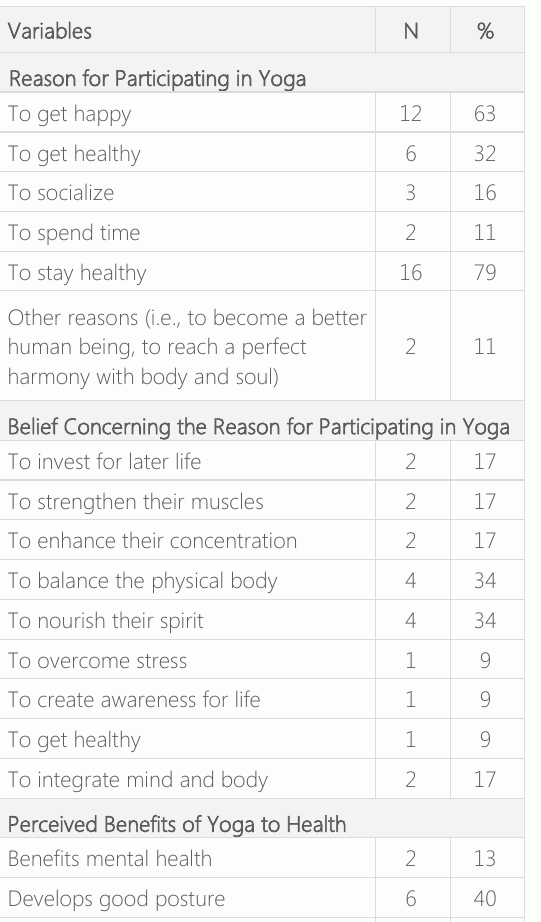
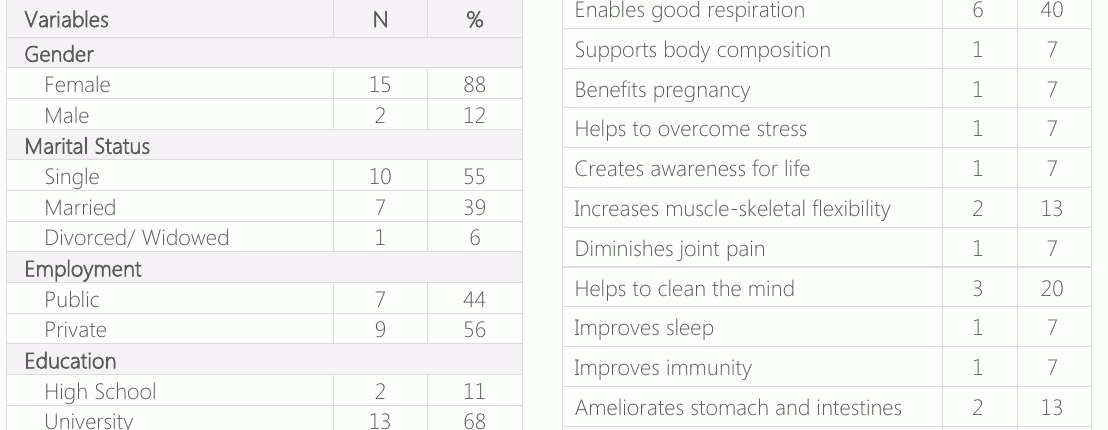
- The mean age was 38.7 (SD:14.41; range: 22-73); 15 (88%) were female; ten (55%) were single, seven (39%) were married, and one (6%) divorced/widowed. Seven (44%) were employed in the public sector, and nine (56%) in the private sector. The participants practiced yoga for four years (range: 1-10). They defined themselves as a novice (5; 29%) and intermediate level (71; 29%) practitioners. The reason for participating in yoga was as follows: to get happy (12; 63%), to get healthy (6; 32%), and to stay healthy (16; 79%). The belief concerning the reason for participating in yoga was to invest for later life (2; 17%), to strengthen their muscles (2; 17%), and to enhance their concentration (2; 17%). The perceived benefits of yoga to health were mental health (2; 13%), good posture (6; 40%), and good respiration (6; 40%).
- Conclusion
- Findings of our study revealed that YT was, similar to the literature, mostly at the middle-age, female, single, private sector employed, and graduate from universities. YT mainly practiced yoga to stay healthy, get happy, and to get fit.
Keywords
Full text
Introduction
Yoga is a system, which comprehensively leads to mind-body integrity. It involves all the body by improving the posture, flexibility, breathing, and the mind. Relaxation and meditation techniques help to develop self-awareness without self-judgment. By the last years, yoga gained popularity around globe (1). Yoga has been recommended by guidelines to help people. It has been found to improve physical and mental conditions (i.e., strength, flexibility, balance, mobility, depression, sleep, executive function, etc.)(2). This study aimed to investigate the perception and views of yoga trainers (YT) on yoga in a purposeful sample in Turkey.
Materials and Method
Yoga trainers (YT) living in different cities were asked to participate in this study in December 2017. Nineteen YT agreed and gave verbal consent to participate. All participants were purposefully selected (purposive sample) from the community of YT because it was expected that it would represent diverse YT in Turkey. The survey included 10 questions (five closed-ended and five open-ended) and was divided into two parts. The first part included questions on any demographics, and the second part included questions about yoga experience and beliefs. The survey was piloted with five YT, and the results of the pilot questionnaire were not included in the final dataset. Data were analyzed with descriptive statistics.
Results
Nineteen YT participated in this study. Their mean age was 38.7 (SD=14.41; range=22-73). Sociodemographic data are shown in Table-1. The participants practiced yoga for four years (range=1-10). And four (21%) were a member of a yoga society. They defined themselves as a novice (5; 29%) and intermediate (71; 29%).
Discussion
The study revealed that participants and found that most were at their middle-age, female, single, private sector employed, and graduate from university. They practiced for four years and mainly perceived themselves as intermediate level yoga practitioners. Their main reasons for participating in yoga were to stay healthy, get happy, to get fit. Their belief concerning the reason for participating in yoga was mainly as to nourish their spirit and to balance their physical body. Their perceived benefits of yoga to health were primarily the development of good posture, enablement of proper respiration, cleaning of the mind, and strengthening of the muscles.
Women frequently prefer yoga. Participants of yoga believed that this orientation was due to the belief that yoga is a feminine activity, that men want to appear more self-conscious, that men are less flexible, and do prefer individual activities (2).
Another study reports that males do prefer aerobic challenges and do not believe that yoga is so (3). Findings of our study revealed that participants and found that most were at their middle-age, female, single, private sector employed, and graduate from university.
According to a market, study participants considered themselves as beginners (44.8 %), average (39.6 %), and expert/advanced (15.6%) (4). The participants practiced yoga for 4 years (range: 1-10). And four (21%) were a member of a yoga society, and perceived themselves as intermediate level yoga practitioners.
Yoga is seen to be effective in the management of psychological problems like stress, affective disorders, and sleep disorders (1, 3). According to NCCIH, the reason why yoga was to maintain health and well-being, to follow doctor recommendation, to treat specific medical conditions, and for musculoskeletal problems (5). Our study revealed that their main reason for participating in yoga was to stay healthy, get happy, and to get fit.
The reasons why people begin yoga was the expectation of gaining general wellness, participating in physical exercise, managing stress, seek spiritual experience, alleviate health condition, follow personal recommendation, prevent illness, request for a hobby, socialize, and follow doctor recommendation (6).
According to a market survey of a yoga journal, the most common reasons for yoga was to gain flexibility, general conditioning, stress relief, improve overall health, and physical fitness (4). Another article stated that almost all people participate in yoga activities for flexibility, stress relief, health, and physical fitness reasons (7). In our study, the belief concerning the reason for participating in yoga was mainly as to nourish their spirit and to balance their physical body.
Neurological studies reported that yoga prevented the decline of the grey matter volüme of the brain, which is related to aging. This beneficial effect is found in the left brain, which is more associated with positive emotions. Exercises of mindfulness decreased stress and regions responsible for learning, memory, cognition, and emotions grew, whereas areas of fear, anxiety, and stress became smaller (7). The perception of respondents in a study revealed that strength, posture, sleep, balance, joint problems, and flexibility improved (3). Another survey of the knowledge of elderly yoga participants stated that physical benefits were the improvement of posture, flexibility, strength, balance, joint, and back problems. Mental benefits were relaxation, stimulation of thought and concentration, and alteration of self-efficacy. Respiratory benefits were calming down anxiety. Social aspects were the improvement of social interaction (2). In our study, the perceived benefits of yoga to health were mainly the development of good posture, enablement of proper respiration, cleaning of the mind, and strengthening of the muscles. Findings of our study revealed that YT was, similar to the literature, mostly at their middle-age, female, single, private sector employed, and graduate from universities. YT mainly practiced yoga to stay healthy, get happy, and to get fit. The nourishment their spirit and to build balance in their physical body were their main stated benefits of yoga. Their perceived benefits of yoga to health were mainly the development of good posture, enablement of proper respiration, cleaning of the mind, and strengthening of the muscles.
Declarations
- Author contributions (CRediT)
- All authors contributed equally to all 14 CRediT roles (Conceptualization, Data curation, Formal analysis, Funding acquisition, Investigation, Methodology, Project administration, Resources, Software, Supervision, Validation, Visualization, Writing – original draft, Writing – review & editing).
- Funding
-
Funding information was not reported in the published version of this article.
- Conflicts of interest
- None of the authors has a conflict of interest with the present article.
- Ethics approval
- Ethics approval details were not reported in the published version of this article.
- Data availability
- A data availability statement was not reported in the published version of this article.
References (7)
2 of 7 references are linked to their DOI.
- Conboy LA, Noggle JJ, Frey JL, Kudesia RS, Khalsa SB, Qualitative evaluation of a high school yoga program: feasibility and perceived benefits. Explore (NY), 2013 May-Jun;9(3):171-80 DOI Crossref PubMed Google Scholar
- Sivaramakrishnan D, Fitzsimons C, Mutrie N and Baker G. Perceptions of Yoga among Older Adults: A Qualitative Approach, Ann Yoga Phys Ther, 2017;2(4):1035 PubMed Google Scholar
- Nayak HD, Patel NK, Wood R, Dufault V, Guidotti N. A Study to Identify the Benefits, Barriers, and Cues to Participating in a Yoga Program among Community-Dwelling Older Adults, J Yoga Phys Ther, 2014; 5: 178 PubMed Google Scholar
- Yoga Journal Releases 2012 Yoga in America Market Study [webpage on the Internet], [cited 03.05.2018], Available from https://www.yogajournal.com/press-releases/yoga- journal-releases-2012-yoga-in-america-market- study PubMed Google Scholar
- Yoga as complementary health approach[webpage on the Internet]. [cited 03.05.2018], Available from: https://nccih. nih.gov/sites/nccam.nih.gov/files/yoga_infographic_NCCIH% 20update_individual-02.png PubMed Google Scholar
- Quilty MT, Saper RB, Goldstein R, Khalsa SBS [webpage on the Internet], Yoga in the Real World: perceptions, Motivators, Barriers, and patterns of Use, Glob Adv Health Med, 2013;2(1):44-49 DOI Crossref PubMed Google Scholar
- Wei M [webpage on the Internet]. Why Do People Do Yoga? [cited 03.05.2018], Available from: https://www.Huffington post.com/marlynn-wei-md-jd/why-people-do-yoga_b_7758 984.html PubMed Google Scholar


Respond to this article
Comments on a published article are welcome as a Letter to the Editor.
Get an e-mail when new articles in your fields are published
Read the full text
Open the PDF here
Loading the PDF…
If the PDF does not show here, use the download button above.
How to cite this article
Yaman H, Akçay I, Günay G. The Perception and Views of Yoga Trainers on Yoga Practices in Turkey. Ulutas Med J. 2019;5(2):129-132. doi:10.5455/umj.20191002094928
Yaman, H., Akçay, I., & Günay, G. (2019). The Perception and Views of Yoga Trainers on Yoga Practices in Turkey. The Ulutas Medical Journal, 5(2), 129–132. https://doi.org/10.5455/umj.20191002094928
Yaman, H., Akçay, I. and Günay, G. (2019) 'The Perception and Views of Yoga Trainers on Yoga Practices in Turkey', The Ulutas Medical Journal, 5(2), pp. 129–132. doi: 10.5455/umj.20191002094928.