The Ulutas Medical Journal · ISSN 2149-0430 (print), 2149-388X (online) · https://www.ulutasmedicaljournal.com/?mno=193156
Original Article · Open access
Evaluation of Total Knee Arthroplasty Surgery with Finite Element Analysis
Also available in: العربية · Türkçe · 中文
- Institute of Faculty of Medicine, Department of Orthopaedics and Traumatology, University of Başkent, Konya, Turkey ROR
Abstract
- Introduction
- This study aims to demonstrate the importance of the finite element method (FEM) in total knee arthroplasty (TKA) to minimize the necessity for revision.
- Materials and Methods
- In our study, the TKA system implanted in femoral and tibial bones has been numerically analyzed by three-dimensional FEM. The results and the TKA model have been transferred to 3D SolidWorks 3D software. This study's application aspect focuses on the stress distribution in the interaction between the distal bone portions of the knee joint and the TKA. Our study presents the load distribution on the implants and the demonstration data applied in the normal surgical procedure. The load distribution has also been analyzed, and the degree of valgus was reduced by 3 degrees. This situation helped us to predict early polyethylene corrosion and failure in the future.
- Results
- When the valgus angle was reduced by 3°, the load distribution on the implants increased in the medial compartment, especially in the polyethylene insert. This led to the prediction of early polyethylene wear and failure in the future.
- Conclusion
- FEM emphasizes the importance of biomechanical load distribution during TKA. It is also a good method to reduce the incidence of TKA revision and increase patient satisfaction after TKA.
Keywords
Full text
Introduction
The main goals of total knee arthroplasty are to relieve the existing knee pain, reorganize the aligmentation of the lower extremity, regain the knee joint's movement function, and restore joint stability (1). Although the clinical results of total knee arthroplasty are generally good, the 10-year revision rate has been reported to be 5% in the literature (2). These results are due to early polyethylene corrosion, malalignment, infection, and aseptic loosening (3). The finite element method studies a complex geometrical structure of the environment offering different properties and the forces acting on it by entering the physical properties of the existing mechanical structures in the computer program and calculating the forces that will act. It also offers modelling of materials regardless of whether the materials are homogeneous or heterogeneous or are isotropic or anisotropic. Modelling of materials consists of two stages. These are the pre-processing and post-processing stages. The first stage is the selection of finite elements, and the second stage is the simulation of the stress conditions between the selected materials. As a result, parametric results arise and guide clinicians (4). As a result, it is aimed to reduce the need for revision of total knee arthroplasties as much as possible by systematizing the reasons for revision. The aim is to reduce the need to revise total knee arthroplasties as much as possible by systematizing the reasons for revision.
After saving the bone models scanned by computed tomography, the modelling is often created using programs such as Cosmos, Catia, Abaqus, and especially Ansysy. When modeled, the bone object's anisotropy and heterogeneity must be considered. This is important in terms of optimal results (5). Failure to consider the anisotropy of bone leads to misinterpretation of numerical data (6). The prosthesis material applied in arthroplasty is scanned with a microlaser, and a model is created utilizing 3D elements by being integrated into the results of the selected software. In the last part of the software, stress conditions of bone properties and metal properties of the implants used are modelled (7).
The present study aims to minimize the need for revision by demonstrating the importance of finite elements in total knee arthroplasties.
Materials and Methods
Biomechanical factors produced by daily life factors are essential in determining the health and longevity of total knee arthroplasty (8). With the finite analysis method, the mechanical contact between the surface contacts of the prosthesis components is determined numerically (9). FE analysis applied to the bone tissue created in the model allows the calculation of the stress and strain responses of the forces applied to the structure in the studies conducted (10). On the other hand, this method is also used to predict deformations of musculoskeletal structures and to investigate biophysical stimuli at the cellular level (11).
Designs of modal
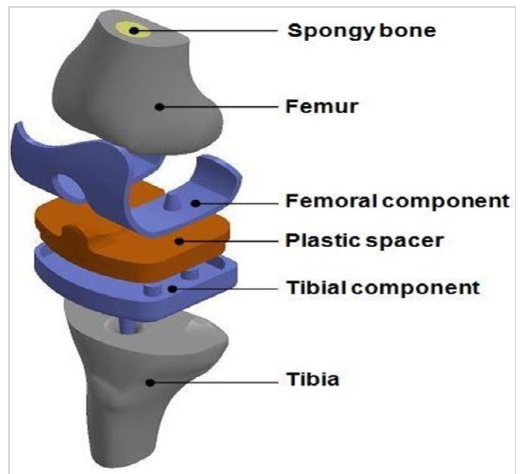
Femur and tibia bone sections were scanned by computerized tomography. The results and total knee arthroplasty model were transferred to 3D SolidWorks software (Dassault Systèmes, Vélizy-Villacoublay, France, 2012). The created model is shown in Figure 1.
This study's application aspect focuses on the stress distribution in the interaction between the distal bone portions of the femur and the proximal bone portions of the tibia and total knee arthroplasty. Thus, the stress factors in the distal and proximal parts of the bones in the knee joint were clearly understood. It was sized between 0.3 and 1 mm to ensure the accuracy of the numerical data (12).
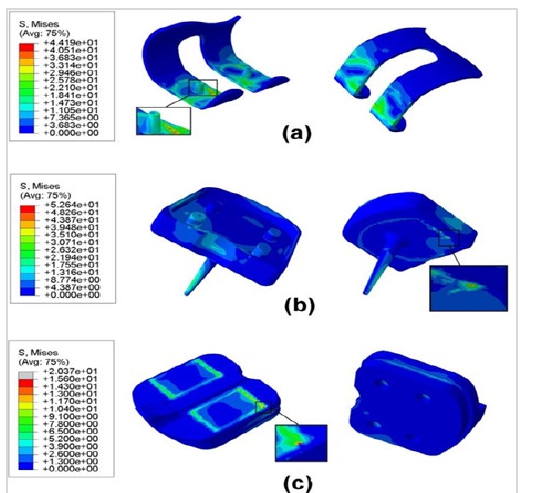
Calculating the mechanical data for each system component by numerical analyses based on suitable predefined parameters is possible. To make the results meaningful for the user, different colour gradients appear. These gradients vary from blue to red. The gradient colour appears as red, where the stress points are high. Figure 2 shows the load distribution on arthroplasty (13).
Results
Minimal position changes may have more significant consequences during arthroplasty placement (14). It has been pointed out that knee arthroplasty should be personalized to ensure maximum compliance, and its effect value should be higher (15). Total knee arthroplasty has been shown to have different effects on the muscles in models with and without cutting the posterior cruciate ligament (16). It has been found that 5-10 degrees of malrotation during arthroplasty causes a more significant effect and increased pressure in the medial compartments (17).
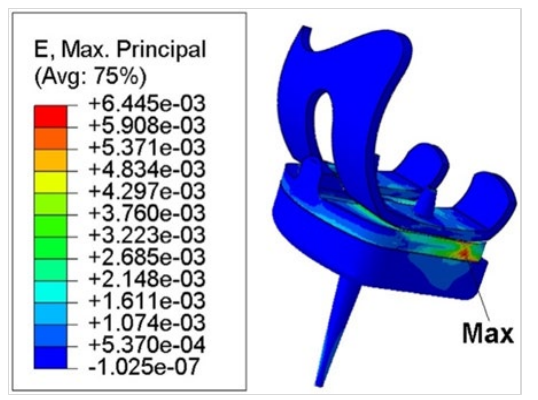
The load distribution and demonstration data on the implants applied in the normal surgical procedure are revealed in Figure 2. At the same time, the load distribution was examined with the valgus degree reduced by three degrees. This time, increased load distribution was observed in medial compartment, especially in polyethylene insertion.This is shown in Figure-3. This situation helped us to predict early polyethylene corrosion and failure in the future.
Discussion
In orthopaedic surgery discipline, total knee arthroplasty is foreseen to be applied in severe pain and functional failure of the patient. Many clinical studies show that the total knee arthroplasty success rate is high (18–20). However, the failure after arthroplasty surgery is usually biomechanical (21).These factors affect the mechanical stiffness of the components of total knee arthroplasties and the supporting bones, the magnitude of the forces on the restored joint, and the load distribution. As a result, it has been shown that any malalignment will completely change the load distribution on the joint in the applied arthroplasty (22–24). It has also been shown that there will be restrictions on joint movements (25).
Total knee arthroplasty is a core value with sensitive areas for preventing high contact stresses, high wear, and prevention of wear risk (26). Evaluation is performed by finite element analysis to calculate contact pressures and to observe high-pressure areas with a numerical approach to investigate the potential possibility arising from the effect of such combined mechanical loads, to calculate contact pressure, and to observe high-pressure areas with a numerical approach (27). Data supporting the clinic are presented to the literature quickly with this non-invasive method.
In this study, FEM analysis was shown to be effective in stimulating various conditions and complications in total knee arthroplasty. Finite element modelling emphasizes the importance of biomechanical load distribution during total knee arthroplasty. It is also an excellent method to reduce incidence of total knee arthroplasties revision and increase patient satisfaction after total knee arthroplasties.
Declarations
- Author contributions (CRediT)
- All authors contributed equally to all 14 CRediT roles (Conceptualization, Data curation, Formal analysis, Funding acquisition, Investigation, Methodology, Project administration, Resources, Software, Supervision, Validation, Visualization, Writing – original draft, Writing – review & editing).
- Funding
-
No financial support was provided from any institution or organization within the scope of the research.
- Conflicts of interest
- The authors declared no conflict of interest.
- Ethics approval
- Since the present research was completely virtual scanning and is not done on any living thing (human or animal), ethical institution approval is not required.
- Data availability
- A data availability statement was not reported in the published version of this article.
References (27)
24 of 27 references are linked to their DOI.
- Çeliktaş M, SARPEL DY. Enfekte total diz protezlerinde iki aşamalı revizyon yapilan hastalarda orta ve uzun dönem sonuçlar. Çukurova Üniversitesi. 2007. PubMed Google Scholar
- Khan M, Osman K, Green G, Haddad F. The epidemiology of failure in total knee arthroplasty: avoiding your next revision. The bone & joint journal. 2016;98(1_Supple_A):105-12. DOI Crossref PubMed Google Scholar
- Bülbül AM, Batmaz AG. Diz artroplastisinin revizyon komplikasyonları. TOTBID Dergisi. 2015;14(2):140-4. DOI Crossref PubMed Google Scholar
- Popescu R, Haritinian EG, Cristea S. Relevance of finite element in total knee arthroplasty-Literature Review. Chirurgia (Bucharest, Romania: 1990). 2019;114(4):437-42. DOI Crossref PubMed Google Scholar
- Au AG, Liggins AB, Raso VJ, Amirfazli A. A parametric analysis of fixation post shape in tibial knee prostheses. Medical Engineering & Physics. 2005;27(2):123-34. DOI Crossref PubMed Google Scholar
- Latypova A, Pioletti D, Terrier A. Importance of trabecular anisotropy in finite element predictions of patellar strain after total knee arthroplasty. Medical Engineering & Physics. 2017;39:102-5. DOI Crossref PubMed Google Scholar
- Sahu NK, Kaviti AK. A review of use FEM techniques in modeling of human knee joint. Journal of Biomimetics, Biomaterials and Biomedical Engineering. 2016;28:14-25. DOI Crossref PubMed Google Scholar
- Hutter EE, Granger JF, Beal MD, Siston RA. Is there a gold standard for TKA tibial component rotational alignment? Clinical Orthopaedics and Related Research®. 2013;471(5):1646-53. DOI Crossref PubMed Google Scholar
- Henak CR, Anderson AE, Weiss JA. Subject-specific analysis of joint contact mechanics: application to the study of osteoarthritis and surgical planning. Journal of biomechanical engineering. 2013;135(2). DOI Crossref PubMed Google Scholar
- Li J, Hua X, Jin Z, Fisher J, Wilcox RK. Influence of clearance on the time-dependent performance of the hip following hemiarthroplasty: A finite element study with biphasic acetabular cartilage properties. Medical engineering & physics. 2014;36(11):1449-54. DOI Crossref PubMed Google Scholar
- Boccaccio A, Ballini A, Pappalettere C, Tullo D, Cantore S, Desiate A. Finite element method (FEM), mechano-biology and biomimetic scaffolds in bone tissue engineering. International journal of biological sciences. 2011;7(1):112-32. DOI Crossref PubMed Google Scholar
- Mahajan S, Patil R. Optimizing dental implant model by comparison of three dimensional finite element. Int J Innov Res Sci Eng Technol. 2015;4:11223-31. PubMed Google Scholar
- Arab AZE-A, Merdji A, Benaissa A, Roy S, Bouiadjra B-AB, Layadi K, et al. Finite-element analysis of a lateral femoro-tibial impact on the total knee arthroplasty. Computer methods and programs in biomedicine. 2020;192:105446. DOI Crossref PubMed Google Scholar
- Mou Z, Dong W, Zhang Z, Wang A, Hu G, Wang B, et al. Optimization of parameters for femoral component implantation during TKA using finite element analysis and orthogonal array testing. Journal of Orthopaedic Surgery and Research. 2018;13(1):1-12. DOI Crossref PubMed Google Scholar
- Azam N, Daud R, Ayu HM, Ramli J, Hassan M, Shah A, et al., editors. The effect of knee flexion angle on contact stress of total knee arthroplasty. MATEC Web of Conferences; 2018: EDP Sciences. DOI Crossref PubMed Google Scholar
- Kang K-T, Son J, Kwon O-R, Koh Y-G. Malpositioning of prosthesis: patient-specific total knee arthroplasty versus standard off-the-shelf total knee arthroplasty. Journal of the American Academy of Orthopaedic Surgeons Global Research & Reviews. 2017;1(4). DOI Crossref PubMed Google Scholar
- Moewis P, Checa S, Kutzner I, Hommel H, Duda GN. Physiological joint line total knee arthroplasty designs are especially sensitive to rotational placement–A finite element analysis. PLoS One. 2018;13(2):e0192225. DOI Crossref PubMed Google Scholar
- Healy WL, Della Valle CJ, Iorio R, Berend KR, Cushner FD, Dalury DF, et al. Complications of total knee arthroplasty: standardized list and definitions of the Knee Society. Clinical Orthopaedics and Related Research®. 2013;471(1):215-20. DOI Crossref PubMed Google Scholar
- Çalbıyık M. Clinical outcome of total knee arthroplasty performed using patient-specific cutting guides. Medical Science Monitor: International Medical Journal of Experimental and Clinical Research. 2017;23:6168. DOI Crossref PubMed Google Scholar
- Robertsson O, Dunbar M, Pehrsson T, Knutson K, Lidgren L. Patient satisfaction after knee arthroplasty: a report on 27,372 knees operated on between 1981 and 1995 in Sweden. Acta Orthopaedica Scandinavica. 2000;71(3):262-7. 43 77 Total Knee Arthroplasty with Finite Element Analysis Javid Mohammadzadeh Azarabadi DOI Crossref PubMed Google Scholar
- Abolghasemian M, Samiezadeh S, Sternheim A, Bougherara H, Barnes CL, Backstein DJ. Effect of patellar thickness on knee flexion in total knee arthroplasty: a biomechanical and experimental study. The Journal of arthroplasty. 2014;29(1):80-4. DOI Crossref PubMed Google Scholar
- Norman TL, Hutchison JD, Gardner MR, Blaha MD J. Knee loading due to varus and external rotation in gait supports medial compartment wear in total knee arthroplasty. Journal of Orthopedics and Rheumatism. 2017;1(1):8. PubMed Google Scholar
- Browne C, Hermida JC, Bergula A, Colwell Jr CW, D'Lima DD. Patellofemoral forces after total knee arthroplasty: effect of extensor moment arm. The Knee. 2005;12(2):81-8. DOI Crossref PubMed Google Scholar
- Ostermeier S, Stukenborg-Colsman C. Quadriceps force after TKA with femoral single radius: an in vitro study. Acta orthopaedica. 2011;82(3):339-43. DOI Crossref PubMed Google Scholar
- Gallo J, Goodman SB, Konttinen YT, Wimmer MA, Holinka M. Osteolysis around total knee arthroplasty: a review of pathogenetic mechanisms. Acta biomaterialia. 2013;9(9):8046-58. DOI Crossref PubMed Google Scholar
- Sathasivam S, Walker PS, Campbell PA, Rayner K. The effect of contact area on wear in relation to fixed bearing and mobile bearing knee replacements. Journal of Biomedical Materials Research: An Official Journal of The Society for Biomaterials, The Japanese Society for Biomaterials, and The Australian Society for Biomaterials and the Korean Society for Biomaterials. 2001;58(3):282-90. DOI Crossref PubMed Google Scholar
- Tanska P, Mononen ME, Korhonen RK. A multi-scale finite element model for investigation of chondrocyte mechanics in normal and medial meniscectomy human knee joint during walking. Journal of biomechanics. 2015;48(8):1397-406. DOI Crossref PubMed Google Scholar
Respond to this article
Comments on a published article are welcome as a Letter to the Editor.
Get an e-mail when new articles in your fields are published
Questions to the authors
Questions are moderated: an editor approves each question, the authors answer, and an editor approves the answer before both appear here.
No answered questions yet.
Ask the authors a question
Discussion
Comments are moderated: they appear after the writer confirms the e-mail address and an editor approves them. Each comment carries a conflict-of-interest statement.
No comments yet.
Write a comment
Tell me when this article is cited
Leave your e-mail address and confirm it. These notices are not being sent yet; your confirmed address is kept for them and used for nothing else.
Read the full text
Open the PDF here
Loading the PDF…
If the PDF does not show here, use the download button above.
How to cite this article
Azarabadi JM. Evaluation of Total Knee Arthroplasty Surgery with Finite Element Analysis. Ulutas Med J. 2024;10(2):39-43. doi:10.5455/umj.20240305070048
Azarabadi, J. M. (2024). Evaluation of Total Knee Arthroplasty Surgery with Finite Element Analysis. The Ulutas Medical Journal, 10(2), 39–43. https://doi.org/10.5455/umj.20240305070048
Azarabadi, J.M. (2024) 'Evaluation of Total Knee Arthroplasty Surgery with Finite Element Analysis', The Ulutas Medical Journal, 10(2), pp. 39–43. doi: 10.5455/umj.20240305070048.
@article{umj193156,
  title = {Evaluation of Total Knee Arthroplasty Surgery with Finite Element Analysis},
  author = {Azarabadi, Javid Mohammadzadeh},
  journal = {The Ulutas Medical Journal},
  year = {2024},
  volume = {10},
  number = {2},
  pages = {39--43},
  doi = {10.5455/umj.20240305070048},
  url = {https://www.ulutasmedicaljournal.com/?mno=193156},
  issn = {2149-388X}
}